The 2026 SCC Supreme Court judgments in Volume 2 Part 1 represent some of the year’s most significant constitutional pronouncements. Legal practitioners across India are grappling with landmark rulings on reservation policy, surrogacy regulations, and parliamentary privileges. These decisions reshape established legal positions. Furthermore, they demand immediate attention from law firms, government departments, and corporate legal teams. This comprehensive analysis breaks down each major judgment with practical insights for practicing lawyers.
Introduction: Overview of 2026 SCC Vol. 2 Part 1
Supreme Court judgments published in SCC Volume 2 Part 1 (2026) address critical constitutional questions affecting millions of Indian citizens. The volume contains rulings on the power of Parliament to enact statutes. Additionally, it covers reservation for persons with disabilities and surrogacy age restrictions under the Surrogacy Act, 2021. According to SCC Times, these cases fundamentally clarify the relationship between parliamentary authority and judicial oversight.
Why These Judgments Matter for Legal Practitioners
First, these rulings establish new precedent on constitutional boundaries that will govern litigation for decades. Second, they resolve ambiguities in beneficial legislation like the RPwD Act and Surrogacy Act. Third, lawyers must immediately update their client counseling strategies based on these pronouncements. The practical implications touch government recruitment, medical practice compliance, and fundamental rights enforcement.
Reservation: Landmark Supreme Court Pronouncements
The 2026 SCC Supreme Court judgments on reservation clarify several contentious issues that have confused practitioners since the 103rd Constitutional Amendment. As noted by SCC Times, these rulings address creamy layer exclusion, EWS implementation, and disability reservation mechanics.
Disability Reservation Under RPwD Act
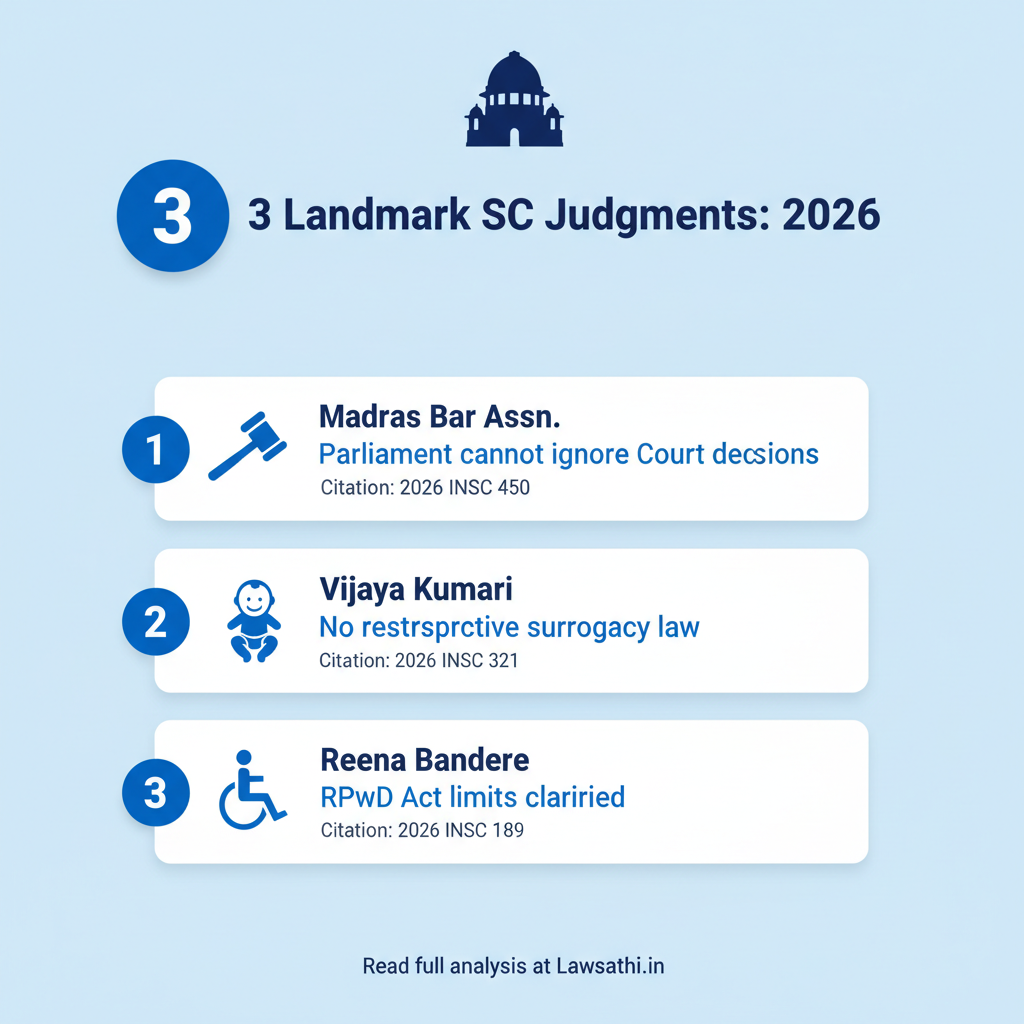
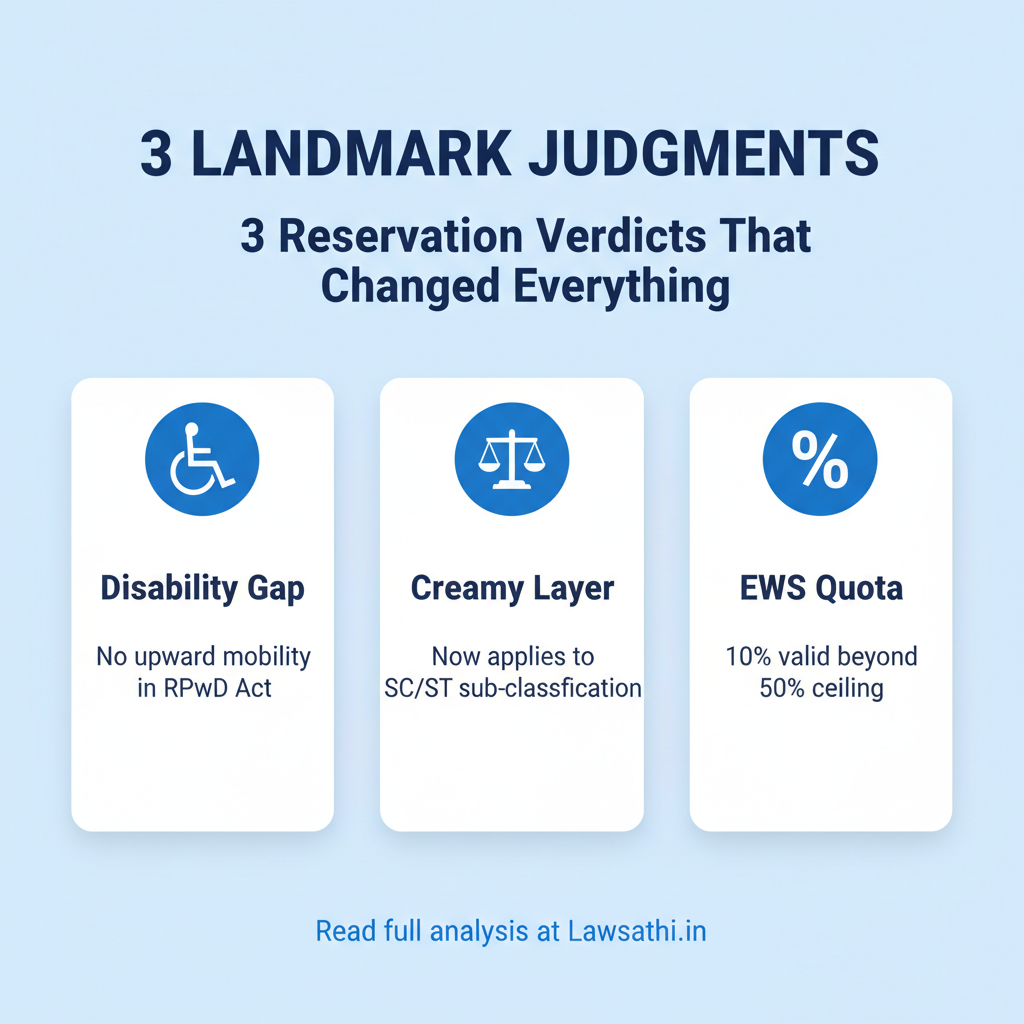
In Reena Banerjee v. State (NCT of Delhi) [(2026) 2 SCC 149], the Supreme Court identified a critical gap in disability reservation implementation. Specifically, under Article 16(4) reservations, reserved category candidates ranking higher in merit can move upward to unreserved seats. However, the RPwD Act contains no such upward movement provision for persons with disabilities.
Impact on Government Recruitment:
Therefore, when a person with disability scores high enough to qualify on merit, they occupy a reserved seat. They cannot move to the general category. This defeats the very purpose of Section 34 of the RPwD Act. Consequently, the reservation quota effectively gets filled by meritorious candidates rather than expanding opportunities for those who need affirmative action most.
For lawyers handling disability rights cases, this distinction is crucial for challenging recruitment notifications and selection lists.
Creamy Layer Exclusion in SC/ST Reservations
The landmark 7-Judge Bench decision in State of Punjab v. Davinder Singh [(2025) 1 SCC 1] continues to shape reservation litigation in 2026. The 6:1 majority held that sub-classification of Scheduled Castes among reserved categories is permissible. As reported by SCC Times, Justice Gavai’s ruling extended the creamy layer principle to SC/STs.
Key Practical Implications:
Justice Gavai observed that children of parents who reached high positions through reservation enjoy significantly better educational facilities. In contrast, placing such children in the same category as children of parents doing manual work in villages defeats the constitutional mandate. Consequently, lawyers must now prepare creamy layer exclusion arguments even for SC/ST reservation cases.
EWS Reservation Implementation Guidelines
The Supreme Court’s validation of the 103rd Constitutional Amendment continues to generate implementation challenges. In Janhita Abhiyan v. Union of India [2022 INSC 1175], the Court upheld 10% EWS reservation by a 3:2 majority. Notably, the 50% ceiling does not apply to EWS reservation under the amendment.
Recent developments reported by LiveLaw show the Court taking strong positions on EWS enforcement. CJI Surya Kant observed that private colleges not following reservation policy should face closure. Furthermore, the Court invoked Article 142 powers to enforce EWS quota compliance in Madhya Pradesh medical admissions.
State-Wise Variations and Judicial Review
Lawyers must track state-specific reservation quotas that vary significantly across India. The current Central Government reservation pattern includes:
– SC: 15% in All India open competition; 16.66% otherwise – ST: 7.5% across both categories – OBC: 27% in All India open competition; 25.84% otherwise – EWS: Additional 10% quota
Additionally, judicial review of state reservation policies remains active. Courts examine whether state variations meet constitutional standards under Articles 15 and 16.
Surrogacy Law: Judicial Interpretation of the Surrogacy Act
The 2026 SCC Supreme Court judgments provide crucial clarity on the Surrogacy (Regulation) Act, 2021. The landmark case of Vijaya Kumari S. v. Union of India [(2026) 2 SCC 96] addresses retrospective application of age restrictions. According to the Supreme Court judgment, statutory regulation cannot apply retrospectively to frustrate rights under Article 21.
Commercial vs. Altruistic Surrogacy Distinction
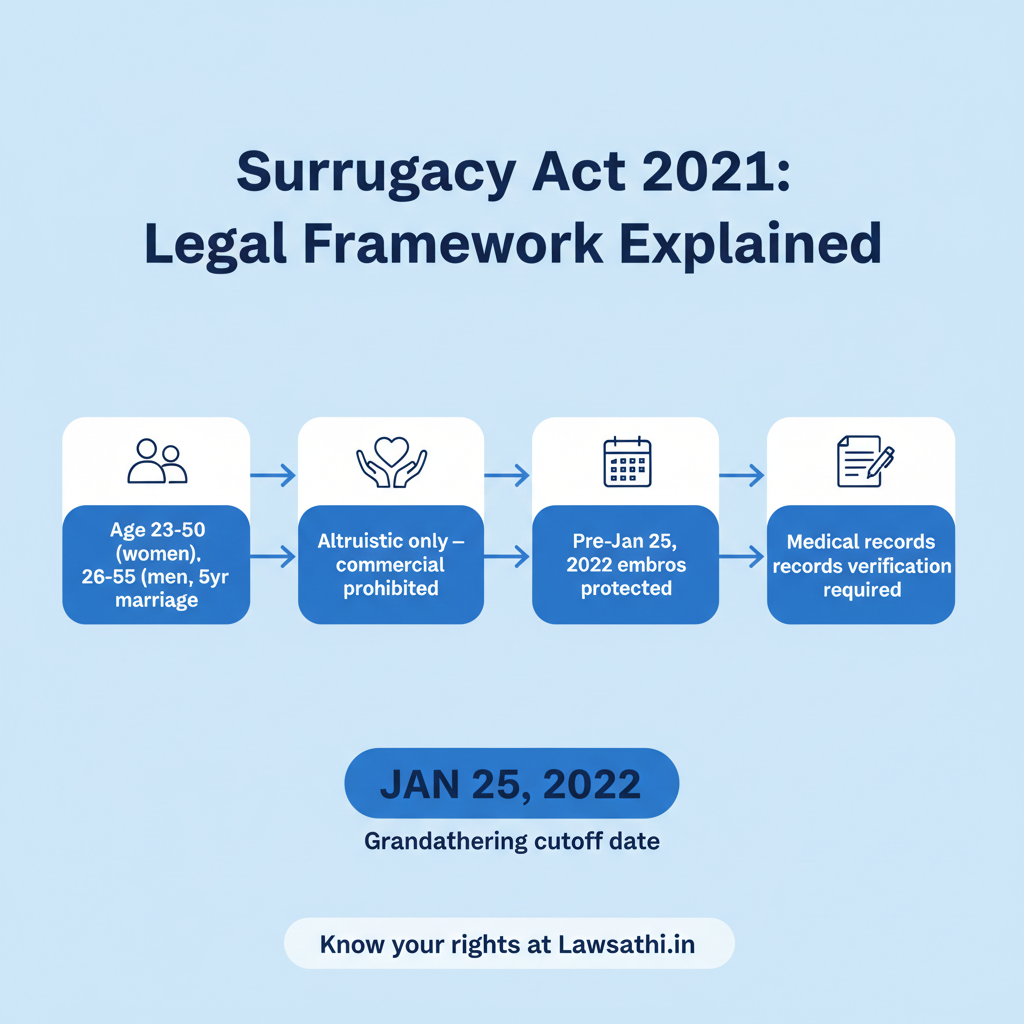
The Surrogacy Act prohibits commercial surrogacy while permitting altruistic surrogacy. Commercial surrogacy includes buying or selling embryos and trading surrogate services for profit. Altruistic surrogacy allows only medical expense reimbursement and insurance coverage for the surrogate mother.
Justice Nagarathna’s judgment emphasizes that the Act’s purpose is protecting vulnerable women from exploitation. However, the Court recognized that couples who commenced surrogacy before January 25, 2022 have protected rights. Therefore, legal practitioners must carefully document when medical procedures began for their clients.
Age Restrictions and Eligibility Criteria
Section 4(iii)(c)(I) of the Surrogacy Act prescribes strict age requirements. For intending couples, the woman must be between 23-50 years and the man between 26-55 years. Additionally, they must have been married for at least five years with a medical indication necessitating gestational surrogacy.
Critical Exception for Pre-Act Cases:
For couples who began surrogacy procedures before the Act’s enforcement, these age restrictions cannot defeat their Article 21 right to parenthood. The Court held that embryos frozen before January 2022 and medical procedures commenced earlier remain protected.
Inter-State Complications and Jurisdiction
The Madras High Court’s guidance from November 2025 remains highly relevant. The Court emphasized that surrogacy petitions concern one of the deepest human aspirations—childless couples seeking children. Judicial Magistrates must pass orders on parentage and custody with sensitivity.
Lawyers filing surrogacy applications should note that Courts cannot reject petitions on technical jurisdiction grounds. Moreover, the administrative role of Secretariat authorities is limited without quasi-adjudicatory functions.
Guidelines for Medical Practitioners
Medical practitioners and surrogacy clinics face strict compliance requirements under the 2026 SCC Supreme Court judgments. Key obligations include:
1. Verifying commencement dates of medical procedures 2. Maintaining records of pre-Act surrogacy cases 3. Documenting frozen embryo preservation dates meticulously 4. Confirming age eligibility for new cases
Non-compliance can result in criminal penalties under the Act. Therefore, legal consultation is essential before proceeding with any surrogacy arrangement.
Parliamentary Powers: Constitutional Boundaries Defined
The 2026 SCC Supreme Court judgments on parliamentary privileges clarify the delicate balance between legislative competence and judicial oversight. Madras Bar Association (6) v. Union of India [(2026) 2 SCC 1] establishes fundamental principles on Parliament’s lawmaking power. As summarized by SCC Times, Parliament cannot ignore Court decisions while Courts cannot compel Parliament to legislate in a particular manner.
Article 105 Privileges and Their Limitations
Article 105 of the Constitution grants Members of Parliament freedom of speech in parliamentary proceedings. However, this privilege is not absolute. The recent impeachment proceedings case reported by SCC Times clarified important limitations.
Justices Dipankar Datta and Satish Chandra Sharma held that the first proviso to Section 3(2) of the Judges (Inquiry) Act applies only in specific circumstances. Specifically, mere giving of notices on the same day does not trigger Joint Committee requirements. The Speaker and Chairman retain independent powers unless both Houses admit notices simultaneously.
Freedom of Speech in Parliament: Scope and Restrictions
Parliamentary privileges protect legislators from legal proceedings for statements made in Parliament. Yet, the Court emphasized that these privileges serve democratic accountability, not personal protection. The Secretary General’s role remains confined to administrative scrutiny without substantive assessment of allegations’ merits.
Key Quote from the Judgment:
> “The Inquiry Act does not contemplate a substantive assessment of the merits of the allegations by the Secretariat of a House.”
Therefore, lawyers challenging parliamentary proceedings must understand the limited scope of judicial intervention.
Judicial Review of Parliamentary Proceedings
The Supreme Court delineated clear boundaries for Article 32 writ jurisdiction. The extraordinary remedy under Article 32 is confined to enforcement of Fundamental Rights. Moreover, it does not extend to issuing advisory directions on internal statutory mechanisms of Parliament.
On February 27, 2026, as reported by LiveLaw, CJI Surya Kant made a significant observation. The Chief Justice stated that executive undertakings do not bind Parliament. Consequently, the legislature has absolute prerogative to make laws independent of executive commitments.
Anti-Defection Law Interpretations
While not directly addressed in this volume, the broader context of parliamentary powers includes anti-defection jurisprudence. Lawyers should monitor pending challenges to Section 152 of the Bharatiya Nyaya Sanhita. This provision replaces colonial sedition law and may affect legislators’ freedom of expression.
Other Notable Judgments in SCC Vol. 2 Part 1
Beyond the headline cases, the 2026 SCC Supreme Court judgments include significant pronouncements on service law and criminal matters. According to SCC Times, these rulings affect government employees, persons with disabilities, and criminal defendants.
Service Law Developments
Sujata Bora v. Coal India Ltd. [2026 SCC OnLine SC 58] addressed disability rights in public employment. The Court held that expiry of selection panels cannot defeat rights of persons with benchmark disabilities. For a visually impaired woman denied appointment despite qualifying, the Court directed creation of a supernumerary post.
Rajasthan Public Service Commission v. Yati Jain [2026 SCC OnLine SC 80] clarified waiting list limitations. Wait-listed candidates have no vested right beyond the statutory life of reserve lists. Furthermore, they cannot claim appointment against vacancies from non-joining of selected candidates.
Pawan Kumar v. Union of India [2026 INSC 156] recognized long-term casual workers’ rights. The Court regularized services despite initial irregular appointments. In doing so, it distinguished between “irregular” and “illegal” recruitment.
Dearness Allowance Rights
State of West Bengal v. Confederation of State Government Employees [2026 INSC 123] delivered a comprehensive 124-page judgment on DA rights. The Court held that welfare states have obligations to protect employees against inflation. As per the Supreme Court’s detailed analysis, DA serves as an instrument of protection for salaried employees.
Criminal Law Pronouncements
The January 2026 Supreme Court roundup highlighted several significant criminal law cases:
– Gulfisha Fatima v. State (NCT of Delhi): Umar Khalid and Sharjeel Imam denied bail; their roles described as “architectural” rather than “episodic” – State of U.P. v. Anurudh: Court suggested Romeo-Juliet clause for POCSO cases; flagged misuse concerns – Dr. Jaya Thakur v. Union of India: Menstrual health declared part of Article 21; free sanitary pads directed for schoolgirls
Practical Implications for Legal Practitioners
The 2026 SCC Supreme Court judgments demand immediate changes in litigation strategy and client counseling. Lawyers must update their practice approaches based on these landmark rulings.
Citation Guidance for Court Filings
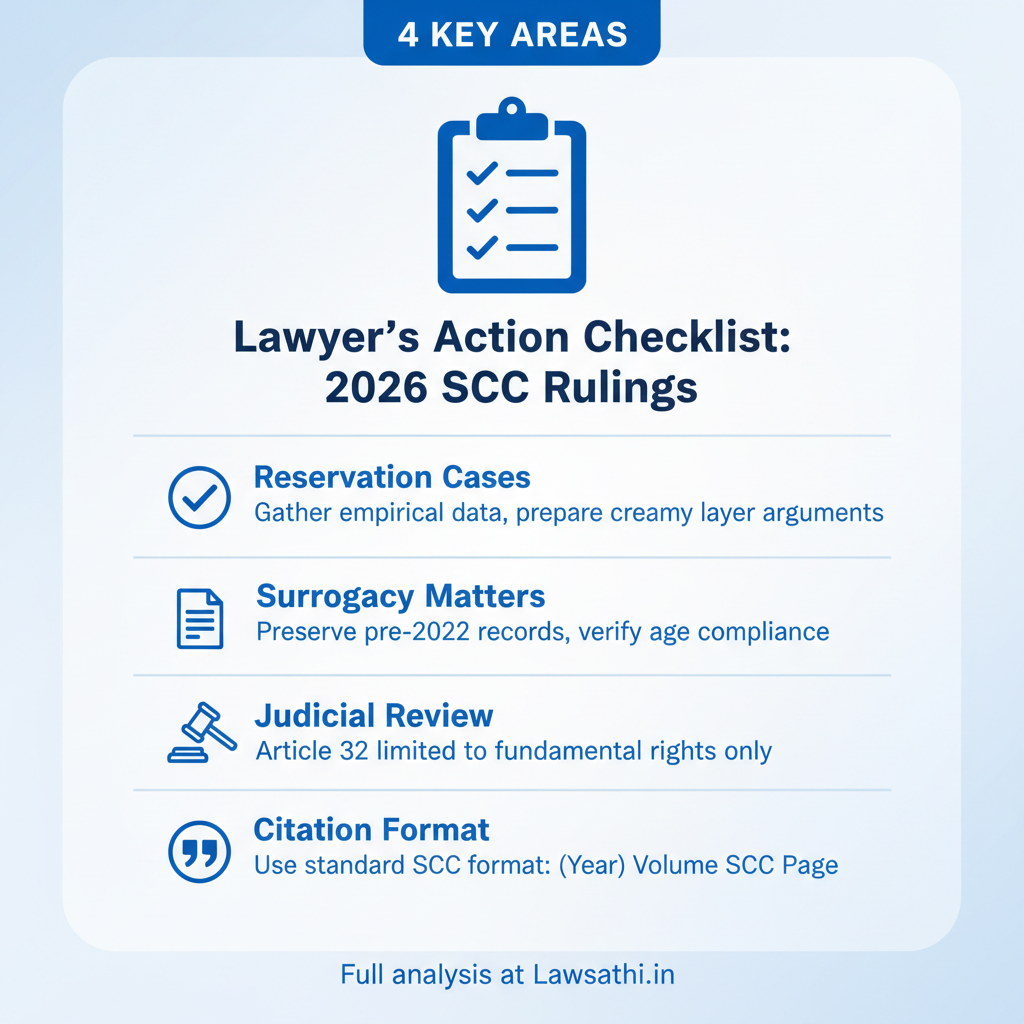
When citing these judgments, use standard SCC format: – Case name with complete party names – Citation: (Year) Volume SCC Page – Example: Madras Bar Assn. (6) v. Union of India, (2026) 2 SCC 1
For online citations, use formats like “2026 SCC OnLine SC [number]” or “2026 INSC [number].”
Litigation Strategy Updates
For Reservation Cases: Lawyers must gather empirical data for sub-classification claims. Additionally, prepare creamy layer exclusion arguments even for SC/ST clients. Document upward movement issues meticulously in disability reservation challenges.
For Surrogacy Matters: Document embryo freezing dates and medical procedure timelines thoroughly. Furthermore, preserve all records from before January 2022. Verify age compliance before filing new applications.
For Parliamentary/Judicial Review: Remember that Article 32 is limited to fundamental rights enforcement. Moreover, internal parliamentary procedures generally remain beyond judicial intervention.
Client Counseling Considerations
Government employment clients need different advice based on these rulings. For instance, waiting lists have limited enforceability after panel expiry. Disability reservation operates differently than social reservation under Article 16(4). However, casual workers may seek regularization with proper documentation of continuous service.
For surrogacy clients, age restrictions are strictly enforced for new cases. Pre-Act cases may qualify for grandfathered treatment with proper documentation. Most importantly, commercial surrogacy remains prohibited nationwide.
Conclusion: Key Takeaways and Future Outlook
The 2026 SCC Supreme Court judgments in Volume 2 Part 1 reshape Indian jurisprudence across multiple domains. The most impactful rulings include:
1. Madras Bar Assn. (6): Parliamentary power boundaries defined clearly 2. Vijaya Kumari S.: Surrogacy Act’s retrospective application barred 3. Reena Banerjee: Disability reservation implementation gap identified 4. Davinder Singh: Creamy layer principle extended to SC/STs
Expected Legal Developments
States will likely formulate creamy layer criteria for SC/ST reservations soon. Parliament may amend the RPwD Act to address the upward movement gap identified in Reena Banerjee. Furthermore, the Central Government is expected to issue comprehensive surrogacy guidelines. Constitutional challenges to Section 152 BNS remain pending after Holi 2026.
Staying Updated with SCC Publications
Legal practitioners should subscribe to SCC Weekly digests for timely updates. Monitoring SCC Online ensures access to the latest judgments and legal analysis.