
Introduction: The Sentinel of Free Speech
On January 26, 2025, the Constitution of India turned 75 years old. Yet, the tension between state law enforcement and individual liberties continues to grow in the digital age. Social media posts, poetry recitations, and satirical content increasingly trigger police action across India.
Freedom of speech and expression stands as one of the most cherished fundamental rights in our democracy. Article 19(1)(a) guarantees every citizen the right to express themselves freely. However, this right often faces challenges from those meant to protect it.
A Wake-Up Call from the Apex Court
The Supreme Court’s evolving jurisprudence on Supreme Court Article 19(1)(a) police duty marks a significant shift. The Court has redefined the police role from “enforcers of silence” to “protectors of expression.” This transformation carries profound implications for legal practitioners defending free speech cases.
Justice Abhay S. Oka delivered a powerful opening statement in the landmark Imran Pratapgadhi v. State of Gujarat judgment 2025 INSC 410. Specifically, he observed that even after 75 years of constitutional existence, law enforcement remains either ignorant or indifferent toward this fundamental right.
The liberty of thought and expression forms a core ideal embedded in the Preamble. Without freedom of expression, citizens cannot lead dignified lives guaranteed under Article 21. Therefore, the Supreme Court has firmly established that police officers bear a constitutional duty to uphold these rights.
Understanding Article 19(1)(a) and Article 19(2): The Constitutional Framework
The Fundamental Right Explained
Article 19(1)(a) grants all citizens the right to freedom of speech and expression. This right encompasses literature, poetry, dramas, films, stage shows, satire, art, and even stand-up comedy. Additionally, it extends to legitimate criticism of government actions and decisions.
The right to dissent lawfully forms an integral part of this freedom. Citizens can express disagreement with state policies without fear of criminal prosecution. However, this right is not absolute and operates within defined constitutional boundaries.
Reasonable Restrictions Under Article 19(2)
Article 19(2) provides eight exhaustive grounds for imposing reasonable restrictions on free speech Article 19, Constitution of India. These include sovereignty and integrity of India, security of the State, and friendly relations with foreign States. Furthermore, they cover public order, decency or morality, contempt of court, defamation, and incitement to an offence.
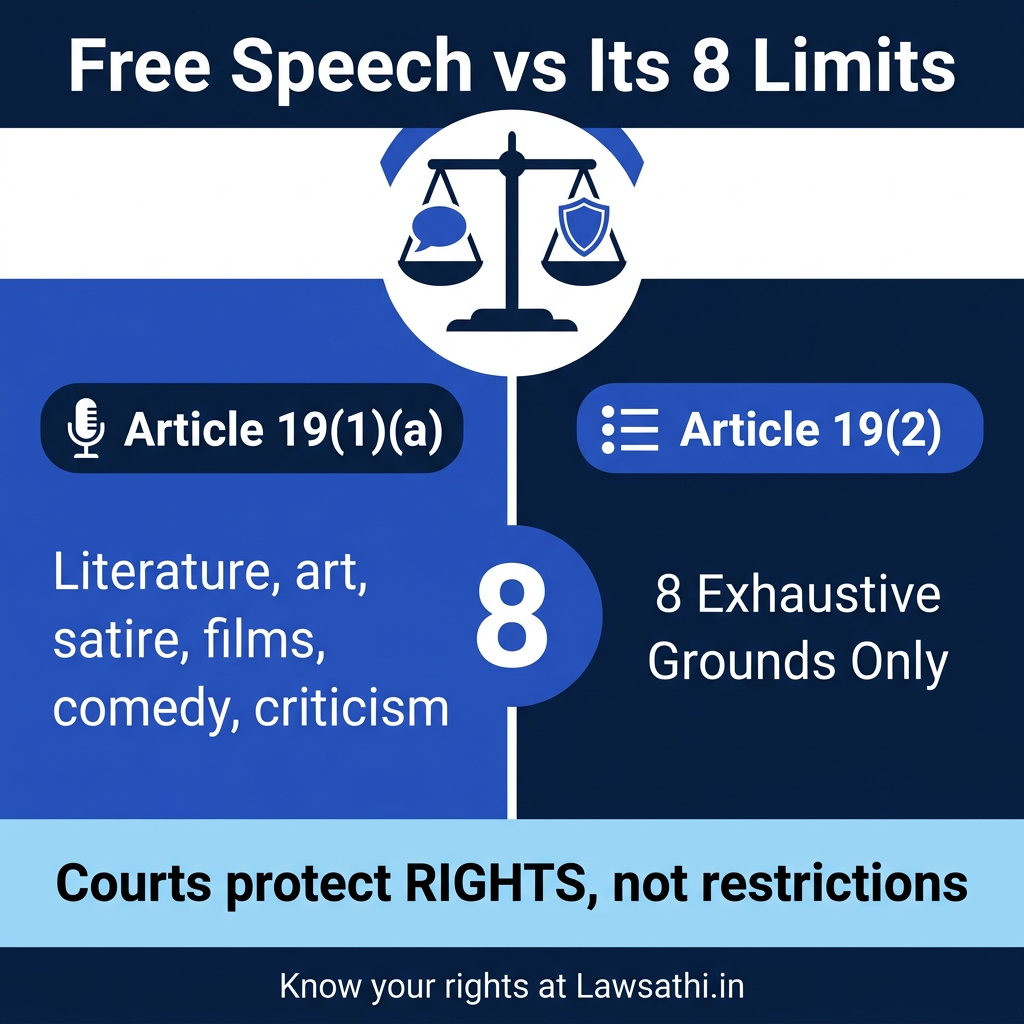
The Supreme Court emphasized in Kaushal Kishor v. State of Uttar Pradesh (2023) that these restrictions are exhaustive. Consequently, no additional restrictions can be imposed beyond these eight grounds. Moreover, restrictions must be reasonable and not “fanciful and oppressive.”
The Critical Distinction
Importantly, Article 19(2) cannot overshadow the substantive rights under Article 19(1)(a). The role of courts is to protect fundamental rights, not to protect restrictions. This principle forms the foundation of the Supreme Court Article 19(1)(a) police duty framework.
The distinction between “restriction” and “prohibition” matters significantly. Police powers extend only to preventing speech that falls within Article 19(2) restrictions. Therefore, they cannot prohibit speech merely because it causes discomfort to those in power.
Landmark Judgment: The Supreme Court’s Directives on Police Conduct
The Imran Pratapgadhi Case Facts
A Rajya Sabha MP posted a 46-second video on ‘X’ featuring a poem recitation. The poem, attributed to either Faiz Ahmed Faiz or Habib Jalib, allegedly promoted communal disharmony. As a result, Gujarat Police registered an FIR under multiple sections of the Bharatiya Nyaya Sanhita (BNS).
The Gujarat High Court refused to quash the FIR, citing the “nascent stage of investigation.” However, the Supreme Court took strong exception to this approach. It found that the poem had nothing to do with any religion, caste, community, or region.
The Court’s Analysis of the Poem
The poem actually preached non-violence, stating that if the fight for rights meets injustice, one should respond with love. The reference to “throne” was symbolic, referring to entities responsible for injustice. Furthermore, there was no promotion of enmity between groups and no incitement to violence.
The Supreme Court observed that subscribing to a contrary view would stifle all legitimate expressions in the public domain. This fundamental principle guides the freedom of speech and expression India jurisprudence SCC Online Blog.
Mandatory Preliminary Inquiry Guidelines
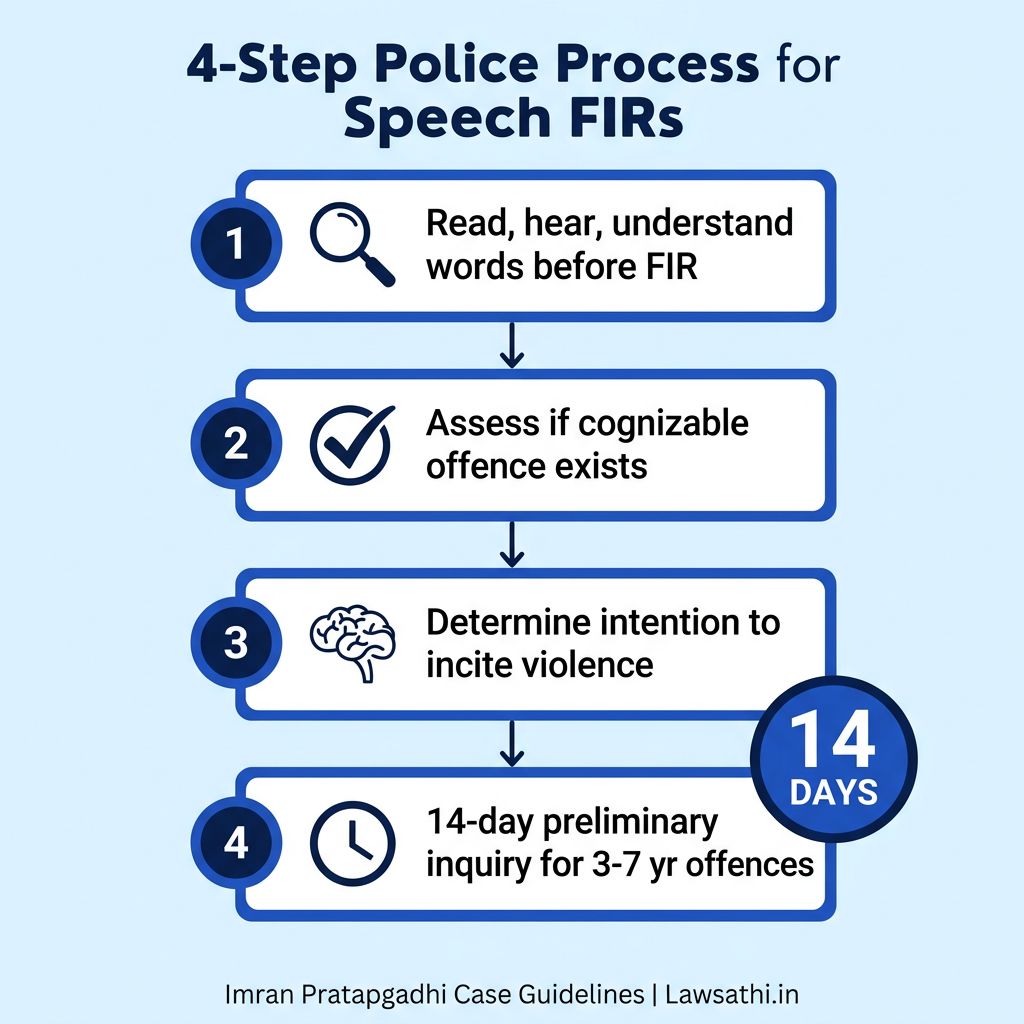
The Court issued crucial guidelines regarding speech-based offences. For offences punishable by 3-7 years based on spoken or written words, police must consider preliminary inquiry under Section 173(3) BNSS. Additionally, a superior officer at DSP rank must normally grant permission for such inquiry.
This requirement protects fundamental rights under Article 19(1)(a). The preliminary inquiry must conclude within 14 days. Importantly, police must conduct a pre-registration assessment before lodging an FIR.
Pre-Registration Assessment Duty
Police must read, hear, and understand the meaning of alleged spoken or written words. They must determine if a cognizable offence is made out on plain reading. In other words, this assessment is not a preliminary inquiry—it is a mandatory pre-registration duty.
Furthermore, the Supreme Court Article 19(1)(a) police duty framework requires mens rea assessment. Intention to cause disorder or incite violence forms the sine qua non of offences like Section 196 BNS. Therefore, mere expression of dissent or criticism cannot be criminalized.
The Positive Obligation: Police as Protectors, Not Adversaries
Constitutional Duty of Police
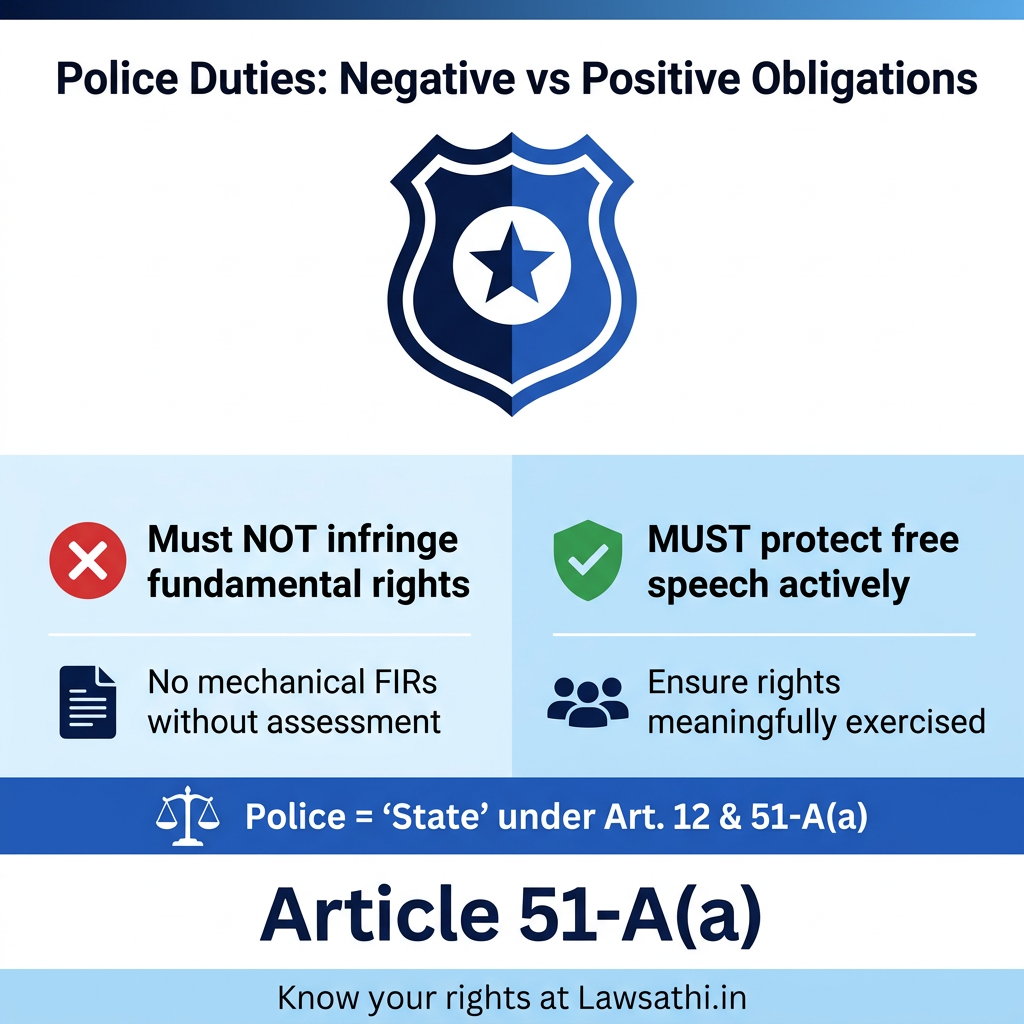
Police constitute “State” under Article 12 of the Constitution. As citizens and state functionaries, police officers are bound by Article 51-A(a). This provision mandates citizens to abide by the Constitution and respect its ideals.
Therefore, police must honour and uphold freedom of speech and expression. The philosophy of the Constitution, found in the Preamble, emphasizes liberty of thought, expression, belief, faith, and worship.
Negative vs. Positive Duties
The Supreme Court distinguished between negative and positive duties of police. Negative duty requires police not to infringe upon citizens’ fundamental rights. Specifically, they cannot register FIRs mechanically without assessing if speech constitutes an offence.
Positive duty requires police to protect citizens’ right to free speech from infringement by others. They must ensure conditions where fundamental rights can be meaningfully exercised. Consequently, the police duty to protect rights extends to providing security for peaceful assemblies SCC Online.
The State Cannot Plead Inability
The Supreme Court affirmed that the State cannot plead inability to protect fundamental rights. Even when non-State actors threaten speakers, the police must intervene. Failure to do so invites judicial scrutiny and intervention.
Justice Oka emphasized that by now, police officers should have been sensitized about their constitutional duty. If officers remain unaware of these obligations, the State must conduct massive training programs. This observation underscores the urgent need for reform.
Balancing Act: Public Order vs. Personal Liberty
The “Public Order” Test Explained
Dr. Ram Manohar Lohia v. State of Bihar (1966) established the famous concentric circle model. The innermost circle represents individual safety. The next circle represents public order. Finally, the outermost circle represents security of the State.
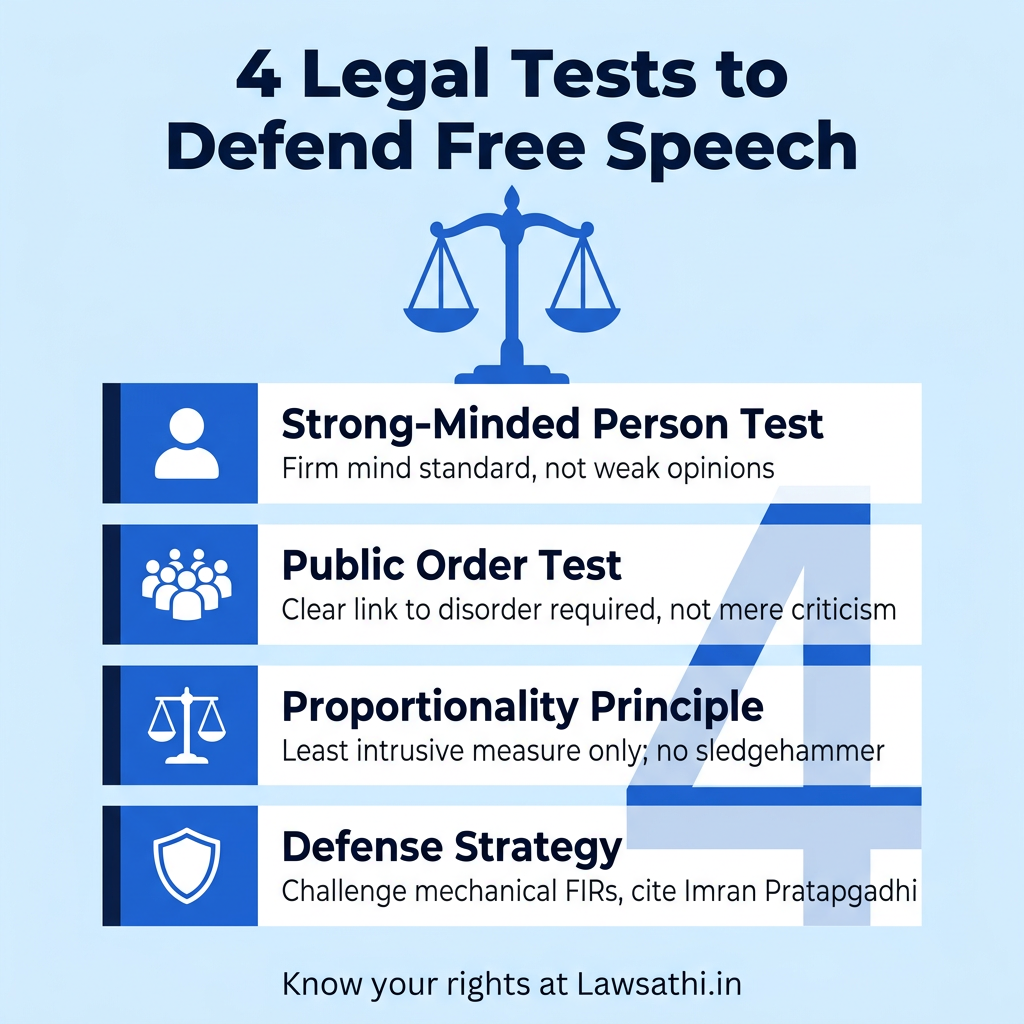
For speech to threaten public order, it must have a clear connection to public disorder. It must affect the “even tempo of community life.” In contrast, mere criticism of government does not disturb public order. Moreover, popular perceptions cannot override constitutional values.
Section 144 CrPC Restrictions
The Supreme Court has firmly restricted Section 144 CrPC usage against free speech. In the Kashmir lockdown case, the Court held that Section 144 cannot prevent legitimate expression of opinion LiveLaw. Specifically, it cannot suppress the exercise of democratic rights.
Section 144 must apply only in situations of emergency. Repetitive orders under this provision constitute abuse of power. Furthermore, orders must state material facts to enable judicial review. The proportionality principle must guide all restrictions.
The Proportionality Principle
Courts must apply the least intrusive measure when balancing rights and restrictions. Restrictions must be proportional to the perceived threat. Simply put, the State cannot use a sledgehammer to crack a nut.
The Supreme Court’s beacon of rule of law shines always, even during emergencies. Disagreement with government policies does not justify destabilization of constitutional order. This principle guides constitutional rights vs police powers jurisprudence CaseMine.
Implications for Legal Practitioners and Law Enforcement
Defense Strategies for Lawyers
Legal practitioners can leverage these landmark judgments effectively. For quashing FIRs, cite Imran Pratapgadhi for premature FIR registration. Additionally, challenge mechanical registration without proper assessment. Argue that preliminary inquiry should have been conducted.
For bail applications, use the “strong-minded person” test argument. This test requires judging speech by standards of reasonable, firm individuals—not weak minds. Furthermore, emphasize the absence of mens rea and challenge the “public order” threshold.
Key Arguments for Defense
The “weak and vacillating minds” standard often used by prosecution fails constitutional muster. No intention to cause disorder means no offence exists. Therefore, speech representing legitimate criticism or dissent deserves protection.
Furthermore, popular perceptions cannot override constitutional values. Lawyers should emphasize that Article 19(1)(a) case laws establish clear protections for artistic expression Indian Express.
Reform Requirements for Police
Police training must include constitutional literacy regarding Article 19(1)(a) and 19(2). Officers need guidance on assessing speech-based complaints before FIR registration. Moreover, understanding mens rea requirements in speech offences is essential.
Additionally, police must distinguish between criticism and hate speech. Application of preliminary inquiry provisions under Section 173(3) BNSS requires proper understanding. Failure to comply may invite disciplinary action or even contempt proceedings.
Accountability and Liability
The Supreme Court’s recent notice on PIL seeking measures to curb false cases signals greater accountability LiveLaw. Petitioners seek display boards in police stations about punishment for false complaints. Furthermore, mandatory affidavits from complainants affirming truth of allegations may become necessary.
Conclusion: Strengthening the Rule of Law
Core Principles Established
The Supreme Court has firmly established several core principles. First, police are constitutionally bound to uphold free speech. Second, restrictions under Article 19(2) remain exhaustive and must be reasonable. Third, preliminary inquiry is necessary for speech-based offences carrying 3-7 years punishment.
Additionally, the “strong-minded person” test applies to all speech cases. Mens rea forms an essential ingredient for speech offences. Consequently, courts must zealously protect fundamental rights against state overreach.
A Powerful Closing Statement
Justice Oka declared that 75 years into the republic, India cannot be so shaky on its fundamentals. Mere recital of a poem or any form of art cannot be alleged to cause animosity between communities. Such views would stifle all legitimate expressions fundamental to a free society.
Future Outlook
The judiciary has become increasingly vigilant against police misuse of criminal law. Clear guidelines now exist for speech-related FIRs. Moreover, artistic expression including poetry, satire, and comedy receives constitutional protection.
However, challenges remain in implementing court directions on the ground. Systematic police training on constitutional rights is essential. In conclusion, the gap between judicial pronouncements and ground reality must close.
Stay ahead of critical legal updates. Use LawSathi’s AI-powered case law research tool to find relevant Supreme Court judgments in seconds. Sign up for your free trial today!