
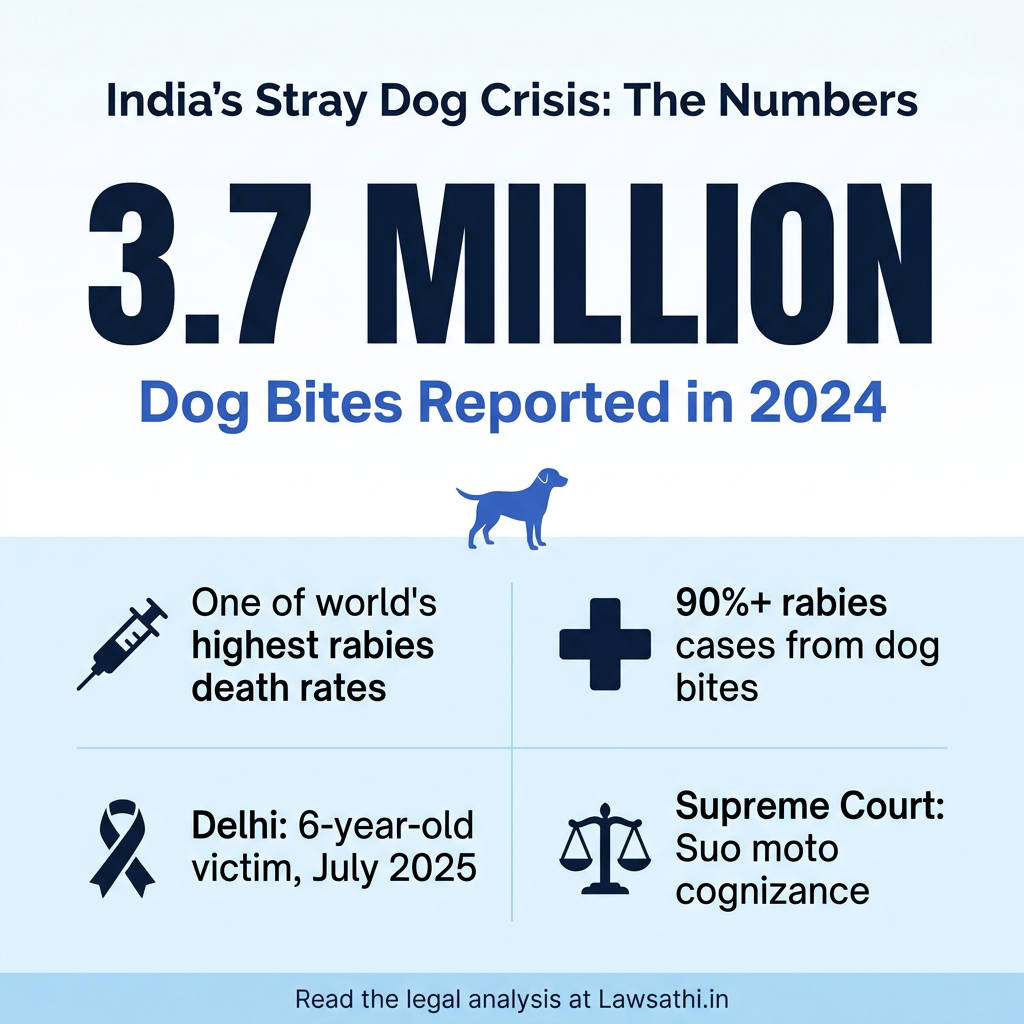
India faces a growing crisis with stray dogs, affecting millions of citizens each year. In 2024 alone, approximately 3.7 million dog bites were reported across the country. Furthermore, India records one of the world’s highest rabies mortality rates globally. Over 90% of human rabies cases result from bites by domestic or stray dogs, according to WHO assessments.
The Supreme Court stray dogs regulation issue has become a critical legal matter. Specifically, the Court must balance animal welfare with public safety. A tragic incident on July 28, 2025, highlighted this urgency. A 6-year-old girl died of rabies after a dog attack in Delhi. Consequently, the Supreme Court took suo moto cognizance.
This blog post analyzes the recent Supreme Court directions based on the Amicus Curiae report. Additionally, it provides legal professionals with insights into the evolving jurisprudence surrounding stray dog management in India.
Background: The Role of the Amicus Curiae in Stray Dog Litigation
Appointment and Mandate of the Amicus Curiae
The Supreme Court appointed Senior Advocate Gaurav Agrawal as the Amicus Curiae. This appointment came through an order dated November 3, 2025. The Court requested him to examine compliance affidavits submitted by States and Union Territories. His role was to identify gaps in implementation and provide recommendations.
The Amicus Curiae operates under a specific legal mandate. He advises the bench on Constitutional provisions, including Article 21 and Article 51A(g). Article 21 guarantees the right to life and safety of citizens. Meanwhile, Article 51A(g) establishes the fundamental duty to show compassion for all living creatures. The Supreme Court order dated November 7, 2025 formalized this mandate.
Key Observations in the Amicus Curiae Report
The Amicus Curiae report highlighted significant concerns. It found “several grave deficiencies and shortcomings” in information furnished by certain States. Additionally, it identified areas where compliance remained incomplete or entirely absent.
The report tendered “constructive suggestions and recommendations” for uniform implementation across India. These suggestions now form part of the Court’s Order. Furthermore, they are annexed as Schedule I to the official judgment. Legal analysts note that this report provides a roadmap for states.
Historical Context of Stray Dog Litigation
The conflict between animal welfare groups and civic bodies has a long history. On May 9, 2024, the Supreme Court disposed of a batch of petitions on stray dogs. The Court gave parties liberty to approach High Courts under the ABC Rules 2023. LiveLaw reported the Court’s observation that “there can’t be indiscriminate killings of canines.”
However, conflicting judgments emerged from various High Courts. The Kerala High Court in 2015 upheld ABC Rules. It held that municipal laws for destroying stray dogs must comply with ABC Rules. Conversely, the Bombay, Karnataka, and Himachal Pradesh High Courts held differently. They ruled that local authorities have discretionary powers to kill stray dogs.
This judicial conflict necessitated Supreme Court intervention. Therefore, the Court needed to provide clarity on the Amicus Curiae report stray dogs issue.
Key Directions Issued by the Supreme Court
Timeline of Supreme Court Orders
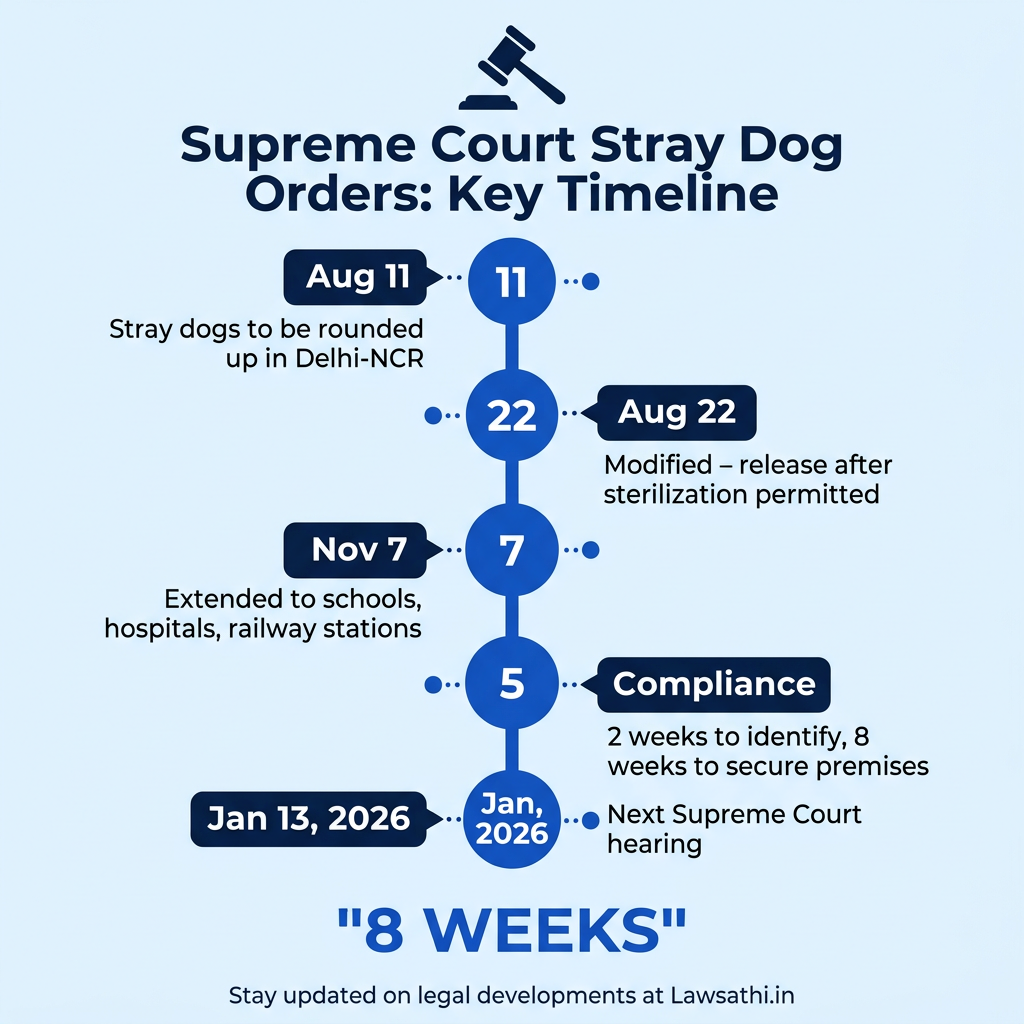
The Supreme Court issued multiple directions between August and November 2025. A two-Judge Bench on August 11, 2025, directed rounding up of stray dogs in Delhi-NCR. Initially, the order prohibited release back to streets.
However, a three-Judge Bench modified this on August 22, 2025. The modified order permitted release after sterilization. The exception was for rabid or aggressive dogs. Subsequently, on November 7, 2025, the Court extended directions to institutional areas.
The Capture-Sterilize-Vaccinate-Release (CSVR) Framework
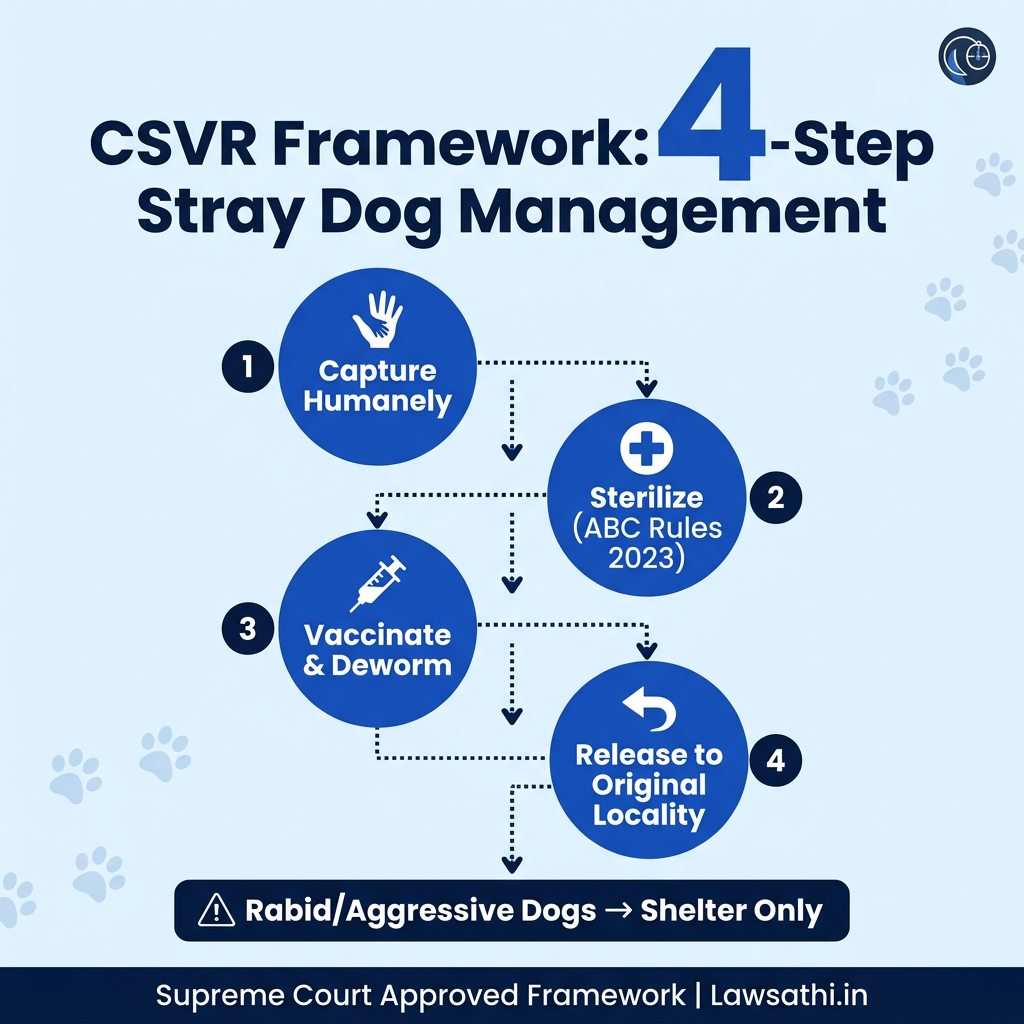
The Court established the CSVR model as the primary approach. Municipalities must continue capturing, sterilizing, deworming, and vaccinating stray dogs. This must follow the Animal Birth Control Rules 2023.
Sterilized and immunized dogs should return to their original localities. However, dogs infected with rabies cannot be released. Similarly, dogs displaying aggressive behavior must remain in shelters.
The Court offered clear reasoning for this approach. Rule 11(19) of ABC Rules 2023 is “scientifically carved out.” It serves two critical purposes. First, it prevents overcrowding in shelters. Second, it ensures compassionate treatment in familiar environments.
Designated Feeding Zones and Municipal Helplines
The Supreme Court stray dogs regulation directions include feeding zone requirements. Each municipal ward must create dedicated feeding spaces. Additionally, gantries and notice boards must mark these areas.
Importantly, feeding stray dogs on streets is no longer permitted. Violators face prosecution under relevant legal frameworks. Furthermore, municipalities must establish dedicated helpline numbers. Citizens can report violations through these helplines.
Directions for Institutional Areas
The November 7, 2025 order addresses institutional areas specifically. Target institutions include schools, colleges, and universities. Hospitals, sports complexes, and bus stands also fall under this category. Moreover, railway stations are included as well.
| Direction | Timeline | |———–|———-| | Identify all institutions | 2 weeks | | Secure premises with fencing | Preferably 8 weeks | | Designate Nodal Officer | Immediate | | Regular municipal inspections | Once every 3 months |
Stray dogs found in these premises cannot return to the same location. The Court reasoned that permitting release would “frustrate the very effect of the directions.”
Compliance Deadlines and Accountability
Chief Secretaries of all States and UTs must file compliance affidavits. The deadline is 8 weeks from November 7, 2025. These affidavits must include complete statistics. Required data includes dog pounds, veterinarians, and catching personnel. Additionally, specially modified vehicles and cages must be reported.
The next hearing is listed for January 13, 2026. The Supreme Court order emphasizes personal accountability. Consequently, officers will be held responsible for lapses in their jurisdictions.
Legal Analysis: Statutory Framework and Overriding Effects
The Prevention of Cruelty to Animals Act, 1960
The parent legislation governing animal welfare dates to 1960. The Prevention of Cruelty to Animals Act prohibits cruelty to animals. It establishes the foundational framework for animal protection in India.
The Animal Birth Control (Dogs) Rules were first introduced in 2001. These rules established the CSVR model. In 2023, the government amended and supplemented these rules. Consequently, the Animal Birth Control Rules 2023 now govern stray dog management nationally.
Resolving Conflict Between State and Central Laws
A significant legal issue concerns conflicting provisions. Many State Municipal Acts empower authorities to destroy stray dogs causing nuisance. However, Central Rules mandate sterilization and release.
The Supreme Court’s judicial interpretation clarifies this conflict. The Court recognized that prohibiting release entirely seemed “too harsh.” Therefore, it modified earlier orders to align with ABC Rules.
The Court explained the “vacuum effect” scientifically. As noted in legal commentary, reducing free-roaming populations creates a vacuum. Migrating animals quickly fill this vacuum. Alternatively, remaining animals have higher birth rates.
Consequently, elimination efforts often leave populations unchanged long-term. However, cities with effective ABC programmes show better results. Lucknow and Dehradun have seen measurable declines in dog populations. The Times of India reported that the Lucknow model shows success.
Balancing Article 21 and Article 51A(g)
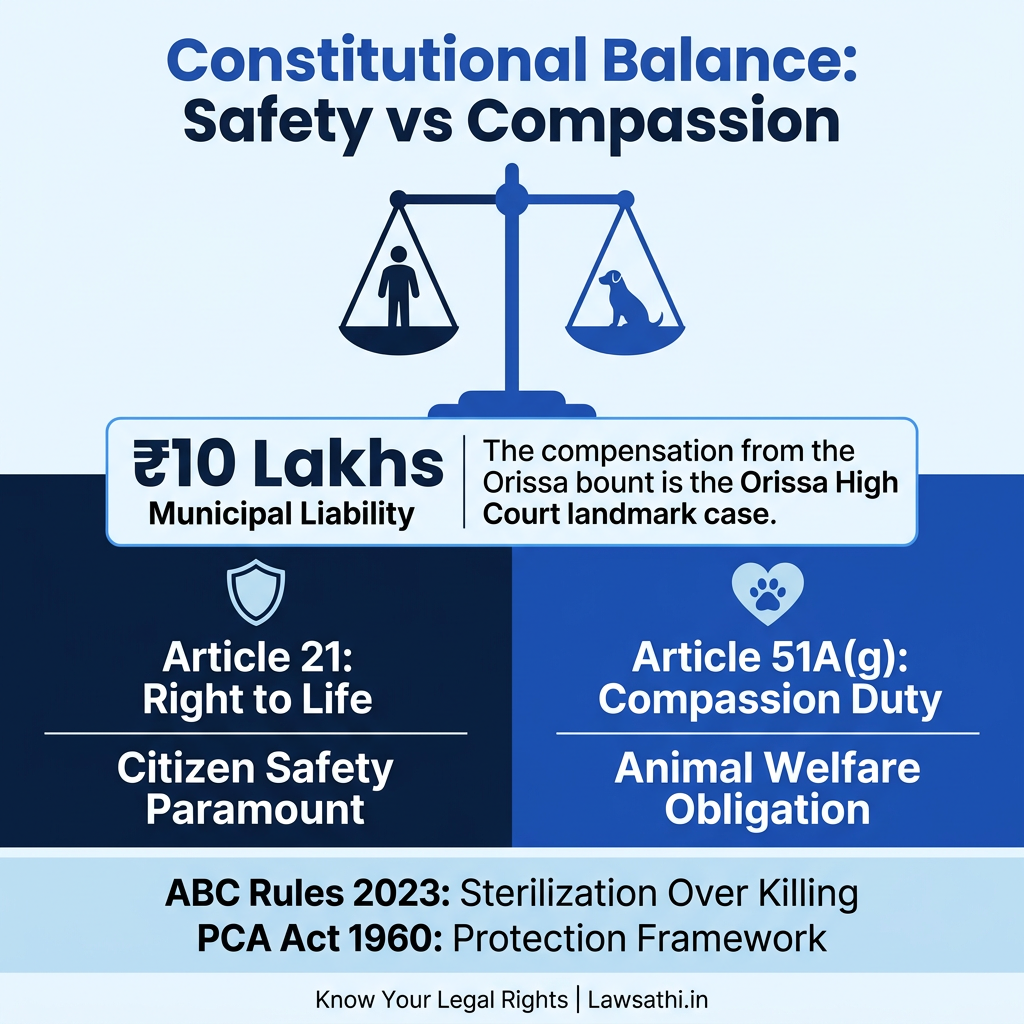
The stray dogs law India framework involves Constitutional balancing. The Court recognized Article 21 as paramount. Specifically, the right to life with human dignity is the primary consideration.
The State has an affirmative obligation. It must ensure citizens are not exposed to preventable injury. However, balance must be maintained with Article 51A(g). This provision mandates compassion for all living creatures.
The Court stated clearly: “The intent behind the order is salutary.” It works towards protecting citizens from attacks by aggressive and rabid stray dogs. Yet, it also protects animal welfare interests.
Implications for Municipal Corporations and Local Bodies
Legal Liability for Non-Compliance
Municipal liability for dog bites has been established through case law. A significant precedent comes from the Orissa High Court in December 2023. The Court dealt with a PIL seeking compensation for a child’s death.
A minor was attacked by four stray dogs and died within minutes. The Orissa High Court directed payment of Rs. 10 lakhs compensation. SCC Online reported that the Court found municipal authorities negligent.
The Court held that the Right to Life under Article 21 mandates State protection. Death resulted from municipal negligence. Therefore, the State and its bodies failed in their Constitutional duty.
Budgetary and Infrastructure Requirements
The Court’s directions impose significant infrastructure requirements. Municipalities must establish several facilities. These include dog shelters with sufficient capacity. Additionally, veterinary infrastructure including kennels and surgical vans is mandatory. Specially modified vehicles and cages for transportation are also required.
Furthermore, hospitals must maintain anti-rabies vaccine stocks. Immunoglobulin supplies are also mandatory. Institutional premises require fencing and boundary walls. Moreover, helpline infrastructure must be established.
The Court also addressed funding mechanisms. Each individual dog lover must deposit Rs. 25,000/-. Similarly, each NGO must deposit Rs. 2,00,000/-. Municipal bodies will utilize these amounts for infrastructure creation.
Risk of Contempt Proceedings
The Supreme Court issued clear warnings about non-compliance. “Any reported non-compliance shall be viewed very seriously.” This may invite penalties including suo moto contempt proceedings. Consequently, erring officials face personal liability.
The Court’s order explicitly states that lapses will be viewed seriously. Responsibility will be fixed on concerned officials. As a result, this creates strong incentives for compliance.
Impact on Legal Practice: New Avenues for Litigation
Filing Compliance Petitions
Lawyers can assist clients through various mechanisms. Filing applications under Article 226 before High Courts is one approach. Clients can seek enforcement of Supreme Court directions.
Relief may include direction to implement ABC Rules 2023. Courts can order creation of designated feeding zones. Additionally, direction to establish helplines is another possibility. Regular inspections of institutional premises can also be mandated.
Legal Remedies for Dog Bite Victims
Compensation for dog bite victims India represents an emerging practice area. The Orissa High Court precedent establishes important principles. Victims can claim compensation under Article 21 violations.
The legal basis includes multiple grounds. First, Article 21 guarantees right to life with dignity. Second, negligence arises from failure to exercise due care. Third, the State has Constitutional duty to protect citizens. Finally, many State Municipal Acts empower authorities to act.
Representing Animal Welfare Organizations
Animal Welfare Organizations have new opportunities. They can seek representation in monitoring committees. Both State and District level committees must be formed. Furthermore, AWOs can assist in certification processes.
Coordination with the Animal Welfare Board of India is essential. The AWBI website provides resources on ABC Rules. NGOs can partner with municipal bodies for adoption programmes.
Additionally, lawyers can challenge illegal culling. Petitions against indiscriminate killing remain viable. The Supreme Court clarified that hindrance in implementation is prohibited. However, obstruction of public servants can face prosecution.
Drafting Public Interest Litigation
PIL drafting requires careful attention to elements. Locus standi must be established as a public-spirited citizen or organization. Violations should specify non-compliance with ABC Rules 2023. Moreover, Supreme Court directions must be referenced.
Relief sought typically includes multiple prayers. First, direction to implement ABC programme is primary. Second, direction to create infrastructure follows. Third, direction to file compliance reports is essential. Additionally, compensation for victims can be included. Finally, constitution of monitoring committees completes the relief sought.
Conclusion: The Road Ahead for Stray Dog Management
Scientific Management Over Elimination
The Supreme Court’s stance on scientific management is clear. “There cannot be any indiscriminate killings of canines,” the Court stated in May 2024. “Exhibiting compassion to all living beings is the enshrined Constitutional value.”
The CSVR/CNVR model represents the most humane approach. Both WHO and the World Organisation for Animal Health recognize this. Therefore, it is scientifically effective for population management.
The Need for Strict Enforcement
Success depends on strict enforcement mechanisms. Compliance affidavits must be mandatory and verified. Personal accountability creates incentives for officials. Furthermore, contempt proceedings ensure consequences for failures.
The Lucknow model demonstrates what works. A monitoring committee headed by the Principal Secretary shows results. Progress reviews occur every three months. Additionally, field surveys document declines in dog bite incidents. Fewer stray puppies appear on streets.
India’s Rabies Elimination Goal
India has committed to rabies elimination. The National Action Plan aligns with the global “Zero by 30” strategy. Mass dog vaccination is essential. Additionally, universal availability of prophylaxis is required. Moreover, inter-departmental coordination must improve.
The Legal Community’s Role
The legal community plays a crucial role in implementation. Lawyers can monitor compliance through contempt petitions. They can assist victims seeking compensation. Furthermore, policy advocacy through AWO representation matters. Public interest litigation drives enforcement. Additionally, education on legal framework helps clients.
The Supreme Court animal welfare jurisprudence continues evolving. This intervention marks a paradigm shift from ad-hoc approaches. Systematic management can achieve balance. In conclusion, public safety and animal welfare are not mutually exclusive. Evidence-based policy works.
Stay updated on the latest Indian Law & Court Updates with LawSathi. Automate your legal research and practice management today. Start your free trial!