Introduction: The Intersection of Contractual Autonomy and Arbitration
On March 9, 2026, the Supreme Court delivered a significant ruling. This decision on arbitral tribunal interest prohibition will reshape how lawyers approach commercial contracts. In Union of India & Ors. v. Larsen & Toubro Limited [1], the Court held that an arbitral tribunal cannot grant pre-award interest when the contract expressly prohibits it. This judgment reinforces a fundamental principle of Indian arbitration law. Party autonomy remains supreme.
The Significance of This Ruling
Commercial contracts frequently contain clauses that either specify interest rates or prohibit interest altogether. However, disputes arise when tribunals attempt to award interest despite such contractual provisions. The Supreme Court’s decision clarifies this confusion definitively.
The case arose from a 2011 turnkey agreement between the Union of India and L&T. The agreement concerned modernizing the North Central Railway’s Jhansi Workshop [1]. The contract, valued at approximately ₹93.08 crore, suffered a 40-month delay. Consequently, L&T filed arbitration claims seeking outstanding payments and financing charges.
Key Legal Question Before the Court
The central issue was whether an arbitral tribunal could award interest by characterizing it as “compensation” when the contract expressly prohibited such payments. The answer was clear. The Supreme Court ruled that tribunals cannot circumvent express contractual prohibitions [1].
This ruling has far-reaching implications for lawyers drafting commercial contracts. Furthermore, it affects those representing clients in arbitration proceedings involving interest disputes.
Understanding Section 31(7) of the Arbitration and Conciliation Act, 1996
The Statutory Framework
Section 31(7) of the Arbitration and Conciliation Act, 1996 governs interest awards in arbitral proceedings. Specifically, this provision creates two distinct frameworks for different types of interest [6][7].
Pre-Award Interest under Section 31(7)(a):
The provision states that “unless otherwise agreed by the parties,” an arbitral tribunal may include interest in its award. This applies to the period between the cause of action and the award date. The critical phrase here is “unless otherwise agreed by the parties” [8].
Post-Award Interest under Section 31(7)(b):
This provision mandates that awarded sums carry interest at 2% above the current rate. Additionally, this applies from the award date until payment. The phrase “unless the award otherwise directs” appears in this subsection [9].
Critical Distinction Between Pre-Award and Post-Award Interest
Lawyers must understand a crucial difference between these two provisions. Section 31(7)(a) places “unless otherwise agreed by the parties” at the beginning of the provision. Therefore, this qualifies the entire section.
However, Section 31(7)(b) places “unless the award otherwise directs” after mentioning the sum directed to be paid. This placement is intentional. In other words, parties can completely exclude pre-award interest through their contract. But they cannot pre-emptively contract out of post-award interest [10].
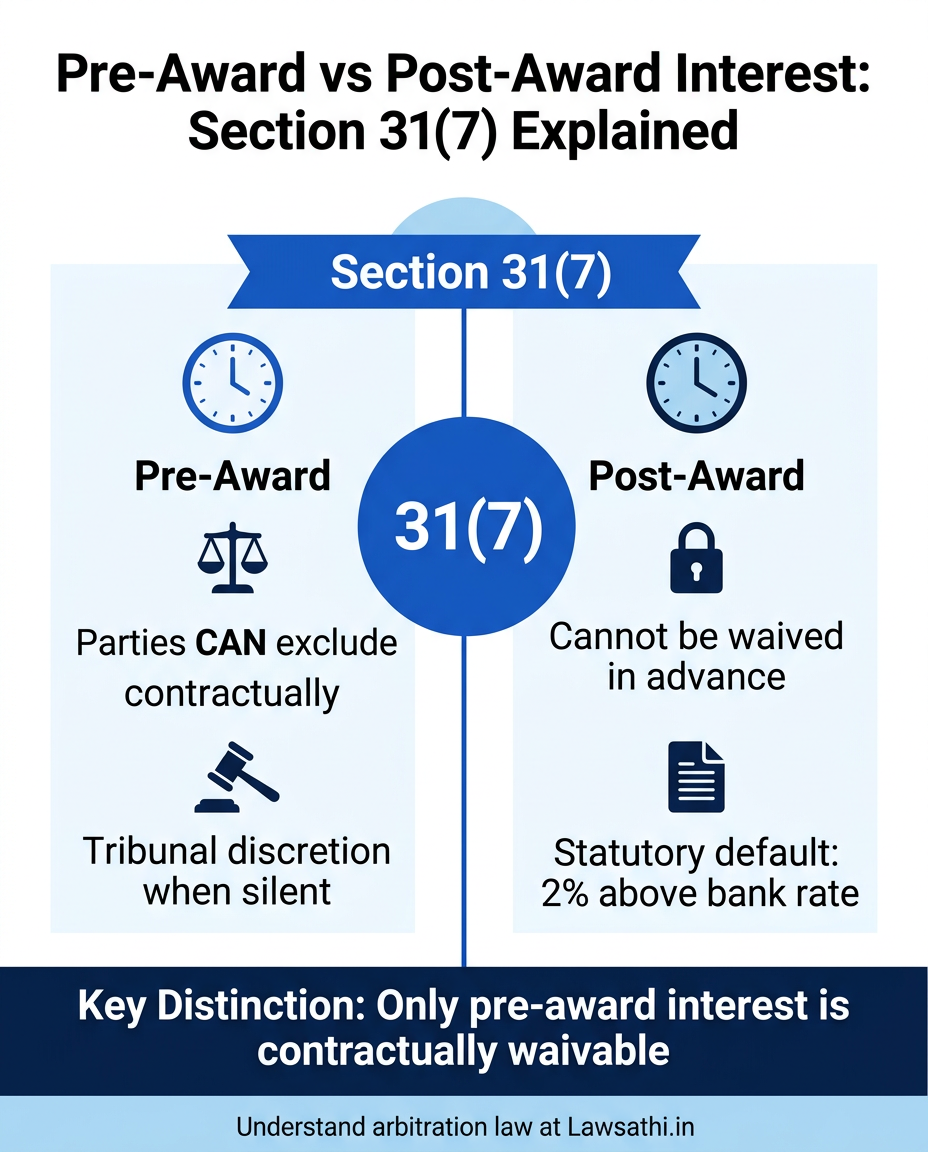
The Supreme Court clarified this distinction in Morgan Securities v. Videocon Industries (2023) [6]. The Court explained that the different placement of qualifying words creates different levels of party autonomy for each type of interest.
Default Positions When Contracts Are Silent
What happens when a contract says nothing about interest? First, the tribunal has full discretion to grant pre-award interest under Section 31(7)(a). This principle was established in Pam Developments v. State of W.B. (2024) [17].
For post-award interest, the statutory default automatically applies if the tribunal remains silent. As a result, this creates a mandatory entitlement that parties cannot waive in advance [7].
Case Analysis: The Supreme Court’s Reasoning
The Factual Background
The dispute originated from a turnkey agreement for railway workshop modernization. L&T, the contractor, claimed outstanding payments and price variations after significant project delays. Additionally, the company sought financing charges as compensation [1].
The Arbitral Tribunal awarded ₹5.53 crore to L&T in 2018. Importantly, the Tribunal acknowledged Clause 64(5) of the General Conditions of Contract (GCC). This clause prohibited interest “till the date on which the award is made” [1].
The Tribunal’s Problematic Approach
Despite recognizing the contractual prohibition, the Tribunal awarded “financing charges” for certain claims. Specifically, it characterized these amounts as “compensation” rather than interest. This was an attempt to circumvent the express prohibition in the contract.
The Tribunal’s reasoning was flawed. In fact, it effectively rewrote the parties’ agreement by substituting “compensation” for “interest” [1].
Procedural History and Supreme Court’s Intervention
The Commercial Court upheld the Tribunal’s award. Subsequently, the Allahabad High Court also affirmed the decision. The Union of India then approached the Supreme Court.
Justice Sanjay Karol and Justice Vipul M. Pancholi examined the matter thoroughly. The Court partly allowed the appeal [1].
The Supreme Court’s Clear Position
The Court examined Clause 16(3) and Clause 64(5) of the GCC in detail. Both clauses clearly prohibited interest for any period until the award date. Therefore, the Tribunal could not sidestep this prohibition by recharacterizing interest as compensation.
The Supreme Court stated unequivocally that the Tribunal committed a serious error. Awarding pre-award interest by calling it “compensation” violated the contract’s express terms [1].
Key Extract from the Judgment
Justice Vipul M. Pancholi authored the judgment. He observed that the Tribunal was “not justified in awarding pre-award/pendente lite interest, by way of compensation” [1].
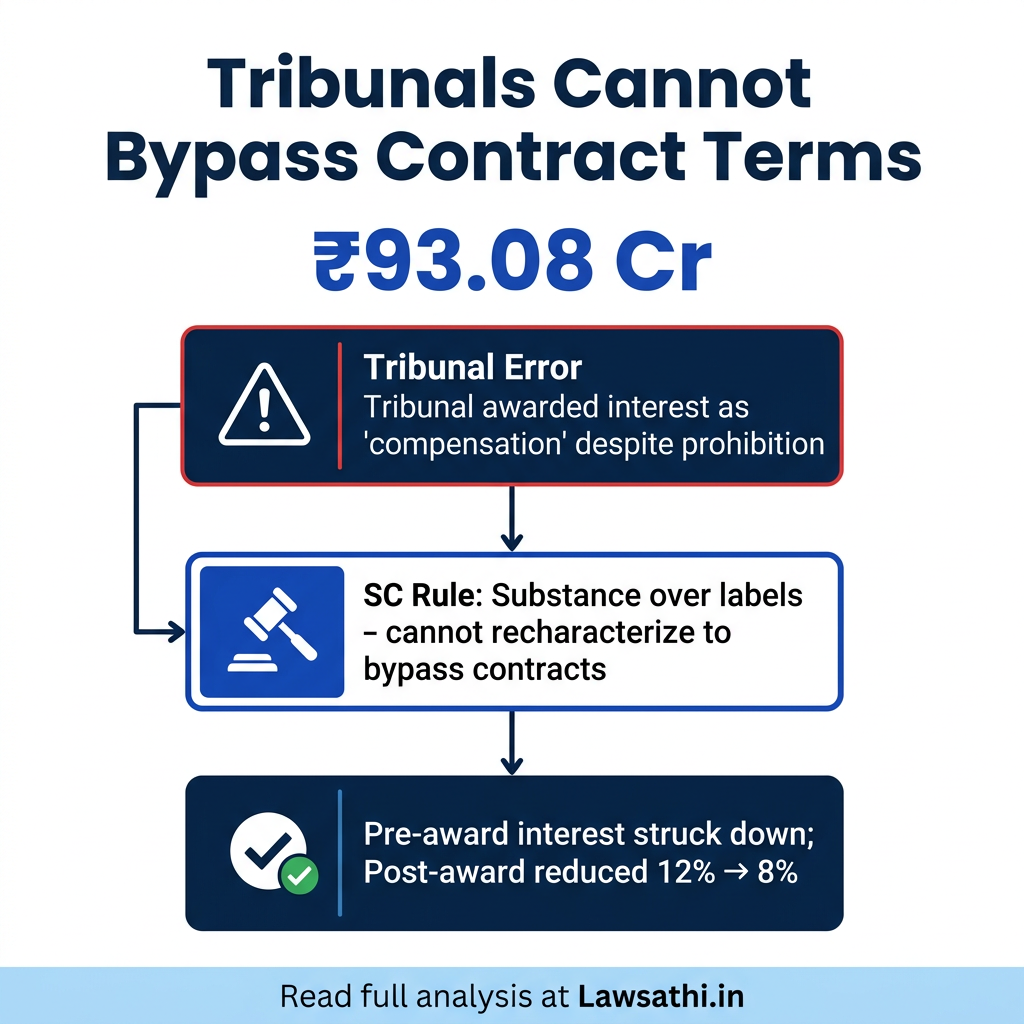
The Court further noted that such interest awards contravene the agreement between parties. Consequently, they must be set aside.
What the Supreme Court Allowed
The Court set aside the pre-award interest portion of the award. However, it upheld post-award interest entitlement. The rate was modified from 12% to 8% per annum.
This demonstrates the difference between the two types of interest. Specifically, pre-award interest is subject to contractual exclusion. Post-award interest remains mandatory regardless of contract terms [5].
Interpreting “Unless Otherwise Agreed”: Scope and Limitations
The Paramount Importance of Party Autonomy
The phrase “unless otherwise agreed by the parties” in Section 31(7)(a) represents party autonomy. This principle forms the bedrock of arbitration law in India [11].
Justice J.B. Pardiwala explained this in BPL Ltd. v. Morgan Securities (2025). He stated that party autonomy will prevail except where legal provisions are strictly non-derogable. Therefore, the opening words of Section 31(7)(a) clearly reserve power to the contracting parties [15].
What Constitutes “Agreement” on Interest?
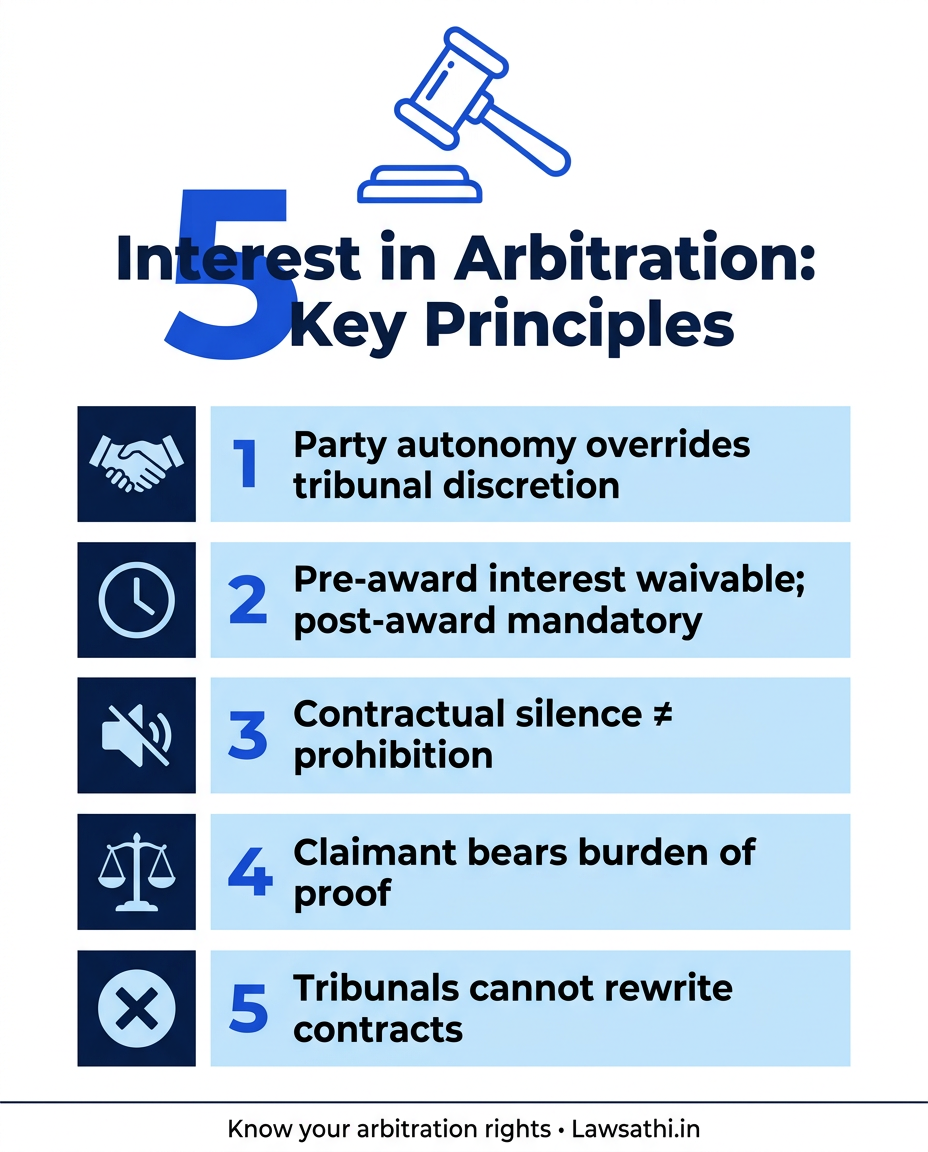
The Supreme Court’s jurisprudence establishes clear principles. First, when parties agree on interest aspects, the tribunal loses all discretion. It becomes bound by the contract’s terms [11].
This applies whether parties: – Expressly prohibit interest – Specify a particular interest rate – Agree to interest for certain periods only
Tribunals cannot create new terms contrary to express agreements [12].
Does Silence Equal Prohibition?
This question frequently arises in arbitration practice. However, the legal position is now settled. Silence does not equal prohibition [17].
Pam Developments v. State of W.B. (2024) established a clear framework. If a contract expressly prohibits interest, the tribunal has no power to grant it. However, if the contract remains silent, the tribunal has full discretion under Section 31(7)(a) [17].
The Burden of Proof Analysis
When claiming interest despite a prohibitory clause, the burden falls on the claimant. Specifically, they must demonstrate that the prohibition does not apply to their specific claim [16].
The Supreme Court rejected creative attempts to circumvent this burden. For example, framing interest as “compensation” or “financing charges” does not work. The substance of the payment matters, not its label [1].
Interpreting Ambiguous Clauses
Courts apply certain principles when contracts contain ambiguous interest provisions. The “Penta Test” for implied terms helps determine parties’ intent [18].
However, these interpretation principles apply only when contracts are silent or ambiguous. They do not override express prohibitions. Above all, clear contractual language must prevail [13].
Implications for Legal Practice and Contract Drafting
Drafting Clear Interest Provisions
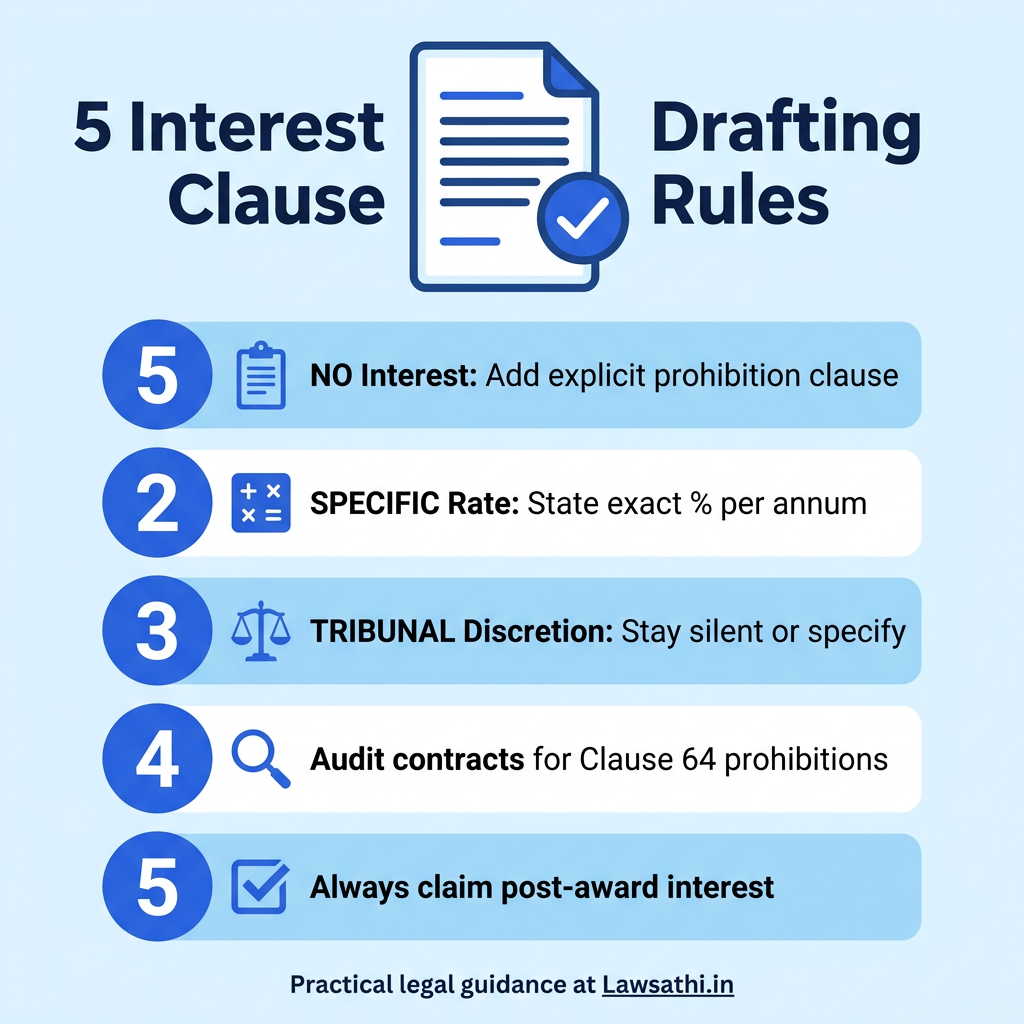
Lawyers must be intentional when drafting interest clauses. The Supreme Court’s ruling requires precise language. Moreover, ambiguity can cost clients significant money [1].
If clients want no interest:
Include an explicit clause stating: “No interest shall be payable on any amounts due under this contract for any period, including pre-award and pendente lite periods.” Such language leaves no room for tribunal discretion [14].
If clients want specific rates:
Specify: “Interest at [X]% per annum shall be payable on delayed payments from the date of default.” This binds the tribunal to the agreed rate [8].
If clients want tribunal discretion:
Stay silent on interest. Alternatively, state expressly: “Interest, if any, shall be at the discretion of the arbitral tribunal” [10].
Reviewing Existing Commercial Contracts
Law firms should audit their clients’ standard form contracts immediately. Government contracts often contain Clause 64-type prohibitions [1].
These clauses will now be strictly enforced following the March 2026 ruling. Therefore, clients need to understand their existing contractual positions regarding interest [1].
Strategic Advice for Litigation
When the contract is silent:
Lawyers should argue that Section 31(7)(a) grants the tribunal full discretion. Cite Pam Developments (2024) for the proposition that silence does not equal prohibition. Additionally, seek reasonable interest based on commercial principles [17].
When the contract expressly prohibits interest:
Distinguish between pre-award and post-award interest. Even if pre-award interest is prohibited, post-award interest remains recoverable. In fact, this is a mandatory entitlement under Section 31(7)(b) [5].
Argue for a higher post-award rate as compensation for delayed recovery. This strategy can partially offset the pre-award loss [9].
When the contract provides a specific rate:
The tribunal is bound by the agreed rate. However, challenge the rate only if it is unconscionable or violates statutory limits [15].
Post-Award Interest Remains Mandatory
The Supreme Court’s ruling reinforces an important principle. Post-award interest is non-negotiable. Furthermore, parties cannot contract out of Section 31(7)(b) [7].
The default rate is 2% above the current bank rate. The tribunal can vary this rate but cannot deny the entitlement entirely [5].
If the tribunal remains silent on post-award interest, the statutory default applies automatically. Therefore, lawyers should always claim this entitlement [10].
Conclusion: Balancing Equity and Contractual Terms
Summary of the Legal Position
The Supreme Court’s March 2026 ruling establishes clear principles for arbitration practice. Express contractual prohibitions on interest trump tribunal discretion. Furthermore, tribunals cannot circumvent these provisions by recharacterizing interest as compensation [1].
Party autonomy remains paramount in Indian arbitration jurisprudence. As a result, courts will enforce commercial terms that parties freely negotiated [11].
Key Takeaways for Indian Lawyers
The distinction between pre-award and post-award interest is critical. First, pre-award interest is completely waivable by contract. Second, post-award interest is a mandatory statutory entitlement [6].
Silence in contracts does not equal prohibition. When contracts are silent, tribunals retain discretion under Section 31(7)(a). Additionally, the burden of proving express prohibition falls on the opposing party [17].
Impact on Commercial Arbitration
This judgment reinforces contractual certainty in Indian arbitration. Tribunals cannot rewrite contracts or create remedies that parties expressly excluded. Consequently, this strengthens India’s position as an arbitration-friendly jurisdiction [13].
Government contracts with interest prohibitions will now be strictly enforced. Therefore, private parties must be intentional about their interest provisions [1].
Final Practical Recommendations
Law firms should audit ongoing arbitrations where interest claims face contractual prohibitions. Additionally, update standard templates to ensure clarity on interest provisions [8].
Counsel clients that interest provisions are risk allocation mechanisms. Most importantly, they must understand the consequences before signing contracts [14].
Document client intent clearly in all cases. Where parties intend to preserve tribunal discretion, state so expressly in the contract [10].
Streamline your arbitration case management with LawSathi. Track judgment updates, manage case deadlines, and automate legal research with AI. Start your free trial today.