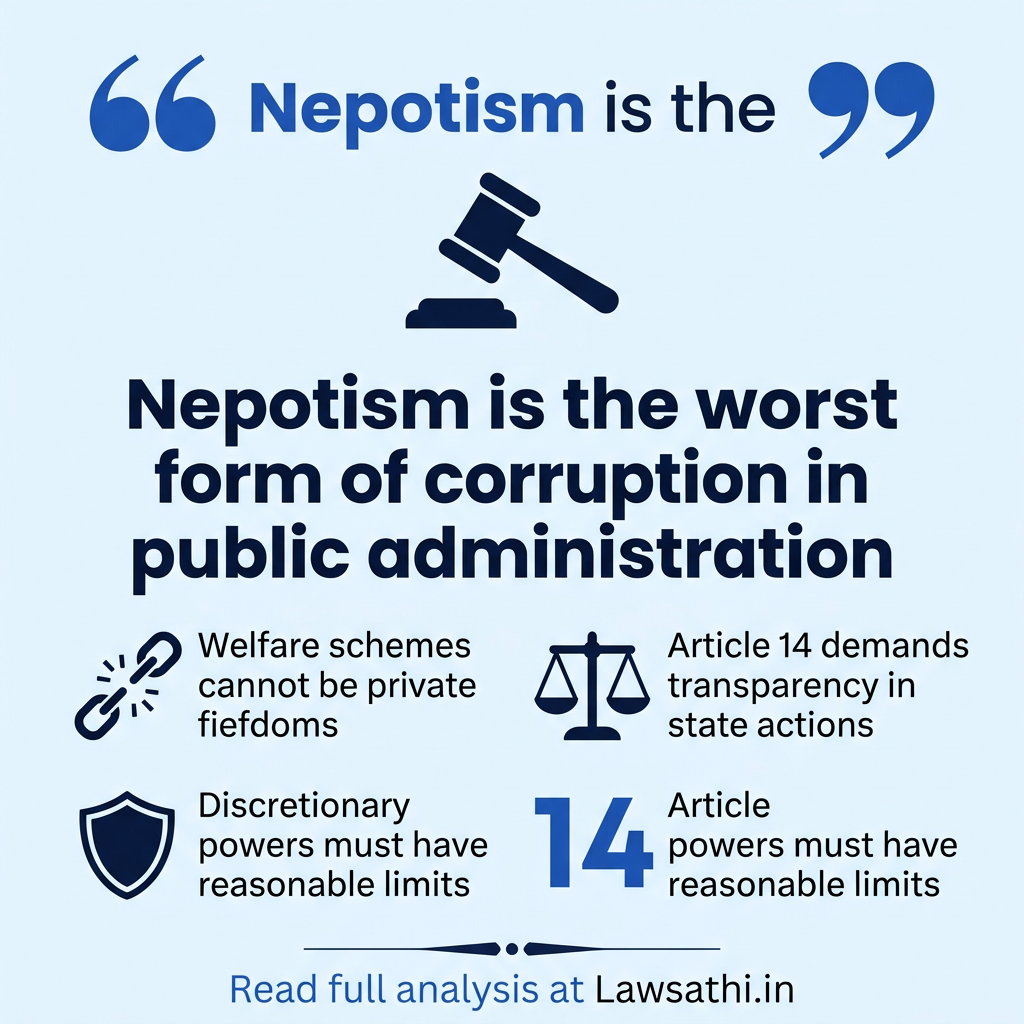
The Supreme Court of India recently delivered a powerful judgment against administrative favoritism in public welfare schemes. In a significant ruling, the Court struck down arbitrary flat allotments in Haryana welfare societies. Specifically, the Supreme Court Haryana flat allotment judgment sends a clear message to bureaucrats and officials across India. Clearly, welfare schemes cannot become private fiefdoms for those in power.
This landmark ruling addresses the misuse of discretionary quotas in government housing allotments. Therefore, it has far-reaching implications for administrative law and constitutional governance. In fact, the judgment reinforces that Article 14 of the Constitution demands transparency and fairness in all state actions.
Introduction: The Judiciary’s Stance on Administrative Nepotism
A Strong Denouncement of Favoritism
Notably, the Supreme Court minced no words in condemning the culture of nepotism. The Bench observed that nepotism represents the “worst form of corruption” in public administration. Such strong language from the apex court signals its growing impatience with arbitrary state action.
However, this judgment is not merely about one case of maladministration. It represents a broader constitutional commitment to equality before law. The Court emphasized that public resources must benefit the public, not privileged individuals.
Why This Judgment Matters
The Supreme Court Haryana flat allotment judgment establishes crucial precedents for administrative accountability. First, it confirms that discretionary powers must have reasonable limits. Second, it reinforces that state largesse cannot be distributed arbitrarily. Third, it imposes actual consequences on those who abuse public trust.
For legal practitioners, this ruling offers valuable insights into challenging government orders. Moreover, it provides a roadmap for arguing Article 14 violations in administrative matters. The judgment will likely influence similar cases across various states.
Case Background: The Haryana Welfare Societies Allotment Dispute
Understanding the Welfare Society Scheme
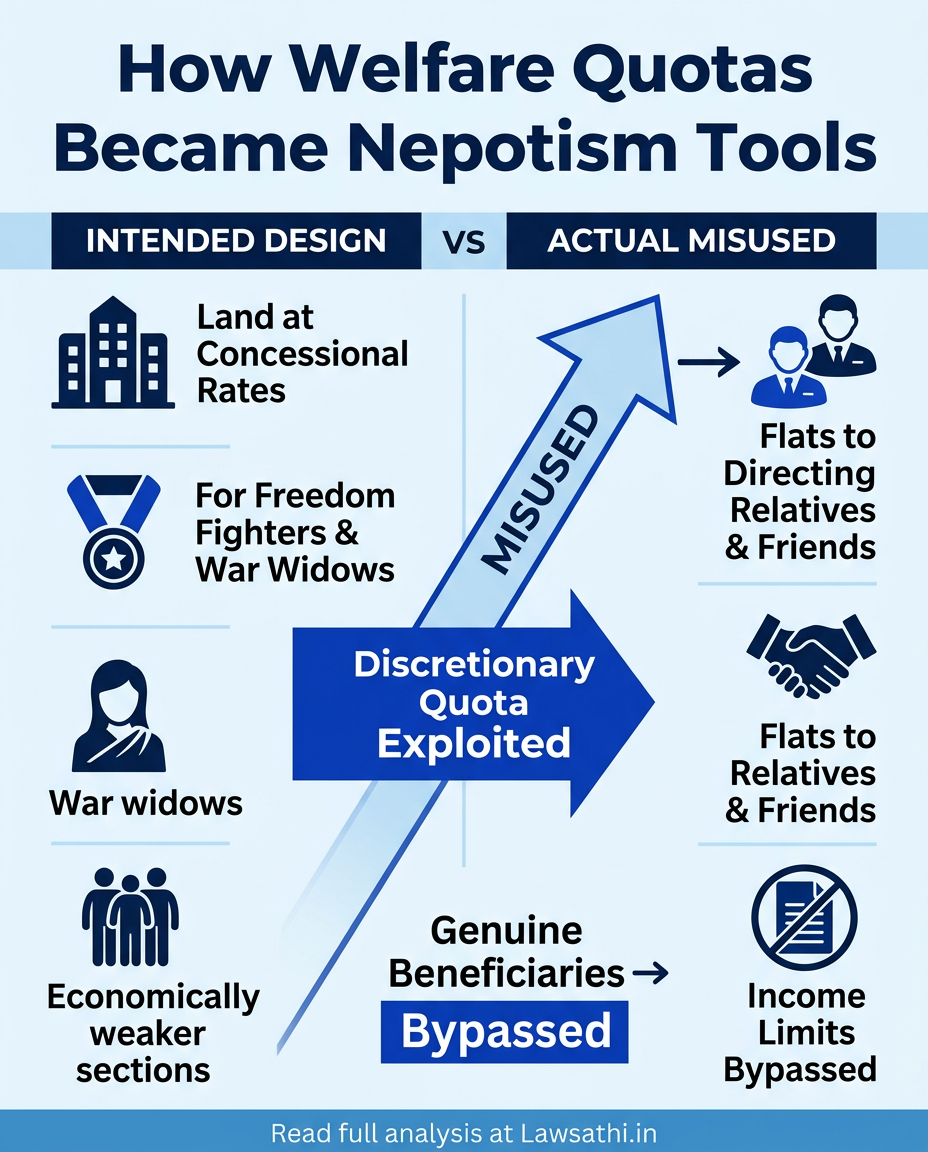
Initially, the Haryana government established welfare societies to provide housing to eligible beneficiaries. As a result, these societies received land at concessional rates from the state government. Specifically, the scheme targeted specific groups including freedom fighters, war widows, and economically weaker sections.
Additionally, certain discretionary quotas existed for special categories. Ideally, the government intended these quotas to address genuine hardship cases. However, officials exploited these discretionary provisions for personal benefit.
The Allegations of Misuse
Subsequently, investigations revealed a systematic pattern of favoritism in flat allotments. For instance, officials allegedly allotted flats to their relatives, friends, and acquaintances. Consequently, many beneficiaries under the discretionary quota had no legitimate claim to welfare housing.
Furthermore, the eligibility criteria were routinely bypassed for favored applicants. Genuine applicants from the intended beneficiary categories were denied their rightful opportunity. Accordingly, the Punjab and Haryana High Court initially took cognizance of these irregularities.
Procedural History of the Case
Eventually, the litigation traveled through multiple stages before reaching the Supreme Court. First, the Punjab and Haryana High Court examined the allotment irregularities. Subsequently, appeals reached the Supreme Court challenging various aspects of the High Court’s order.
The Supreme Court Haryana flat allotment judgment thus represents the final authoritative word on this dispute. Ultimately, it clarifies the legal position on discretionary allotments and administrative accountability.
Supreme Court Observations: ‘Nepotism is the Worst Form of Corruption’
The Bench’s Critical Remarks
Significantly, the Supreme Court Bench delivered scathing observations on the conduct of officials. Importantly, the Court noted that welfare schemes exist to serve deserving citizens. However, officials converted these schemes into instruments of private patronage.
Specifically, the Bench stated that nepotism undermines public confidence in governance. As a result, when officials favor their own circles, the entire system loses credibility. Consequently, the Court refused to accept bureaucratic explanations for the irregular allotments.
Violation of Established Guidelines
In particular, the judgment details how state authorities bypassed their own rules. Specifically, the government had established clear eligibility criteria for flat allotments. Nevertheless, these criteria were ignored when convenient for favored applicants.
For example, income limits were overlooked for certain applicants. Similarly, category requirements were relaxed without proper justification. Thus, the Court found no reasonable basis for these deviations.
State Function and Constitutional Scrutiny
Crucially, the Court examined whether the allotment process constituted “state action.” Fundamentally, under Indian constitutional law, state action must comply with fundamental rights. In this case, the welfare societies received government land at subsidized rates.
Therefore, the Court held that the allotment function was subject to constitutional scrutiny. Indeed, this finding is crucial for future cases involving public-private partnerships. Furthermore, the ruling confirms that any distribution of state largesse must follow constitutional norms.
Legal Analysis: Article 14 and the Doctrine of Arbitrariness
Article 14: The Right to Equality
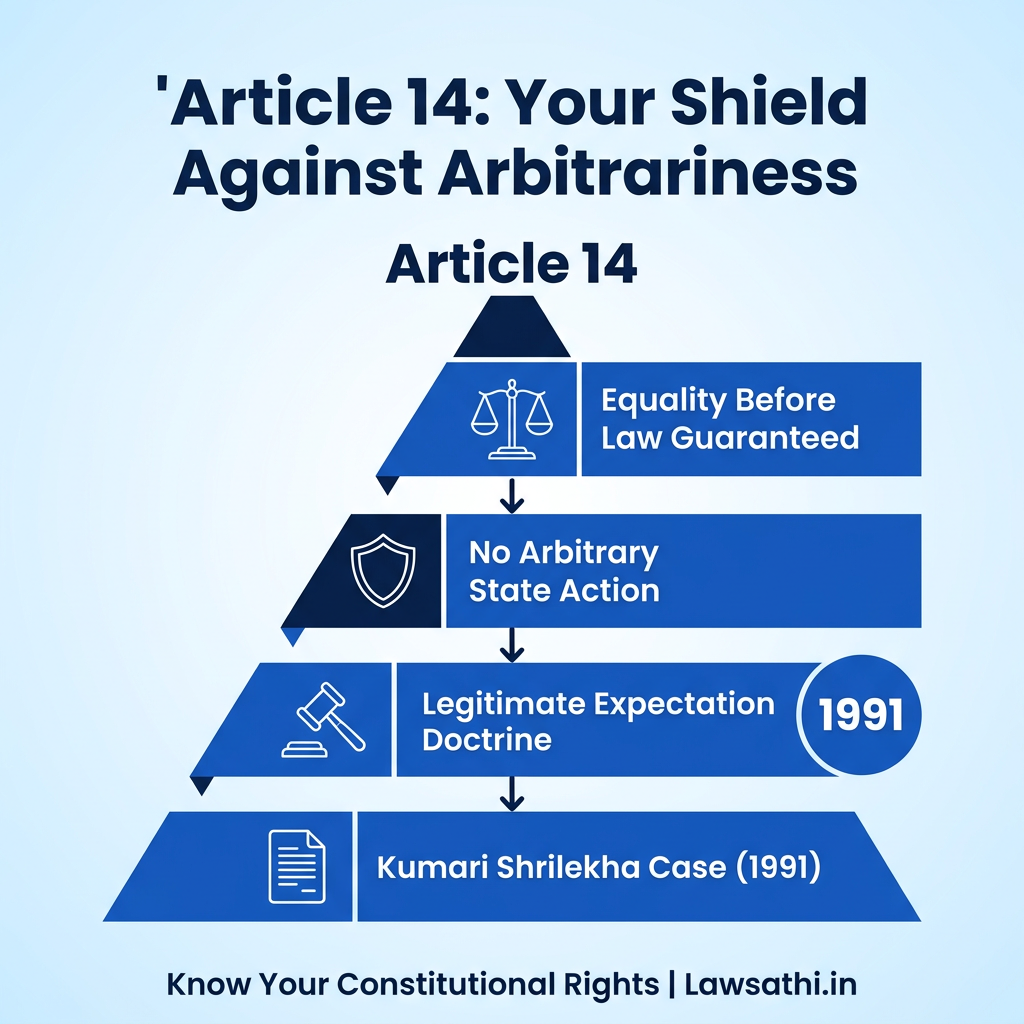
Fundamentally, Article 14 of the Indian Constitution guarantees equality before law. Moreover, it also prohibits arbitrary state action through the concept of “reasonable classification.” Consequently, the Supreme Court Haryana flat allotment judgment applies these principles rigorously.
Specifically, the Court found that the allotment process lacked any rational basis. Thus, arbitrary decisions favoring connected individuals violated the equality guarantee. Therefore, the entire discretionary allotment mechanism required constitutional correction.
The Doctrine of Legitimate Expectation
Importantly, genuine applicants developed a legitimate expectation of fair consideration. In fact, they fulfilled eligibility criteria and applied through proper channels. However, their applications were ignored in favor of well-connected individuals.
As a result, the Court recognized this legitimate expectation as a protectable interest. Therefore, administrative bodies cannot disappoint legitimate expectations without valid reasons. Ultimately, this doctrine strengthens citizens’ rights against arbitrary official action.
Relevant Precedents on State Largesse
Notably, the Supreme Court relied on established precedents in administrative law. In Kumari Shrilekha Vidyarthi v. State of UP (1991), the Court held that state largesse must be distributed fairly. Crucially, this foundational case established that discretionary powers require objective criteria.
Additionally, the Court referenced principles from M/s. Yogi Jan Vikas Samiti v. State of Uttar Pradesh. Indeed, these precedents confirm that arbitrary distribution of public resources violates Article 14. The Haryana judgment thus builds on a strong foundation of constitutional jurisprudence.
The Verdict: Imposition of Costs and Directions for Correction
Monetary Costs Imposed
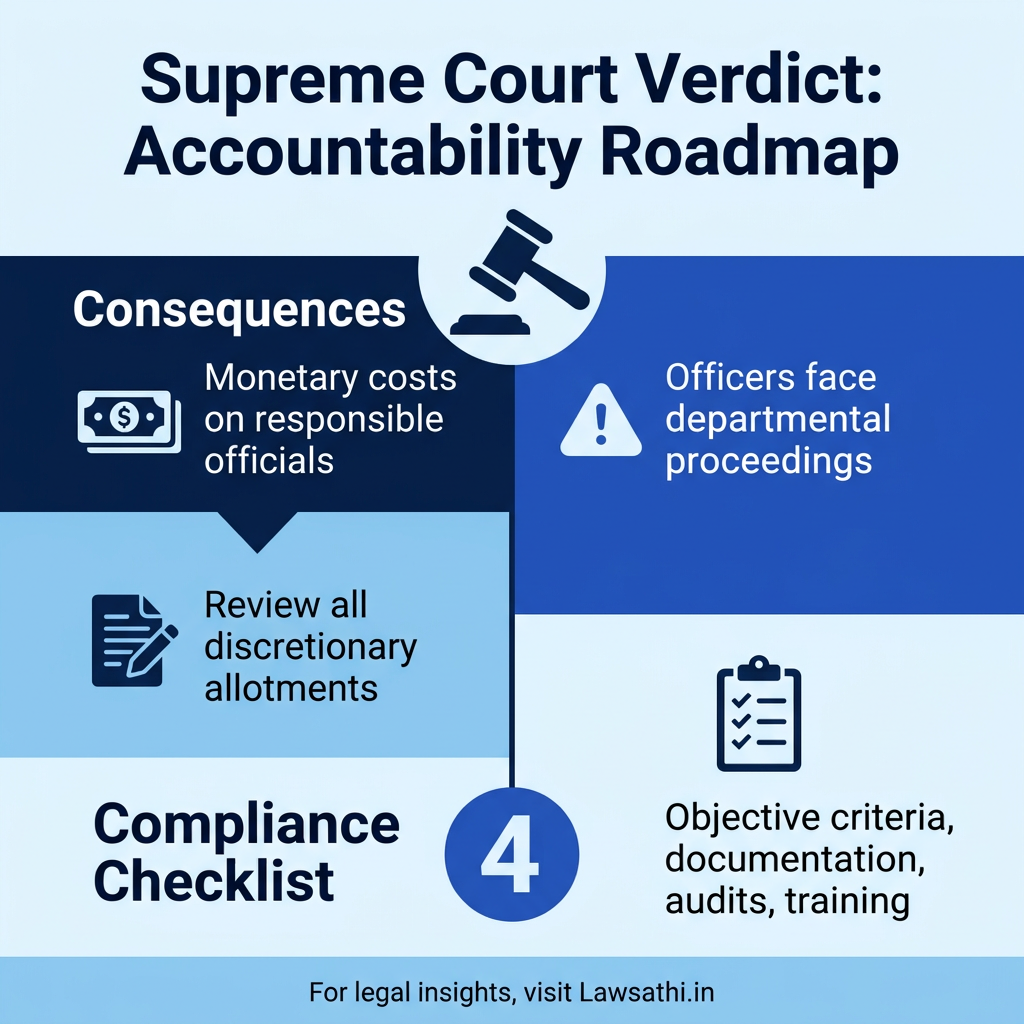
Strikingly, the Supreme Court went beyond mere disapproval in this case. Specifically, it imposed actual monetary costs on the respondents found responsible. Clearly, this aspect of the Supreme Court Haryana flat allotment judgment signals serious consequences.
Importantly, costs serve both punitive and deterrent functions in judicial orders. Thus, they demonstrate that constitutional violations carry real penalties. Consequently, future officials will think twice before engaging in similar favoritism.
Directions for Corrective Action
In addition, the Court issued specific directions for remedying the illegal allotments. Specifically, it ordered a review of all allotments made under the discretionary quota. As a result, illegal allotments must be cancelled and the flats reassigned to eligible candidates.
Furthermore, the government must establish transparent criteria for future allotments. Also, the judgment requires documentation of reasons for every discretionary decision. Ultimately, these requirements aim to prevent recurrence of the same problems.
Accountability for Responsible Officers
Furthermore, the judgment also addresses individual accountability for the violations. Specifically, officers who authorized illegal allotments must face appropriate consequences. For example, the Court suggested departmental proceedings against complicit officials.
Indeed, this focus on individual accountability represents an important development. Unfortunately, systemic failures are often blamed without fixing personal responsibility. Therefore, the Supreme Court refused to allow such evasion in this case.
Implications for Legal Practitioners and Administrative Bodies
Structuring Arguments Against Arbitrary Government Orders
Importantly, litigators can draw valuable lessons from this judgment. First, establish the state action character of the impugned decision. Second, demonstrate the absence of reasonable criteria or their arbitrary application.
For example, lawyers should compile evidence of disparate treatment among applicants. In essence, showing that similarly situated persons received different treatment proves arbitrariness. Additionally, document any patterns of favoritism or personal connections.
Compliance Requirements for Government Bodies
Consequently, government departments must now document their decision-making processes thoroughly. Specifically, every discretionary decision should include written reasons. Furthermore, the criteria for selection must be transparent and publicly available.
Moreover, authorities should maintain records of all applications received. Crucially, the decision-making process must demonstrate that all eligible applicants received fair consideration. Ultimately, these steps will protect against future Article 14 challenges.
A Practical Checklist for Legal Advisors
Accordingly, lawyers advising government clients should recommend several preventive measures. First, establish objective eligibility criteria for all benefit schemes. Second, create documentation requirements for every discretionary decision.
Third, implement audit mechanisms to review allotment decisions regularly. Fourth, train officials on constitutional requirements for state action. Finally, establish grievance redressal mechanisms for rejected applicants.
Conclusion: Reinforcing the Rule of Law
Summary of the Court’s Position
Overall, the Supreme Court Haryana flat allotment judgment represents a significant victory for administrative accountability. Explicitly, the Court firmly rejected the notion that welfare schemes exist for private benefit. Consequently, officials who abuse discretionary powers will face judicial consequences.
In essence, this ruling reaffirms that Article 14 remains a potent check on arbitrary governance. Specifically, the equality guarantee demands more than formal non-discrimination. Instead, it requires substantive fairness in the distribution of public resources.
Future Impact on State Welfare Schemes
Importantly, the implications extend far beyond the Haryana case specifically. Currently, states across India operate similar welfare schemes with discretionary components. Therefore, this judgment requires all such schemes to implement transparent, objective criteria.
For legal practitioners, the ruling offers powerful arguments for future litigation. As a result, citizens denied fair consideration can challenge arbitrary decisions with greater confidence. Notably, the Supreme Court has provided both the reasoning and the remedy.
In conclusion, the message is unmistakable: nepotism in public welfare schemes will not survive constitutional scrutiny.
Streamline your case research and manage your litigation practice effortlessly. Try LawSathi’s AI-powered legal practice management platform free for 14 days to organize your case law research and client documents.