Excel Sheets vs Legal Case Management Software: Why Indian Advocates Are Moving Beyond Spreadsheets in 2026

For decades, Indian advocates have relied on a familiar duo. Specifically, these are the trusted physical register and the versatile Excel sheet. These tools served the legal fraternity well during the era of paper-heavy litigation. However, the Indian judicial landscape has undergone a seismic shift by 2026. The e-Courts Phase III project is digitizing over 660 crore pages of court records. As a result, the old ways are becoming obsolete [1]. Therefore, the modern advocate needs more than rows and columns to stay competitive. This is why forward-thinking lawyers are increasingly adopting legal case management software India to handle the demands of a digital judiciary.

The Hidden Costs of ‘Free’: Why Excel is Expensive for Law Firms

Many law firms cling to spreadsheets because they appear cost-effective. After all, an Excel license often comes bundled with office software. However, the “free” label hides significant operational costs that accumulate silently.

The Time Drain of Manual Data Entry

Time is a lawyer’s most valuable asset. Unfortunately, Excel demands extensive manual input for every update. Advocates or their clerks must manually enter case details, hearing dates, and client information. This process is not only tedious but also prone to delays. In contrast, modern law firm management software automates data capture. For example, cases can be synced directly from court databases using CNR numbers. Consequently, lawyers save hours previously spent on administrative drudgery [11].

Errors and Opportunity Loss

Spreadsheets are notoriously fragile when managing complex legal data. A single broken formula or an accidental deletion can corrupt critical deadlines. Furthermore, version control becomes a nightmare when multiple team members edit the same file. The result is often conflicting information across different devices.

Consider the risks in high-stakes litigation: Missing a limitation date due to a formula error. Losing case history because a file was overwritten. * Spending hours reconciling multiple versions of the “master sheet.”

These errors translate directly to financial loss. Moreover, time spent managing spreadsheets is time taken away from billable work. Therefore, firms lose both revenue and client strategy focus [12].

Security & Compliance: Can Spreadsheets Protect Client Confidentiality?

The Hidden Costs of 'Free': Why Excel is Expensive for Law Firms

In 2026, data security is not just an IT concern. Rather, it is a regulatory mandate. Law firms handle sensitive client information, from trade secrets to personal identifiers. However, spreadsheets simply lack the architecture to protect this data adequately.

DPDPA 2023 and Your Liability

The Digital Personal Data Protection Act (DPDPA) 2023 has changed the compliance landscape permanently. Law firms are now classified as “data fiduciaries” under this law. This classification means they must implement strict security safeguards. Additionally, they must report data breaches to the Data Protection Board within specific timelines [15].

Excel files stored on local drives or shared via email fail to meet these standards. First, they lack encryption by default. Furthermore, there is no audit trail to track who accessed the data and when. If a lawyer’s laptop is stolen, client data is completely exposed. Similarly, a ransomware attack can expose sensitive information instantly.

The Myth of Spreadsheet Security

Attorney-client privilege is the cornerstone of legal practice. The Bharatiya Sakshya Adhiniyam (BSA), 2023, codifies this protection [6]. However, privilege relies heavily on confidentiality. Sharing an Excel file via WhatsApp or email creates multiple copies across unsecured devices. Therefore, maintaining confidentiality becomes nearly impossible.

Dedicated software, on the other hand, offers role-based access controls. A junior associate might only see case listings, while a partner sees billing details. Moreover, legal case management software India providers now offer enterprise-grade encryption. This ensures that even if a device is compromised, the central data remains secure [15].

Collaboration Bottlenecks vs. Real-Time Teamwork

The modern Indian law firm is no longer confined to a single room. Associates work from home, and partners travel to different High Courts. Additionally, clients expect instant updates in today’s fast-paced environment. However, Excel was designed for single-user desktop work, not for a hybrid, mobile legal team.

Security & Compliance: DPDPA 2023 and Your Liability

The ‘Locked File’ Nightmare

Every associate has faced this frustrating scenario. A crucial spreadsheet is locked because a colleague has it open. The file is on a shared drive, but only one person can edit it at a time. This bottleneck brings collaboration to a halt. Consequently, urgent updates are delayed until the file is available.

Furthermore, even when files are shared, they scatter across emails and messaging apps. The “master copy” quickly becomes outdated as team members work on different versions. As a result, this fragmentation leads to confusion and inefficiency.

Breaking the WhatsApp-Excel Loop

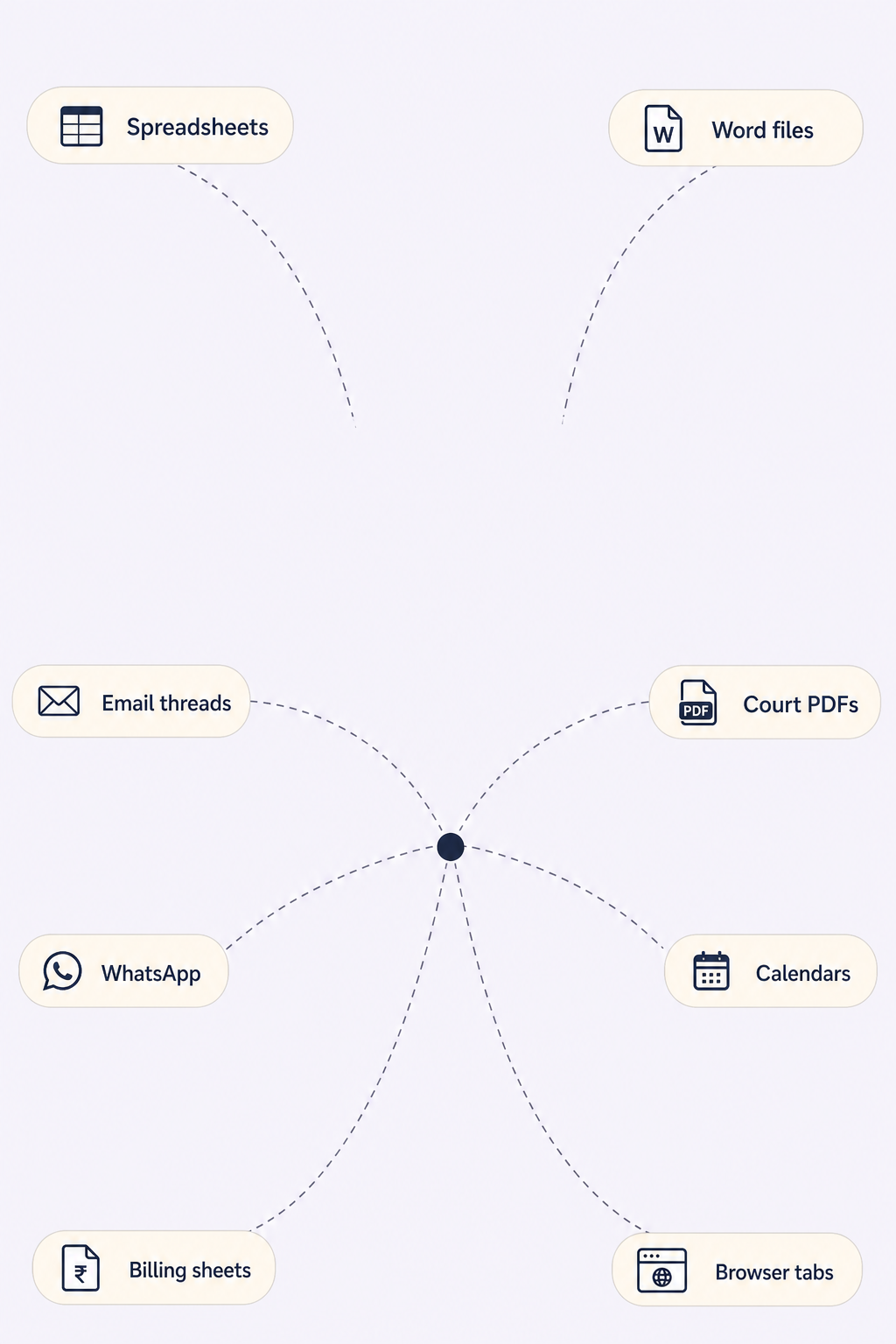
Most Indian firms rely on a disjointed workflow. Case details stay in Excel, communication happens on WhatsApp, and documents remain in email attachments. Unfortunately, this loop is inefficient and risky. Important messages get buried in chat threads, and documents are lost in inboxes [13].

Modern case tracking software eliminates this fragmentation completely. For instance, platforms like LawSathi provide centralized communication channels. Team members can discuss cases within the software itself. Documents are attached directly to case files, not scattered in random folders. As a result, everyone works from a single source of truth in real-time.

Automation & Integrations: The 2026 Advantage

Spreadsheets are static tools. They store data but cannot process or act upon it intelligently. In 2026, the legal profession demands tools that actively assist lawyers. Specifically, lawyers need software that does more than just store their notes.

Automating Critical Deadlines

Breaking the Collaboration Bottleneck: From Locked Files to Real-Time Teamwork

Calculating limitation dates is a high-risk task. The Limitation Act, 1963, contains 137 articles covering various suits and appeals [24]. A manual error in calculation can dismiss a case before it even begins.

While courts like the Supreme Court offer online calculators, Excel cannot integrate with them [21][22]. Similarly, the Madhya Pradesh High Court provides tools that spreadsheets cannot access. However, specialized software can bridge this gap. Legal software automatically computes limitation periods based on court holidays and custom triggers. Therefore, advocates receive proactive alerts instead of manually calculating dates.

GST and Billing Integration

Billing is another area where Excel falls short. Since the implementation of GST, lawyers must generate compliant invoices. This includes generating Invoice Reference Numbers (IRN) for e-invoicing [27].

Doing this manually or through spreadsheets is time-consuming and prone to errors. In contrast, dedicated law firm management software integrates directly with IRIS IRP portals. It generates GST-compliant invoices automatically. Consequently, firms maintain clean financial records without extra administrative burden [28].

AI-Driven Insights

The biggest game-changer in legal tech India 2026 is Artificial Intelligence. Software like LawSathi now incorporates AI features. These tools can analyze case sentiment, suggest relevant judgments, and even draft petitions [16]. Excel remains a passive grid. It cannot predict case outcomes or offer legal research assistance.

In contrast, AI-powered platforms act as digital junior advocates. Specifically, they reduce research time by up to 10x, allowing lawyers to focus on strategy [23].

Feature-by-Feature: Excel vs. Dedicated Legal Software

To truly understand the gap, a direct comparison is necessary. Therefore, the table below highlights why generic tools fail specific legal tasks.

Feature-by-Feature Breakdown

| Feature | Excel | Dedicated Legal Software | | :— | :— | :— | | Case Tracking | Manual entry, error-prone | Auto-sync with court databases | | Calendaring | Static lists, manual updates | Intelligent sync with court dates | | Document Storage | File paths, no version control | Centralized, searchable repository | | Client Portal | Not available | Secure, dedicated client access | | Billing | Manual formulas | GST-compliant, automated invoicing | | Vakalatnama | Manual tracking | Digital records with expiry alerts | | Security | Password protection (weak) | Role-based access, encryption | | Teamwork | “Locked file” issues | Real-time collaboration |

A significant pain point for Indian advocates is managing Vakalatnamas. A spreadsheet might list case numbers and client names. However, it cannot alert you when a Vakalatnama needs renewal. Similarly, it cannot track the physical location of these documents.

Furthermore, generic tools cannot scale effectively. As a firm grows from a solo practice to a team of ten, the Excel file grows larger and slower. Moreover, it becomes prone to crashing at critical moments. Dedicated software like LawSathi is built to scale. Consequently, it grows with the firm, handling thousands of cases without performance loss [16].

Conclusion: The Future is Specialized

The Indian legal services market is projected to reach $67.4 billion by 2030 [16]. To capture a share of this growth, firms must move beyond outdated tools. Excel is an excellent calculator. However, it is not a practice manager.

The transition to specialized tools is no longer about luxury. Rather, it is about survival. The judiciary has embraced digital transformation through the e-Courts project [5]. Therefore, advocates must follow suit to remain effective. Legal case management software India provides the security, automation, and collaboration features that modern practice demands.

Technology is an enabler of justice, not a substitute for judgment. By adopting platforms like LawSathi, Indian advocates can reclaim their time. They can serve clients better. Most importantly, they can build sustainable, efficient practices for the future.

Ready to retire your spreadsheets? Modernize your practice today. Start your free trial of LawSathi and experience the power of dedicated legal case management built for Indian advocates.

Leave a Comment

Your email address will not be published. Required fields are marked *

Scroll to Top