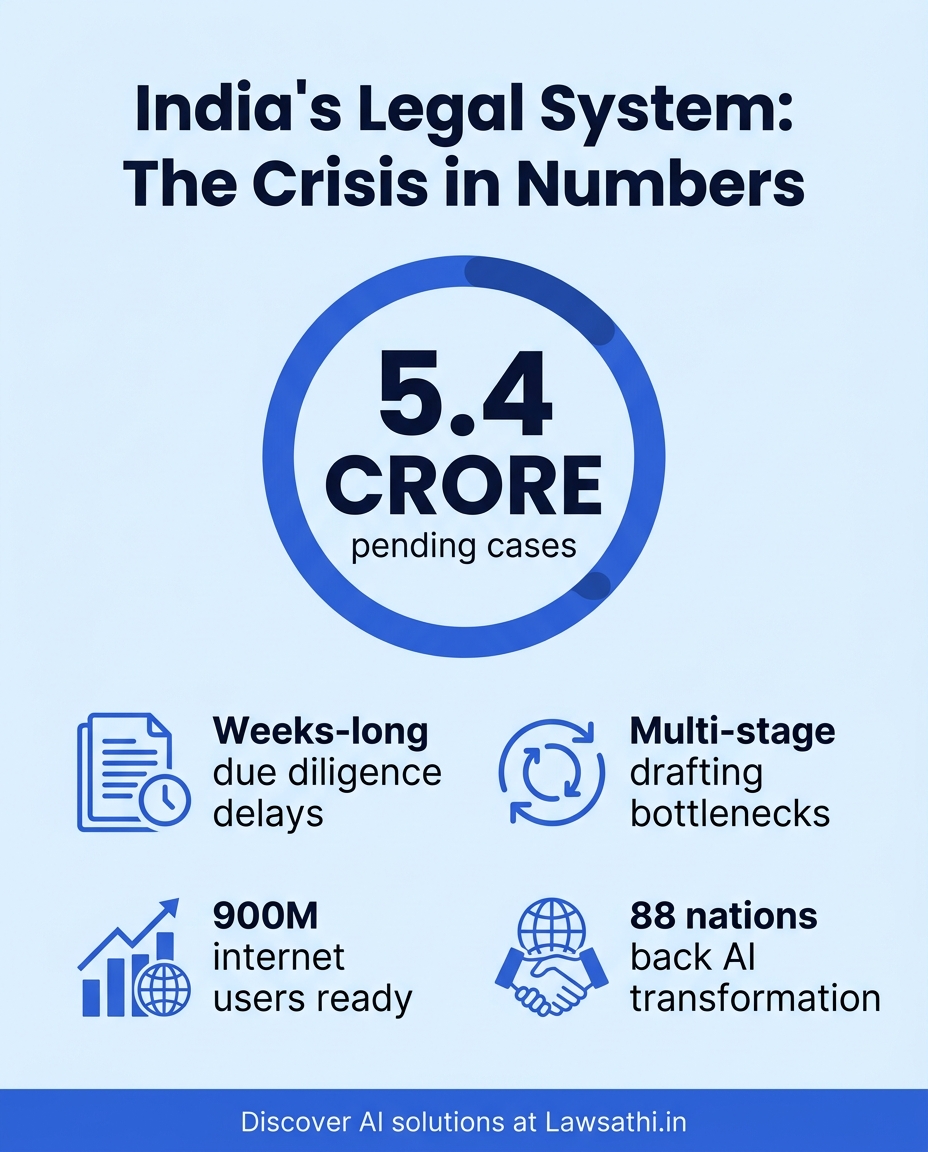
The landscape of corporate legal practice in India is undergoing a profound transformation. With over 5.4 crore cases pending across Indian courts as of February 2026, lawyers face unprecedented pressure. They must deliver faster, more accurate work [^1]. Against this backdrop, AI contract drafting and due diligence India has emerged as a game-changing solution for forward-thinking legal professionals. The transition from manual, time-consuming processes to technology-driven workflows is no longer optional. In fact, it has become essential for competitive survival.
Introduction: The Digital Shift in Indian Corporate Law
The Current State of Legal Practice in 2026
India’s digital revolution has touched every sector, and legal services are no exception. With over 900 million internet users and a projected $1 trillion digital market by 2026, the infrastructure for legal technology adoption is firmly in place [^1]. However, traditional legal research and drafting have long depended on manual effort and fragmented sources. Lawyers routinely spent hours on precedent searches, drafting similar formats, and preparing case briefs.
The India AI Impact Summit in February 2026 marked a watershed moment. Eighty-eight countries endorsed the New Delhi Declaration, signaling global recognition of AI’s transformative potential [^1]. For Indian corporate lawyers, this summit underscored an urgent reality. Specifically, the profession must adapt or risk obsolescence.
Identifying the Bottlenecks
Corporate legal work involves repetitive, high-volume tasks that consume valuable time. Contract drafting follows a multi-stage workflow. Draft, statutory review, revision, and re-verification create endless cycles. Furthermore, due diligence for M&A transactions can take weeks. Documents often fail to account for recent statutory amendments. Additionally, verification typically depends on the judgment of experienced colleagues, creating bottlenecks.
These inefficiencies directly impact profitability and client satisfaction. Therefore, the question is not whether to adopt AI, but how to implement it responsibly.
Demystifying AI in Contract Drafting: Beyond Standard Templates
How NLP and Generative AI Transform Drafting
Natural Language Processing (NLP) and Generative AI have revolutionized contract drafting. These technologies go far beyond simple template filling. Modern AI systems create jurisdiction-specific clauses tailored to Indian law.
In March 2026, NYAI launched India’s first Legislation-Verified Drafting Ecosystem [^6]. This platform features a proprietary “Intelligence Layer” that operates concurrently with drafting. As a user drafts any legal instrument, the system cross-references the document against applicable Indian legislation. This includes parent statutes, rules, regulations, and subsequent amendments.
Dawood Sangameshwari, CTO of NYAI, explains this innovation clearly. He states that “the draft is not merely generated. It is continuously tested against the law” [^6]. Consequently, this real-time legislative verification represents a paradigm shift for Indian practitioners.
Automating Routine Contracts
High-volume contracts consume disproportionate lawyer hours. NDAs, employment agreements, and vendor contracts follow predictable patterns. AI excels at automating these documents while maintaining quality.
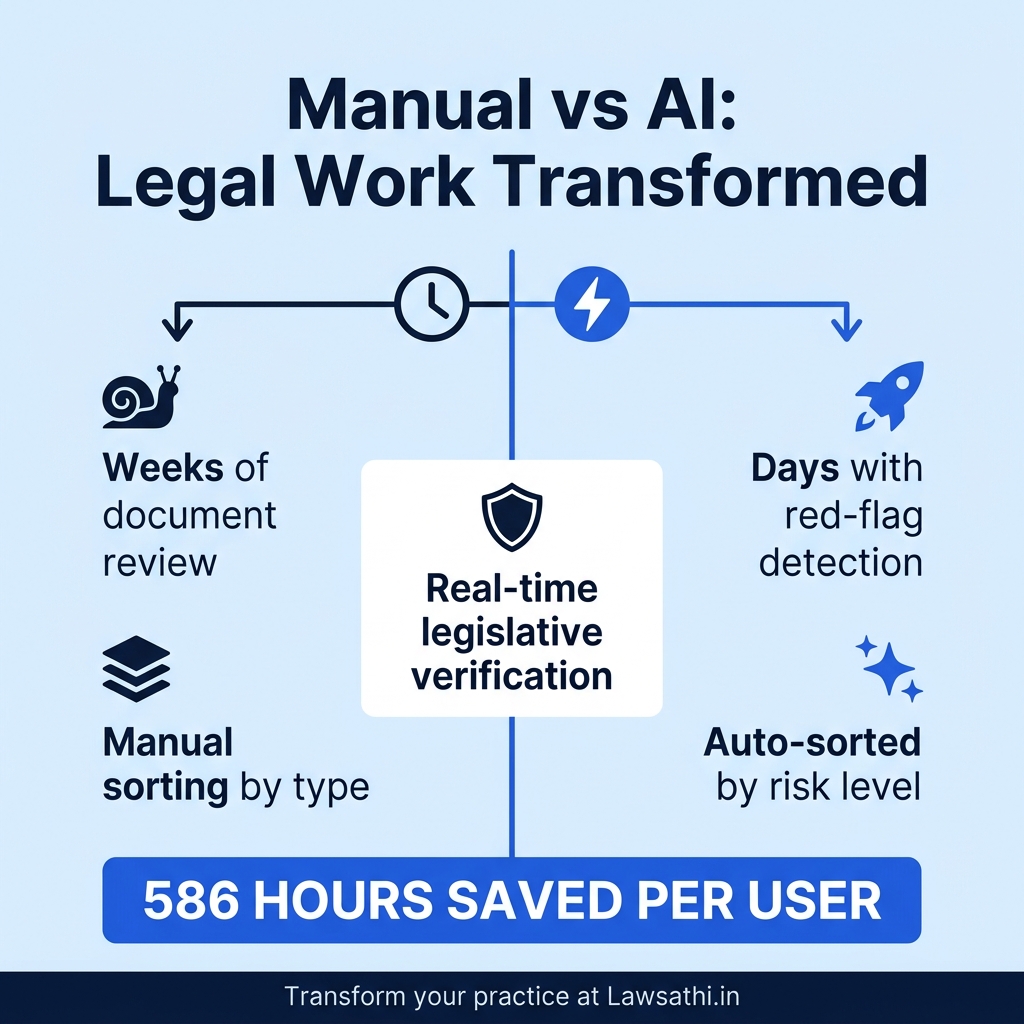
Lawttorney.ai reports impressive metrics from its platform [^2]. Over 50,000 users have entered 1.78 million prompts for research and drafting. The platform has generated 76,589 legal drafts and prepared 68,000 court arguments. Most significantly, users saved approximately 586 hours of legal research time.
Ensuring Indian Contract Act Compliance
The Indian Contract Act, 1872 remains the cornerstone of commercial agreements. AI platforms now verify documents against this foundational statute. Additionally, they check subordinate legislation and recent amendments.
Vikrant Labde, Co-Founder of NYAI, emphasizes the tool’s purpose [^6]. He notes that “the platform does not substitute legal judgment. It arms that judgment with the precise legislative text.” As a result, this approach ensures that AI serves as an intelligent assistant rather than a replacement.
Revolutionizing Due Diligence: Speed and Precision in M&A
AI-Driven Data Rooms
Mergers and acquisitions demand extensive document review. Traditional due diligence involves sorting through thousands of contracts, compliance certificates, and financial records. This process typically requires weeks of intensive labour.
AI-powered data rooms have transformed this workflow dramatically. Machine learning algorithms sort and index documents automatically. They categorize files by type, risk level, and relevance. Consequently, lawyers can focus on analysis rather than organization.
Chandhiok & Mahajan announced a firm-wide rollout of Legora in February 2026. This followed a rigorous pilot process [^4]. Managing Partner Sujoy Bhatia highlighted what set the platform apart. He noted that “the Legora team worked closely with our lawyers on the ground, investing real legal engineering effort to address India-specific legal realities” [^4].
Red-Flag Detection and Risk Assessment
Identifying liabilities in contract portfolios requires meticulous attention. A single overlooked clause can expose clients to significant risk. Therefore, AI systems excel at pattern recognition across large document sets.
These tools detect anomalies that human reviewers might miss. For example, they flag unusual termination provisions, uncapped liability clauses, and compliance gaps. Furthermore, they cross-reference obligations against regulatory requirements.
From Weeks to Days: A Practical Timeline Reduction
The impact on due diligence timelines is substantial. What previously required weeks can now be accomplished in days. Moreover, certificate courses now train lawyers specifically on “conducting M&A due diligence” with AI dashboards [^7].
Amit Kothiyal, Head of India at Legora, emphasizes the strategic priority [^3]. He states that “India is a strategic priority for Legora, and our aim is to build the most comprehensive, reliable, and practical legal AI platform for Indian law.”
Key Benefits for Indian Law Firms and In-House Counsel
Cost-Efficiency and Resource Optimization
Legal AI tools India deliver measurable returns on investment. Junior lawyers produce more accurate initial drafts. Senior practitioners spend less time on repetitive groundwork and oversight.
Advocate Niraj Shah of J.N. Shah and Company shares his experience [^2]. He notes that “the platform significantly reduces the time and effort involved in legal research, drafting, and citation management.” As a result, this efficiency enables lawyers to focus on core legal work. They can also maintain healthier work-life balance.
Minimizing Human Error
High-volume document review inevitably introduces human error. Fatigue, distraction, and time pressure all contribute to mistakes. In contrast, AI systems provide consistent, tireless analysis.
Data safety features are equally important. Leading platforms offer zero data tracking, zero external AI training, and zero third-party storage [^2]. Documents are verified against current legislation rather than outdated training data.
Advocate Amol Thakare, Founder of Advocate Thakare & Associates, confirms these benefits [^2]. He states that “research time has reduced considerably. The tool delivers legally relevant content with strong Indian context accuracy.”
Enhancing Client Satisfaction
Clients increasingly expect faster turnaround times. In a competitive market, responsiveness differentiates successful practices. Therefore, automated contract review enables lawyers to deliver quicker results without sacrificing quality.
Dr. Adv. Manish Agarwal of EOS Chambers of Law offers perspective [^2]. He describes Lawttorney.ai as “a highly effective legal research and drafting platform” with “cost-effective pricing.”
Over 200 participants from organizations have enrolled in AI training courses [^8]. These include Tata Steel, PowerGrid, and Paytm. Consequently, this corporate interest signals growing client expectations for AI-proficient counsel.
Navigating Regulatory and Ethical Considerations in India
Digital Personal Data Protection Act Compliance
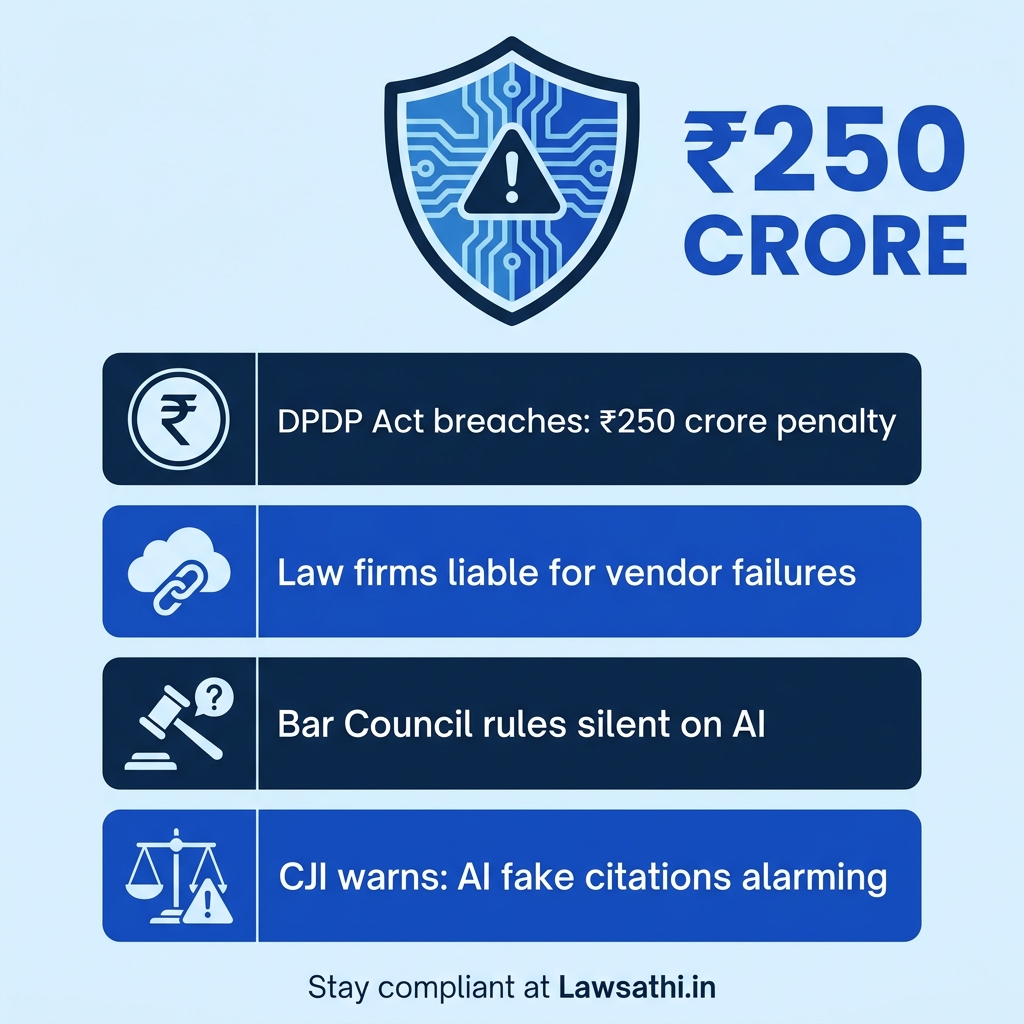
The Digital Personal Data Protection Act, 2023 introduces critical obligations for legal professionals. Section 8(5) requires companies to implement “reasonable security safeguards” [^11]. Moreover, breaches carry penalties up to ₹250 crore.
Rule 6 of the DPDP Rules 2025 mandates seven specific safeguards [^13]. These include encryption, multi-factor authentication, and real-time monitoring. The compliance deadline is May 13, 2027, providing an 18-month window [^14].
Lawyers must understand a crucial vicarious liability trap [^15]. The Data Fiduciary remains liable for any breach by its Data Processor. Even if a third-party cloud vendor fails, the law holds the law firm responsible.
Bar Council of India Guidelines: The Current Gap
The Bar Council of India Standards of Professional Conduct predates AI technology entirely [^5]. These rules are “entirely silent on AI delegation.” As a result, this regulatory vacuum creates uncertainty.
Recent judicial warnings underscore the risks. Chief Justice Surya Kant called AI-generated fake citations “alarming” in February 2026 [^5]. Similarly, Justice Nagarathna cited a petition containing a fabricated case titled “Mercy vs Mankind.” The Bombay High Court has imposed costs on litigants for submitting AI-generated fake citations.
International jurisdictions offer guidance. The American Bar Association issued Formal Opinion 512 in July 2024 [^5]. It requires lawyers using AI to discharge obligations of competence, confidentiality, and supervision.
The Imperative of Human Oversight
Former Chief Justice BR Gavai articulates the fundamental principle [^17]. He states that “justice involves ethical considerations, empathy and contextual understanding that algorithms cannot replicate.”
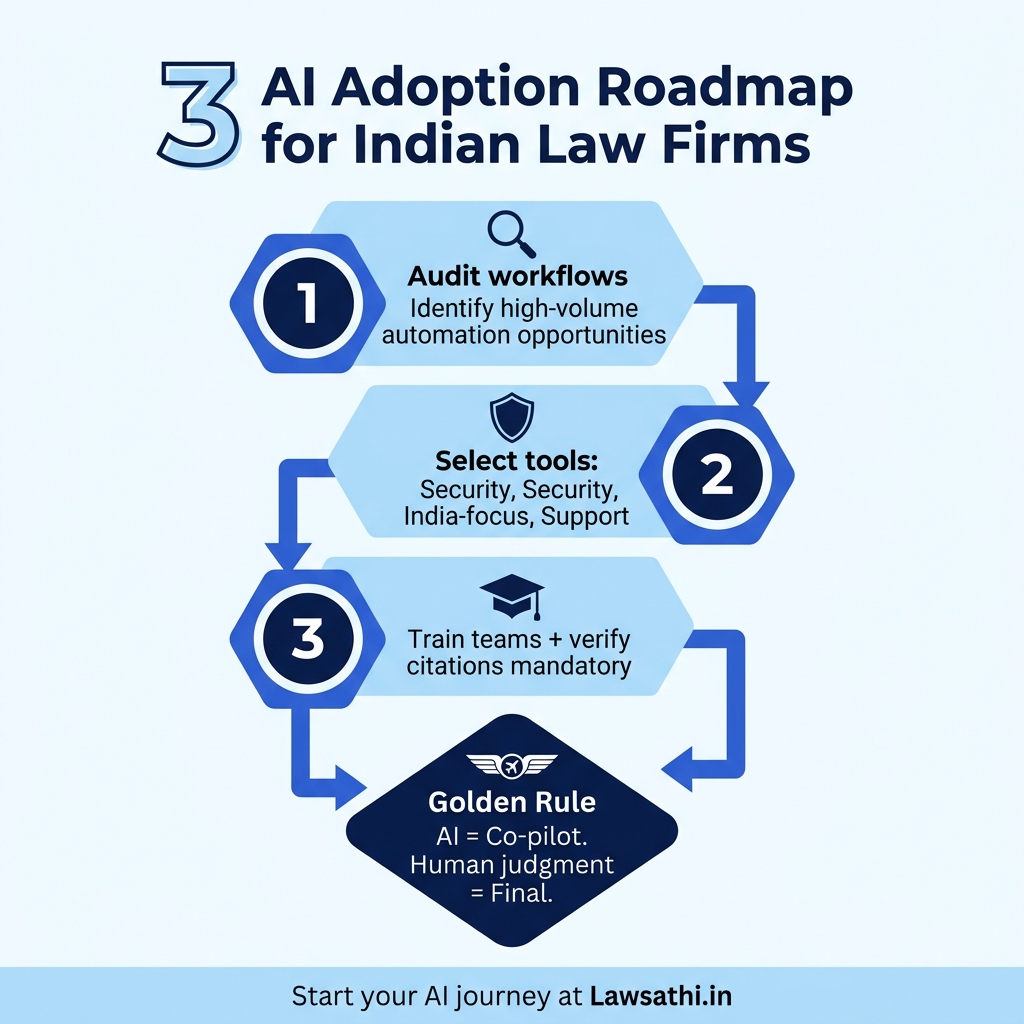
Therefore, AI must function as a co-pilot, not a replacement. Every AI-sourced authority requires independent verification against authorized databases. Human judgment remains the final arbiter of legal strategy.
SILF President Lalit Bhasin addressed this concern at IPBA 2026 [^18]. He emphasized that “AI must not become the master of our profession.”
A Step-by-Step Implementation Strategy
Step 1: Auditing Current Workflows
Successful implementation begins with honest assessment. First, audit all current processes to identify automation opportunities. Map how personal data flows through your practice.
Focus on high-volume, repetitive tasks first. Contract drafting, document review, and legal research offer immediate returns. Additionally, identify bottlenecks where work stalls.
Step 2: Selecting the Right Tools
Not all legal AI tools India are created equal. Therefore, evaluate platforms based on three critical factors.
Security: Ensure zero data tracking and no third-party storage. Verify that documents remain confidential.
India-Specific Focus: The platform must understand Indian statutes, case law, and procedural requirements. Generic international tools may produce inaccurate results.
Support and Integration: Look for vendors who invest in “legal engineering expertise” [^4]. The platform should integrate with existing workflows.
Step 3: Training Teams and Establishing Protocols
Technology adoption fails without proper training. Therefore, establish clear quality control protocols from the outset.
Several certificate programs now offer comprehensive AI training [^9]. These courses cover prompt engineering, corporate law applications, and ethical considerations. Furthermore, participants receive hands-on experience with multiple platforms.
Quality control protocols must include mandatory verification. Every AI-generated citation requires checking against authorized databases. Finally, establish disclosure policies for AI use in submissions.
Conclusion: Future-Proofing Your Legal Practice
The Competitive Advantage
M&A due diligence technology and AI contract drafting are moving beyond experimentation. They are becoming core infrastructure for legal practice [^17]. Early adopters gain clear advantages in efficiency and accuracy. However, delayed adoption risks falling behind client expectations.
Dr. Chinmay Bhosale, Co-Founder of NYAI, articulates the vision [^6]. He explains that “the intent was to give qualitative, intelligent output to lawyers and help them focus on what matters most—legal strategy and personal judgment.”
The Evolving Role of Corporate Lawyers
Corporate law software automates mechanical tasks. This shift liberates lawyers to focus on strategy, negotiation, and client relationships. Junior lawyers gain built-in safeguards that reduce consequential errors. Similarly, senior lawyers escape the burden of repetitive oversight.
The profession awaits regulatory clarity. The Bar Council of India is expected to issue enforceable AI guidance. Moreover, High Courts may require disclosure of AI use in filings. Responsible practitioners must prepare now.
Embracing Change Responsibly
AI contract drafting and due diligence India represents both opportunity and responsibility. Success requires viewing AI as a powerful assistant rather than an oracle. Human oversight remains non-negotiable. Additionally, data sovereignty and confidentiality demand careful attention.
The future belongs to lawyers who harness technology while preserving professional judgment. The tools are available. The training is accessible. Ultimately, the only question is whether you will lead the transformation or follow it.
—
Ready to transform your contract drafting and due diligence workflows? Sign up for a free LawSathi demo today and experience the power of AI built for Indian law firms.
—
[^1]: Bar & Bench, “What the India AI Impact Summit means for Indian legal practice” (February 27, 2026), https://www.barandbench.com/columns/when-ai-agents-enter-the-courtroom-what-the-delhi-summit-means-for-indian-legal-practice
[^2]: Bar & Bench, “Law firms accelerate AI adoption as Lawttorney.ai reshapes legal workflows” (February 3, 2026), https://www.barandbench.com/news/law-firms-accelerate-ai-adoption-as-lawttorneyai-reshapes-legal-workflows
[^3]: Bar & Bench, “Amit Kothiyal on how Legora can aid associate training, expansion plans and more”, https://www.barandbench.com/interviews/amit-kothiyal-on-how-legora-can-aid-associate-training-expansion-plans-and-more
[^4]: Bar & Bench, “Chandhiok & Mahajan announces firm-wide rollout of Legora” (February 6, 2026), https://www.barandbench.com/news/corporate/chandhiok-mahajan-announces-firm-wide-rollout-of-legora
[^5]: Bar & Bench, “What the India AI Impact Summit means for Indian legal practice”, https://www.barandbench.com/amp/story/columns/when-ai-agents-enter-the-courtroom-what-the-delhi-summit-means-for-indian-legal-practice
[^6]: Bar & Bench, “NYAI Redefines the Frontier: India’s First Legally Compliant Drafting Ecosystem Goes Live” (March 3, 2026), https://www.barandbench.com/amp/story/news/nyai-redefines-the-frontier-indias-first-legally-compliant-drafting-ecosystem-goes-live
[^7]: Bar & Bench, “Certificate Course on Generative AI for Legal professionals”, https://www.barandbench.com/others/certificate-course-on-generative-ai-for-legal-professionals-by-bettering-results-enroll-now
[^8]: Bar & Bench, “Course on Generative AI for Legal Professionals by Bettering Results”, https://www.barandbench.com/others/course-on-generative-ai-for-legal-professionals-by-bettering-results-enroll-now-2
[^9]: Bar & Bench, “Course on Generative AI for Legal Professionals by Bettering Results”, https://www.barandbench.com/others/course-on-generative-ai-for-legal-professionals-by-bettering-results-enroll-now
[^10]: SCC Online, “In Conversation with Nitin Potdar on Specializing in Corporate M&A” (November 2024), https://www.scconline.com/blog/post/2024/11/11/in-conversation-with-nitin-potdar-on-specializing-in-corporate-ma-and-overcoming-challenges-in-law/
[^11]: Bar & Bench, “Companies can save up to ₹250 crore: Navigating the DPDP Act 2023” (February 16, 2026), https://www.barandbench.com/view-point/companies-can-save-up-to-250-crore-navigating-the-dpdp-act-2023
[^12]: LiveLaw, “The Digital Gavel: Navigating Adjudication Under DPDP Act, 2023”, https://www.livelaw.in/amp/law-firms/law-firm-articles-/digital-gavel-navigating-adjudication-dpdp-act-523111
[^13]: Bar & Bench, “MeitY notifies final Digital Personal Data Protection Rules 2025” (November 17, 2025), https://www.barandbench.com/view-point/meity-notifies-final-digital-personal-data-protection-rules-2025
[^14]: Bar & Bench, “Digital Personal Data Protection Rules 2025: A practical roadmap” (November 2025), https://www.barandbench.com/amp/story/view-point/digital-personal-data-protection-rules-2025-a-practical-roadmap-for-data-fiduciaries-preparing-for-a-new-compliance-era
[^15]: Bar & Bench, “The two halves of trust: Why DPDP compliance is more than a legal puzzle” (November 25, 2025), https://www.barandbench.com/view-point/the-two-halves-of-trust-why-dpdp-compliance-is-more-than-a-legal-puzzle
[^16]: India AI Impact Summit 2026, “Sessions & Seminars”, https://impact.indiaai.gov.in/sessions
[^17]: Bar & Bench, “What the India AI Impact Summit means for Indian legal practice”, https://www.barandbench.com/columns/when-ai-agents-enter-the-courtroom-what-the-delhi-summit-means-for-indian-legal-practice
[^18]: Bar & Bench, “AI must not become the master of our profession: SILF President Lalit Bhasin at IPBA 2026” (February 26, 2026), https://www.barandbench.com/news/law-policy/ai-must-not-become-the-master-of-our-profession-silf-president-lalit-bhasin-at-ipba-2026
[^19]: India AI Impact Summit 2026, “Sessions” (February 20, 2026), https://impact.indiaai.gov.in/sessions?date=2026-02-20
[^20]: Bar & Bench, “Supreme Court to deploy AI to end human role in case listing, bench allocation”, https://www.barandbench.com/news/litigation/supreme-court-to-deploy-ai-to-end-human-role-in-case-listing-bench-allocation