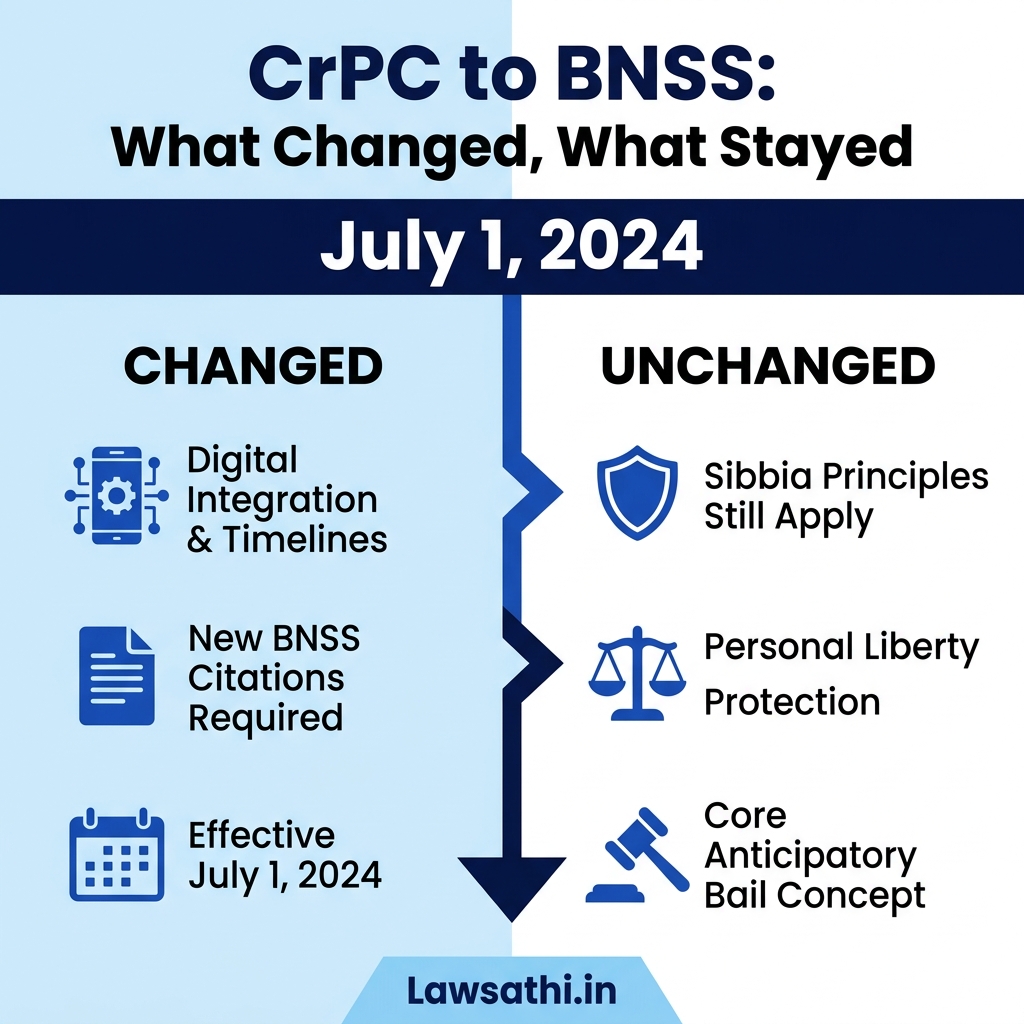
The landscape of criminal procedure in India underwent a seismic shift on July 1, 2024. The Bharatiya Nagarik Suraksha Sanhita (BNSS) officially replaced the Code of Criminal Procedure (CrPC), 1973. Consequently, criminal defense lawyers must adapt their strategies to this new legal framework. One of the most critical provisions involves anticipatory bail under Section 438 BNSS. This guide explores the nuances of pre-arrest bail under the new code to help you navigate client representation effectively.
Introduction: The Shift from CrPC to Bharatiya Nagarik Suraksha Sanhita (BNSS)
The implementation of the BNSS marks a departure from colonial-era procedures. However, the core principle of protecting personal liberty remains intact. For criminal practitioners, understanding anticipatory bail under Section 438 BNSS is essential for effective defense. The new code retains the spirit of Section 438 CrPC but introduces procedural updates. Therefore, relying solely on old CrPC precedents without considering BNSS modifications may lead to procedural errors.
Continuity and Change in Bail Provisions
The transition from CrPC to BNSS does not erase decades of judicial interpretation. The fundamental concept of “anticipatory bail” remains a direction to release a person on bail before arrest. Yet, the BNSS emphasizes digital integration and specific timelines. Lawyers must recognize that while the Gurbaksh Singh Sibbia principles still apply, procedural compliance must align with the 2023 Act. Furthermore, staying updated ensures you can file robust applications that withstand judicial scrutiny.
Understanding Section 438 BNSS: Scope and Applicability
Anticipatory bail under Section 438 BNSS serves as a shield against arbitrary arrest. It empowers the High Court or the Court of Session to direct the release of a person on bail. This direction applies when a person anticipates arrest for a non-bailable offense. Therefore, the provision is preventive rather than curative.
Who Can Apply for Pre-Arrest Bail?
Not every individual fearing arrest qualifies for this relief. The applicant must satisfy specific eligibility criteria established by the statute and interpreted by courts. The primary requirement is a reasonable belief of arrest. Additionally, the accusation must relate to a non-bailable offense. If the offense is bailable, the right to bail arises automatically upon arrest.
Jurisdictional Framework: High Court vs. Sessions Court
Choosing the correct forum is a strategic decision for defense lawyers. Both the High Court and the Court of Session hold concurrent jurisdiction under Section 438(1) BNSS.
| Court | Jurisdiction | Practical Consideration | |——-|————-|————————| | Sessions Court | First forum | Often the first point of contact for urgency | | High Court | Concurrent jurisdiction | Wider inherent powers; preferred for complex legal issues |
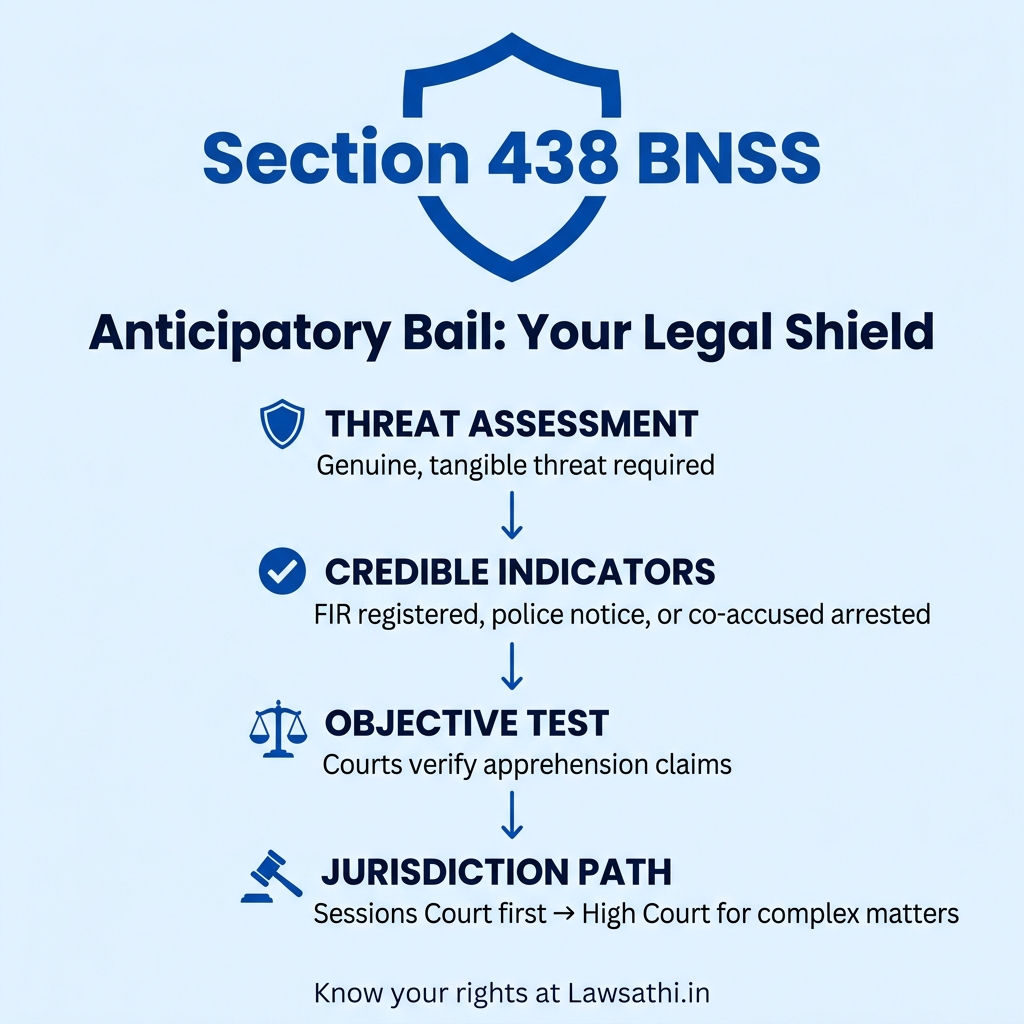
Typically, lawyers approach the Sessions Court first. However, in exceptional circumstances involving urgency or complex questions of law, moving the High Court directly is permissible. The choice depends on the case sensitivity and the relief sought.
Grounds for Filing: Establishing ‘Apprehension of Arrest’
The phrase “reason to believe” forms the cornerstone of a successful application. Mere vague fear or imaginary apprehension does not suffice. The applicant must demonstrate a genuine, tangible threat of arrest. Therefore, the courts apply an objective test to verify the claim.
Differentiating Vague Fears from Credible Threats
Courts distinguish between frivolous applications and genuine pleas for protection. Credible indicators include a registered FIR or a police notice for appearance. Furthermore, if co-accused persons have already been arrested, the apprehension gains validity. In contrast, a general rumor of police inquiry without specific grounds usually fails to convince the court.
Relevance of the Accusation
The nature of the accusation significantly impacts the outcome. Courts assess whether the offense warrants pre-arrest bail or requires custodial interrogation. For instance, in cases involving economic offenses or serious crimes affecting society, courts exercise greater caution. The landmark case of Gurbaksh Singh Sibbia v. State of Punjab established that the power under Section 438 is extraordinary. Therefore, it should not be exercised in a casual or routine manner.
Step-by-Step Procedure for Filing under Section 438 BNSS
Filing for anticipatory bail under Section 438 BNSS requires meticulous attention to procedure. A procedural lapse can derail even the strongest case. Therefore, follow this roadmap to ensure compliance with the new code.
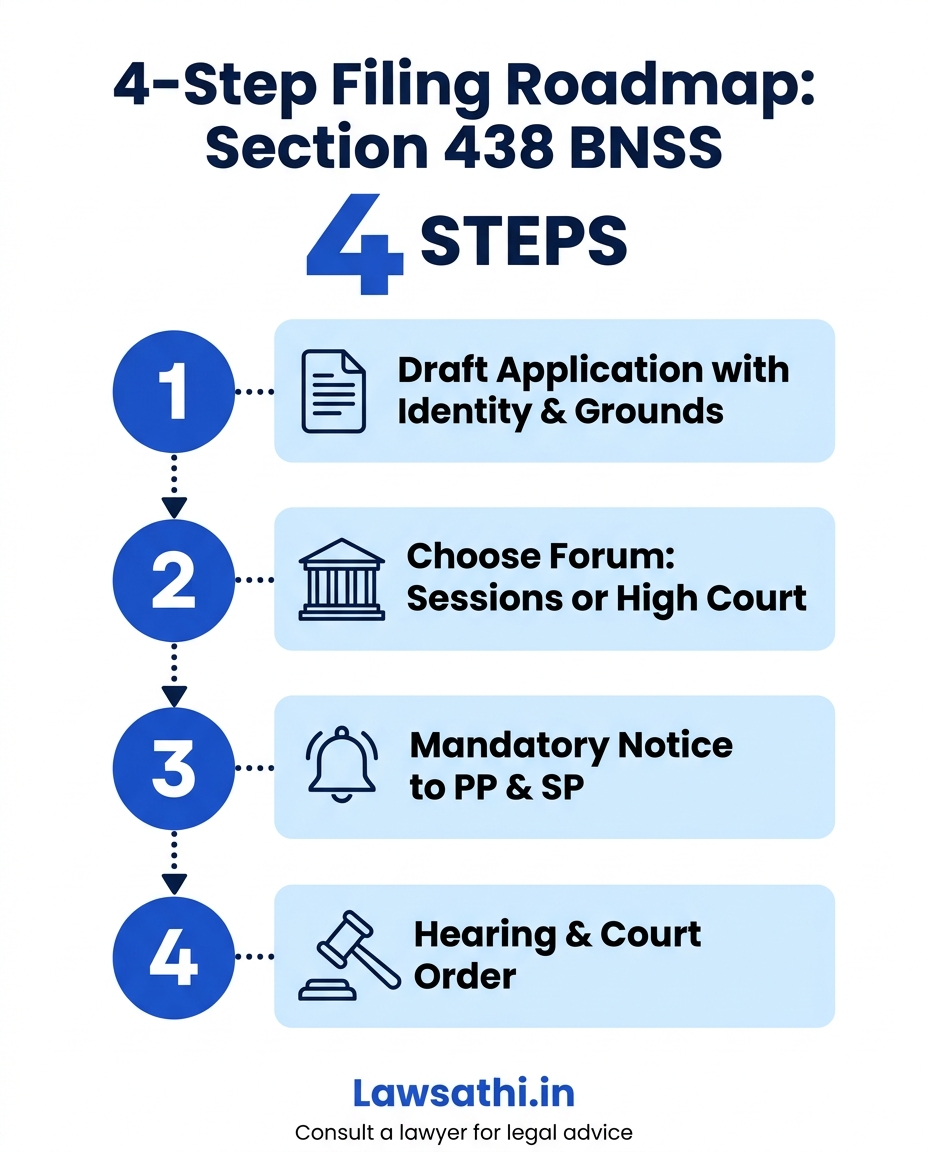
Step 1: Drafting the Application
The application must contain precise details. Include the applicant’s complete identity, the accusation details, and specific grounds for apprehension. Crucially, explain why the accusation is false or motivated. The prayer clause must explicitly request a direction for release on bail in the event of arrest.
Step 2: Choosing the Appropriate Forum
Decide whether to approach the Sessions Court or the High Court. Consider the urgency and the complexity of the legal issues involved. For straightforward cases, the Sessions Court is typically sufficient. However, for sensitive matters requiring broader relief, the High Court may be preferable.
Step 3: Mandatory Notice to Prosecution
Section 438(3) BNSS mandates giving notice to the Public Prosecutor and the Superintendent of Police. This requirement ensures the prosecution has an opportunity to oppose the application if necessary. The court cannot grant final relief without hearing the prosecution. However, exceptions exist in cases requiring interim protection.
Step 4: Hearing and Court Order
During the hearing, the defense must establish the grounds for apprehension. The prosecution may present counter-arguments regarding the need for custody. Finally, if the court is satisfied, it will pass an order granting bail subject to conditions under Section 438(2).
Essential Documentation: A Lawyer’s Checklist
Documentation plays a pivotal role in the success of a bail application. Incomplete paperwork often leads to rejection or adjournment. Therefore, use this comprehensive checklist to prepare your client’s file.
Mandatory Documents for Filing
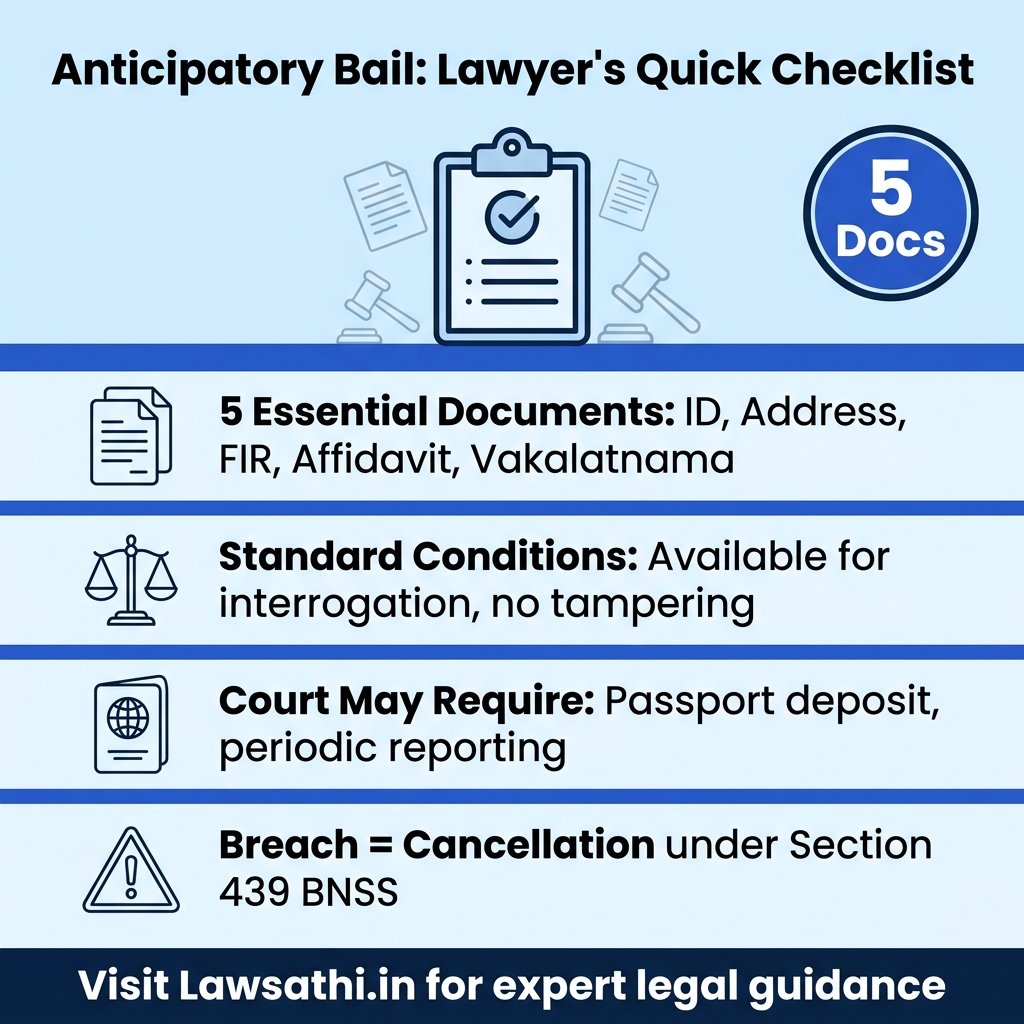
1. Identity Proof: Aadhaar, PAN, or Voter ID to establish the applicant’s identity. 2. Address Proof: Utility bills or rental agreements to verify territorial jurisdiction. 3. Copy of FIR/Complaint: The basis of the apprehension must be on record. 4. Supporting Affidavit: A verified affidavit stating the facts in the application.
Professional and Medical Documents
Always include a properly executed Vakalatnama. Additionally, if the client seeks bail on medical or age grounds, attach relevant medical certificates. These documents provide the court with a complete picture of the applicant’s situation. For instance, in Siddharam Satlingappa Mhetre v. State of Maharashtra, the Supreme Court emphasized considering personal circumstances while granting relief.
Conditions Imposed by the Court under Section 438(2) BNSS
Granting anticipatory bail is not absolute freedom. Courts impose specific conditions to balance individual liberty with the interests of justice. Section 438(2) BNSS enumerates the standard conditions typically attached to such orders.
Standard Mandatory Conditions
The applicant must remain available for police interrogation. They cannot avoid investigation under the pretext of bail. Furthermore, the court prohibits the applicant from inducing, threatening, or promising witnesses. This condition ensures the integrity of the trial process remains uncompromised.
Travel and Cooperation Restrictions
Courts often restrict the applicant from leaving India without prior permission. The passport may need to be deposited with the investigating agency. Additionally, the applicant must appear before the officer as and when required.
Discretionary Conditions
Courts may impose further conditions based on case specifics. For example, in cases involving repeated offenses, the court may require periodic reporting to a police station. The aim is to prevent misuse of the liberty granted.
Duration and Validity: Till When Does the Protection Last?
A common question among clients concerns the lifespan of the bail order. Does the protection last until the end of the trial? Or is it time-bound?
Constitutional Interpretation of Validity
Historically, the Sibbia case suggested that anticipatory bail could continue until the end of the trial. However, judicial trends in 2026 show a shift towards time-bound orders in specific cases. Courts now prefer fixing a tentative duration with liberty to extend.
Cancellation and Revocation
The protection is not irrevocable. Under Section 439 BNSS, the court can cancel anticipatory bail if the applicant breaches conditions. Similarly, interference with evidence or influencing witnesses invites cancellation. The prosecution must apply for cancellation, providing the applicant a chance to be heard.
Key Differences: Section 438 BNSS vs. Old Section 438 CrPC
While the core principles remain, the transition to BNSS introduces subtle but significant changes. Lawyers must update their drafting templates to reflect these modifications.
Procedural and Terminology Shifts
| Aspect | CrPC Section 438 | BNSS Section 438 | |——–|—————–|——————| | Core Provision | Direction for release on bail | Retained with modifications | | Notice Issuance | Specific timeline emphasis | Enhanced procedural clarity | | Digital Filing | Limited provisions | Strong emphasis on electronic processes |
Updating Precedent References
Precedents under CrPC remain persuasive for substantive principles. However, procedural citations must now align with BNSS sections. Consequently, lawyers should avoid quoting CrPC section numbers in court. Instead, use the corresponding BNSS provisions to demonstrate familiarity with the current law.
Conclusion: Strategic Considerations for Defense Lawyers
Navigating anticipatory bail under Section 438 BNSS requires a blend of legal acumen and procedural diligence. The shift from CrPC to BNSS demands that lawyers update their knowledge base. By establishing genuine apprehension and maintaining impeccable documentation, you can secure favorable outcomes for clients. Furthermore, understanding the specific conditions and duration trends helps manage client expectations effectively. In short, adapting to the new legal landscape is not optional; it is a professional necessity.
Streamline your criminal defense practice with LawSathi. Automate your bail application drafting, manage court dates, and access up-to-date BNSS legal libraries. Start your free trial today and focus on winning cases.