The legal profession in India is undergoing a seismic transformation. Between 2023 and 2026, Generative AI tools have proliferated across law firms of all sizes. What began as experimental adoption has now become mainstream practice. However, this rapid technological shift has prompted the Bar Council of India to establish clear regulatory boundaries.
The BCI AI guidelines for lawyers represent a watershed moment in Indian legal history. They define how advocates can harness AI while upholding their ethical duties. Therefore, understanding these regulations is no longer optional—it is essential for every practicing lawyer.
This comprehensive guide breaks down the 2026 framework. Additionally, it provides you with a practical compliance checklist to implement immediately.
Key Provisions of the 2026 BCI AI Framework
The Bar Council of India has taken a proactive stance on AI regulation. Rather than banning technology outright, the BCI has crafted a balanced approach. The guidelines permit AI usage while mandating critical safeguards.
Mandatory Disclosure Requirements
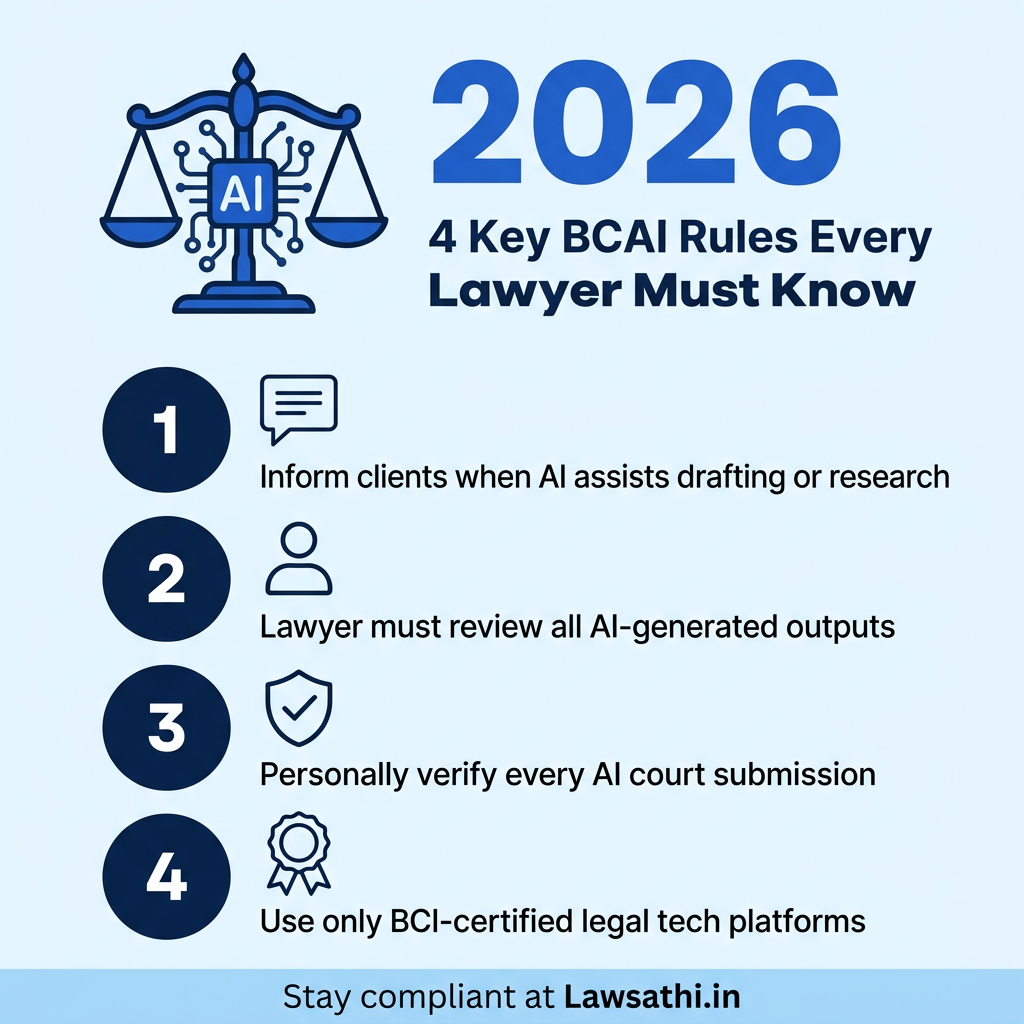
Transparency forms the cornerstone of the new framework. Lawyers must now inform clients when AI tools assist in drafting documents or conducting legal research. This disclosure must appear in engagement letters and billing statements.
For example, if you use an AI tool to draft a contract, your client must know this beforehand. The rationale is simple: clients have a right to understand how their legal work is performed. Furthermore, failure to disclose could constitute a breach of professional conduct rules.
The Human-in-the-Loop Mandate
Perhaps the most significant provision is the “Human-in-the-Loop” requirement. AI cannot replace the professional judgment of a qualified advocate. Specifically, the guidelines prohibit AI from:
– Signing legal documents or affidavits – Making strategic litigation decisions independently – Providing legal opinions without lawyer review and approval – Appearing in court or representing clients in any proceeding
The BCI emphasizes that the “legal mind” remains irreplaceable. AI serves as a tool to enhance efficiency, not a substitute for professional expertise. Consequently, every AI-generated output must undergo thorough human verification before use.
Restrictions on Unsupervised AI in Litigation
Court submissions demand heightened scrutiny under the new framework. Lawyers cannot file AI-generated pleadings, petitions, or affidavits without personal verification. The guidelines specifically address the risk of “AI hallucinations.” This occurs when AI generates fabricated case citations or false legal propositions.
Several Indian courts have already taken note of this concern. In late 2024, the Delhi High Court reportedly cautioned against reliance on unverified AI outputs. As a result, the BCI guidelines now codify this principle into a binding professional obligation.
Licensing for Legal Tech Tools
The framework introduces certification requirements for Legal Tech platforms. Software used in legal practice must meet BCI-approved security and privacy standards. This provision aims to protect client data from unauthorized access or misuse.
Lawyers must verify that their chosen tools carry valid certifications. Using uncertified platforms could expose practitioners to disciplinary action. Therefore, due diligence in software selection has become a compliance necessity.
Data Privacy & Confidentiality under the DPDP Act and BCI Rules
The intersection of AI and data privacy creates complex obligations for Indian lawyers. The Digital Personal Data Protection (DPDP) Act, 2023 establishes strict requirements. Additionally, the BCI rules impose parallel ethical duties regarding client confidentiality.
Understanding the Interplay
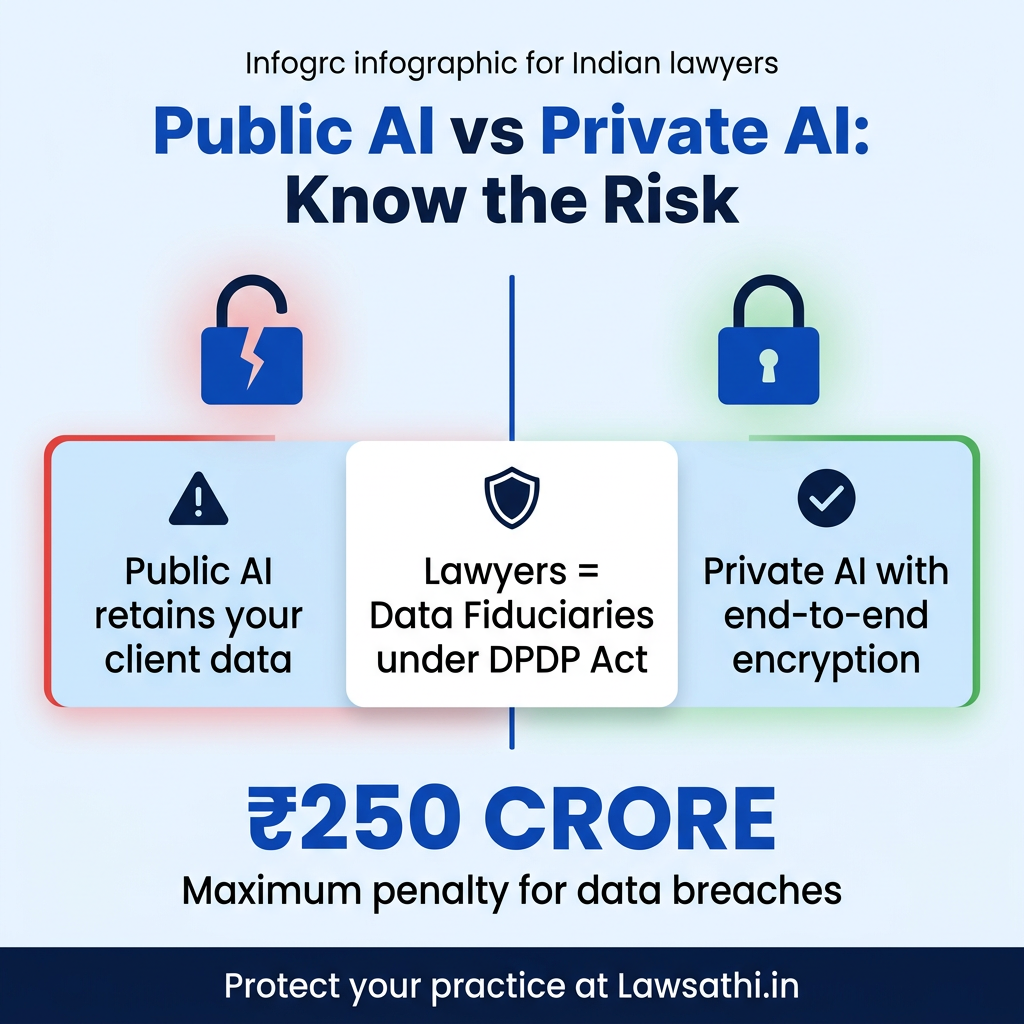
The DPDP Act classifies legal service providers as “Data Fiduciaries.” This classification triggers specific obligations when handling client information. Lawyers must:
– Obtain clear consent before processing personal data – Implement reasonable security safeguards – Notify affected parties in case of data breaches – Maintain records of data processing activities
The BCI guidelines reinforce these statutory requirements through an ethical lens. Client confidentiality has always been a foundational principle of legal practice. Therefore, AI usage must not compromise this sacred duty.
Risks of Public AI Models
Many lawyers unknowingly expose client data through public AI platforms. Tools like ChatGPT or Gemini may retain user inputs for training purposes. Consequently, inputting sensitive case details into such platforms constitutes a significant breach risk.
Consider this scenario: A lawyer inputs facts from an ongoing divorce case into a public AI chatbot. The platform stores this information on external servers. Days later, excerpts from that conversation appear in the AI’s responses to other users.
Such scenarios represent clear violations of both DPDP Act provisions and BCI ethical standards. The consequences could include data protection penalties and professional disciplinary action.
Selecting Compliant AI Solutions
The guidelines recommend private or on-premise AI solutions for law firms. These platforms process data within controlled environments. Moreover, they do not transmit client information to external servers or third parties.
When evaluating AI tools, lawyers should ask:
– Where is client data stored and processed? – Does the vendor share data with third parties? – What encryption standards protect sensitive information? – Can data be permanently deleted upon request?
LawSathi, for instance, offers end-to-end encryption and local data processing. These features align with both DPDP Act requirements and BCI guidelines.
Penalties for Negligent AI Usage
Non-compliance carries serious consequences. Under the DPDP Act, data breaches can result in penalties up to ₹250 crore. Additionally, the BCI can initiate disciplinary proceedings before State Bar Councils.
Possible sanctions include censure, suspension of practice rights, or even removal from the roll of advocates. In other words, the risk is not merely theoretical—it represents a genuine threat to professional standing.
The 2026 Compliance Checklist for Indian Law Firms
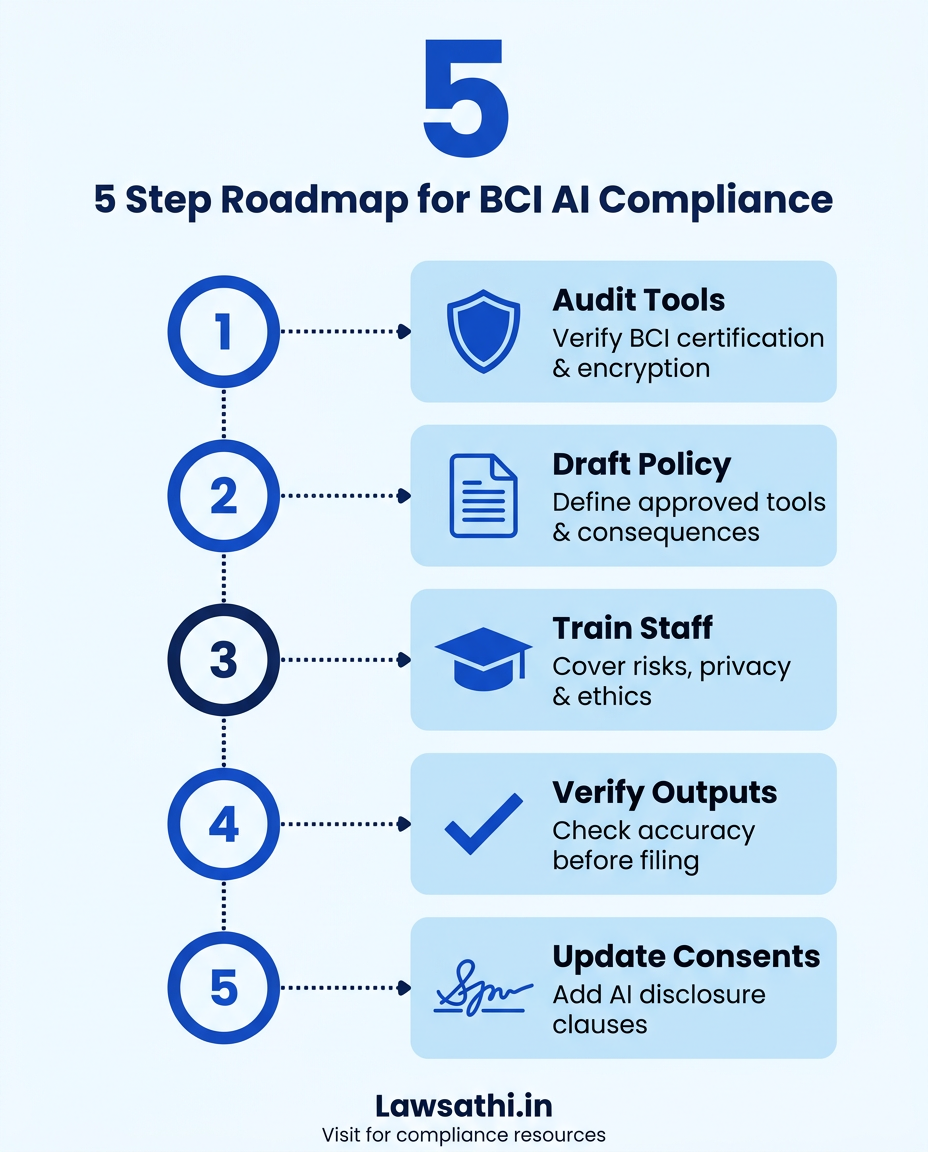
Implementing the BCI guidelines requires systematic effort. The following checklist provides a roadmap for compliance.
Step 1: Audit Your Current Tools
Begin by cataloging all software used in your practice. This includes research tools, document drafting platforms, and practice management systems. For each tool, verify:
– BCI certification status – Data processing location – Encryption and security measures – Data retention and deletion policies
Document your findings in a formal audit report. This record demonstrates due diligence if questions arise later.
Step 2: Draft an Internal AI Usage Policy
Create a comprehensive policy governing AI use within your firm. This document should address:
– Approved AI tools and platforms – Prohibited uses (e.g., inputting sensitive client data into public models) – Review protocols for AI-generated work – Consequences for policy violations
Circulate this policy to all associates and staff members. Furthermore, require written acknowledgment of receipt and understanding.
Step 3: Mandate AI Literacy Training
The BCI framework emphasizes professional competence in technology. All bar members should understand how AI tools function. Additionally, they must recognize AI limitations and risks.
Organize regular training sessions covering:
– Basic AI functionality and terminology – Identifying AI hallucinations and errors – Data privacy best practices – Ethical obligations under the new guidelines
Document attendance and maintain records for compliance purposes.
Step 4: Establish Verification Protocols
AI-generated content requires rigorous human review. Therefore, implement a standardized process for verifying:
– Factual accuracy of statements – Citation validity and relevance – Logical coherence of arguments – Compliance with procedural requirements
Assign senior associates or partners to conduct final reviews. Additionally, create checklists to ensure consistent verification across all matters.
Step 5: Update Client Consent Forms
Revise your engagement letters to include AI disclosure clauses. These provisions should:
– Explain how AI tools assist in legal work – Clarify that a qualified lawyer reviews all outputs – Obtain explicit client consent for AI-assisted services – Describe data protection measures in place
Transparent communication builds trust and satisfies disclosure requirements.
—
Common Pitfalls and Disciplinary Risks
Despite clear guidelines, some lawyers will inevitably face compliance challenges. However, understanding common pitfalls helps avoid costly mistakes.
The Danger of AI Hallucinations
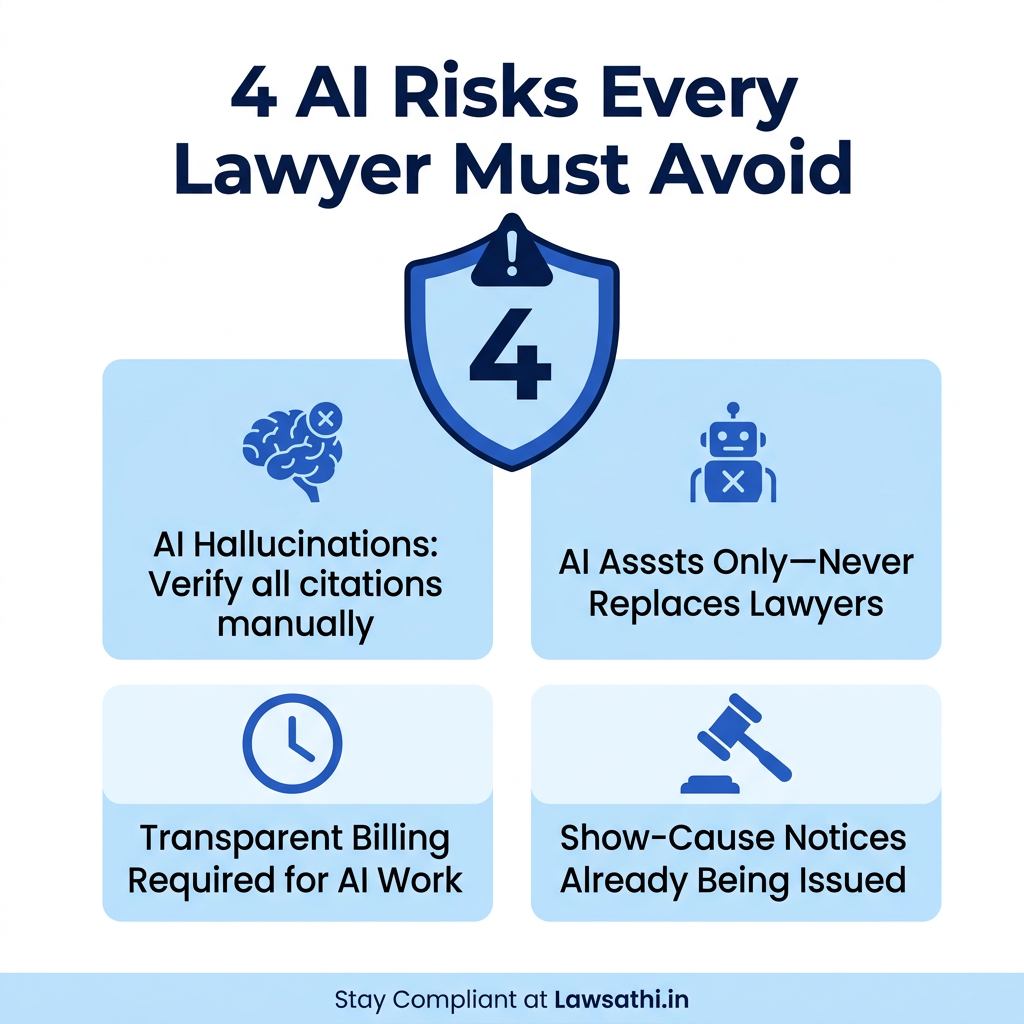
AI tools can generate plausible-sounding but entirely fabricated information. This phenomenon, known as “hallucination,” poses severe risks in legal practice.
Several incidents have already occurred globally. In a notable 2023 US case, lawyers cited non-existent cases generated by ChatGPT and faced court sanctions. Similarly, Indian courts have expressed concerns about this issue.
The BCI guidelines make lawyers personally responsible for citation accuracy. Relying on AI without verification is professional negligence. Therefore, always cross-check case citations against authentic sources like SCC Online or Manupatra.
Unauthorized Practice of Law
Some AI platforms offer direct legal advice to consumers. Lawyers who deploy such tools without proper oversight risk enabling unauthorized practice. The BCI prohibits AI systems from providing independent legal consultation.
Ensure your technology setup maintains clear boundaries. In other words, AI should assist lawyers, not replace them in client interactions.
Billing Ethics and Transparency
AI significantly reduces time spent on certain tasks. This creates billing dilemmas. For instance, should lawyers charge traditional hourly rates for AI-accelerated work?
The BCI guidelines require billing transparency. If AI completes in minutes what once took hours, clients deserve honest accounting. Therefore, consider value-based billing or reduced rates for AI-assisted services. Failing to adjust billing practices could raise ethical questions about overcharging.
Recent Disciplinary Actions
State Bar Councils have begun addressing AI misuse. While comprehensive public records are limited, reports suggest show-cause notices have been issued. Alleged violations include:
– Filing petitions with fabricated AI-generated citations – Unauthorized disclosure of client data through public AI platforms – Failure to disclose AI usage to clients
These cases underscore that the guidelines carry real enforcement teeth. Consequently, proactive compliance is far preferable to reactive damage control.
How LawSathi Ensures BCI-Compliant AI Integration
LawSathi has been designed specifically for Indian legal practice. The platform incorporates compliance features aligned with the 2026 BCI framework.
Built-in Lawyer Oversight Features
LawSathi prevents automated filing without human review. Every document generated through the platform requires lawyer approval before submission. As a result, this design choice directly addresses the “Human-in-the-Loop” mandate.
The system also maintains clear audit trails. All AI-generated content is tagged and tracked through the review process. Furthermore, this documentation supports compliance reporting if needed.
End-to-End Encryption
Data security is fundamental to LawSathi’s architecture. The platform employs end-to-end encryption for all client information. In addition, data never leaves secure, BCI-compliant servers.
This approach satisfies both DPDP Act requirements and BCI ethical standards. Lawyers can use AI features without compromising client confidentiality.
Minimizing Hallucination Risks
LawSathi’s AI draws from verified Indian legal databases. Rather than relying on general internet data, the system references authoritative sources. These include Supreme Court judgments, High Court decisions, and Central Acts.
This focused approach significantly reduces hallucination risks. However, human verification remains essential—and LawSathi’s workflows encourage this final review step.
Seamless Compliance Integration
The platform includes built-in disclosure templates for engagement letters. Client consent clauses are easily customizable. Additionally, training modules help firms educate associates on AI ethics.
LawSathi transforms compliance from a burden into an integrated workflow. As a result, lawyers can embrace AI confidently, knowing their practice meets regulatory standards.
—
Conclusion: Embracing Responsible Legal Tech
The BCI AI guidelines for lawyers mark a new chapter in Indian legal practice. They establish clear boundaries while permitting beneficial innovation. However, the fundamental principle remains unchanged: lawyers bear ultimate responsibility for their work.
Technology enhances efficiency but cannot replace professional judgment. AI tools are instruments; advocates are the architects of legal strategy. The guidelines remind us that the client-lawyer relationship demands human insight, empathy, and accountability.
The Path Forward
Firms that embrace ethical AI adoption gain competitive advantages. They deliver faster, more cost-effective services while maintaining quality. Moreover, they demonstrate commitment to professional standards—a powerful differentiator in attracting clients.
Looking ahead to 2027, expect further regulatory refinement. The BCI will likely update guidelines as technology evolves. Therefore, staying informed and adaptable is crucial.
The message is clear: responsible AI usage is not just an obligation—it is an opportunity. Lawyers who master this balance will lead the profession forward.
Stay ahead of the regulatory curve. Explore LawSathi’s BCI-compliant practice management suite today and secure your practice for the future. Start Your Free Trial