Introduction: High Court’s Prima Facie View on CBI’s Appeal
The Delhi High Court Excise Policy Case has taken a significant turn. The High Court issued notice to Arvind Kejriwal and Manish Sisodia on the CBI’s challenge to their discharge. On March 9, 2026, Justice Swarana Kanta Sharma prima facie found that certain observations made by the trial court appeared “erroneous.” Specifically, these observations at the charge stage required deeper examination. Therefore, this development holds immense significance for criminal law practitioners across India.
Context of the CBI’s Challenge
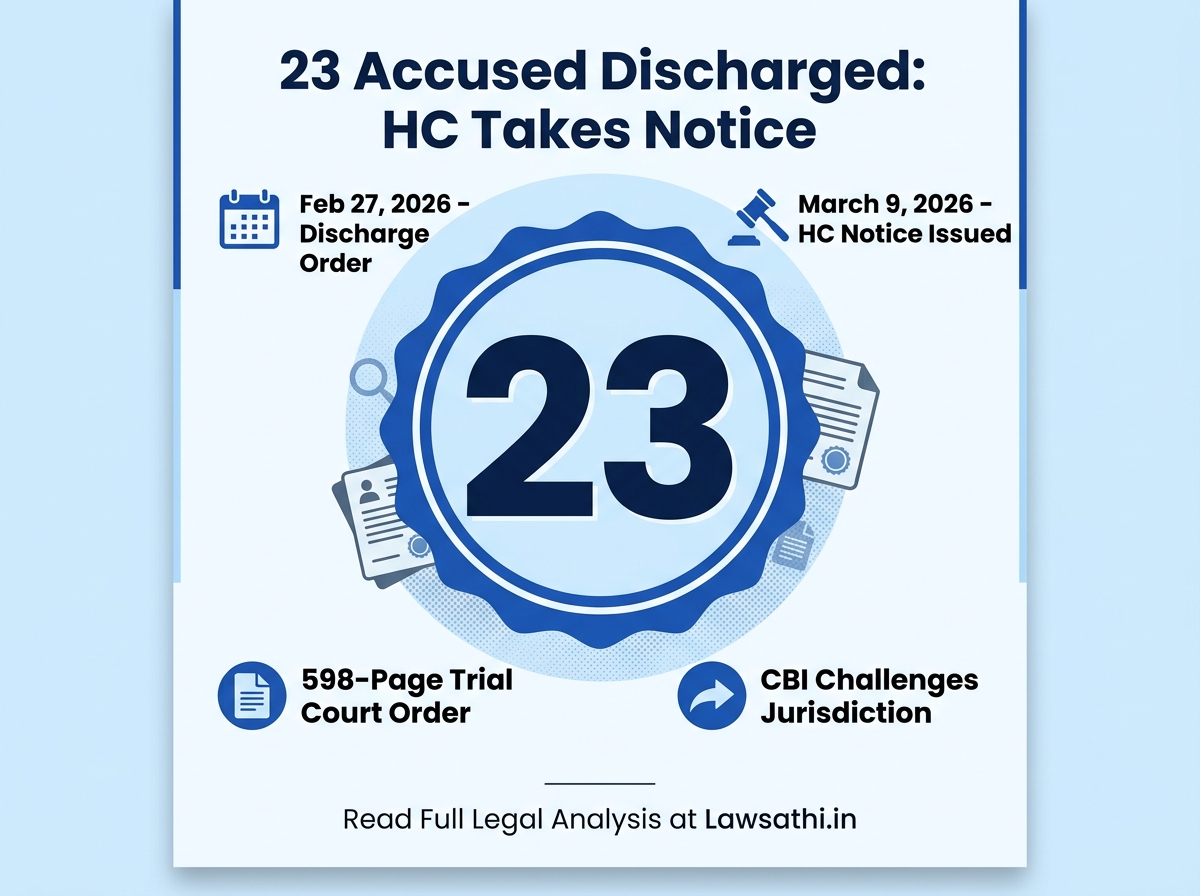
The CBI filed a criminal revision petition challenging the trial court’s discharge order dated February 27, 2026. The trial court had discharged all 23 accused in the Delhi Excise Policy case. This included the former Delhi Chief Minister and Deputy Chief Minister. The agency argued that the trial court exceeded its jurisdiction. In particular, it conducted a detailed evaluation of evidence at the discharge stage itself.
Why This Matters for Legal Practitioners
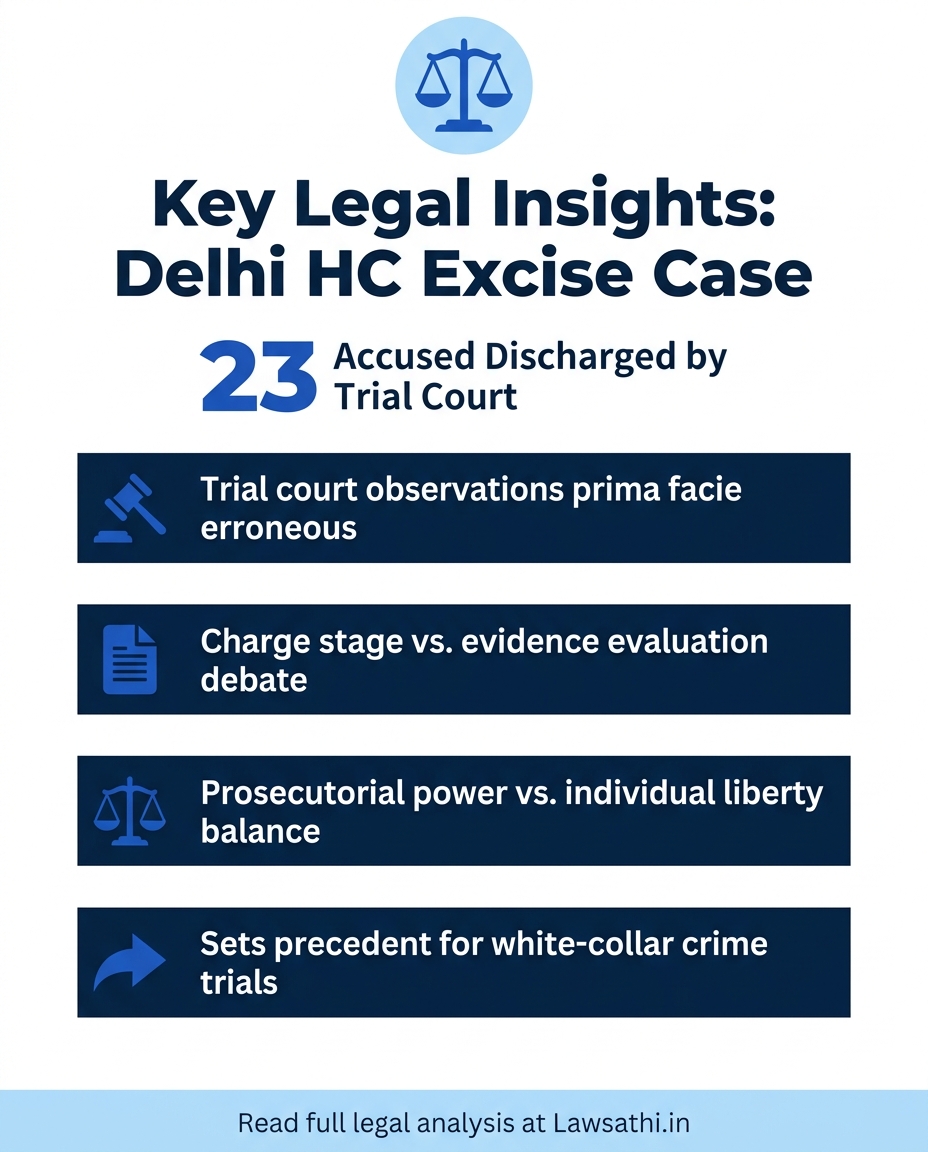
For criminal law practitioners, this case offers critical insights. It illuminates the boundaries of judicial scrutiny at the charge stage. The High Court’s observations will likely shape how trial courts approach discharge applications. This is especially relevant in complex white-collar crime cases. Furthermore, the case highlights the delicate balance between prosecutorial power and individual liberty.
Background: The Trial Court’s Discharge Order
The trial court’s 598-page order was delivered on February 27, 2026. Special Judge Jitendra Singh at Rouse Avenue Courts pronounced this significant victory for the accused. The court discharged all 23 accused, including Kejriwal and Sisodia. It found that the prosecution had failed to establish a prima facie case.
Understanding the Allegations
The CBI case centered on alleged irregularities in the Delhi Excise Policy 2021-22. The prosecution alleged that undue benefits were extended to the “South Group.” These benefits were allegedly exchanged for illegal gratification of approximately Rs 90-100 crores. Additionally, the chargesheet cited deviations from Expert Committee recommendations. It also alleged hawala transfers of Rs 44.54 crores for election campaigns.
Legal Standard Applied: “Grave Suspicion” Test
The trial court applied the well-established legal framework governing discharge under Section 227 CrPC. According to Supreme Court precedents, charges must be framed based on “grave suspicion,” not mere suspicion simpliciter. Consequently, the court found that the prosecution material disclosed, at best, only suspicion. It lacked the requisite gravity to warrant a trial.
Collapse of the Prosecution’s Foundation
The trial court invoked the legal maxim sublato fundamento cadit opus. This means: when the foundation is removed, the structure falls. The court found no evidence of demand, payment, or receipt of illegal gratification by any public servant. Moreover, the approver statements lacked independent corroboration. As a result, the entire conspiracy narrative collapsed.
Critical Observations on Investigation
Significantly, the trial court made scathing observations about the CBI’s investigation. It found a “troubling picture of an investigation steered by a preconceived outcome.” Furthermore, the court noted that lawful administrative actions were “selectively extracted.” They were “stripped of context” and “artificially interlinked to manufacture an appearance of conspiracy.” These observations would later become a point of contention before the High Court.
Legal Framework: Section 378 CrPC and Appellate Jurisdiction
The Delhi High Court Excise Policy Case brings into focus critical provisions governing appeals against discharge orders. Understanding the legal framework is essential for practitioners handling similar matters.
Section 378(2) CrPC – CBI’s Right to Appeal
Section 378(2) CrPC provides that in cases investigated by the CBI, only the Central Government can direct an appeal against acquittal or discharge. Therefore, the State Government has no locus standi in such matters. This provision ensures centralized control over appeals in central agency cases.
The “Leave to Appeal” Requirement
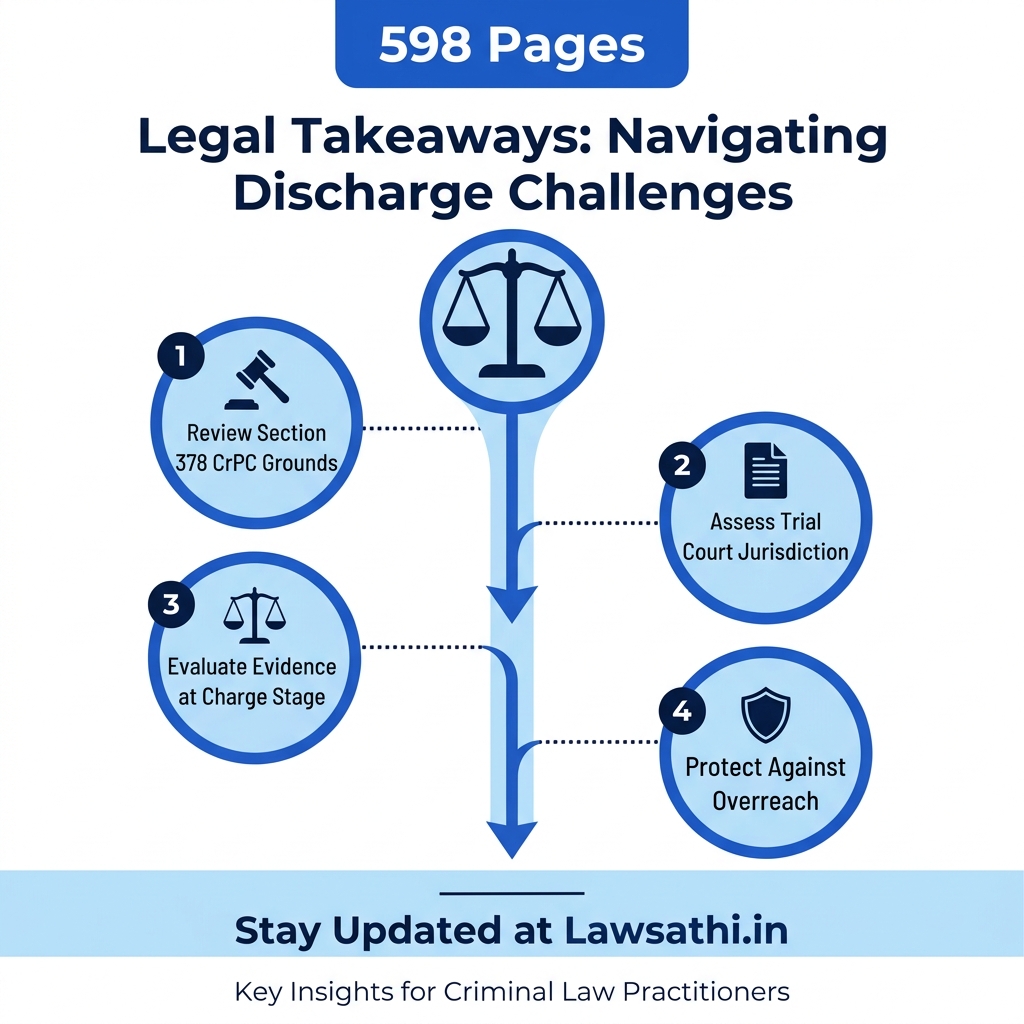
Section 378(3) CrPC mandates that no appeal to the High Court shall be entertained without the leave of the court. The Supreme Court has clarified the standard for granting leave. The court must consider if prima facie case or arguable points exist. It need not determine whether the acquittal is likely to be reversed. Thus, this creates a threshold requirement that the High Court must examine before proceeding.
Revisional Jurisdiction in Discharge Matters
High Courts exercise revisional jurisdiction under Section 397 CrPC over discharge orders. However, this jurisdiction is limited. The court can only examine whether the order is illegal, improper, or involves a material irregularity in procedure. Re-appreciation of evidence is generally not permitted at this stage.
Recent Supreme Court Clarifications
In State of Chhattisgarh v. Amit Aishwarya Jogi, 2025 INSC 1285, the Supreme Court reaffirmed an important principle-crpc-and-sets-a-liberal-standard-for-condoning-cbi-delays-victim%E2%80%99s-appeal-held-prospective/view). It held that Section 378(1) and Section 378(2) are mutually exclusive. In CBI cases, only the Central Government can direct appeals. Additionally, the court emphasized a “liberal and pragmatic approach” to condonation of delay in serious criminal matters.
CBI’s Submissions: Grounds for Challenge
The CBI, through Solicitor General Tushar Mehta, advanced several arguments before the Delhi High Court. These submissions highlight the agency’s perspective on the alleged deficiencies in the trial court’s order.
Argument on Erroneous Discharge
First, the CBI contended that the trial court “erroneously discharged the accused persons by ignoring material evidence.” This evidence was presented through the principal chargesheet and four supplementary chargesheets. The agency argued that the court failed to consider crucial documentary and oral evidence.
Beyond the Scope of Charge Stage Scrutiny
Second, and most significantly, the CBI argued that the trial court exceeded the limited scope of scrutiny permissible at the stage of framing charge. The trial court “went beyond the limited scope of scrutiny… and effectively conducted a full-fledged evaluation of evidence”. Such evaluation is ordinarily the function of a trial. This argument challenges the fundamental premise of the discharge order.
Impact on PMLA Proceedings
Third, the CBI highlighted that the discharge order could affect proceedings under the Prevention of Money Laundering Act. Since the CBI case constitutes the predicate offence for PMLA proceedings, its collapse would weaken the ED’s case. Therefore, this factor adds another layer of complexity to the matter.
Challenge to Adverse Remarks
Fourth, the CBI challenged the trial court’s scathing remarks against the investigating officer. The observations that the officer “abused his official position” were characterized as unwarranted. Similarly, the finding of an “unfair investigation” was disputed. The agency argued that such findings should not have been made at the preliminary stage of charge framing.
High Court’s Prima Facie Response
Justice Swarana Kanta Sharma’s order indicated a prima facie agreement with some CBI contentions. The court observed that the trial court’s findings regarding statements of witnesses and approvers appeared “prima facie erroneous and need consideration”. Furthermore, the remarks against the investigating officer were prima facie “foundationally misconceived.”
Implications for the Accused and Due Process
The Delhi High Court Excise Policy Case raises profound questions about the balance between state power and individual liberty. Understanding the implications requires examining both the immediate legal consequences and broader principles.
Current Legal Status Post-Notice
Following the High Court’s notice, the accused remain discharged. However, they must now file replies defending the trial court’s order. The notice does not automatically reverse the discharge. Instead, it signals that the High Court finds the CBI’s arguments worthy of detailed examination.
Potential Outcomes of the Revision
Several scenarios could emerge from the High Court’s adjudication. If the discharge is confirmed, the accused would remain discharged. Additionally, the ED case would be severely weakened. However, if the discharge is set aside, the matter would be remanded for trial. The accused would then face prosecution. A third possibility involves limited remand for reconsideration of specific issues.
The Due Process Dimension
The trial court’s order emphasized that criminal proceedings impose “serious strain, stigma and prolonged uncertainty” on accused persons. The court cautioned against mechanical framing of charges “merely by way of abundant caution”. Consequently, this principle underscores the protective function of the discharge stage.
Incarceration Statistics and Human Cost
The trial court noted that Manish Sisodia spent approximately 530 days in jail. Similarly, Arvind Kejriwal spent approximately 156 days in incarceration across two periods. These statistics highlight the human cost of prolonged criminal proceedings. This is true even when charges ultimately fail to withstand judicial scrutiny.
What This Means for Legal Practitioners
The Delhi High Court Excise Policy Case offers valuable lessons for both defense lawyers and prosecutors. Practitioners can derive strategic insights applicable to similar matters.
For Defense Lawyers: Mastering Discharge Arguments
Defense counsel should focus on articulating why the prosecution case shows only “suspicion simpliciter,” not “grave suspicion.” The Supreme Court has consistently held that if two views are possible, discharge is justified. This applies when one view gives rise only to suspicion. Practitioners must cite precedents like Sajjan Kumar v. CBI and M.E. Shivalingamurthy v. CBI comprehensively.
Attacking Narrative-Based Prosecutions
The trial court cautioned against being influenced by “coherent and well-knitted narrative” alone. Therefore, defense lawyers should demand material capable of being proved as evidence. Additionally, they should attack inferential chains that substitute conjecture for proof. In conspiracy cases, demanding complete chains of circumstances becomes crucial at the discharge stage.
For Prosecutors: Strategic Appeal Considerations
Prosecutors must anticipate the defense argument regarding evidence appreciation. Defense counsel will argue that prosecutors seek trial-court-level evidence appreciation at the revision stage. Therefore, at the leave stage, the focus should be on establishing arguable points worthy of full hearing. Prosecutors should highlight the impact on predicate offence proceedings if relevant. Documentation of specific factual discrepancies and legal errors is essential.
Importance of Tracking High Court Revisions
For all practitioners, tracking High Court revisions in significant cases provides valuable insights. Such tracking helps in understanding evolving standards for discharge and charge framing. Moreover, it aids in strategic planning for similar cases. Resources like SCC Online, LiveLaw, and Bar & Bench provide real-time updates on judicial developments.
Conclusion: The Road Ahead for the Excise Policy Case
The Delhi High Court Excise Policy Case presents several critical legal questions for judicial determination. The High Court must examine whether the trial court exceeded its jurisdiction at the discharge stage. It must also evaluate whether the adverse remarks against the CBI investigating officer were warranted.
Summary of Pending Questions
The primary questions include whether the trial court conducted a full-fledged evidence evaluation prematurely. Additionally, the court must determine if the discharge order meets the standard for reversal under Section 397 CrPC revision. The impact on PMLA proceedings remains a significant consideration.
Potential Outcomes and Their Impact
If the discharge is confirmed, it would represent a major victory for the accused. The ED case would be severely weakened due to the collapse of the predicate offence. Conversely, if the discharge is set aside, the accused would face trial. Furthermore, ED proceedings could resume with renewed vigor. A limited remand would provide procedural relief to the CBI without substantive reversal.
Final Reflections
This case exemplifies the fundamental tension between state power to prosecute and judicial duty to protect individual liberty. The trial court’s observations about “preconceived outcome” investigations raise serious questions. Specifically, they highlight concerns about investigation standards in India. However, the High Court’s prima facie view suggests that certain trial court observations were “erroneous.” This indicates more nuanced examination is needed.
In conclusion, the principle that “criminal law does not proceed on impression” remains paramount. Whatever the outcome, this case will significantly impact jurisprudence on discharge standards and investigative conduct in India.
Stay ahead with real-time legal updates. Use LawSathi to track case precedents, manage your court dates, and access a comprehensive database of Indian law. Start your free trial today.