Artificial intelligence has transformed how content is created and consumed across India. However, this technological revolution brings unprecedented legal challenges. The Delhi High Court personality rights AI case involving Swami Ramdev marks a watershed moment in Indian jurisprudence.
On February 24, 2026, Justice Jyoti Singh granted an interim injunction protecting Baba Ramdev’s personality rights against unauthorized AI-generated content [^1]. This decision represents a crucial precedent for celebrities and public figures facing the growing threat of deepfakes and synthetic media.
Introduction: The Clash Between AI and Individual Autonomy
The Rise of AI-Generated Deepfakes in India
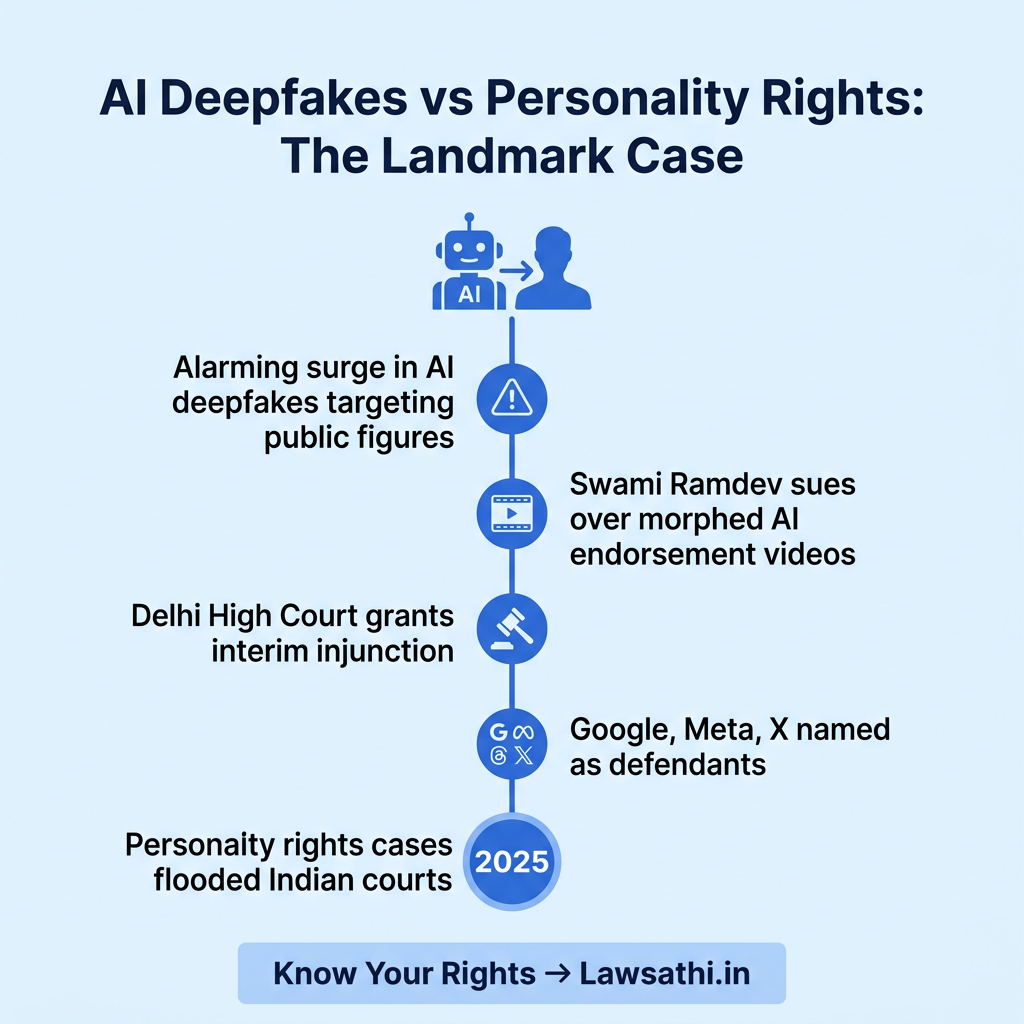
India has witnessed an alarming surge in AI-generated deepfakes targeting public figures. Voice cloning technology has become increasingly sophisticated and accessible. Consequently, celebrities, spiritual leaders, and politicians find their digital personas hijacked for commercial gain or malicious purposes. The year 2025 saw multiple personality rights cases flood Indian courts seeking protection against AI manipulation [^2].
Swami Ramdev’s Legal Battle
Swami Ramdev, the renowned yoga guru and co-founder of Patanjali, filed suit against unidentified defendants. The case, titled Baba Ramdev v. John Doe(s) and Ors., targeted morphed videos created using AI tools. These videos allegedly damaged his reputation through false endorsements and misleading content. Specifically, the Delhi High Court’s intervention signals a robust judicial response to these emerging technological threats [^1].
Significance of the Judgment
This decision forms part of a broader judicial trend. Courts across India now recognize “digital likeness” as a proprietary right deserving immediate protection. Moreover, the judgment establishes crucial boundaries for AI usage while safeguarding individual autonomy. For legal practitioners, understanding this case is essential for navigating the evolving landscape of personality rights in the digital age.
Case Background: Facts and Plaintiff’s Arguments
Parties and the Nature of Infringement
The plaintiff, Swami Ramdev, sought comprehensive protection for his personality attributes. These included his voice, image, likeness, and unique style of discourse. Additionally, he sought protection for various names including “Ramdev,” “Swami Ramdev,” “Baba Ramdev,” and “Yog Guru Ramdev” [^1].
The defendants included unidentified creators, commonly called John Doe or Ashok Kumar. Furthermore, major technology platforms like Google, Meta, and X were named as defendants. Government bodies MEITY and DoT were also included in the suit. This wide-net approach reflects the complexity of combating AI-generated infringement in the digital ecosystem.
Specific Allegations of AI Misuse
The objectionable content took multiple forms. Deepfakes were created using AI tools for “amusement and online engagement.” Furthermore, digitally created publications projected false endorsements of medicines and health products in Ramdev’s name, likeness, and voice [^1]. Such misinformation poses serious risks to public health and safety.
Constitutional and Legal Arguments
The plaintiff’s counsel, Senior Advocate Rajiv Nayar, argued that these actions violated fundamental rights. Specifically, the suit claimed violation of personality rights, right to publicity, and right to privacy under Article 21 of the Constitution. Additionally, the arguments invoked passing off and commercial misappropriation of persona [^1].
The plaintiff emphasized that his name, visage, and persona enjoy “extraordinary goodwill and trust” built over decades. Therefore, unauthorized AI manipulation constituted a direct attack on this carefully cultivated reputation.
Defense Arguments by Intermediaries
Social media intermediaries, including X and Meta, raised objections during the hearing on February 17, 2026. They argued that Ramdev was using the personality rights suit to remove legitimate criticism from the internet. However, Ramdev countered that these intermediaries, expected to be neutral, were “fiercely opposed” to his prayers [^1].
Legal Framework: Understanding Personality Rights in India
The Legislative Vacuum
Indian intellectual property statutes lack specific provisions for “celebrity” or “personality rights.” The Copyright Act, 1957 includes “performer” rights under Section 38, but this definition remains limited. A celebrity is not necessarily a “performer,” and vice versa. Consequently, the judiciary has stepped in to fill this legislative void [^6][^8].
Constitutional Foundation Under Article 21
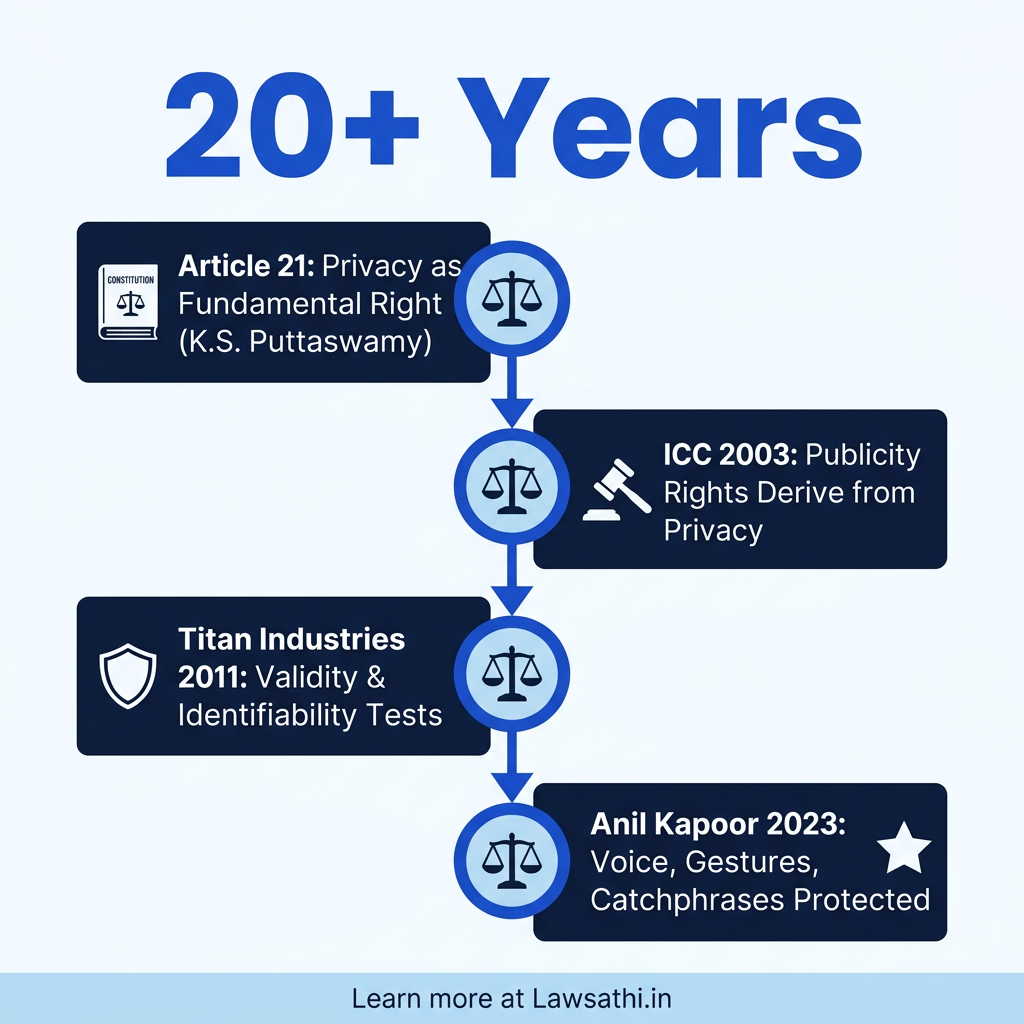
Personality rights in India derive their constitutional foundation from Article 21. This article guarantees the right to life and personal liberty. The Supreme Court’s landmark judgment in Justice K.S. Puttaswamy v. Union of India recognized privacy as a fundamental right. Therefore, individuals now have the right to control commercial use of their identity as part of their privacy rights [^6].
Evolution Through Judicial Precedent
Indian courts have progressively expanded personality rights protection through several landmark cases. For instance, in R. Rajagopal v. State of T.N. (1994), the Supreme Court laid the groundwork by recognizing the right to control commercial use of identity [^6].
The Delhi High Court further developed this jurisprudence in ICC Development v. Arvee Enterprises (2003). Here, the court held that the right of publicity derives from privacy and inheres only in individuals [^8].
Defining Right to Publicity
In Titan Industries Ltd. v. Ramkumar Jewellers (2011), the Delhi High Court defined the right of publicity precisely. The court established it as the “right to control commercial use of human identity.” Additionally, the judgment created dual tests of “validity” and “identifiability” for determining infringement [^8].
Expansion to Voice and Mannerisms
More recently, Anil Kapoor v. Simply Life India (2023) broadened protection significantly. The Delhi High Court extended protection beyond name and resemblance. Now, voice, gestures, and even catchphrases like “Jhakaas” receive legal protection [^8]. This expansion reflects courts’ recognition of the multifaceted nature of celebrity persona.
Distinguishing Personality Rights from Publicity Rights
Legal scholars note an important distinction between these concepts. Personality rights encompass a person’s name, voice, signature, photograph, image, and other attributes. In contrast, publicity rights represent the exclusive right to commercially exploit one’s personality [^9].
Publicity rights function as property rights with a commercial focus. Conversely, personality rights should protect dignity through autonomy-based protection. However, courts have often used these terms interchangeably, creating some confusion in the jurisprudence [^9].
The Court’s Rationale: The Injunction Order
Recognition of Established Goodwill
Justice Jyoti Singh delivered a comprehensive order on February 24, 2026. First, the court recognized Ramdev as a “prominent public figure” who has “established substantial goodwill over decades” [^1]. This acknowledgment formed the foundation for granting protection.
AI Manipulation as Misappropriation
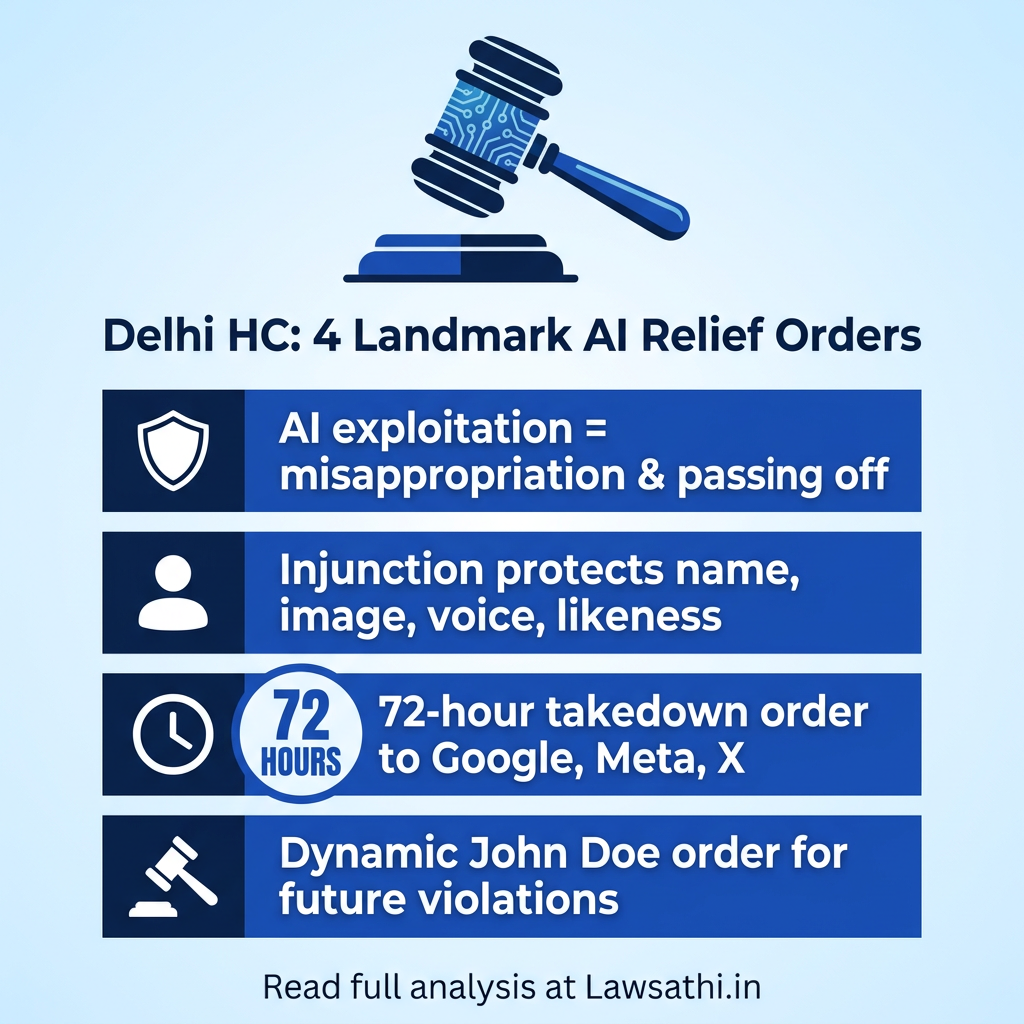
The court made a crucial observation about AI technology. Specifically, it stated that “unauthorized commercial exploitation of a public figure’s persona, particularly through AI manipulation, could amount to misappropriation and passing off” [^1]. This establishes AI manipulation as a recognized form of infringement.
Public Interest Considerations
Importantly, the court emphasized the broader implications of the infringing content. Content falsely projecting endorsements of medicines can be detrimental to his reputation. Furthermore, such misinformation can lead to serious and adverse consequences to public interest [^1].
Trust and Credibility at Stake
The judgment highlighted another critical aspect. AI-generated content “affects his public image and may tarnish his credibility and undermine the trust reposed in him” [^1]. For public figures whose influence depends on trust, such damage can be irreparable.
Relief Granted by the Court
The court granted an interim injunction restraining unauthorized use of Ramdev’s name, image, voice, and other personality attributes. This protection explicitly extends to AI-generated content and deepfakes. Furthermore, the court issued a 72-hour takedown directive to Google, Meta, and X for specified URLs [^1].
Dynamic Injunction Against Unidentified Defendants
The court also issued a dynamic injunction against unidentified defendants. This John Doe/Ashok Kumar order enables Ramdev to take action against future infringements without filing new suits. As a result, such proactive relief reflects the court’s understanding of the fast-paced digital environment.
Implications for AI Governance and Tech Liability
The IT Rules Amendment 2026
The judgment coincides with significant regulatory developments. On February 10, 2026, the Centre amended the Information Technology Rules to regulate AI-generated content [^12]. These amendments, effective February 20, 2026, dramatically reshape intermediary obligations.
Dramatic Reduction in Takedown Timelines
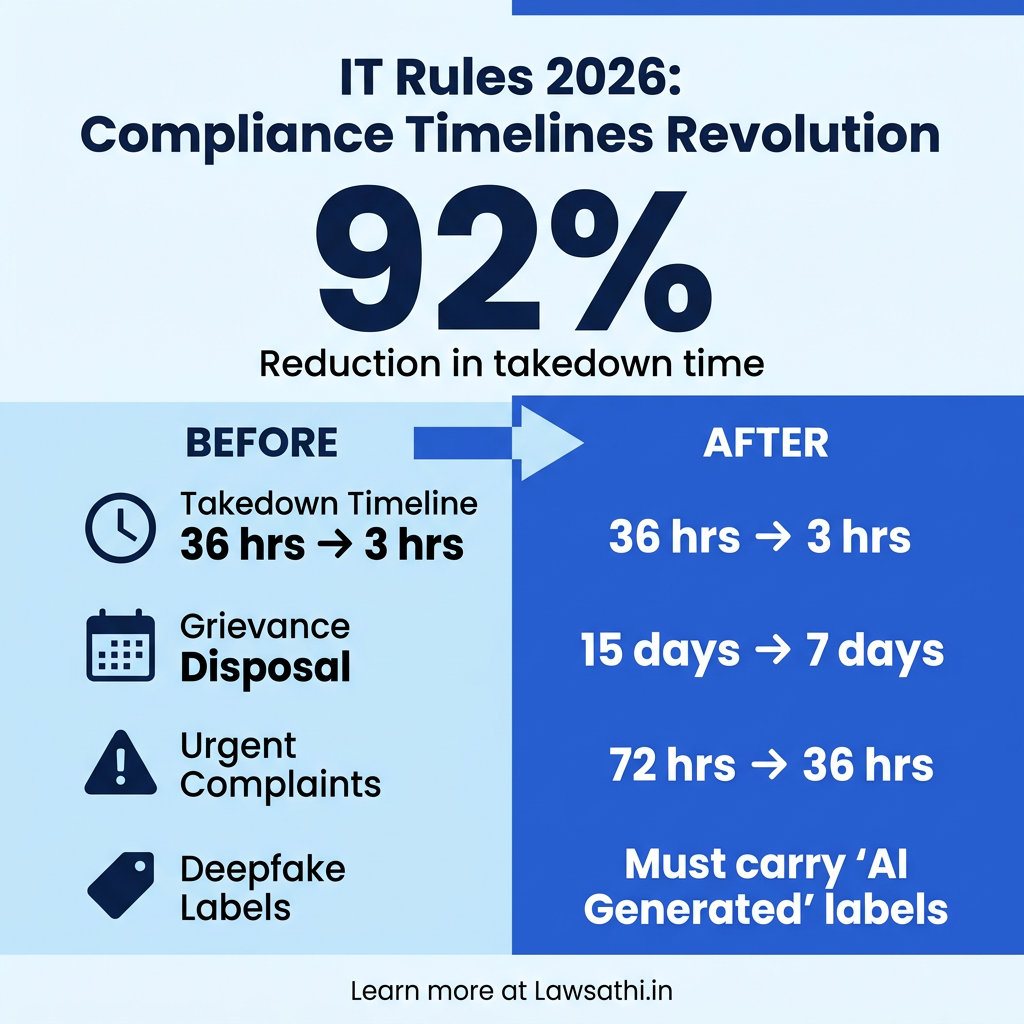
The amendments substantially reduced compliance timelines for intermediaries. Specifically, the takedown timeline for court or government orders decreased from 36 hours to just 3 hours. This represents a 92% reduction, signaling the government’s serious approach to AI regulation [^12].
| Requirement | Previous Timeline | New Timeline (2026) | |————-|——————|———————| | Court/Govt order compliance | 36 hours | 3 hours | | Grievance disposal | 15 days | 7 days | | Urgent complaint action | 72 hours | 36 hours | | Specified content removal | 24 hours | 2 hours |
Definition of Deepfake
The amended rules provide a specific definition for deepfakes. A “deepfake” means content generated using algorithmic or computational techniques. This content must produce sound or visuals that convincingly pass as authentic representations of real individuals [^11]. Additionally, the definition includes AI-generated images, replicated voices, and video clips crafted to mislead.
New Obligations for Intermediaries
Intermediaries now face several new obligations. First, AI-generated content must carry clear labels identifying it as “synthetically generated.” Second, platforms must embed permanent metadata or provenance mechanisms for traceability [^13].
Additionally, platforms must warn users about consequences of violations at least once every three months. Users must also declare whether content is AI-generated before uploading. Finally, platforms must verify the accuracy of these declarations [^13].
Constitutional and Practical Concerns
Critics have raised concerns about these amendments. The 3-hour takedown requirement may impose an effective “prior restraint” burden on intermediaries. Additionally, the vagueness in certain requirements creates compliance uncertainty [^11].
The risk of chilling effect on free expression remains significant. For example, satirical content may be particularly difficult to distinguish from harmful deepfakes. Therefore, proportionality assessment and procedural safeguards become crucial for balanced implementation.
Global Regulatory Context
India’s approach differs from other jurisdictions. The European Union employs a risk-classification model under its AI Act. Meanwhile, China mandates visible watermarking of all synthetic media. California primarily targets election-related deepfakes [^11].
India has adopted a timeline-centric, compliance-driven approach. This represents a blend of speech regulation and platform governance. Consequently, the effectiveness of this model will depend on implementation and judicial interpretation.
Practical Advice for Legal Practitioners
Building the Enforcement Toolkit
Lawyers handling personality rights cases must leverage multiple legal frameworks. Constitutional remedies under Article 21 provide the strongest foundation for privacy-based claims. Additionally, statutory remedies under the Trade Marks Act, 1999 allow registration of names, signatures, and catchphrases [^8].
The Copyright Act, 1957 offers protection through Section 38 for performer’s rights. The Information Technology Act, 2000 provides penalties for online identity misuse. Furthermore, the Bharatiya Nyaya Sanhita, 2023 creates criminal offences for certain violations [^6].
Evidence Gathering Strategies
Effective litigation requires thorough evidence documentation. Lawyers should document all URLs and screenshots of infringing content systematically. Moreover, preserving metadata and technical markers can establish the AI-generated nature of the content.
Additionally, plaintiffs must demonstrate identifiability—the subject must be recognizable from the content. Showing commercial exploitation or likelihood of confusion strengthens the case. Finally, evidence of damage to goodwill or reputation supports claims for damages.
Drafting Effective Legal Notices
When drafting legal notices for personality rights infringement, specificity is crucial. The notice should list all protected attributes including name, voice, image, likeness, mannerisms, and catchphrases [^8]. It should also enumerate all variations and monikers under which the client is known.
The notice must reference the constitutional framework under Article 21. Citing relevant precedents like the Swami Ramdev case strengthens the legal basis. Finally, request takedown within the applicable statutory timelines under the IT Rules [^12].
John Doe Orders: The Critical Tool
John Doe or Ashok Kumar orders have become essential for combating online infringement. These orders allow ex parte interim injunctions against unidentified infringers. Specifically, they provide exemption from the typical procedural requirement of naming specific defendants [^6].
For AI-related infringement, such orders enable rapid, pre-emptive relief. Lawyers should specifically request dynamic injunctions that extend protection to future violations. As a result, this approach proves particularly effective against anonymous creators and evolving AI technologies.
Proactive Client Counseling
Advising clients on preventive measures is equally important. First, encourage registration of distinctive personality traits as trademarks where applicable. Clients should document the commercial value of their persona through endorsements and licensing agreements.
Regular monitoring of digital platforms for unauthorized use should become standard practice. Establishing official channels and verified accounts helps combat impersonation. Finally, creating clear licensing frameworks for authorized use provides legal clarity.
Conclusion: Setting a Precedent for the Digital Era
A Watershed Moment for Personality Rights
The Delhi High Court personality rights AI judgment in the Swami Ramdev case marks a watershed moment. Courts now treat “digital likeness” as a proprietary right deserving fast, robust protection [^1]. Moreover, this decision, along with similar rulings in the Ravi Shankar and Sadhguru cases, establishes a clear precedent for AI-related violations [^2][^4].
Balancing Competing Interests
However, the evolving jurisprudence must balance competing interests. Distinguishing permissible expressive use from impermissible commercial exploitation remains challenging. Overbroad injunctions risk encroaching on artistic expression, parody, and satire [^10].
The Need for Legislative Action
The absence of comprehensive statutory framework creates significant uncertainty. Currently, scope and contours of personality rights are determined case-by-case. Therefore, legislative clarity is needed to delineate scope, limitations, and enforcement mechanisms [^9].
Future Outlook
As AI technology continues advancing, legal frameworks must evolve accordingly. Conflicts with end-to-end encryption will intensify. Furthermore, the balance between public safety and democratic expression will require continuous refinement [^11].
For legal practitioners, staying updated on these developments is essential. The intersection of technology and personality rights will generate increasing litigation. In conclusion, understanding precedents like the Swami Ramdev case provides a foundation for effective client representation.
Stay ahead of evolving Indian case law with LawSathi. Our AI-powered platform helps you track landmark judgments, manage IP litigation documents, and automate legal research. Start your free trial today.