Introduction: The Push for Administrative Efficiency in Goa
The Revenue Department of Goa has issued a significant notification in early 2026. Specifically, this notification reduces the stipulated period for land conversion approvals from 60 days to 45 days. For legal practitioners handling real estate matters, this change represents a major shift in administrative timelines.
Goa’s real estate market continues to experience robust growth. The Economic Survey 2024-25 indicates that Goa’s per capita income has risen to ₹7,64,392. This figure is significantly higher than the national average [^31]. Therefore, the demand for land conversion remains strong across both North and South Goa districts.
Balancing Speed with Legal Scrutiny
The government aims to balance administrative efficiency with proper legal scrutiny. However, lawyers must understand that faster approvals do not reduce their due diligence obligations. The notification aligns with the Goa Public Service Guarantees Act. This Act mandates time-bound delivery of government services [^16][^17].
This development particularly impacts developers, homebuyers, and investors. Consequently, legal practitioners must adapt their workflows to align with these accelerated timelines. They must also maintain rigorous compliance standards throughout the process.
Understanding the Legal Framework: Section 17 of the Goa Land Revenue Code
The Goa land conversion process operates under the Goa, Daman and Diu Land Revenue Code, 1968 [^10]. Section 32 of this Code empowers the Collector to regulate land use for non-agricultural purposes. Additionally, Section 105 defines the Mamlatdar’s powers in revenue matters.
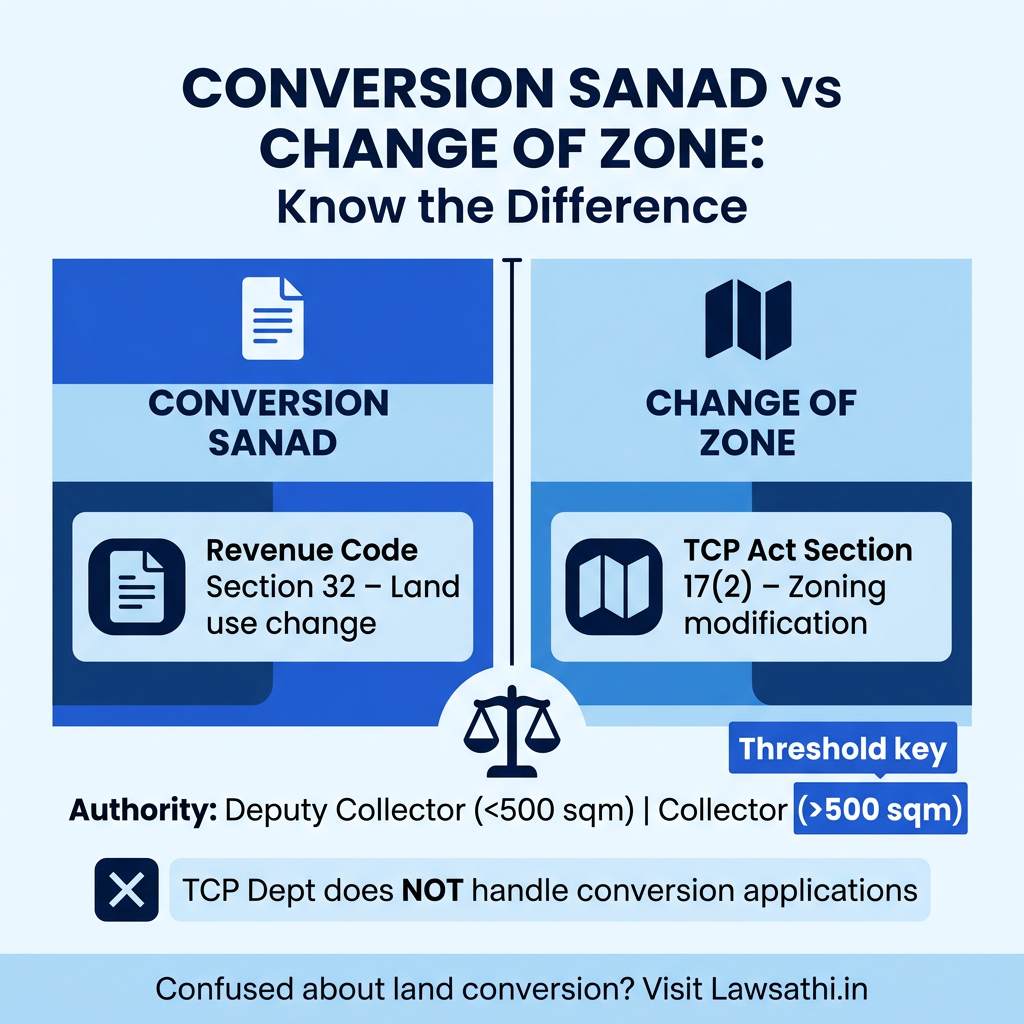
Land conversion, commonly called “Conversion Sanad,” changes the land use entry from agricultural to non-agricultural purposes. The Revenue Department processes these applications through the District Collector’s office [^4]. However, many lawyers confuse this with “Change of Zone” applications under the Town and Country Planning Act.
Key Distinction: Conversion Sanad vs. Change of Zone
It is crucial to understand the distinction between these two processes. Conversion Sanad alters land use classification under the Revenue Code. In contrast, Change of Zone modifies zoning classification under the Regional Plan 2021 through the TCP Department [^27][^28].
The Goa Legislative Assembly clarified in February 2024 that the TCP Department does not process conversion applications. Instead, it only handles alterations to the Regional Plan under Section 17(2) of the TCP Act. Therefore, lawyers must direct clients to the appropriate authority based on their specific requirements.
The hierarchy of authorities depends on land area. For instance, land below 500 square meters falls under the Deputy Collector and Sub-Divisional Officer. Conversely, land above 500 square meters requires Collector-level approval [^4].
The Revised Timeline: Procedural Breakdown for Lawyers
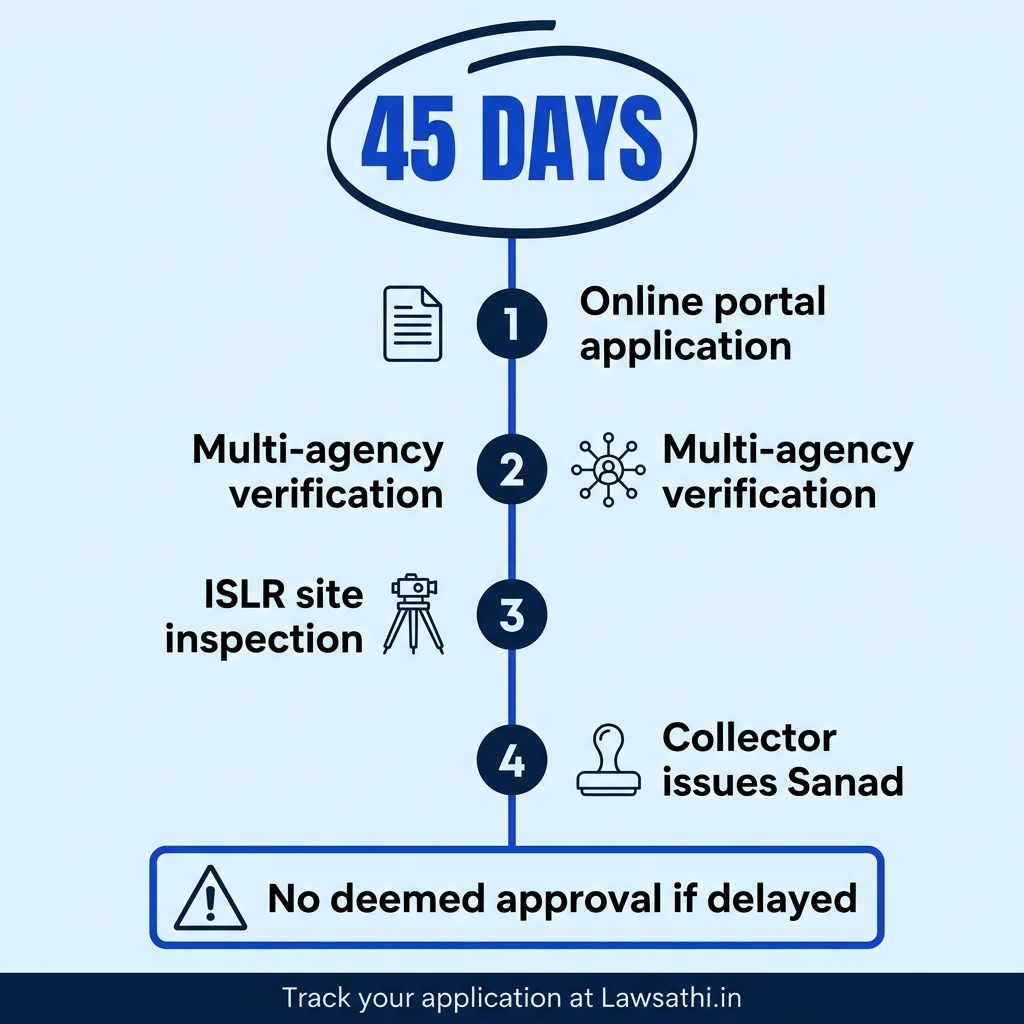
The new 45-day timeline for the Goa land conversion process significantly accelerates the previous standard. Lawyers must now prepare applications with greater precision to meet these compressed deadlines. The process begins with application submission through the Goa Online portal [^2][^12].
Stage-Wise Breakdown of the Process
The first stage involves application submission with all mandatory documents. The Revenue Department then forwards the application to multiple agencies. These include the Forest Department, TCP Department, and Mamlatdar for verification. These departments must submit their reports within the stipulated timeframe [^3].
Subsequently, the Inspector of Survey and Land Records (ISLR) conducts a site survey. The survey report forms a critical component of the approval process. Finally, the Collector reviews all reports and issues the Conversion Sanad.
Importantly, there is no provision for deemed approval if the timeline is not met [^3]. Therefore, lawyers cannot rely on automatic approvals due to administrative delays. They must actively track application status and follow up with concerned departments.
Documentation Requirements for Accelerated Processing
Complete documentation is essential for meeting the 45-day deadline. Incomplete applications face rejection or delay, defeating the purpose of accelerated processing. Lawyers must ensure all documents are in order before submission [^4].
The Goa Online portal facilitates real-time tracking of applications [^1][^13]. This digital infrastructure supports the accelerated timeline by enabling transparency and accountability. However, technical glitches can still cause delays.
Impact on Real Estate Transactions and Due Diligence
Faster approvals under the revised Goa land conversion process directly impact transaction timelines. Sale Agreements and Conveyance Deeds can now proceed with reduced waiting periods. This acceleration benefits both buyers and sellers in Goan real estate transactions.
Implications for “Time is of the Essence” Clauses
Many Sale Agreements include “time is of the essence” clauses. The reduced conversion timeline makes these clauses more enforceable. However, lawyers must carefully draft conditional clauses to account for potential delays from other departments.
For example, CRZ clearances from the Goa Coastal Zone Management Authority remain separate requirements. These clearances can extend transaction timelines beyond the conversion approval period. Therefore, lawyers should not conflate conversion approval with complete regulatory compliance.
Reduced Scrutiny Risks for Legal Practitioners
The accelerated timeline poses risks for due diligence quality. Lawyers may face pressure to complete title searches faster than advisable. However, the standard 30-year title search requirement remains unchanged [^4].
Title verification must still include Form I & XIV mutation entries, tenancy status, and pending disputes. The Economic Survey 2024-25 shows Goa’s urban population has grown to 9.07 lakh. This growth has intensified land transaction volumes [^31]. Consequently, the risk of title defects increases with market activity.
Prudent practitioners should advise clients that conversion approval does not guarantee clear title. Instead, it merely confirms the land use change. Comprehensive due diligence remains essential regardless of administrative timelines.
Analyzing the Benefits for Developers and Homebuyers
The streamlined Goa land conversion process offers substantial benefits for developers. Reduced holding costs represent the most significant advantage. Previously, land parcels awaiting conversion incurred carrying costs for extended periods.
Cost Savings and Project Acceleration
Developers can now launch projects faster with conversion approvals in hand. This acceleration improves project viability and financing arrangements. Furthermore, clear documentation chains facilitate bank loans and investor confidence.
The Investment Promotion Board of Goa has documented these benefits in their service catalog [^3][^6]. Investment Promotion Areas receive expedited processing under dedicated provisions. These streamlined processes enhance Goa’s attractiveness for Foreign Direct Investment.
Homebuyer Advantages and RERA Integration
Homebuyers benefit from quicker clear title verification and possession timelines. The conversion Sanad serves as a prerequisite for RERA registration. Therefore, faster conversion approvals accelerate the entire project compliance chain.
Indian real estate investments surged to US$6.5 billion in 2024, with 22% year-over-year growth [^34]. Foreign investors contributed 66% of total inflows. As a result, Goa’s streamlined processes position it favorably within this investment landscape.
The Real Estate Regulatory Authority maintains its oversight role independent of conversion timelines. Developers must still comply with RERA registration requirements. Therefore, the conversion timeline reduction complements but does not replace RERA compliance.
Compliance Checklist: Essential Documents for the 45-Day Process
Successful navigation of the Goa land conversion process requires complete documentation. Lawyers must prepare comprehensive application packages before submission. Incomplete applications face rejection, causing delays beyond the 45-day timeline.
Mandatory Documents for Application
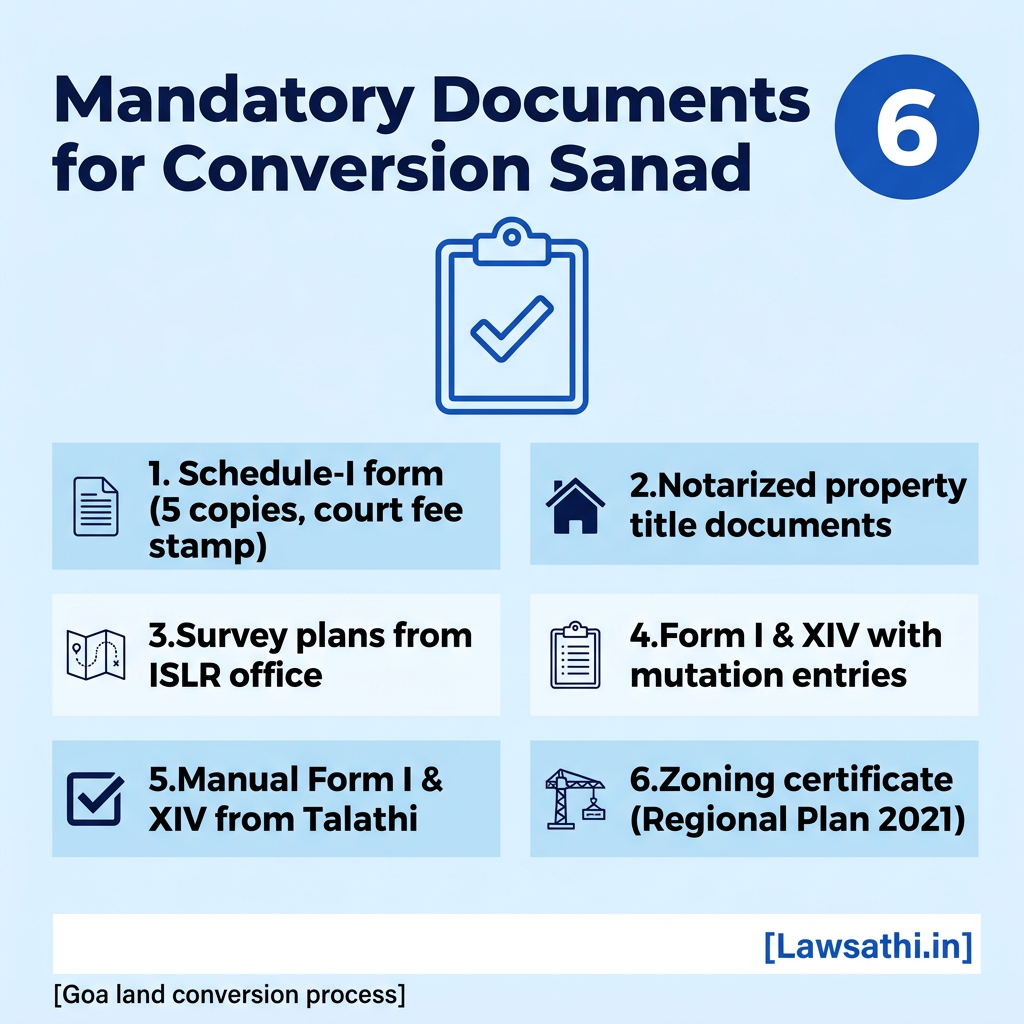
The North Goa Collectorate specifies the following mandatory documents [^4]. First, the application must be in Schedule-I format with a court fee stamp of Rs. 5. Lawyers should prepare one original plus four photocopies.
Second, title documents of the property require notarization. The application must include one notarized original and four photocopies. Third, survey plans from the ISLR office must accompany the application.
Fourth, Form I & XIV must show proper mutation entries in favor of the applicant. These forms confirm ownership and possession records. Fifth, the manual Form I & XIV from the village Talathi serves as verification.
Regional Plan 2021 Alignment Requirements
The property must align with permissible zones under the Regional Plan 2021 [^27]. Settlement zones permit development with conversion Sanad. However, orchard zones, natural cover, and eco-sensitive zones face restrictions [^29].
Lawyers must obtain zoning certificates before application submission. The TCP Department issues these certificates confirming zone classification. Properties in CRZ areas require additional clearances from GCZMA [^25].
Common Rejection Reasons to Preempt
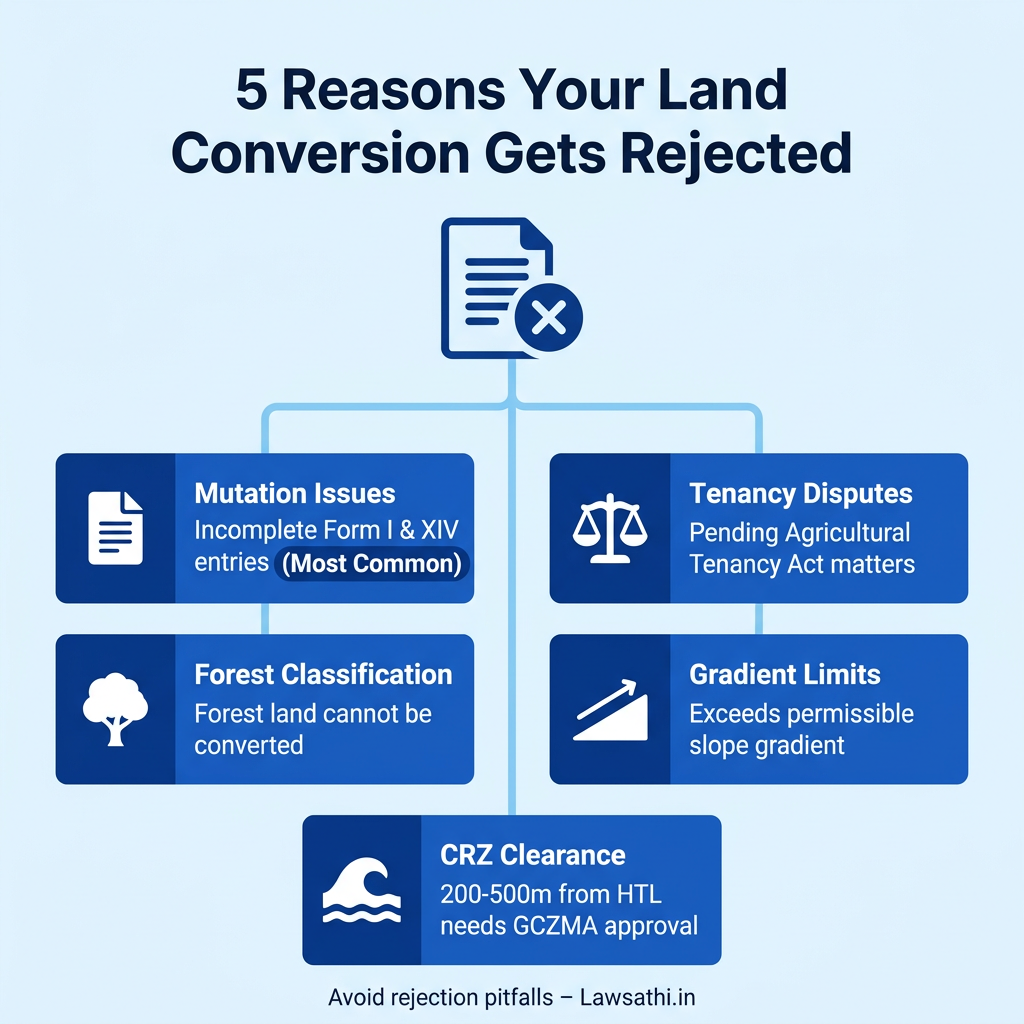
Incomplete mutation entries cause the majority of rejections. Lawyers must verify that Form I & XIV reflects current ownership. Additionally, pending tenancy disputes under the Agricultural Tenancy Act also cause rejections.
Forest land classification presents another significant hurdle. Properties designated as forest land cannot receive conversion approval. Furthermore, gradient exceeding permissible limits in slope areas leads to rejection.
Potential Legal Bottlenecks and Litigation Risks
The revised Goa land conversion process does not eliminate legal challenges. Instead, accelerated timelines may increase litigation risks in certain scenarios. Lawyers must anticipate and mitigate these risks for their clients.
Judicial Precedents on Improper Conversion
The Bombay High Court at Goa has adjudicated several conversion-related disputes. In Francisco X. Jacques v. Directorate of Panchayats, the Court addressed agricultural tenancy and conversion legality issues [^21]. The judgment emphasized that third-party rights created before writ petitions cannot be easily set aside.
Additionally, Goa Foundation v. North Goa Planning Development Authority addressed CRZ violations [^22]. The Court ordered expert committee reports on environmental impact. These precedents underscore the importance of proper compliance beyond conversion approval.
Environmental Concerns and CRZ Areas
Properties within 200-500 meters of the High Tide Line require GCZMA clearance. This clearance is mandatory regardless of conversion Sanad approval. Consequently, environmental litigation can significantly delay or derail projects.
Recent Public Interest Litigation in 2025 challenged amendments to the Goa Land Revenue Code [^24][^25]. The Court upheld the classification as reasonable under Article 14. However, such litigation creates uncertainty for pending applications.
Writ Jurisdiction as a Remedy
Aggrieved parties can approach the Bombay High Court under Article 226. Common grounds include arbitrary refusal, due process violations, and timeline non-compliance. However, writ jurisdiction has limitations for resolving complex title disputes.
Lawyers should advise clients that civil suits remain the appropriate forum for title challenges. Writ petitions serve better for administrative grievance redressal.
Conclusion: Strategic Advice for Legal Practitioners
The reduction of the Goa land conversion process timeline to 45 days signals a shift toward facilitative governance. However, this shift does not reduce the legal practitioner’s responsibility. Instead, it demands greater efficiency and precision in practice management.
Updating Firm Procedures
Law firms must update their standard operating procedures immediately. The accelerated timeline requires parallel processing of NOCs and documentation. Traditional sequential workflows no longer suffice for efficient client service.
Technology adoption becomes essential for tracking these accelerated timelines. Digital practice management systems enable real-time deadline monitoring. As a result, firms that embrace technology will deliver superior client outcomes.
Maintaining Due Diligence Standards
Above all, practitioners must maintain rigorous due diligence standards. Faster government approvals do not justify reduced legal scrutiny. The 30-year title search, mutation verification, and encumbrance checks remain mandatory.
The Goan real estate market will continue its growth trajectory. Lawyers who adapt to these administrative changes while upholding professional standards will thrive. Those who compromise due diligence for speed risk professional liability and client harm.
Streamline your real estate practice with LawSathi. Automate document tracking for land conversions, manage client deadlines, and ensure compliance with India’s smartest legal practice management software. Start your free trial today.
—
[^1]: Goa Online EODB Dashboard Updated February 2026 [^2]: Goa Online Revenue Department Services Portal [^3]: Goa Investment Promotion Board – Change in Land Use Documentation [^4]: North Goa Collectorate – Conversion Sanad Service Details [^10]: The Goa, Daman and Diu Land Revenue Code, 1968 – Full Text [^13]: Goa Online – EODB Notifications Portal [^16]: Goa Official Gazette Series III No. 31 – Service Guarantees [^17]: Goa Official Gazette Series III No. 34 – Service Guarantees [^21]: Francisco X. Jacques v. Directorate of Panchayats – Bombay High Court Judgment [^22]: Goa Foundation v. North Goa Planning Development Authority – Bombay High Court Judgment [^24]: Bombay High Court Goa Judgment – PIL WP 6/2025 Disposition [^25]: Bombay High Court Goa – Land Revenue Code Amendment Challenge [^27]: Regional Plan for Goa 2021 – Town & Country Planning Department [^28]: Goa Legislative Assembly Questions – Land Conversion Clarification [^29]: Goa Official Gazette Series III No. 30 – Zoning Notifications [^31]: Economic Survey of Goa 2024-25 – Statistical Data [^34]: Indian Real Estate Investments Surge to US$6.5 Billion in 2024