Introduction: The Rising Tide of Shareholder Disputes in India
Shareholder disputes in India have reached unprecedented levels in recent years. The National Company Law Tribunal (NCLT), established in 2016, has become the primary forum for resolving these complex corporate conflicts. For minority shareholders facing unfair treatment, an NCLT petition for oppression and mismanagement under Sections 241-242 of the Companies Act, 2013, offers a powerful statutory remedy.
The legislative intent behind these provisions is clear. Parliament designed Sections 241-246 as an alternative to winding up proceedings. This allows the tribunal to regulate company affairs without dissolving the entity entirely. Unlike the Companies Act, 1956, which restricted remedies to continuing acts of oppression, the 2013 Act permits action against past conduct as well [^1].
Understanding the Scope of NCLT Jurisdiction
The NCLT exercises exclusive jurisdiction over oppression and mismanagement matters. The Supreme Court, in Mrs. Shailja Krishna v. Satori Global Limited (September 2024), confirmed an important principle. Specifically, the tribunal can examine allegations of fraud and document validity in such cases [^5]. This expansive interpretation strengthens the remedial scope of these provisions.
Two distinct concepts form the foundation of this remedy. “Oppression” refers to conduct that is burdensome, harsh, and wrongful towards minority shareholders. “Mismanagement” encompasses broader harm to the company’s interests, potentially affecting creditors and public welfare. Both concepts require careful pleading and strategic evidence presentation.
Understanding the Legal Grounds: Oppression vs. Mismanagement
Defining ‘Oppression’ Under Section 241(1)(a)
The Companies Act does not statutorily define “oppression.” However, judicial precedents have established a clear framework. The Supreme Court’s landmark decision in S.P. Jain v. Kalinga Tubes Ltd. (1965) laid down foundational principles. These principles continue to govern modern cases [^2].
Oppression must relate to the manner in which company affairs are conducted. Furthermore, it must involve majority conduct that unfairly prejudices minority members. The test examines whether controlling shareholders treat the company “as if it were their own property” to the detriment of others.
In Needle Industries v. Needle Industries Newey (1981), the Supreme Court clarified essential elements [^26]. An isolated illegal act does not constitute oppression unless accompanied by harsh, burdensome conduct or mala fide intention. However, multiple wrongful acts against a person may justify finding oppression.
The Essential Test for Oppression Claims
The V.S. Krishnan v. Westfort Hi-Tech Hospital Ltd. (2008) decision established the contemporary test [^2]. Courts evaluate whether conduct lacks probity and good faith. Additionally, they examine whether actions are burdensome, harsh, or wrongful. Mala fide intention or collateral purpose strengthens the claim.
Commercial misjudgments alone do not amount to oppression. Therefore, the bar for proving oppression remains deliberately high. This prevents Tribunal interference in legitimate business decisions.
Defining ‘Mismanagement’ Under Section 241(1)(b)
Mismanagement covers different territory than oppression. This ground addresses material changes in company management or control that harm stakeholder interests. For example, it includes changes in board composition, managerial appointments, or ownership structures.
Critically, mismanagement claims require demonstrating harm to creditors, shareholders, or the company itself. Unlike oppression, this ground may invoke public interest considerations when broader stakeholder harm exists.
Key Judicial Precedents Shaping Interpretation
The Tata Consultancy Services v. Cyrus Investments (2021) decision fundamentally reshaped NCLT practice [^26]. The Supreme Court held that mere removal of a director does not constitute oppression. Remedies under Section 241 are restricted to shareholders for violations of proprietary rights as members, not as directors.
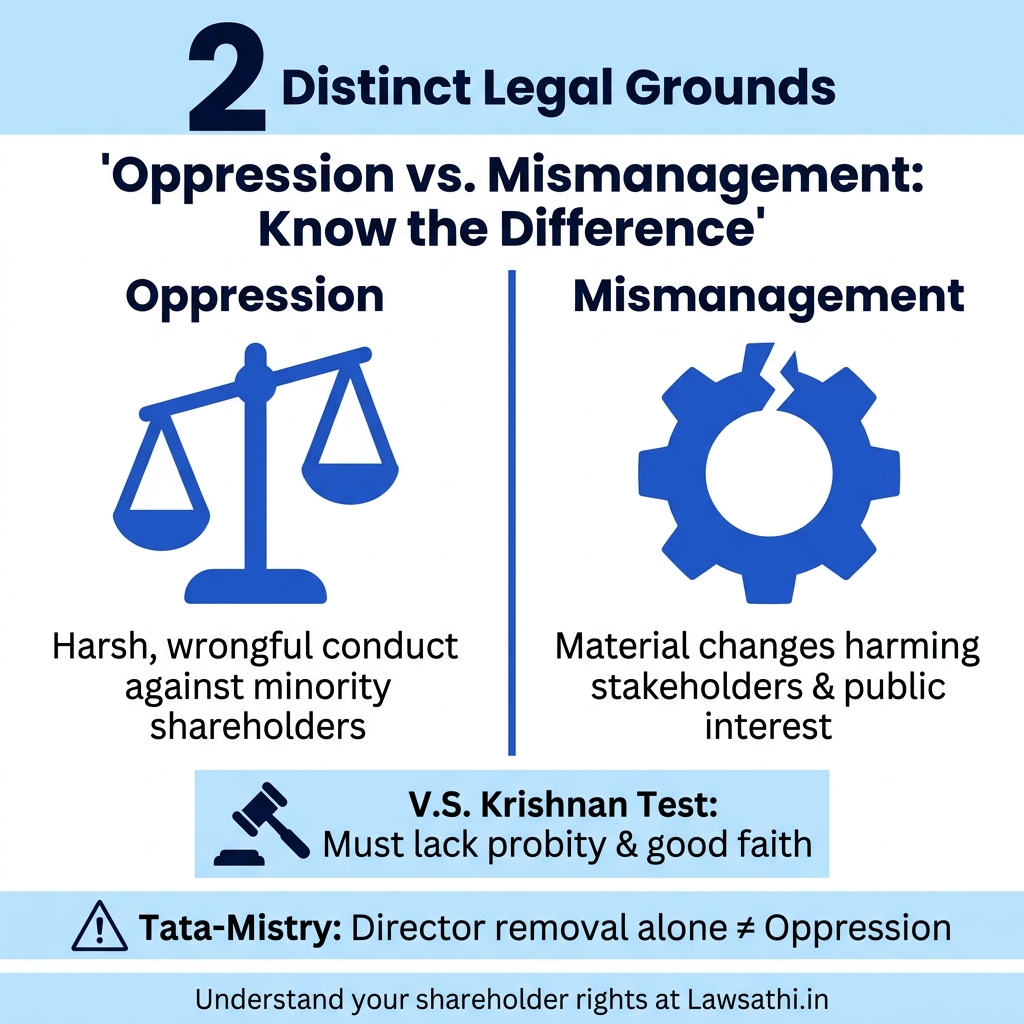
This distinction proves crucial for case strategy. Consequently, lawyers must demonstrate a larger scheme to harm certain members rather than isolated board-level disputes. Evidence must show lack of probity and mala fide intention underlying corporate actions [^27].
Determining Locus Standi: Who Can File?
The Numerical Threshold Requirements
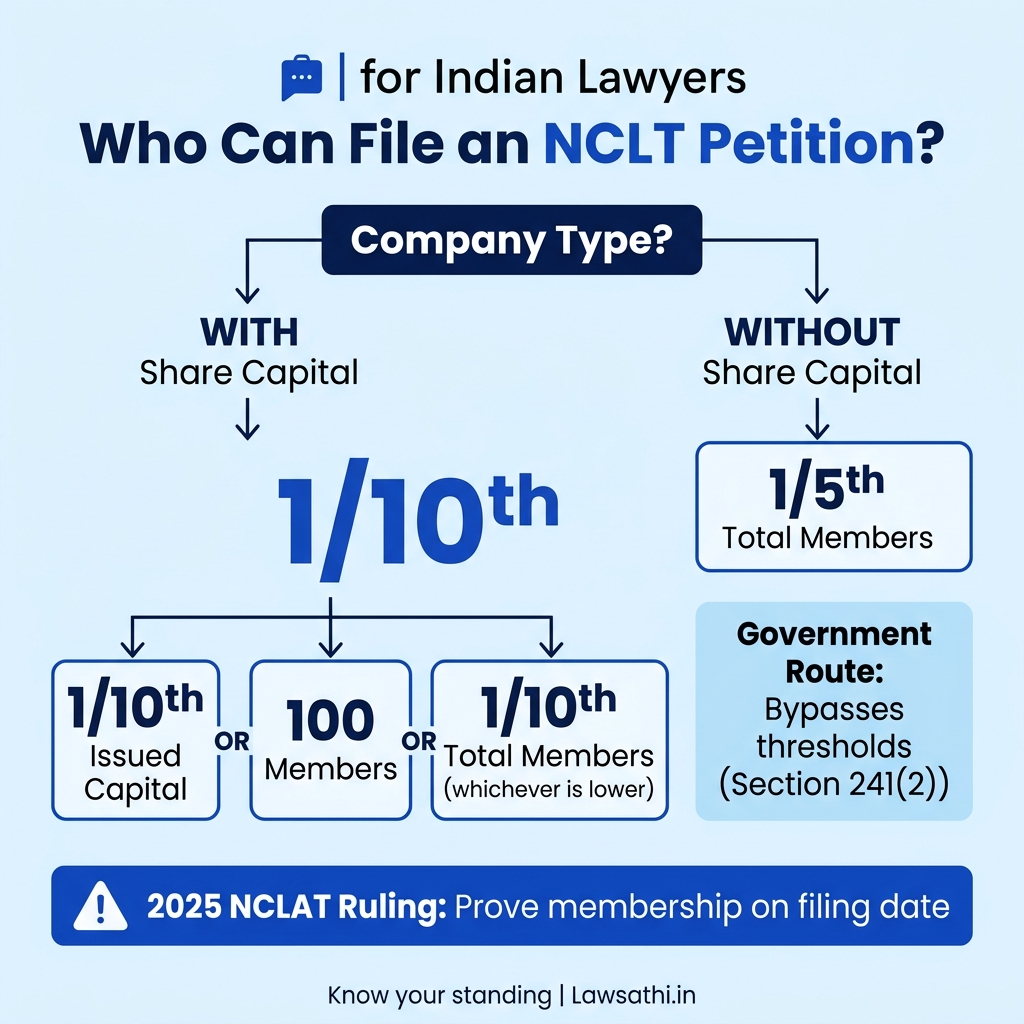
Section 244 prescribes specific numerical thresholds for filing an NCLT petition oppression mismanagement. For companies with share capital, petitioners must hold not less than one-tenth of the issued share capital. Alternatively, they may qualify as at least 100 members.
A third option exists for smaller shareholder groups. Petitioners may comprise one-tenth of total members, whichever figure is lower. For companies without share capital, the requirement increases to one-fifth of total members [^11].
Recent NCLAT Clarification on Membership Status
A critical NCLAT ruling in December 2025 fundamentally affects petition strategy. In Apex Luminaires Pvt. Ltd. v. Shringeri Sheshagiri, the Appellate Tribunal held that petitioners must establish membership status on the filing date [^1][^14].
Once respondents challenge membership, the burden shifts entirely to petitioners. Therefore, the Tribunal cannot presume membership from non-availability of documents. NCLT must decide maintainability as a preliminary question before examining merits.
Central Government Filing Power
Section 241(2) provides an alternative pathway. The Central Government may refer a company to NCLT if its affairs are conducted prejudicially to public interest [^13]. This power bypasses numerical thresholds applicable to private petitioners.
Government intervention typically occurs in cases involving widespread public harm or systemic corporate governance failures. However, this remains an exceptional remedy exercised sparingly.
Waiver of Numerical Requirements
NCLT possesses discretionary power to waive numerical requirements upon application. Tribunals consider exceptional circumstances, the nature of allegations, and prima facie case strength. As a result, this flexibility proves vital for minority shareholders in closely-held companies where shareholding concentrations are high.
Pre-Filing Procedural Strategy and Evidence Gathering
Conducting Forensic Financial Analysis
Success in NCLT petition oppression mismanagement cases depends heavily on documentary evidence. Therefore, pre-filing preparation should include comprehensive forensic analysis of financial statements and board minutes [^4]. This analysis identifies patterns of fund diversion, related party transactions, and governance failures.
Key documents include audited financial statements, bank statements, and audit reports. These reveal financial irregularities and potential asset stripping. Additionally, board minutes expose decision-making patterns and potential conflicts of interest.
Categories of Evidence to Collect
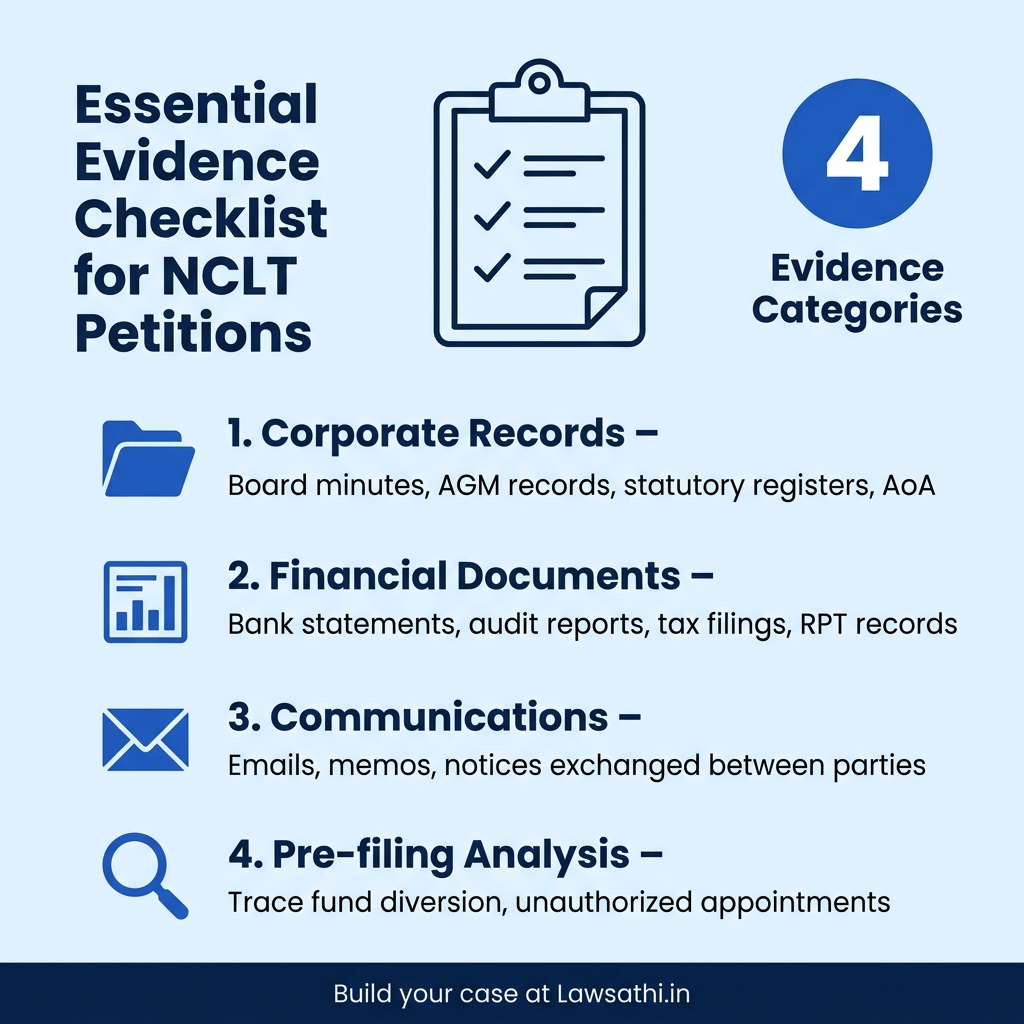
The Escientia Life Sciences v. Escientia Advanced Sciences (NCLT Hyderabad, March 2025) order illustrates evidentiary requirements [^3]. Evidence may include documentation of siphoning business opportunities to competing entities. Furthermore, petitioners should gather proof of unauthorized appointments to consolidate control.
Financial mismanagement through inter-company loans requires careful tracing. Violation of Articles of Association provisions strengthens the claim. Moreover, breach of fiduciary duties by nominee directors provides additional grounds.
Documentary Evidence Checklist
Corporate Records: – Board minutes and AGM minutes – Statutory registers maintained under the Act – Shareholders’ agreements and Articles of Association – Minutes of committee meetings
Financial Documents: – Bank statements for all accounts – Related party transaction records – Audit reports and management letters – Tax filings and assessment orders
Communications: – Email correspondence between stakeholders – Internal memos and circulars – Notices and responses exchanged
Pre-Filing Notice Considerations
Unlike IBC proceedings, no mandatory pre-filing notice requirement exists for oppression petitions. However, documenting prior complaints to the board strengthens the case significantly. Such documentation demonstrates that internal remedies were exhausted before approaching the Tribunal.
Drafting the Petition: Critical Components and Pleading Strategy
Structuring the Petition Effectively
Rule 32 of the NCLT Rules, 2016 prescribes essential petition components [^21]. The structure must include complete particulars of the company, including name, CIN, and registered address. All respondents must be identified with their full addresses and designations.
The synopsis provides the Tribunal’s first impression. Therefore, it should concisely summarize grievances and relief sought within two to five pages. Clear articulation of facts and legal grounds follows.
Drafting the List of Dates and Events
The chronological list of dates and events serves as the petition’s backbone. Each entry should include a specific date, concise event description, and document reference. Consequently, the list must tell a coherent narrative of oppression or mismanagement [^22].
Best practices for this section: – Arrange events strictly chronologically – Reference supporting documents for each entry – Highlight critical dates in bold – Limit entries to material events only
Articulating the Public Interest Element
Mismanagement claims under Section 241(1)(b) require demonstrating public interest harm. Petitioners should explain how corporate conduct affects broader stakeholders. Reference to regulatory violations strengthens this element considerably [^23].
The public interest argument need not involve actual government action. Instead, it should demonstrate potential harm to creditors, employees, and other stakeholders beyond the immediate disputants.
Drafting Prayers Strategically
Section 242 permits various remedial orders. Available reliefs include regulation of company affairs, removal of directors, and share buyouts. Additionally, the Tribunal may appoint administrators, set aside resolutions, or order forensic audits [^24].
Strategic prayer drafting should request primary relief with alternative options. This approach gives the Tribunal flexibility while preserving petitioner interests. However, overbroad or excessive prayers may undermine credibility.
The Filing Process: Forms, Fees, and Tribunal Procedure
Required Forms for Filing
The filing process requires specific prescribed forms under NCLT Rules [^21]. Form NCLT-1 constitutes the main application or petition document. Form NCLT-2 provides the mandatory affidavit verifying the petition’s contents.
Form NCLT-3 covers authorization for advocates or authorized representatives. Proper completion of all forms is essential. Incomplete filings face immediate rejection.
Court Fees and Payment Procedures
Court fee requirements are relatively modest but mandatory [^6]. Court fee stamps on vakalatnama amount to Rs. 3/-. Additionally, welfare fund contribution of Rs. 25/- applies. Fees vary based on petition nature and company share capital.
Payment methods accepted: – Bharatkosh portal payment – Demand Draft drawn in favor of NCLT – E-payment through MCA portal integration
E-Filing Protocol on NCLT Portal
The NCLT e-filing portal (https://efiling.nclt.gov.in) handles all submissions [^7][^10]. Registration requires selecting user type and completing verification. Advocates must link their bar council registration numbers.
Technical requirements for documents: – PDF format only with color scans – Proper pagination throughout – Bookmarking for easy navigation – Volume-wise indexing mandatory
Common Filing Objections to Avoid
NCLT objection lists reveal recurring defects leading to rejection [^6]. Incomplete indexing remains the most common issue. Missing pagination renders petitions technically defective. Additionally, Hindi pages require English translation certificates.
Other frequent defects include missing signatures in index, non-readable scanned pages, and extra PDFs uploaded incorrectly. Court fee payment on vakalatnama must be clearly visible. Furthermore, MOA and AOA attachments are mandatory for company petitions.
Seeking Interim Relief: Strategy for Urgent Hearings
Statutory Powers Under Section 242(4)
Section 242(4) grants NCLT broad interim relief powers during proceedings [^16]. The Tribunal may pass orders that “appear to it to be just and equitable” to protect company interests. This standard allows flexible, situation-specific relief.
Interim orders can fundamentally alter litigation dynamics. For example, effective interim relief may preserve the status quo pending final adjudication. Additionally, it may prevent asset dissipation or evidence destruction.
Types of Interim Orders Available
NCLT regularly grants stay orders on board meetings and AGMs. Freezing of bank accounts prevents fund diversion during proceedings. Injunctions against share transfers maintain existing ownership structures.

More dramatic remedies include status quo orders on management positions and appointment of administrators. The Tribunal may also order forensic audits to investigate financial irregularities [^18].
The Three-Part Test for Interim Relief
Successful interim applications must satisfy a three-part test. First, petitioners must demonstrate a prima facie case of oppression or mismanagement. Second, they must establish that balance of convenience favors interim intervention.
Third, petitioners must prove that irreparable injury would occur without relief. Monetary damages must be inadequate to compensate the harm. In other words, this standard mirrors traditional injunction principles in Indian civil jurisprudence.
Illustrative Case: The Kanta Agarwala Order
The Ms. Kanta Agarwala v. Exclusive Capital Limited order (May 2024) demonstrates comprehensive interim relief [^19]. NCLT appointed Justice R.K. Gauba, a former Delhi High Court Judge, as Administrator. Board functions were suspended for 180 days.
Additional measures included cancellation of illegally issued OCDs/CCPS. The Tribunal ordered transaction audits for related party dealings. Moreover, monthly reporting requirements ensured ongoing monitoring.
Conclusion: Best Practices for Corporate Litigators
Avoiding Common Procedural Pitfalls
Success in NCLT petition oppression mismanagement cases requires meticulous attention to procedural requirements. The most common reason for dismissal is failure to prove membership on the filing date. The NCLAT Chennai decision in December 2025 confirmed this fundamental requirement [^12][^17].
Another frequent pitfall involves treating director removal as oppression. Post Tata-Mistry, lawyers must demonstrate broader harm to member rights, not merely board-level disputes. Specifically, evidence must show lack of probity and continuing oppressive conduct.
Documentation and Client Preparation
Comprehensive documentation forms the foundation of successful petitions. Email communications prove particularly valuable as contemporaneous evidence. Furthermore, board minutes and financial records provide objective verification of allegations.
Client preparation should include frank discussion of the high burden of proof. Expectations regarding timeline must be managed realistically. Consequently, proceedings may extend for years before final resolution.
The Future of NCLT Jurisprudence
Shareholder disputes before NCLT continue evolving. Increasing acceptance of buyout remedies provides practical exit options for oppressed minorities. Additionally, expanded interim relief powers enable more effective case management.
However, the Tata-Mistry decision raised the threshold for proving oppression. Future success requires demonstrating clear harm to proprietary rights as shareholders. Mere corporate governance disputes will not suffice.
Streamline your NCLT case management with LawSathi. Organize voluminous case documents, automate court deadline reminders, and collaborate with clients securely. Start your free trial for your next corporate dispute today.