Filing a child custody petition under Guardians and Wards Act requires careful attention to procedural nuances. For family law practitioners in India, understanding this 1890 legislation remains essential. However, newer statutes have emerged since its enactment. The Act provides a secular framework that supplements personal laws across religious communities. Therefore, lawyers must master both procedural requirements and substantive welfare considerations.
Introduction: The Guardians and Wards Act, 1890 in Contemporary Family Law
Understanding the Scope and Applicability
The Guardians and Wards Act, 1890 operates as secular legislation applicable to all minors regardless of religion. It supplements personal laws while providing uniform procedural mechanisms for guardianship matters. According to Indian Kanoon’s comprehensive analysis, the Act governs guardian appointments for minor children. Specifically, it covers both the persons and property of minors.
Importantly, the legislation distinguishes between “guardianship” and “custody” in legal parlance. Guardianship encompasses broader decision-making authority over the child’s life decisions. Custody, however, refers specifically to physical possession and day-to-day care responsibilities. Consequently, a guardian may not always have physical custody of the minor.
The Paramount Welfare Principle under Section 17
Section 17 of the Act establishes the welfare principle as the paramount consideration. Courts must prioritize the minor’s welfare above parental claims or legal technicalities. The India Code legislative database confirms this provision mandates comprehensive welfare assessments.
Furthermore, “welfare” extends beyond mere economic well-being. It encompasses moral, ethical, emotional, and educational dimensions of the child’s development. The Supreme Court has consistently reinforced this holistic interpretation in landmark judgments. Therefore, practitioners must present evidence addressing all welfare aspects comprehensively.
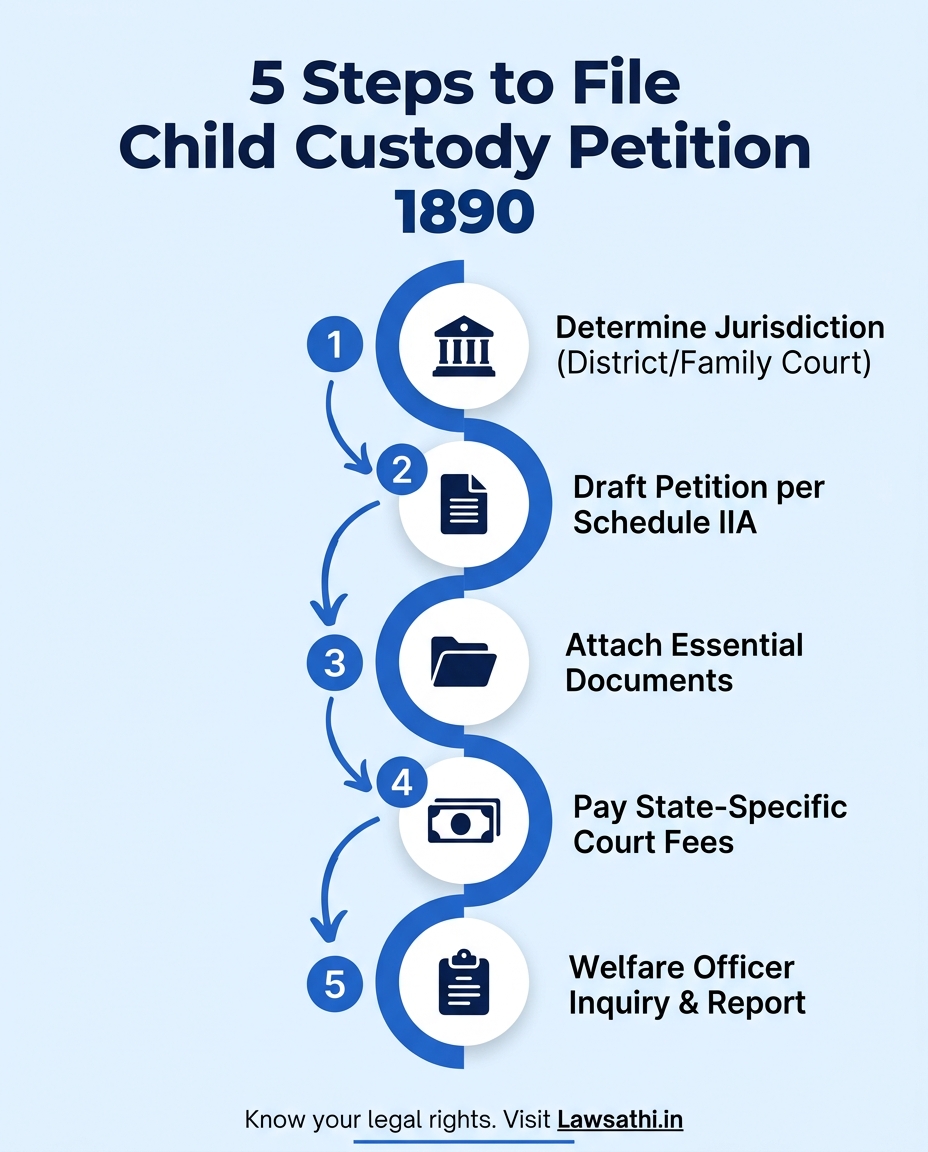
Determining Jurisdiction and Venue for Filing
Section 9: The Jurisdictional Framework
Section 9 of the Guardians and Wards Act establishes the jurisdictional parameters for filing petitions. The Indian Kanoon database clarifies that District Courts possess original jurisdiction in guardianship matters. However, determining the appropriate venue requires careful analysis of the minor’s residence.
The concept of “ordinary residence” determines jurisdiction under the Act. Courts have interpreted this term to mean the place where the child normally lives. For example, if a child temporarily stays with grandparents during school holidays, their ordinary residence remains with the primary caregiver. Additionally, the minor’s presence within the court’s territorial jurisdiction at filing suffices for establishing venue.
Interaction with Family Courts Act, 1984
The Family Courts Act, 1984 significantly affects jurisdictional considerations in custody matters. Where Family Courts exist, they exercise exclusive jurisdiction over guardianship proceedings. Section 19 of the Guardians and Wards Act delineates courts’ power to appoint guardians.
Moreover, practitioners must verify whether their jurisdiction has established Family Courts. In such districts, filing in the District Court would face dismissal on jurisdictional grounds. The transfer of cases between courts can cause significant delays. Therefore, confirming jurisdiction before filing prevents unnecessary procedural complications.
Step-by-Step Procedure for Filing the Petition
Drafting the Petition: Essential Requirements

Drafting a child custody petition under Guardians and Wards Act requires compliance with Schedule IIA requirements. The petition must contain specific particulars including the minor’s name, age, and residence. Additionally, it should detail the relationship between the petitioner and the minor child.
Furthermore, practitioners must clearly state the grounds for seeking guardianship or custody. The petition should explain why existing guardianship arrangements require modification. Vague or generalized statements may result in rejection during the admission stage. Consequently, lawyers should draft petitions with precision and supporting particulars.
Required Documentation and Filing Formalities
Successful filing requires comprehensive documentation supporting the petition’s claims. Essential documents include the minor’s birth certificate establishing parentage and age. Marriage certificates become relevant when custody disputes arise from matrimonial breakdown.
Additionally, financial affidavits demonstrating the petitioner’s capacity to maintain the child prove crucial. Courts assess the petitioner’s financial stability as part of welfare determination. School records, medical reports, and character certificates further strengthen the application. For practitioners, compiling complete documentation prevents adjournments during admission hearings.
Court Fees and Procedural Timelines
Court fees for guardianship petitions vary across states under respective Court Fees Acts. Practitioners must verify applicable fee structures in their jurisdiction. Additionally, insufficient court fee payment can delay the petition’s admission.
The procedural timeline typically spans several months for contested custody matters. After admission, the court issues summons to respondents within 30 days. The Law Commission Report No. 257 recommends expedited procedures for child-related matters. However, practical delays remain common in overburdened family courts.
Role of the Welfare Officer
The Court Guardian or Welfare Officer plays a vital investigative role in custody proceedings. They conduct preliminary inquiries and submit reports to the court. Their recommendations carry significant weight though courts retain final discretion.
Therefore, practitioners should facilitate the Welfare Officer’s investigation process. Ensuring client cooperation with home visits and interviews strengthens the case. The Welfare Officer’s report often influences interim custody arrangements significantly.
The Paramount Consideration: Determining ‘Welfare of the Child’
Beyond Economic Well-being: Holistic Welfare Assessment
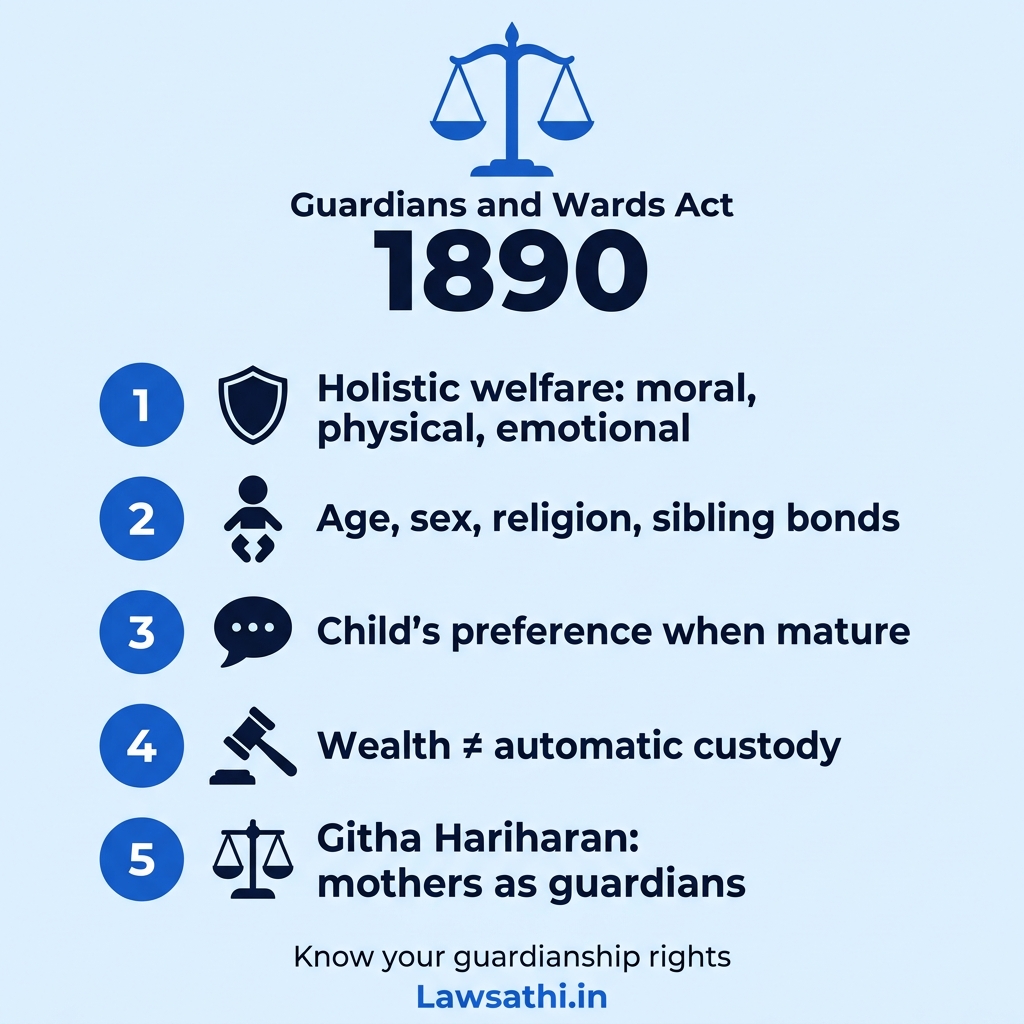
The welfare of the child principle India encompasses multiple dimensions beyond financial security. Courts examine moral, ethical, physical, and emotional welfare comprehensively. Educational stability, religious upbringing, and sibling relationships also factor into assessments.
For example, a wealthy parent may not automatically receive custody. Courts prioritize emotional bonding and caregiving continuity over economic advantages. Recent Supreme Court guidance emphasizes multi-factor welfare analysis in custody determinations.
Factors Considered in Welfare Determination
Courts consider several established factors when assessing the child’s best interests. The minor’s age and sex influence custody decisions, particularly for young children. Additionally, the child’s religious upbringing and cultural background require consideration.
The preference of older children carries weight in custody proceedings. Courts typically consider children’s views once they attain sufficient maturity. However, mere preference doesn’t determine custody independently. Judges balance expressed preferences against overall welfare considerations.
The Githa Hariharan Paradigm Shift
The landmark judgment in Githa Hariharan v. Reserve Bank of India transformed guardianship jurisprudence. The Supreme Court recognized mothers as natural guardians under the Hindu Minority and Guardianship Act. This decision challenged the traditional primacy of paternal guardianship rights.
Furthermore, the judgment emphasized that welfare principles override technical legal constructions. The case analysis by SCC Online examines the decision’s lasting impact. Practitioners should cite this precedent when advocating for maternal custody arrangements.
Visitation Rights: Balancing Access and Custody
Legal Basis for Visitation Rights
Visitation rights legal procedure recognizes the non-custodial parent’s entitlement to maintain child relationships. Courts consistently affirm that children benefit from continued contact with both parents. Denial of visitation requires exceptional circumstances threatening child welfare.
The Delhi High Court’s recent ruling reinforces this principle strongly. The Court stated that non-custodial parents must have access to ensure meaningful child contact. Joint parenting has become the judicial norm rather than exception.
Types of Visitation Arrangements
Practitioners should understand different visitation models when drafting custody agreements. Fixed visitation specifies exact dates, times, and durations for access. This arrangement provides clarity but lacks flexibility for changing circumstances.
Reasonable visitation allows parents to adjust schedules mutually without court intervention. However, this arrangement requires cooperative co-parenting relationships. Supervised visitation applies where safety concerns warrant monitoring during access periods. Courts order supervision when allegations of abuse or neglect require investigation.
Enforcement and Remedies for Violation
Enforcing visitation rights presents practical challenges for practitioners. Violation of court-ordered access constitutes contempt of court. Affected parents may file execution applications seeking compliance orders.
Additionally, courts can modify custody arrangements for persistent visitation interference. Recent Calcutta HC guidelines establish protocols for access enforcement. Practitioners should document all visitation denials systematically for enforcement proceedings.
Virtual Visitation in Modern Context
Modern custody arrangements increasingly incorporate virtual visitation provisions. Video calls and digital communication supplement physical access between visits. This arrangement benefits families separated by distance or NRI parents.
Courts now routinely include virtual visitation clauses in custody orders. For practitioners, drafting comprehensive visitation schedules should address digital access parameters. Clear provisions prevent disputes over communication frequency and timing.
Interim Custody Orders and Urgent Reliefs
Procedure for Interim Applications
Interim custody applications follow expedited procedures given the urgent nature of child welfare. Practitioners typically file applications under Order 39 of the Civil Procedure Code. Alternatively, specific provisions under the Guardians and Wards Act permit interim relief.
The application must demonstrate immediate necessity for interim custody arrangements. Courts balance urgency against the need for preliminary inquiry before orders. Recent judicial trends show increasing willingness to grant interim relief promptly.
Grounds for Urgent Interim Relief
Several circumstances warrant immediate interim custody orders. Threats to the child’s safety or physical well-being justify urgent intervention. Additionally, removal of the child from the court’s jurisdiction necessitates immediate action.
Parental alienation during litigation also grounds interim custody applications. Courts recognize that prolonged separation from one parent causes lasting emotional harm. Therefore, maintaining status quo arrangements pending final determination serves child welfare.
Preventing Parental Alienation
Parental alienation syndrome presents serious concerns in custody litigation. One parent may consciously or unconsciously damage the child’s relationship with the other parent. Courts increasingly recognize and address alienation behaviors in custody proceedings.
Practitioners should seek appropriate safeguards against alienation during proceedings. Regular visitation maintenance, counseling orders, and guardian involvement can mitigate alienation risks. The Supreme Court’s approach emphasizes preventing alienation through balanced interim arrangements.
Recent Judicial Trends and Landmark Judgments
Shift Towards Shared Parenting
Indian courts increasingly embrace shared parenting and joint custody concepts. This judicial evolution reflects research demonstrating children’s benefits from both parents’ involvement. Recent discussions at IIDW 2026 highlighted emerging shared parenting norms.
However, shared custody requires parents’ geographic proximity and cooperative capability. Courts assess practical feasibility before ordering joint custody arrangements. Practitioners should evaluate whether clients can sustain shared parenting relationships before seeking such orders.

Natural Guardianship and Maternal Rights
The interaction between the Guardians and Wards Act and personal laws continues evolving. Judicial interpretation increasingly recognizes mothers’ natural guardianship rights. The analysis of changing legal positions demonstrates this progressive trend.
Practitioners representing mothers should cite this jurisprudential development effectively. Courts no longer presume paternal superiority in custody matters automatically. Instead, welfare assessments determine appropriate custody arrangements regardless of gender.
NRI Custody Disputes and International Considerations
Cross-border custody disputes present unique procedural challenges. India remains non-signatory to the Hague Convention on International Child Abduction. This status creates complex jurisdictional questions in NRI custody matters.
The Bombay High Court’s approach to international custody disputes provides guidance. Courts consider the child’s habitual residence and welfare paramount. Additionally, recent Delhi HC decisions address international parental removal concerns.
Conclusion: Ethical Considerations and Case Management
The Lawyer’s Role in Promoting Settlement
Family law practitioners bear ethical responsibilities beyond zealous advocacy. Encouraging mediation and amicable settlement serves children’s long-term interests. Protracted custody litigation often harms children despite favorable court orders.
Therefore, lawyers should explore settlement possibilities before initiating contested proceedings. Mediation frequently produces more sustainable custody arrangements than adversarial litigation. The child’s welfare remains paramount throughout the dispute resolution process.
Managing Client Expectations
Effective practice requires honest client counseling about realistic outcomes. Custody litigation often extends over years with uncertain results. Managing expectations prevents client disappointment and potential professional liability.
Furthermore, practitioners should explain the welfare principle’s primacy over parental rights. Clients often approach custody matters expecting vindication of their parental claims. Clarifying that courts prioritize child welfare helps clients understand potential outcomes.
Ensuring the Child’s Voice in Proceedings
Modern custody jurisprudence increasingly emphasizes hearing children’s perspectives. Courts appoint guardians ad litem or welfare officers to represent child interests. Practitioners should facilitate children’s participation appropriate to their maturity levels.
The Guardians and Wards Act 1890 continues serving as the primary procedural framework for custody matters. This family law practitioner guide provides foundational knowledge for effective custody practice. However, continuous learning through recent judgments remains essential for competent representation.
Streamline your family law practice with LawSathi. Automate document drafting for custody petitions, track court dates, and manage case files effortlessly. Sign up for a free trial today.