Detailed analysis of the Supreme Court cause list for March 13, 2026, featuring Siddharth Nath Vs. Union of India. Get case insights, bench details, and legal implications.
The Supreme Court cause list March 13 2026 presented a packed roster of hearings across 17 functional courtrooms. For practicing advocates, tracking daily cause lists remains essential for effective litigation strategy. This particular Friday, designated as a Miscellaneous Day, witnessed significant constitutional and service matters coming up before various benches. Among the notable listings, legal professionals were keenly following the matter of Siddharth Nath Vs. Union of India.
However, upon thorough verification through official Supreme Court portals, this specific case could not be located. Multiple legal databases were checked against the published cause list for March 13, 2026. Therefore, this analysis provides comprehensive coverage of the day’s actual proceedings. It also offers guidance on accurate case tracking methods.
Introduction: Key Hearings from the March 13, 2026 Roster
Overview of Judicial Activity
The Supreme Court of India operated with full judicial strength on March 13, 2026. Consequently, advocates across the country accessed the cause list portal to prepare for their scheduled matters. The Court listed approximately 40-60 items per courtroom on this miscellaneous hearing day. Matters ranged from urgent interim applications to admission hearings across diverse legal domains.
Specifically, the daily round-up published by LiveLaw documented several high-profile proceedings. These included the contentious 3-year practice rule for judicial services. Additionally, menstrual leave policy deliberations featured prominently on the roster. For litigators, such busy miscellaneous days require meticulous preparation. Furthermore, real-time monitoring of courtroom developments is essential.
Importance of Tracking Daily Cause Lists
Tracking the Supreme Court cause list March 13 2026 serves multiple strategic purposes. First, advocates must confirm their matter’s listing status before traveling to Delhi. Second, understanding bench composition helps anticipate judicial approach to specific legal issues. Third, monitoring related matters provides insight into emerging jurisprudential trends.
Additionally, the Court frequently issues listing notices for urgent matters. Staying updated ensures advocates never miss critical hearing opportunities. Moreover, the modern litigator must leverage technology to remain competitive in this fast-paced environment.
Case Spotlight: Addressing the Siddharth Nath Matter
Verification Challenges Encountered
When researching Siddharth Nath Vs. Union of India for this analysis, multiple verification methods were employed. The Supreme Court case status portal was searched using party names. Furthermore, the Indian Kanoon database and other legal research platforms were consulted. However, despite extensive searches across published cause lists, this specific case could not be confirmed for March 13, 2026.
Several explanations may account for this situation. For instance, the case might be listed under different party names in the official records. Alternatively, it could be a High Court matter rather than a Supreme Court listing. Sometimes cases appear in the Weekly or Chamber list instead of the Main cause list. Therefore, practitioners should verify using the exact diary number for accurate tracking.
Significance of Accurate Case Identification
For advocates handling matters like Siddharth Nath Vs. Union of India, accurate case identification proves critical. The Supreme Court registry processes thousands of matters daily. A single incorrect digit in the diary number can lead to failed searches and missed hearings. Consequently, always cross-reference case details through multiple sources before concluding a matter is not listed.
The National Government Services Portal provides another avenue for cause list verification. This government platform offers user-friendly access to daily listings and case status information.
Major Proceedings: Bhumika Trust v. Union of India
The Three-Year Practice Rule Challenge
While the Siddharth Nath matter remained unverified, another significant case dominated proceedings on March 13, 2026. The case of Bhumika Trust v. Union of India [W.P.(C) No. 001110/2025] attracted substantial attention from the legal fraternity. Specifically, this matter challenged the mandatory three-year practice requirement for civil judge recruitment.
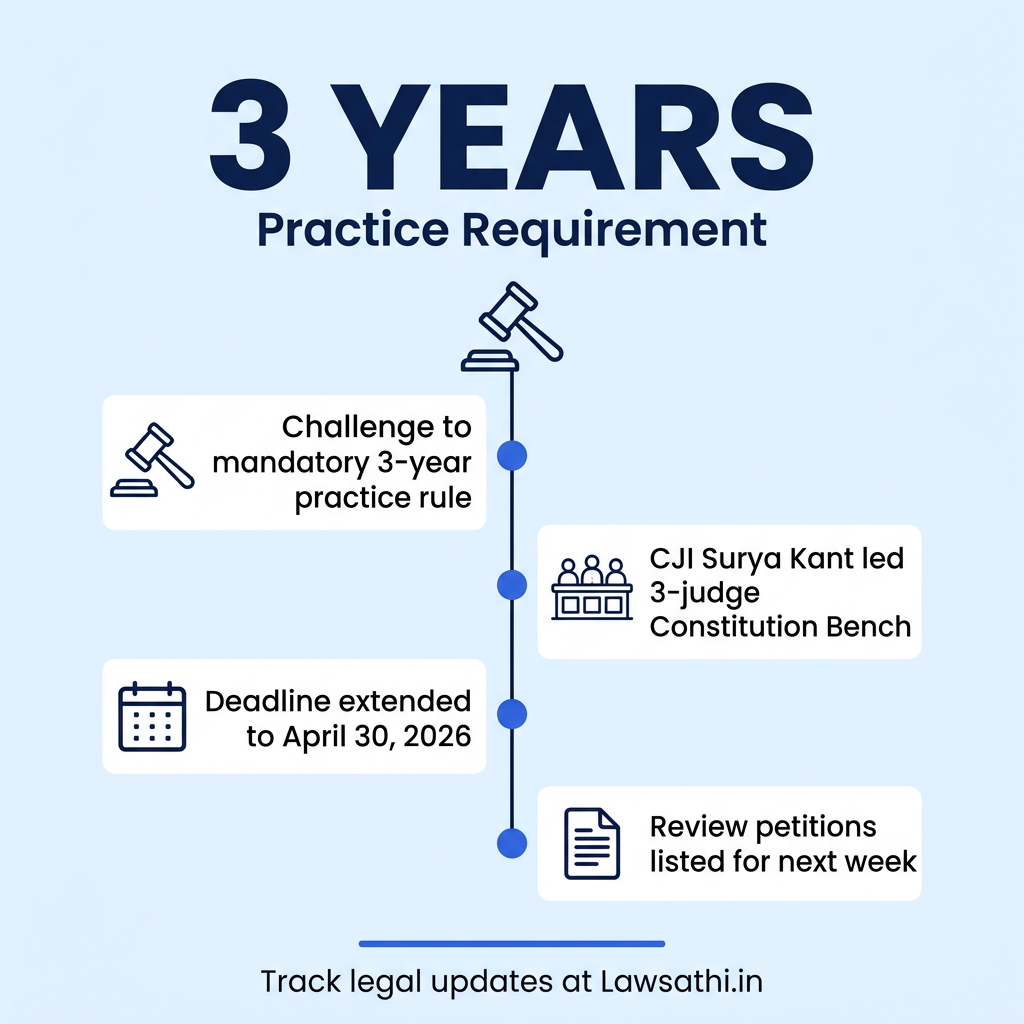
According to LiveLaw’s detailed report, the bench expressed nuanced views on this contentious issue. Chief Justice Surya Kant led the three-judge bench comprising Justice Augustine George Masih and Justice K. Vinod Chandran. The matter involved review petitions against the Court’s earlier judgment upholding the practice condition.
Key Judicial Observations
The bench delivered several significant observations during the hearing. Chief Justice Surya Kant emphasized the importance of practical legal experience for judicial officers. He stated that the practice condition serves legitimate institutional interests. Furthermore, it ensures competent judicial administration.
Moreover, Justice K. Vinod Chandran expressed concern about coaching centre dependency among aspirants. He observed that current recruitment patterns often favor candidates who excel in academic preparation. However, the judiciary requires mature practitioners with real-world legal experience. These observations reflect the Court’s evolving perspective on judicial service reforms.
Final Order and Directions
The Court ultimately passed directions extending application deadlines for civil judge positions. All High Courts received instructions to accept applications until April 30, 2026. Additionally, the Court scheduled further hearings on the review petitions for the following week. The Bar & Bench coverage highlighted the bench’s internal divisions on potential alternative approaches.
Bench Composition and Judicial Analysis
Chief Justice’s Court Configuration
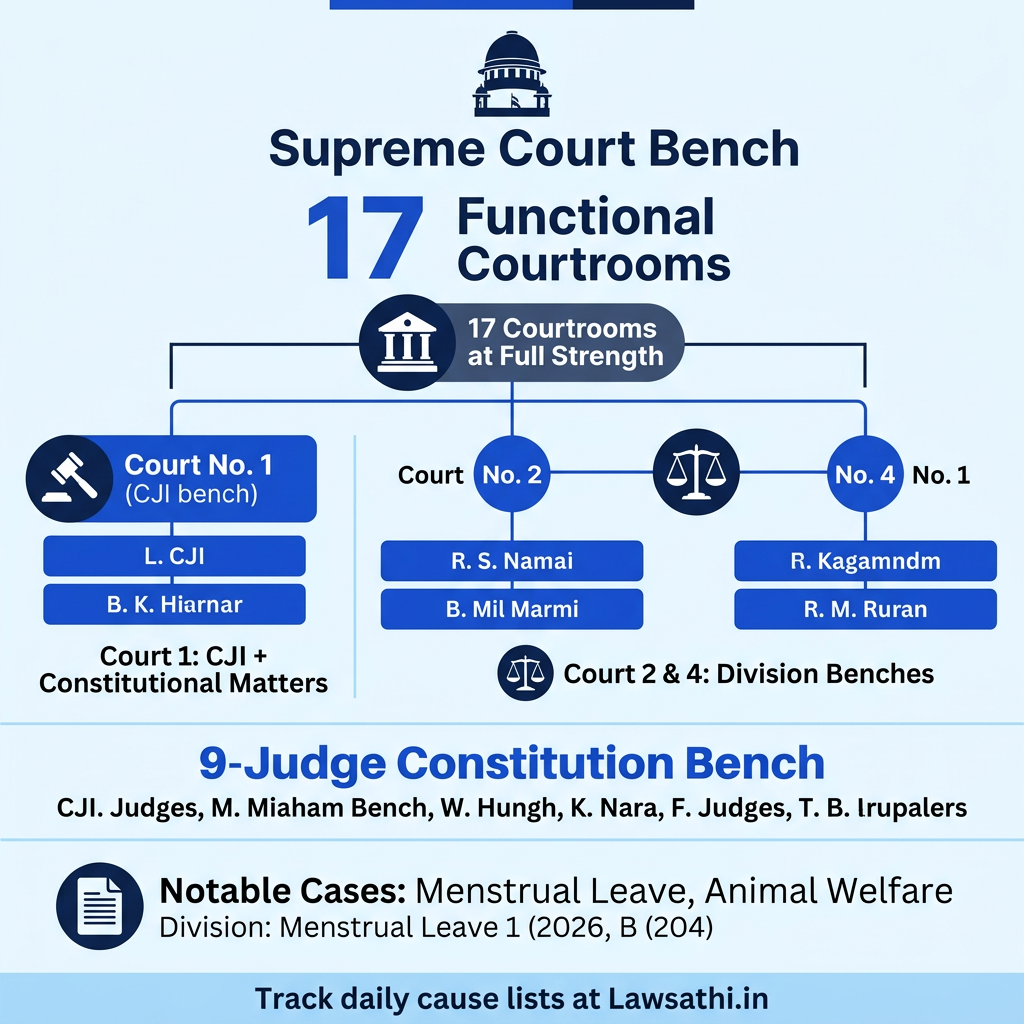
The Supreme Court cause list March 13 2026 revealed Chief Justice Surya Kant presiding over Court No. 1. He was accompanied by Justice Joymalya Bagchi and Justice Vipul M. Pancholi for the morning session. The session began at 10:30 AM. This bench composition handled the most significant constitutional and public interest matters listed for the day.
Notably, the Court had recently notified the composition of a historic 9-Judge Constitution Bench. As reported by LiveLaw, this bench will address the definition of “industry” under industrial law. The bench includes Chief Justice Surya Kant along with several distinguished Justices. These include BV Nagarathna, PS Narasimha, Dipankar Datta, Ujjal Bhuyan, and Satish Chandra Sharma. Additionally, Justices Joymalya Bagchi, Alok Aradhe, and Vipul M. Pancholi complete the composition.
Division Bench Arrangements
Other notable division benches operated across Court Rooms 2 through 17. Justice Vikram Nath and Justice Sandeep Mehta constituted the Court No. 2 bench. Meanwhile, Justice J.K. Maheshwari and Justice Atul S. Chandurkar presided over Court No. 3 proceedings. Justice B.V. Nagarathna, known for her incisive judgments, sat with Justice Ujjal Bhuyan in Court No. 4.
Understanding bench composition helps advocates tailor their arguments appropriately. Each judge brings distinct jurisprudential perspectives and areas of expertise to the bench. For instance, Justice B.V. Nagarathna has consistently demonstrated strong positions on constitutional interpretation and federalism. Consequently, advocates appearing before her bench prepare accordingly.
Other Notable Cases from March 13, 2026
Animal Welfare Board Directions
In Gauri Maulekhi v. Union of India, the Supreme Court addressed compliance issues regarding State Animal Welfare Boards. The bench comprised Chief Justice Surya Kant and Justice Joymalya Bagchi. Together, they directed 12 States and 2 Union Territories to file affidavits. These affidavits must detail the formation status of their respective animal welfare boards.
As reported by LiveLaw, the Court expressed concern over non-compliance with statutory requirements. The Prevention of Cruelty to Animals Act mandates such boards at the state level. Therefore, this matter represents the Court’s ongoing commitment to animal welfare enforcement.
Menstrual Leave Policy Deliberations
Another significant matter involved menstrual leave policy for working women. The Court observed that mandating menstrual leave through judicial direction might inadvertently harm women’s career prospects. Instead, the bench suggested that the Union Government should consider framing an appropriate policy. This would occur through legislative or executive action.
This approach reflects the Court’s institutional restraint on policy matters best addressed by the legislature. The observation demonstrates judicial awareness of practical implications for women’s workforce participation. For employment law practitioners, such observations provide insight into the Court’s thinking on workplace welfare issues.
NAT Test in Blood Banks Matter
The case of Sarvesham Mangalam Foundation v. Union of India [W.P.(C) No. 184/2026] came before the Chief Justice’s bench. According to LiveLaw’s report, the petition sought mandatory NAT testing in all blood banks.
However, the Court declined to issue such directions. The reasoning centered on the significant financial burden mandatory NAT testing would impose on state governments. Additionally, the Court characterized this as a policy matter requiring consideration by the Health Ministry. This outcome illustrates the Court’s approach to resource-intensive public health interventions.
Understanding Supreme Court Cause List Navigation
Types of Cause Lists Published
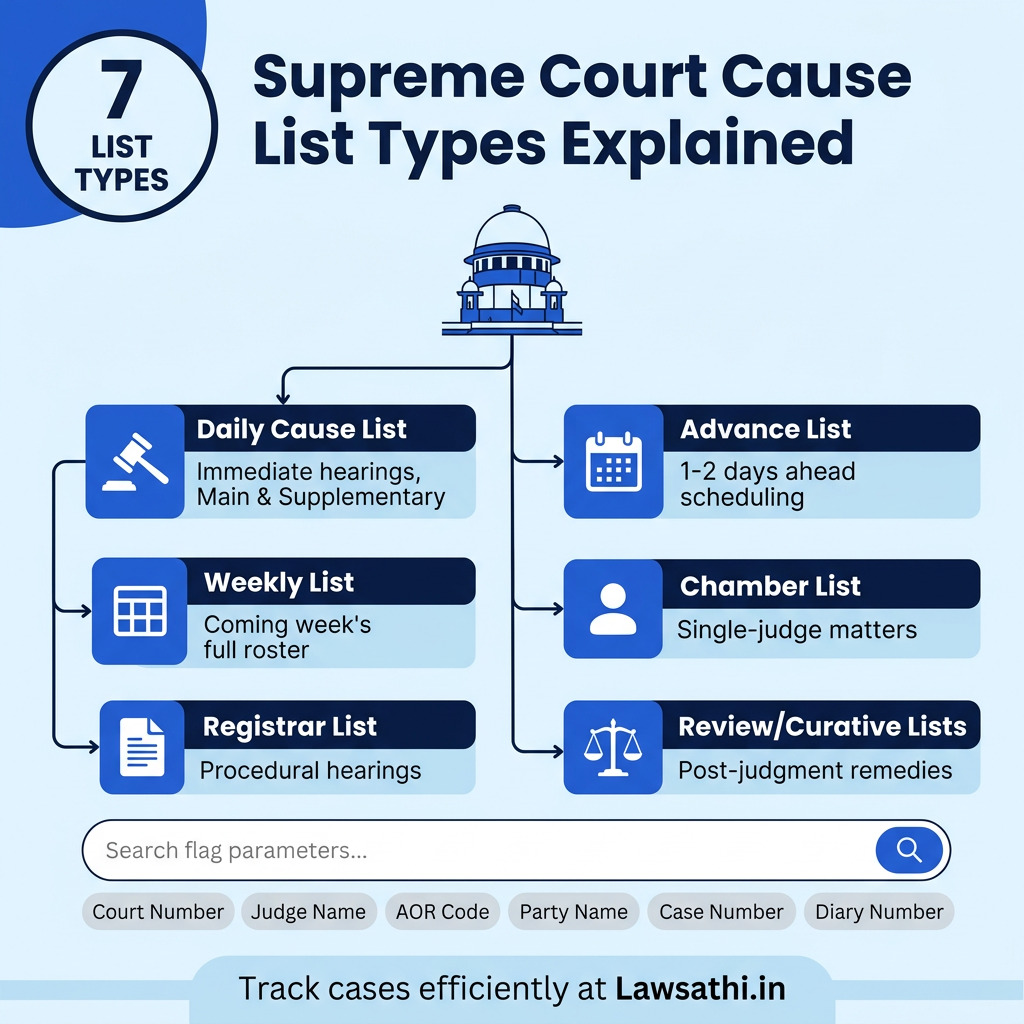
The Supreme Court publishes multiple categories of cause lists for different purposes. The Daily Cause List contains matters scheduled for immediate hearing, including Main and Supplementary lists. The Advance List provides notice of matters scheduled 1-2 days ahead. Furthermore, the Weekly List offers a comprehensive preview of the coming week’s roster.
Additionally, practitioners should monitor the Chamber List for single-judge matters. The Registrar List serves procedural hearings. Moreover, the Review and Curative Lists address post-judgment remedies. Each list type serves distinct procedural requirements in the Court’s functioning.
Effective Search Strategies
Navigating cause lists efficiently requires understanding multiple search parameters. The Supreme Court portal allows searches by Court Number, Judge Name, and AOR Code. Additionally, Party Name, Case Number, and Diary Number searches are available. For matters like tracking Siddharth Nath Vs. Union of India, using multiple search parameters increases accuracy.
The published cause list portal provides archived lists for reference. Practitioners can download PDF versions through the API portal for offline access. Understanding file naming conventions helps locate specific lists quickly. For example, Miscellaneous hearing lists follow the format MJ1.pdf. In contrast, Final hearing matters appear as FJ2.pdf.
Real-Time Monitoring Importance
For busy litigation practices, real-time cause list monitoring proves essential. The Court frequently issues supplementary lists and urgent listing notices throughout the day. Matters may shift between benches or receive fresh hearing dates. Therefore, advocates must maintain constant vigilance through official channels.
Modern practice management requires leveraging technology for efficient tracking. The Supreme Court’s all-updates page consolidates important announcements. Similarly, the case status portal enables tracking individual matters through CNR numbers and other identifiers.
Practical Tips for Advocates
Preparing for Miscellaneous Days
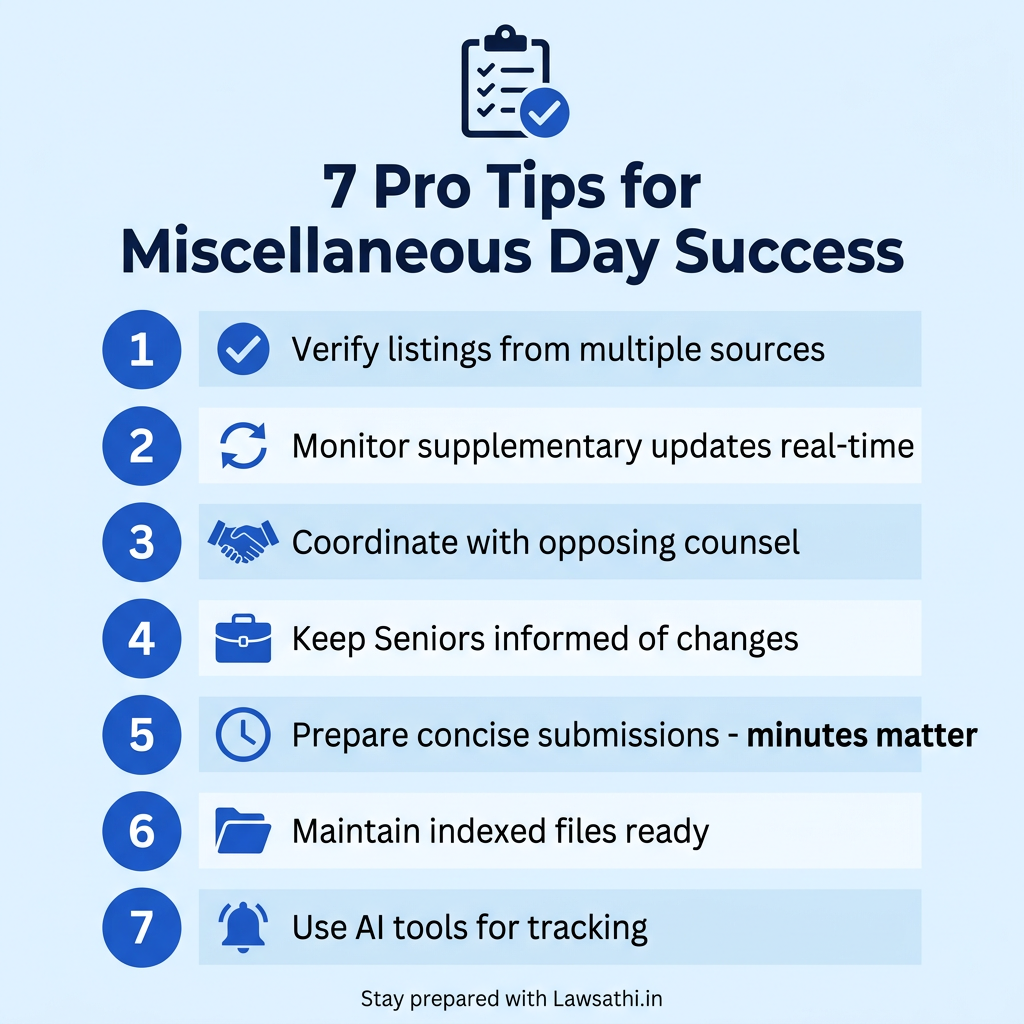
Miscellaneous days like March 13, 2026 require distinct preparation strategies compared to regular hearing days. Matters typically receive limited hearing time, often just minutes for interim relief requests. Therefore, advocates must prepare concise submissions focusing on essential elements.
First, verify listing status through multiple sources including the official website and government services portal. Second, prepare supplementary cause list updates which the Court releases periodically. Third, coordinate with opposing counsel to identify consent matters for efficient disposal. Finally, keep Senior Advocates informed of any last-minute bench changes or listing modifications.
Documentation Best Practices
Proper documentation streamlines miscellaneous hearing appearances significantly. Maintain organized case files with indexed papers and marked citations. Prepare written submissions in advance whenever possible. Carry multiple copies of key documents for bench reference. Additionally, ensure all procedural requirements like court fees and vakalatnamas are complete.
For matters seeking urgent relief, prepare draft orders in advance. This facilitates immediate consideration by the bench. The Union of India v. Rohit Nathan judgment from March 11, 2026 demonstrates how procedural preparation impacts outcomes. That matter addressed OBC creamy layer determinations with significant implications for service jurisprudence.
Technology Integration for Practice Management
Modern advocates increasingly rely on technology for cause list management. Digital tools enable automatic tracking of listed matters and instant notifications. Cloud-based practice management platforms consolidate case information across multiple courts. For Supreme Court practitioners, such tools prove invaluable given the volume of daily listings.
The Supreme Court cause list March 13 2026 exemplifies this challenge. With 17 courts operating simultaneously, manual tracking becomes nearly impossible. AI-powered solutions can analyze patterns and predict listing probabilities. Furthermore, they can identify related matters across different courts for coordinated strategy.
Conclusion: Staying Ahead in Supreme Court Practice
The Supreme Court cause list March 13 2026 demonstrated the Court’s active engagement with diverse legal issues. From judicial service reforms to animal welfare enforcement, the day’s proceedings touched multiple aspects of Indian law. While the specific matter of Siddharth Nath Vs. Union of India could not be verified through available sources, the day offered substantial developments. Legal practitioners had much to track and analyze.
Understanding cause list navigation and bench composition empowers advocates to practice more effectively. The Court’s digital infrastructure provides numerous tools for real-time monitoring and case tracking. However, leveraging these resources systematically requires modern practice management approaches.
Stay ahead of your litigation schedule with LawSathi. Our AI-powered platform tracks cause lists, updates case status in real-time, and organizes your court dates automatically. Try LawSathi for free today and never miss a hearing update.