The Supreme Court’s latest ruling on Section 439 CrPC bail power has sent a clear message to High Courts across India. In a significant judgment delivered on January 9, 2026, the apex court restricted High Courts from conducting detailed evidence appreciation during bail hearings.
This landmark decision in State of Uttar Pradesh v. Anurudh & Anr 2026 INSC 47 fundamentally reshapes criminal practice. Specifically, it changes how practitioners must approach bail applications.
The core issue before the Court was whether High Courts can effectively conduct a “mini-trial” at the bail stage. Many High Courts had begun examining evidence in excruciating detail before granting bail. However, the Supreme Court firmly rejected this approach. Consequently, the ruling establishes that bail adjudication is distinctly different from trial proceedings.
For criminal lawyers practicing in High Courts, this judgment carries profound implications. It changes the very strategy of drafting and opposing bail applications. Therefore, understanding the nuances of this ruling is essential for effective criminal litigation practice.
The Statutory Framework: Understanding Section 439 CrPC
Special Powers of Higher Courts
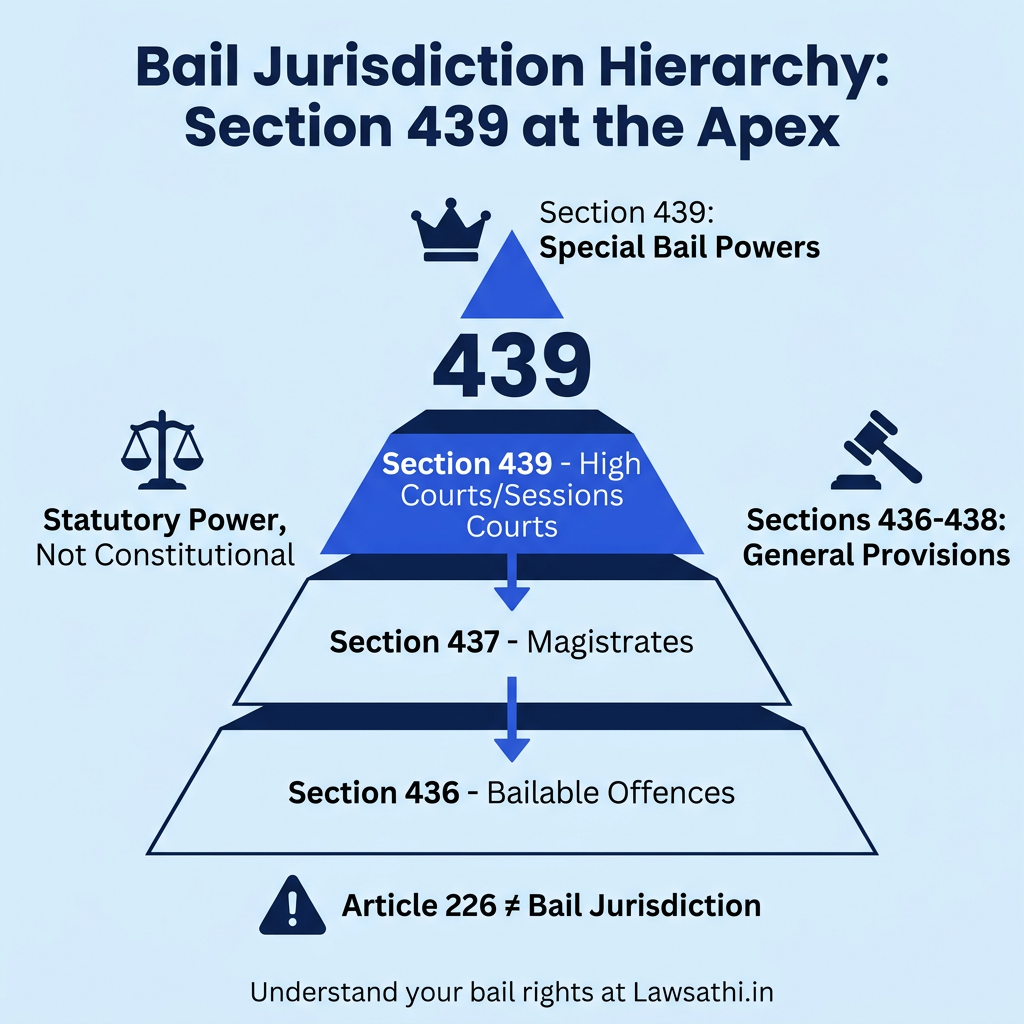
Section 439 CrPC confers special powers upon High Courts and Sessions Courts regarding bail matters. Unlike general bail provisions under Sections 436-438, this section provides broader discretionary authority. However, this discretion has definite boundaries.
The provision empowers these courts to grant bail in cases where lower courts might lack jurisdiction. Additionally, they can impose conditions and even cancel bail when necessary. The text of Section 439 CrPC explicitly outlines these powers.
Distinction from General Bail Provisions
The Code of Criminal Procedure creates a hierarchical structure for bail jurisdiction. Section 436 applies to bailable offences where bail is a matter of right. Section 437 governs non-bailable offences before Magistrates with limited discretion. Furthermore, Section 438 deals with anticipatory bail for pre-arrest protection.
In contrast, Section 439 CrPC bail power represents the highest level of bail jurisdiction. Sessions Courts and High Courts exercise this authority with greater flexibility. Nevertheless, the Supreme Court has now clarified that this flexibility does not extend to evidence re-appreciation.
Constitutional Versus Statutory Power
The judgment draws a crucial distinction between constitutional and statutory powers. High Courts possess inherent constitutional powers under Article 226. However, bail jurisdiction under Section 439 derives solely from statute.
The Court emphasized that constitutional power cannot expand statutory jurisdiction beyond legislative intent. As stated in the judgment, both powers coexist but serve different purposes. Therefore, one cannot usurp the ambit of another without explicit legal sanction.
The Supreme Court’s Ruling: Restricting Re-Appreciation of Evidence
The Core Legal Principle
The Supreme Court’s pronouncement was unambiguous in its clarity. Specifically, a court at the bail stage cannot conduct a mini-trial under any circumstances. This position, the Court noted, is “trite in law” and requires no elaborate restatement.
In State of Uttar Pradesh v. Anurudh, the Allahabad High Court had issued comprehensive policy directions in a POCSO case. The directions mandated medical age determination tests across all such cases in Uttar Pradesh. However, the Supreme Court held this approach was fundamentally flawed and “coram non judice.”
Key Excerpts on Section 439 Limitations
The Court extensively quoted from precedent to establish the proper scope of bail proceedings. In Vaman Narain Ghiya v. State of Rajasthan [(2009) 2 SCC 281], the Supreme Court had previously laid down clear guidelines. Therefore, detailed discussion of evidence at the bail stage must be avoided completely.
Furthermore, the judgment cited State v. M. Murugesan [(2020) 15 SCC 251] with approval. That case held that academically proper directions cannot be issued under the colour of judicial office during bail proceedings. Consequently, the jurisdiction under Section 439 remains strictly limited to grant or denial of bail.
The Prima Facie Test Explained
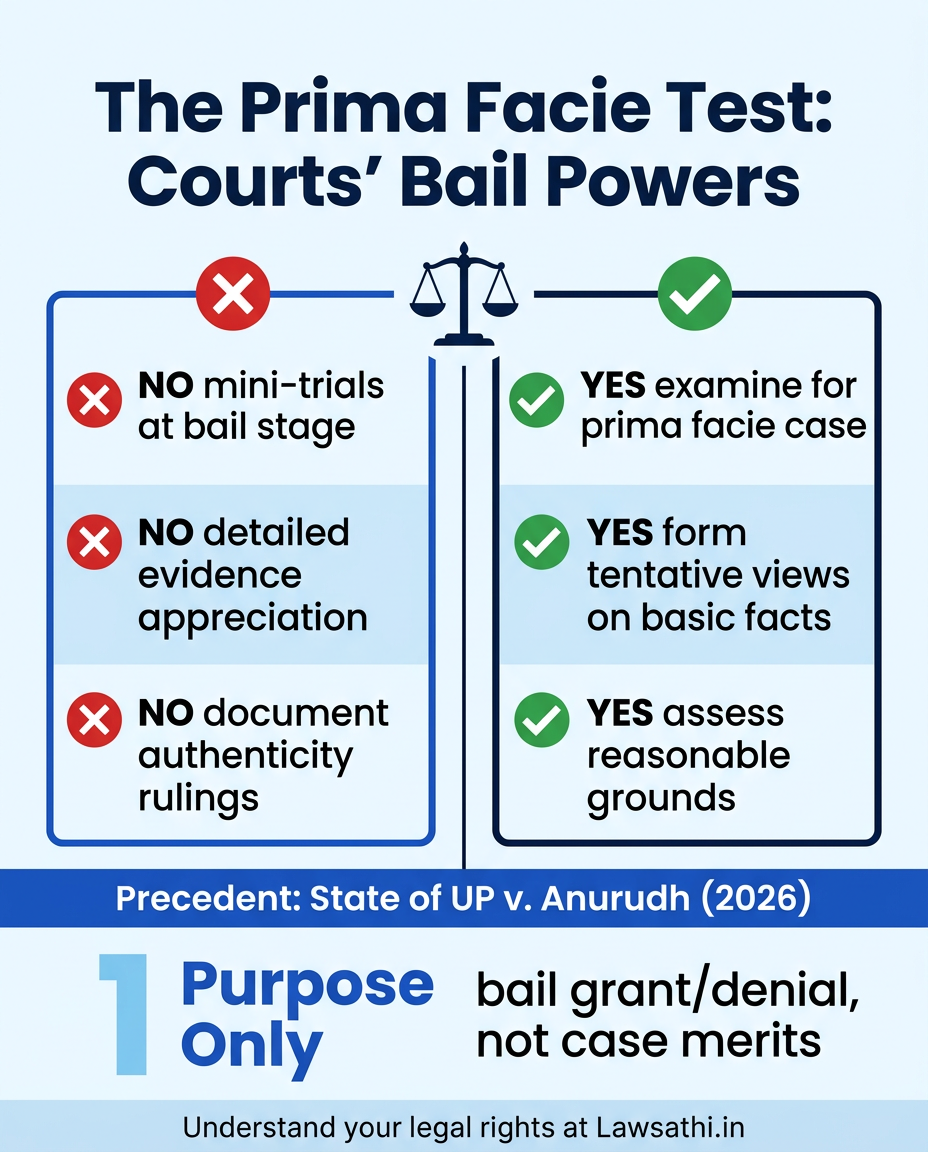
The Supreme Court articulated a clear test for bail courts to follow. First, courts may examine documents to establish whether a prima facie case exists. Second, they can form a tentative view on basic facts like age or identity of parties. However, they cannot enter into the correctness or veracity of produced documents.
For example, if a victim’s age becomes relevant at the bail stage, the court takes a prima facie view. It does not adjudicate the authenticity of age-proof documents. Instead, that task belongs exclusively to the trial court after proper evidentiary examination.
As the Court explicitly stated, detailed appreciation of evidence remains impermissible throughout bail proceedings. Therefore, the focus must remain on whether reasonable grounds exist to believe the accused may not be guilty.
Rationale Behind the Restriction
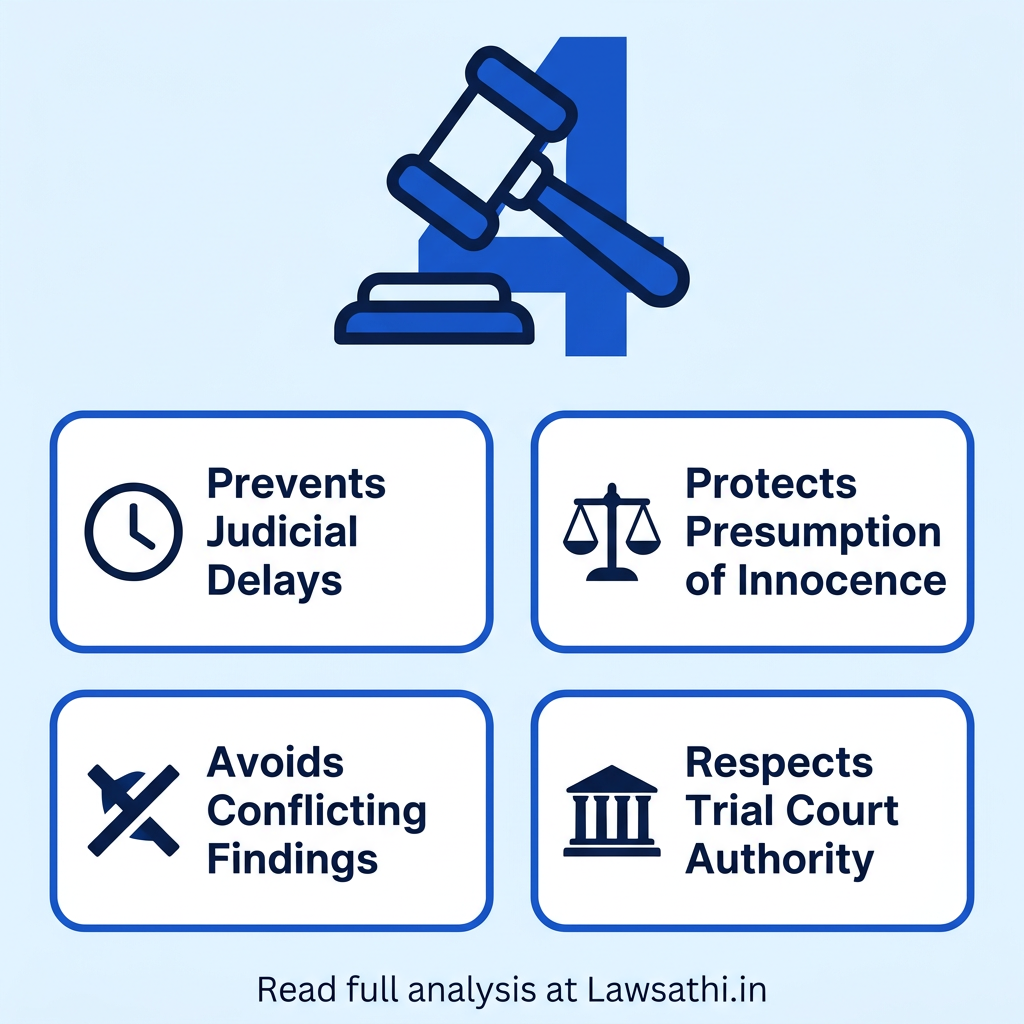
Preventing Delay in Trial Proceedings
Detailed bail orders examining evidence at length cause significant procedural delays. When High Courts engage in extensive evidence analysis, precious judicial time gets consumed unnecessarily. As a result, this delays not just the bail decision but impacts overall court efficiency.
Moreover, such detailed orders create expectations among litigants about the merits of their case. Parties may believe the court has already pre-judged crucial aspects. Consequently, this perception undermines the trial court’s authority and the fairness of subsequent proceedings.
Upholding the Presumption of Innocence
The fundamental principle of criminal jurisprudence requires preserving the presumption of innocence. However, detailed evidence appreciation at bail stage effectively prejudges the case. Therefore, this approach violates the accused’s right to a fair trial before a neutral adjudicator.
The Supreme Court in Jayshree Kanabar v. State of Maharashtra 2025 INSC 13 reinforced this principle strongly. Recording determinate, exculpatory findings on roles or contact with co-accused is impermissible. As a result, such findings prejudice the fair trial that every accused person deserves.
Avoiding Conflicting Findings of Fact
Perhaps the most practical concern involves conflicting judicial findings. When bail courts make detailed factual observations, these may contradict eventual trial verdicts. Consequently, this creates procedural complications that serve no one’s interest.
The Kerala High Court observed in 2025 that prima facie findings in bail orders do not bind trial courts. However, the very existence of such detailed findings creates confusion. In fact, trial courts may feel constrained by observations from higher courts, even when technically non-binding.
Respecting Trial Court Jurisdiction
Trial courts possess specialized fact-finding authority under the CrPC. They examine witnesses under oath and assess documentary evidence through established procedures. Therefore, bail courts exercising Section 439 CrPC bail power must respect this jurisdictional boundary.
The Supreme Court’s ruling protects the integrity of the trial process. It ensures that evidence evaluation happens where it properly belongs—in the trial court. Thus, this preserves both procedural correctness and substantive justice.
Practical Implications for Criminal Practitioners
Changing Bail Application Strategy
This ruling fundamentally transforms how lawyers must approach High Court bail applications. The traditional strategy of challenging evidence merits at length no longer holds validity. Therefore, practitioners must recalibrate their approach entirely.
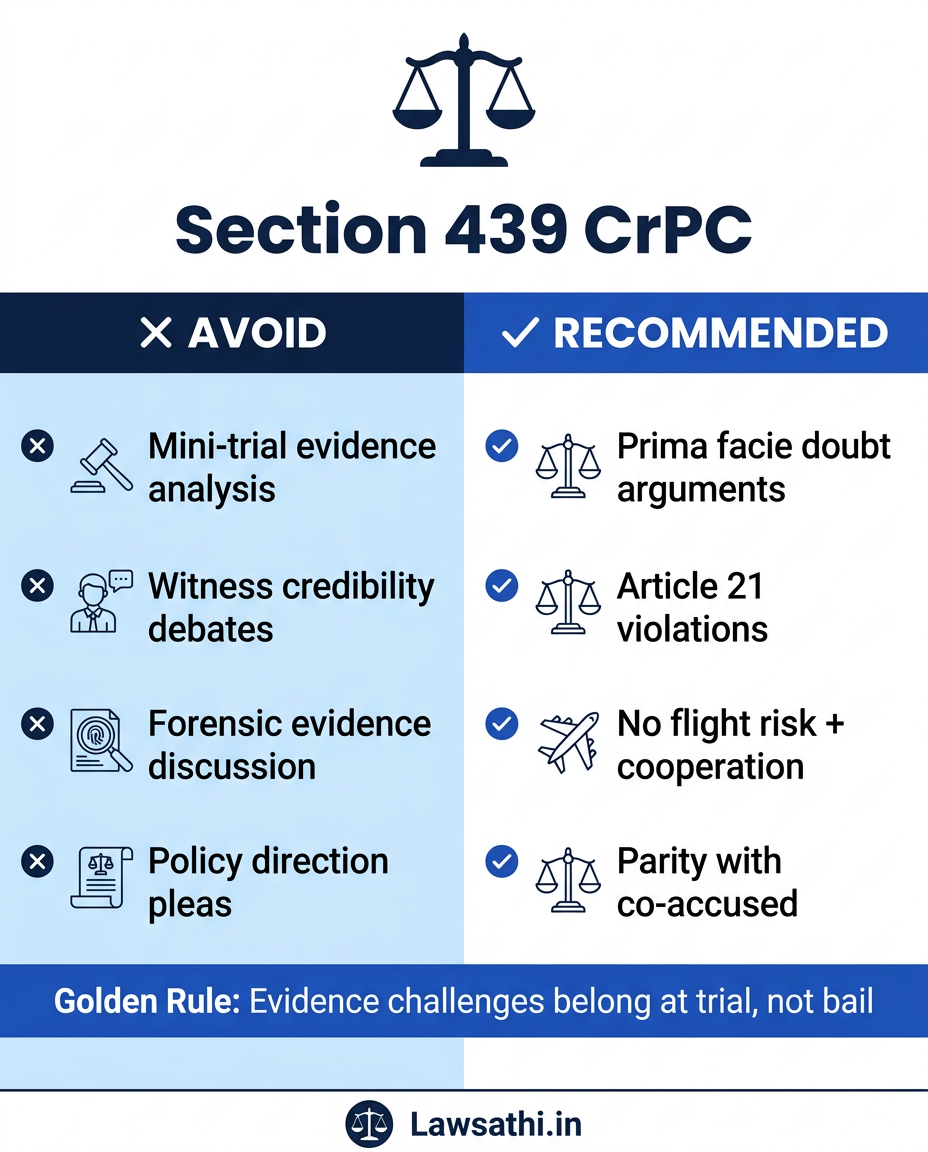
Arguments lawyers should now avoid include:
– Detailed analysis of witness credibility at the bail stage – Extensive discussion of medical or forensic evidence quality – Requests for courts to determine evidence admissibility – Seeking policy directions through individual bail matters
Instead, the focus must shift to establishing prima facie doubt regarding the prosecution case. Lawyers should emphasize procedural compliance and constitutional considerations. In other words, the argument structure must respect the limitations the Supreme Court has now clarified.
Recommended Arguments for Defense Counsel
Defense lawyers should concentrate on specific, permissible grounds for bail. First, they can argue that prima facie doubt exists about the accused’s involvement. Second, prolonged detention without trial violates Article 21 rights. Third, any procedural irregularities during investigation warrant consideration.
Additionally, conduct-based arguments remain fully valid. For instance, cooperation with investigation demonstrates good faith. Absence of flight risk supports bail grant. Furthermore, no evidence of witness tampering strengthens the application. Parity with similarly placed co-accused persons provides another legitimate ground.
Sample Defense Argument Structure
A properly structured bail argument after this ruling might proceed as follows:
> “It is respectfully submitted that at the bail stage, this Hon’ble Court is not required to conduct detailed evidence appreciation. The settled position, as affirmed in State of Uttar Pradesh v. Anurudh, permits only prima facie examination. The documents on record indicate reasonable grounds exist to believe the accused may not be guilty.”
This approach respects judicial boundaries while effectively advocating for the client. Additionally, it aligns with the Supreme Court bail judgment framework without overreaching.
Strategy for Prosecution Counsel
Prosecutors also benefit from understanding this judgment’s implications. When defense counsel attempts detailed evidence analysis, prosecutors should promptly object. Specifically, they can cite the mini-trial prohibition established in recent precedents.
Furthermore, prosecutors should emphasize statutory requirements under special laws. For POCSO, NDPS, UAPA, and PMLA cases, specific statutory rigours apply. Therefore, the bail court’s limited jurisdiction becomes even more relevant in these contexts.
As noted in recent Supreme Court observations, bail must not be granted on irrelevant considerations. However, equally, it cannot be refused based on improper evidence analysis.
Conclusion: Balancing Liberty and Judicial Process
Summary of Established Principles
The Supreme Court has established clear boundaries for High Court bail jurisdiction. Section 439 CrPC bail power remains subject to statutory limitations. Furthermore, constitutional powers cannot expand this jurisdiction beyond legislative intent. Prima facie examination alone is permissible at the bail stage.
The judgment also clarifies that bail findings remain tentative and non-binding on trial courts. Moreover, no policy directions can be issued through bail proceedings. These principles create a coherent framework for bail adjudication across India.
Exceptional Cases and Nuanced Approach
However, the Court acknowledged that exceptional circumstances may warrant broader consideration. When continued custody violates Article 21 due to prolonged detention, constitutional remedies remain available. Therefore, in such cases, courts can address fundamental rights violations without conducting evidence analysis.
Additionally, health conditions and advanced age of accused persons remain relevant factors. Procedural irregularities under special laws also merit examination at the bail stage. Thus, these limited exceptions preserve flexibility while maintaining the core prohibition against mini-trials.
Future Outlook for Bail Jurisprudence
The legal commentary on this ruling,-2025-insc-1181/view) suggests stricter adherence to jurisdictional limits ahead. Courts will likely show less tolerance for policy directions in bail matters. Consequently, constitutional grounds for bail under special laws will receive more emphasis than evidentiary arguments.
For practitioners, this means developing new strategies that respect these boundaries. Focus on speedy trial rights and procedural compliance will yield better results. Therefore, detailed evidence challenges should await the trial stage where they properly belong.
The Supreme Court has also circulated the judgment to the Law Ministry for policy consideration. This may lead to legislative reforms addressing adolescent relationships under POCSO. As a result, such developments could further reshape bail jurisprudence in sensitive cases.
Stay ahead of critical legal updates. Automate your case tracking and legal research with LawSathi. Sign up for a free trial today.