The Supreme Court latest orders uploaded on 20 March 2026 offer critical insights for legal practitioners across India. Over 100 orders are processed daily across various categories. Therefore, staying updated with these developments has become essential for litigators. Among the significant rulings of the day, the transfer petition in Aditi Chhonkar Vs. Dhawal Kaushal stands out. Specifically, this case represents a noteworthy development in matrimonial jurisprudence. This blog provides a comprehensive analysis of this case and other key orders from the day’s cause list.
Introduction: Supreme Court Developments on 20 March 2026
Daily Order Volume and Practice Areas
The Supreme Court of India routinely processes a substantial volume of orders each working day. On 20 March 2026, the Court addressed matters spanning criminal appeals, civil disputes, transfer petitions, and constitutional questions. Legal practitioners must track these daily developments through the Latest Orders portal and published cause lists.
Furthermore, understanding the Court’s current approach to different categories of matters helps lawyers advise clients more effectively. The Daily Round-Up for March 20, 2026 reported 19 major rulings across diverse practice areas.
Importance of Tracking Supreme Court Latest Orders
For practicing advocates, monitoring the Supreme Court latest orders serves multiple strategic purposes. First, it reveals emerging judicial trends that may affect pending matters. Second, it provides precedential value for argumentation in lower courts. Third, it helps identify the Court’s priorities and concerns during case management.
Additionally, the Cause List portal publishes listings for all Courts (1-17 plus Registrar Court). These include Miscellaneous, Regular, Chamber, and Review/Curative listings. Therefore, lawyers with matters before the apex court must develop systems for real-time tracking of judicial developments.
Case Spotlight: Aditi Chhonkar Vs. Dhawal Kaushal T.P.(C) No. 568/2026
Background of the Transfer Petition
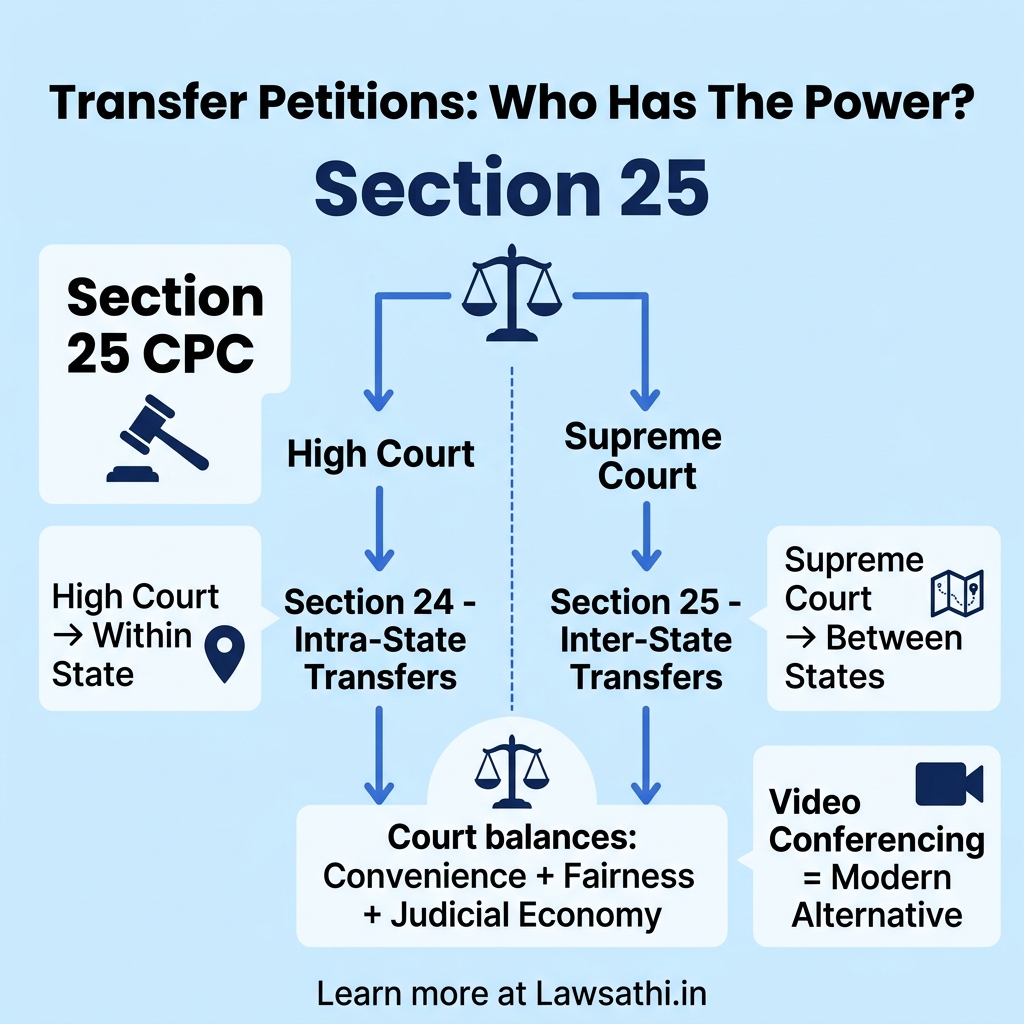
Transfer Petition (Civil) No. 568 of 2026, titled Aditi Chhonkar Vs. Dhawal Kaushal, represents a typical matrimonial transfer dispute. Specifically, this matter reached the Supreme Court for adjudication. The petitioner, Aditi Chhonkar, sought transfer of divorce proceedings from one jurisdiction to another. Such petitions are governed by Section 25 of the Code of Civil Procedure, 1908.
Section 25 empowers the Supreme Court to transfer suits, appeals, or other proceedings from one State to another. However, the Court must be satisfied that such transfer is “expedient for the ends of justice.” The provision specifically applies to matrimonial proceedings under the Hindu Marriage Act. This principle was established in Guda Vijayalakshmi v. Guda Ramachandra Sekhara Sastry (1981) see analysis here.
Jurisdictional Conflict and Factual Matrix
The transfer petition arose from parallel matrimonial proceedings in different states. The petitioner-wife sought transfer of the divorce petition filed by the respondent-husband. She requested transfer to her current place of residence. This scenario represents a common jurisdictional conflict in matrimonial disputes.
In such cases, the wife typically argues that traveling to the husband’s chosen venue causes hardship. Moreover, she may cite the presence of minor children, health concerns, or pending litigation at her residence. The respondent, conversely, often resists transfer citing advanced stage of proceedings or witness convenience.
Arguments Presented Before the Court
The petitioner’s counsel emphasized the constitutional mandate of access to justice. Specifically, the argument highlighted that procedural technicalities should not obstruct substantive rights. The respondent’s counsel, however, pointed to the stage of proceedings. Additionally, he referenced prior agreements regarding venue.
For comparison, consider Lovely Singh v. Vivek Singh T.P.(C) No. 2788/2024. There, a similar transfer was allowed where the petitioner-wife had a minor child. The Court noted the difficulty of traveling with a young daughter as a decisive factor.
Key Observations and Ratio Decidendi
Legal Framework Under Section 25 CPC
The Supreme Court’s order in Aditi Chhonkar’s case reiterates established principles of transfer jurisdiction. Section 25 CPC creates an extraordinary power. This power is exercisable only when “expedient for the ends of justice.” The Court must balance competing considerations of convenience, fairness, and judicial economy.
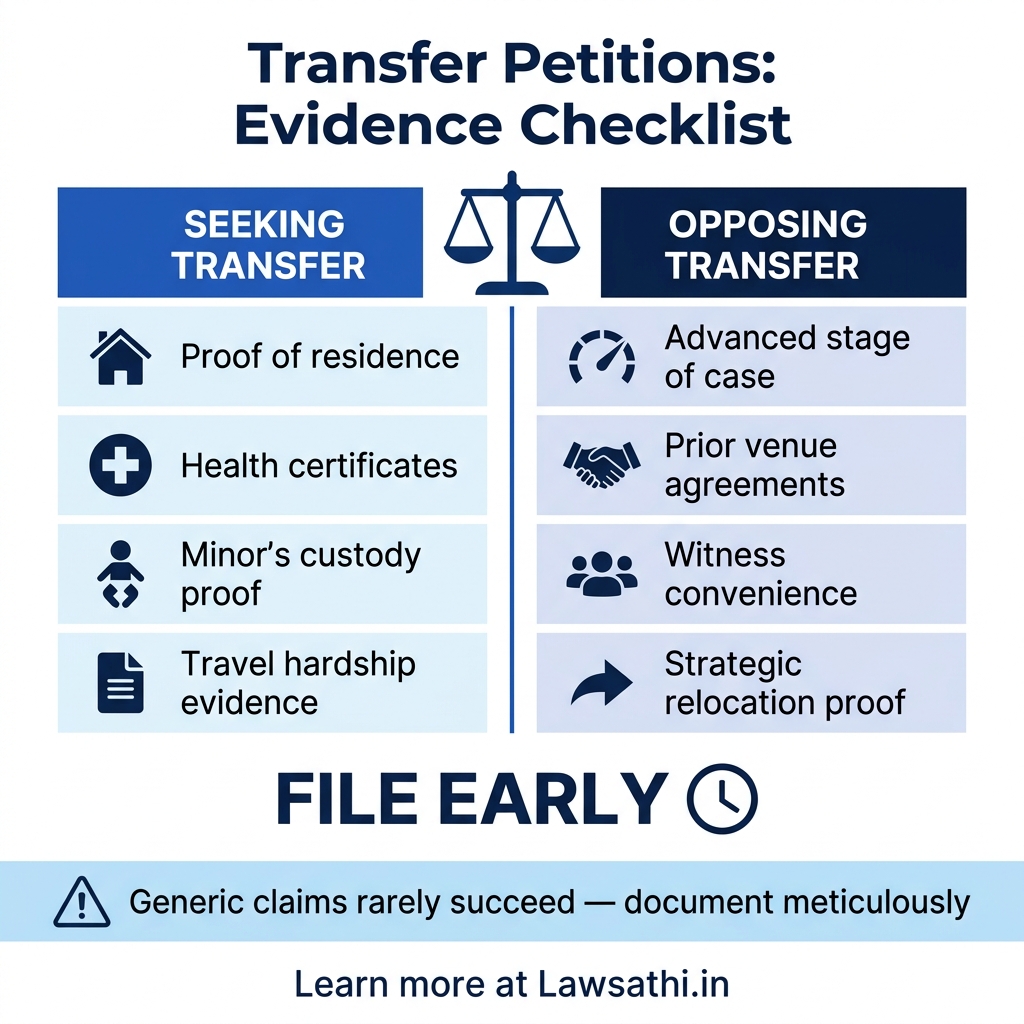
Furthermore, the scope of Section 25 versus Section 24 CPC has been clarified in recent jurisprudence. Section 24 empowers High Courts for intra-state transfers. In contrast, Section 25 reserves inter-state transfers exclusively for the Supreme Court. This distinction becomes crucial when parties reside in different states.
Balancing Convenience and Fairness
The Court’s analysis in transfer petitions increasingly focuses on practical alternatives to physical transfer. Modern technology, particularly video conferencing, has transformed this area of law. In fact, recent orders routinely provide for virtual appearance while denying formal transfer.
For instance, consider Sumit Kaur Malhotra v. Ajitesh Chauhan T.P.(C) No. 2920/2024. The Court allowed transfer but permitted the respondent to appear via video conference. This balanced approach recognizes both parties’ legitimate concerns.
Precedents Influencing the Decision
The bench in Aditi Chhonkar’s matter likely considered several binding precedents. First, the principle that wife’s convenience, while important, is not paramount. The Madhya Pradesh High Court recently observed that alternatives may suffice. Specifically, video conferencing or travel compensation could address convenience concerns.
Second, the stage of proceedings significantly affects transfer outcomes. The Kerala High Court’s March 2026 ruling held that transfer at an advanced trial stage is unsustainable. Therefore, timing of the transfer petition remains strategically crucial.
Implications for Family Law Practice in India
Strategic Considerations for Transfer Petitions
Lawyers handling multi-jurisdictional divorce cases must carefully evaluate transfer strategy. Filing a transfer petition at the Supreme Court involves significant time and cost. Moreover, success depends on specific evidentiary factors that practitioners must document comprehensively.
Additionally, the Court has objected to repeated transfer petitions where parties frequently change residence. Such conduct undermines the credibility of transfer requests. Counsel must therefore advise clients on the risks of multiple filings.
Evidentiary Standards for Transfer Requests
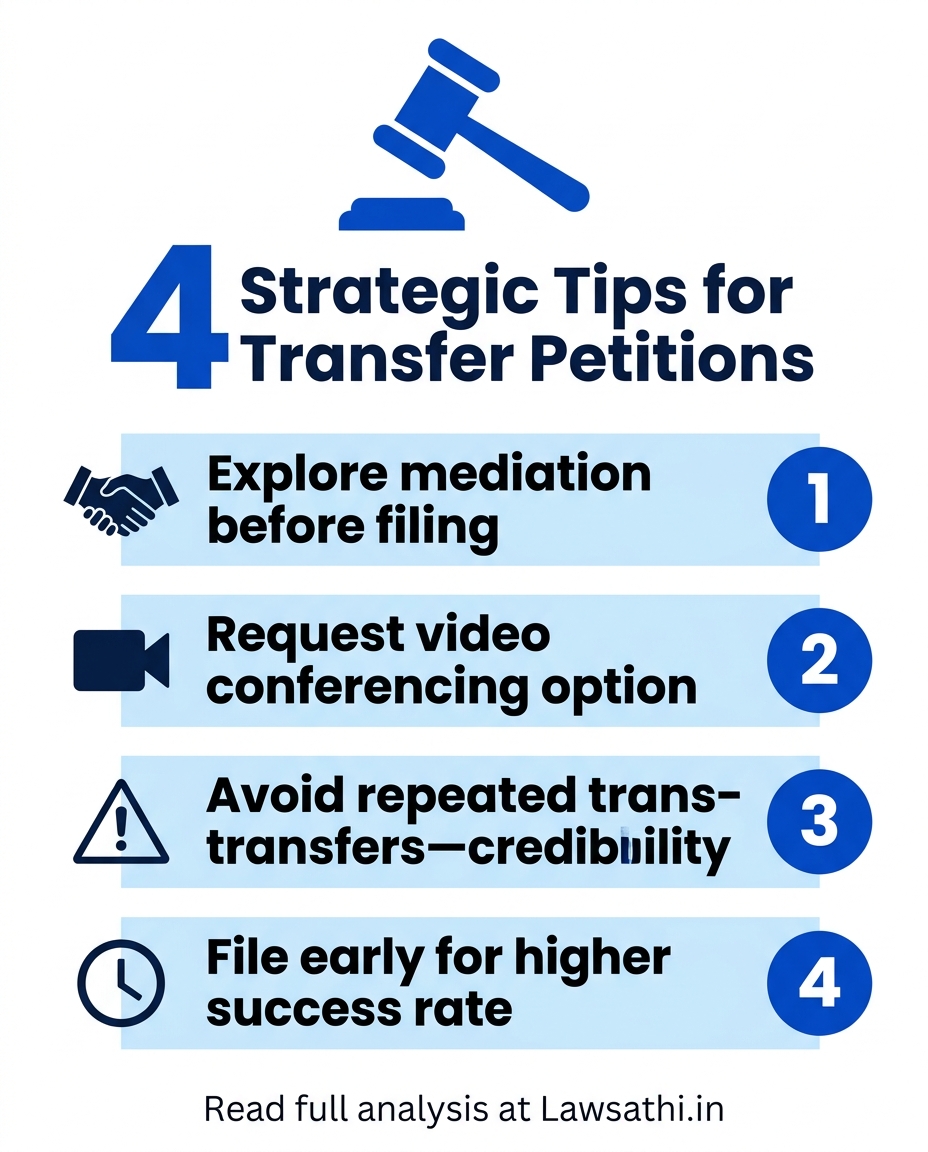
Practitioners should prepare the following documentation when seeking transfer:
– Proof of residence at the transfer destination – Medical certificates if health grounds are claimed – Evidence of minor children’s custody and schooling – Details of pending cases at the destination court – Documentation of distance and travel hardship
Conversely, opposing a transfer requires showing:
– Advanced stage of proceedings – Prior agreements regarding venue – Witness convenience at original venue – Evidence of strategic relocation by petitioner
Practical Advice for Litigators
First, explore settlement or mediation before filing transfer petitions. The Supreme Court often refers parties to mediation in matrimonial matters. Second, consider seeking video conferencing facility rather than formal transfer. Courts increasingly favor this middle path that accommodates both parties.
Third, document all instances of hardship meticulously. Generic claims without supporting evidence rarely succeed. Finally, timing matters critically. Therefore, file early in the proceedings for best results.
Other Significant Orders Uploaded on 20 March 2026
Criminal Law Developments
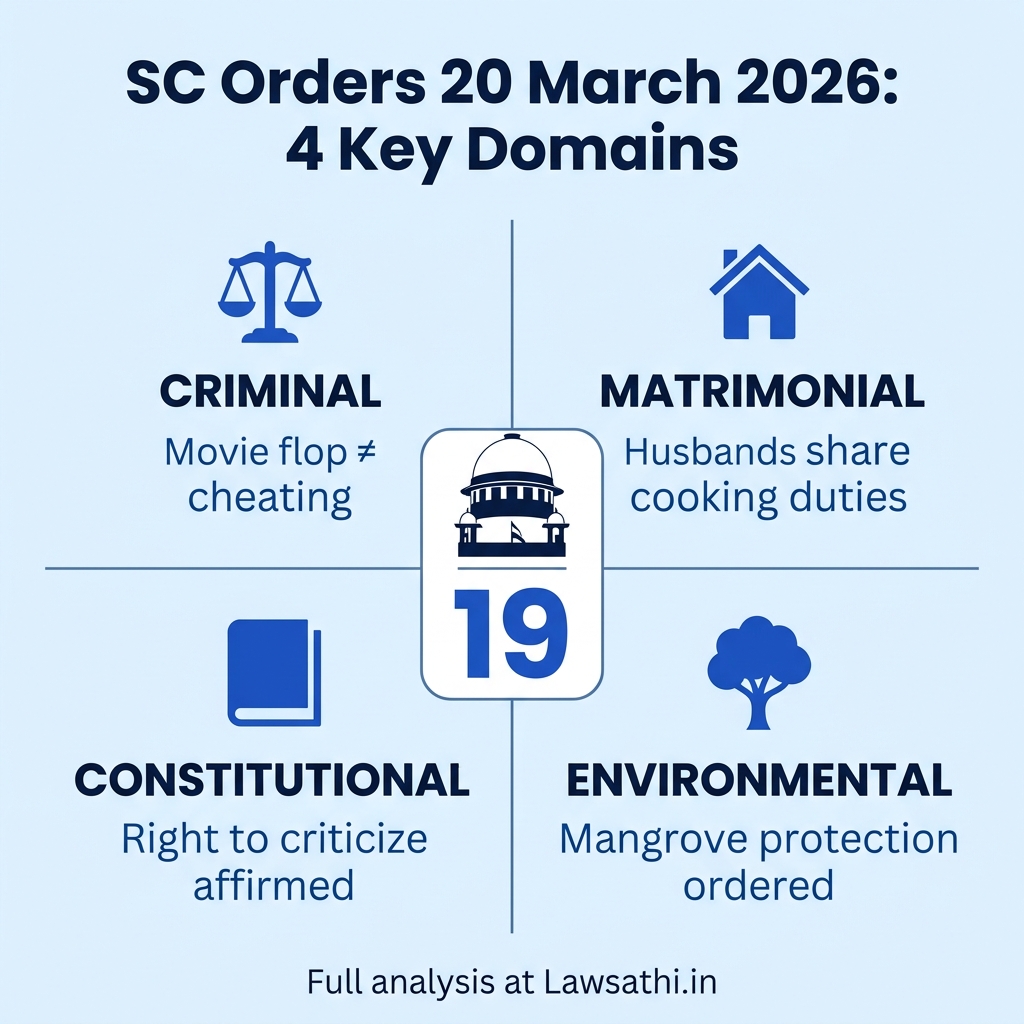
The Supreme Court latest orders on 20 March 2026 included several significant criminal law rulings. In a notable observation, the Court stated that “a movie can be flop too.” Consequently, this alone cannot constitute cheating merely because film investment failed to yield returns. This reinforces the distinction between commercial failure and criminal fraud.
Furthermore, the Court held that High Courts can look beyond the FIR to quash frivolous criminal proceedings. This strengthens the inherent power under Section 482 CrPC for protecting against abuse of process. Additionally, calling a debtor for loan repayment was clarified as not constituting abetment of suicide. This observation provides significant relief for creditors.
Matrimonial and Family Law Observations
A particularly noteworthy observation emerged in a matrimonial matter. The Court reportedly remarked, “You are not marrying a maid, husband also must contribute to cooking.” Such observations, while obiter, reflect the judiciary’s progressive approach to gender roles and domestic responsibilities.
These comments align with broader judicial trends recognizing shared domestic obligations. For family law practitioners, such observations provide valuable context for counseling clients on realistic expectations.
Constitutional and Public Interest Matters
The day’s orders also addressed significant constitutional questions. The NCERT textbook controversy continued with the Expert Committee reviewing the judiciary chapter. The Court affirmed people’s right to criticize judgments while maintaining judicial dignity.
Moreover, challenges to the Election Commissioners’ appointment law progressed through the docket. Environmental matters also featured in the day’s business. Specifically, these included mangrove cutting for coastal roads and Chambal Sanctuary issues.
Conclusion: Staying Ahead in Legal Research
The Supreme Court latest orders from 20 March 2026 demonstrate the Court’s multifaceted engagement with diverse legal questions. The Aditi Chhonkar Vs. Dhawal Kaushal ruling reinforces balanced principles of convenience and fairness. This decision sits within established transfer petition jurisprudence. For family law practitioners, the order provides guidance on evidentiary requirements and strategic timing.
However, the true value of such analysis lies in real-time application. Litigators who track judicial developments daily gain competitive advantages in strategy and client counseling. The Court’s approach to video conferencing alternatives directly affects case outcomes. Additionally, stage-of-proceedings considerations and evidentiary standards impact litigation strategy.
Therefore, systematic tracking of Supreme Court latest orders is no longer optional for serious practitioners. Technology now enables faster access and analysis of judicial trends. Those who leverage such tools position themselves for success in an increasingly complex legal landscape.
Stay updated with daily Supreme Court analysis and streamline your case research with LawSathi. Sign up for our legal newsletter or try our AI-powered case summarizer today.