The Supreme Court restrains ‘Ghooskhor Pandat’ in a significant interim order. This ruling has sparked debate across India’s legal and entertainment communities. The judgment was delivered by Justices B.V. Nagarathna and Ujjal Bhuyan in February 2026. It represents a pivotal moment in constitutional jurisprudence. Furthermore, the case raises fundamental questions about artistic freedom and constitutional fraternity in a diverse democracy.
At its core, the matter concerns whether a film title can be restrained for “vilifying a community.” This restraint would operate under Article 19(2) reasonable restrictions. The petitioners argued that the title perpetuates harmful stereotypes against an identifiable group. However, the filmmakers claimed protection under Article 19(1)(a) as creative expression.
Introduction: The Clash Between Artistic Freedom and Social Harmony
The Supreme Court’s intervention in the ‘Ghooskhor Pandat’ controversy marks a significant departure from traditional free speech jurisprudence. The case involves a Netflix series starring Manoj Bajpayee. It is directed by acclaimed filmmaker Neeraj Pandey. The title “Ghooskhor Pandat” translates to “Corrupt/Bribe-Taking Pandat” according to LiveLaw reports.
Understanding the Core Legal Question
The fundamental question before the Court was deceptively simple yet constitutionally complex. When does a film title cross the line from permissible satire to impermissible community vilification? The petitioners, representing the Brahman Samaj of India, argued that the title creates offensive stereotyping. Specifically, they claimed it links an identifiable community to corruption and bribery.
Furthermore, the case raises broader questions about constitutional values in India. The Supreme Court had to balance competing constitutional principles. On one side stood Article 19(1)(a) guaranteeing freedom of speech and expression. On the other side stood the constitutional duty of fraternity embedded in the Preamble and Article 51A(e).
Why This Ruling Matters for Constitutional Law
The significance of this ruling extends far beyond entertainment industry regulations. This judgment represents one of the first major pronouncements in 2026 addressing fraternity as a constitutional limitation on free speech. Previous cases primarily dealt with public order concerns or individual defamation claims.
However, this case introduced a different framework altogether. The Court framed community dignity as a constitutional value worthy of protection. As Bar & Bench reported, the Court asked directly: “Why should you denigrate a section of society by this kind of title?”
Factual Matrix: Why the Court Intervened
The factual background reveals why the Supreme Court took the unusual step of restraining a film title before release. Atul Mishra, National Organisation Secretary of Brahman Samaj of India, filed the petition. He argued that the title creates collective defamation of the entire Brahmin community.
Decoding the Term ‘Ghooskhor Pandat’
The term “Ghooskhor” means bribe-taker or corrupt person in Hindi. “Pandat” represents a traditional spelling variant of “Pandit.” This term is historically associated with the Brahmin community and Acharyas. Therefore, the combination creates a direct association between a specific community and corruption.
The petitioners presented detailed arguments about the implications of this nomenclature. They contended that the title perpetuates negative stereotypes. Additionally, they argued it would cause irreversible harm to the dignity and reputation of Acharyas and community members.
Arguments Presented Before the Court
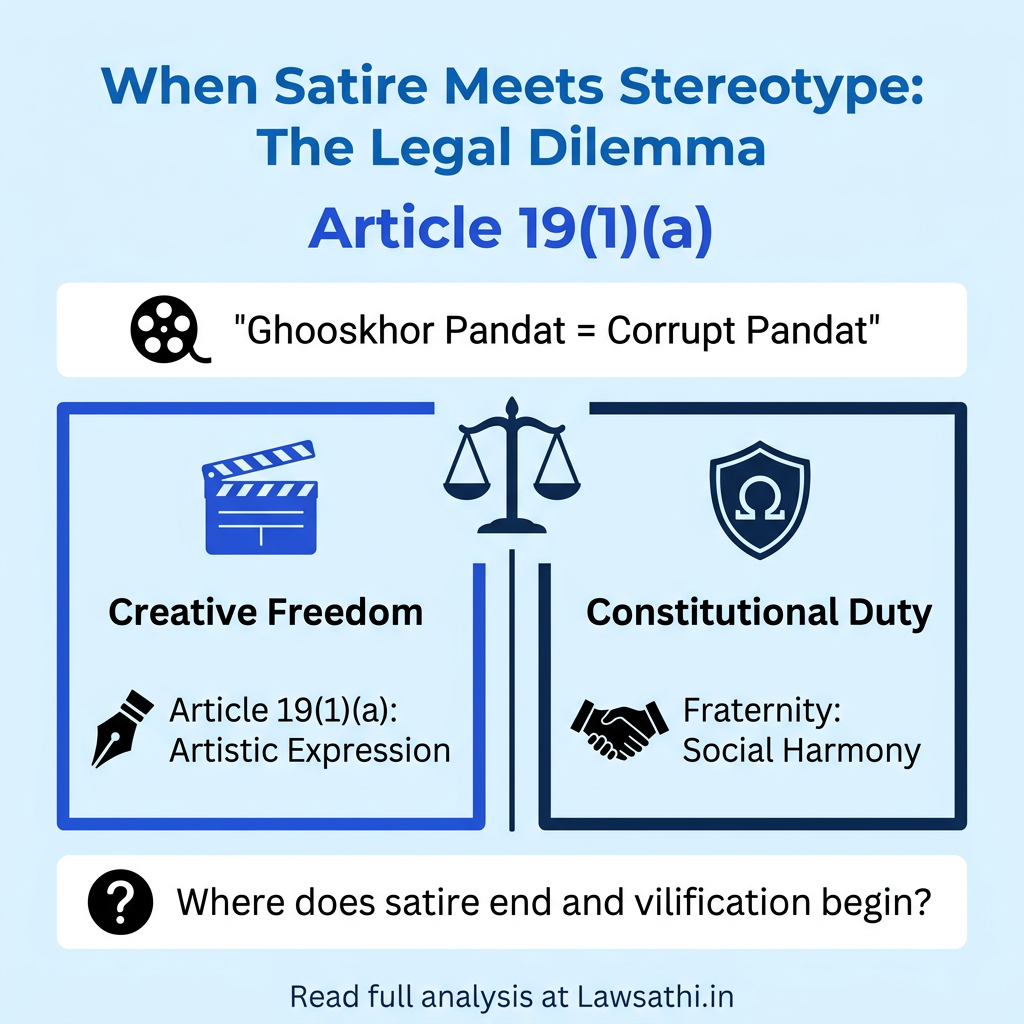
The petitioners’ counsel made several key submissions before the Bench. First, they argued that the title amounts to collective defamation of an entire community. Second, they claimed it creates offensive stereotyping linking community members to corruption. Third, they highlighted that the narrative conflates “dakshina” (traditional offering) with “ghoos” (bribe).
Moreover, the petitioners invoked multiple constitutional provisions. They cited Articles 14, 19(1)(a), and 21 of the Constitution. The argument was that community dignity forms part of the right to life under Article 21.
The Filmmakers’ Defense Under Article 19(1)(a)
The filmmakers presented a different version of events before the Court. They informed the Bench that the title had already been withdrawn. A similar petition was filed before the Delhi High Court. There, Netflix had undertaken to change the title.
Furthermore, the defense emphasized that the film is a fictional police drama. It is reformative in nature. They denied any intent to target any community. The film deals with police officers, not pandits or pujaris, they clarified.
Legal Analysis: ‘Fraternity’ as a Constitutional Limitation
The Supreme Court’s invocation of “fraternity” represents a significant evolution in Indian constitutional jurisprudence. The Preamble speaks of fraternity assuring the dignity of the individual and the unity of the nation. However, the question remains whether fraternity can function as an enforceable restriction.
The Constitutional Framework of Fraternity
Justice Ujjal Bhuyan authored a separate opinion that provides crucial insights into this constitutional value. He observed that “fraternity is essentially an attitude of respect and reverence towards fellow human beings.” Therefore, cultivating brotherhood and respecting fellow citizens irrespective of caste, religion, or language is constitutional dharma.
The Court connected fraternity to Article 51A(e) of the Constitution. This fundamental duty mandates citizens to promote harmony and the spirit of common brotherhood. As SCC Online reported, the Court held that vilification is constitutionally impermissible. Specifically, nobody—whether State or non-State actors—may vilify any community through speeches, memes, cartoons, or visual arts.
Fraternity Beyond the Preamble
The significance of this framing cannot be overstated for legal practitioners. Previously, fraternity was considered a non-justiciable aspirational value in the Preamble. The Court has now elevated it to an enforceable constitutional principle.
Additionally, the judgment draws from earlier precedent. In the Citizenship Act case (2024), the Court observed that fraternity embodies a sense of collective brotherhood amongst all Indians. Dr. B.R. Ambedkar’s vision of fraternity as essential for national unity received explicit endorsement.
Article 51A(e) and Its Interpretation
The Court’s reliance on Article 51A(e) introduces fundamental duties into the free speech discourse. This article states that it shall be the duty of every citizen to promote harmony. The duty specifically mentions transcending religious, linguistic, and regional diversities.
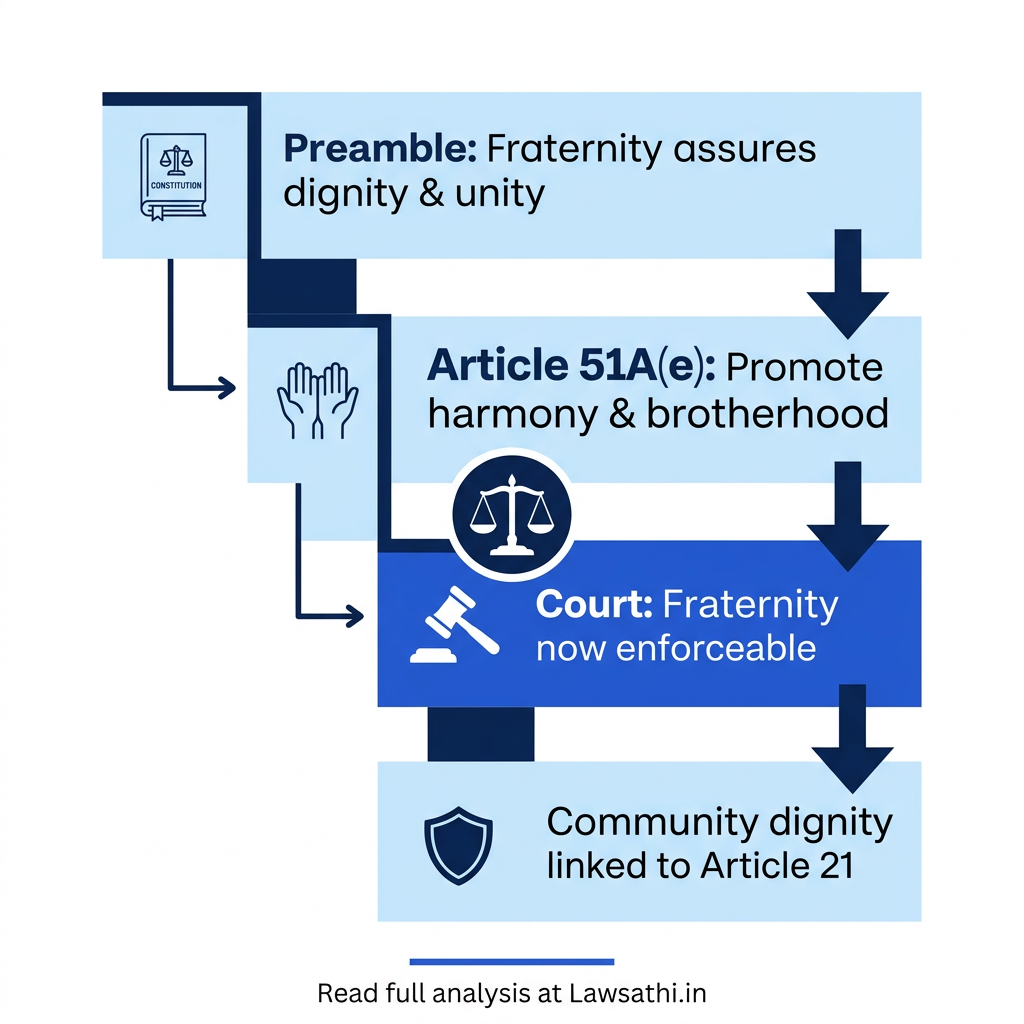
Consequently, the Court framed the issue not merely as a restriction on free speech. Instead, it presented the matter as balancing competing constitutional duties and rights. The Ministry of Education’s official documentation confirms that Article 51A(e) was inserted to strengthen social fabric.
Article 19(2): Expanding the Scope of Reasonable Restrictions
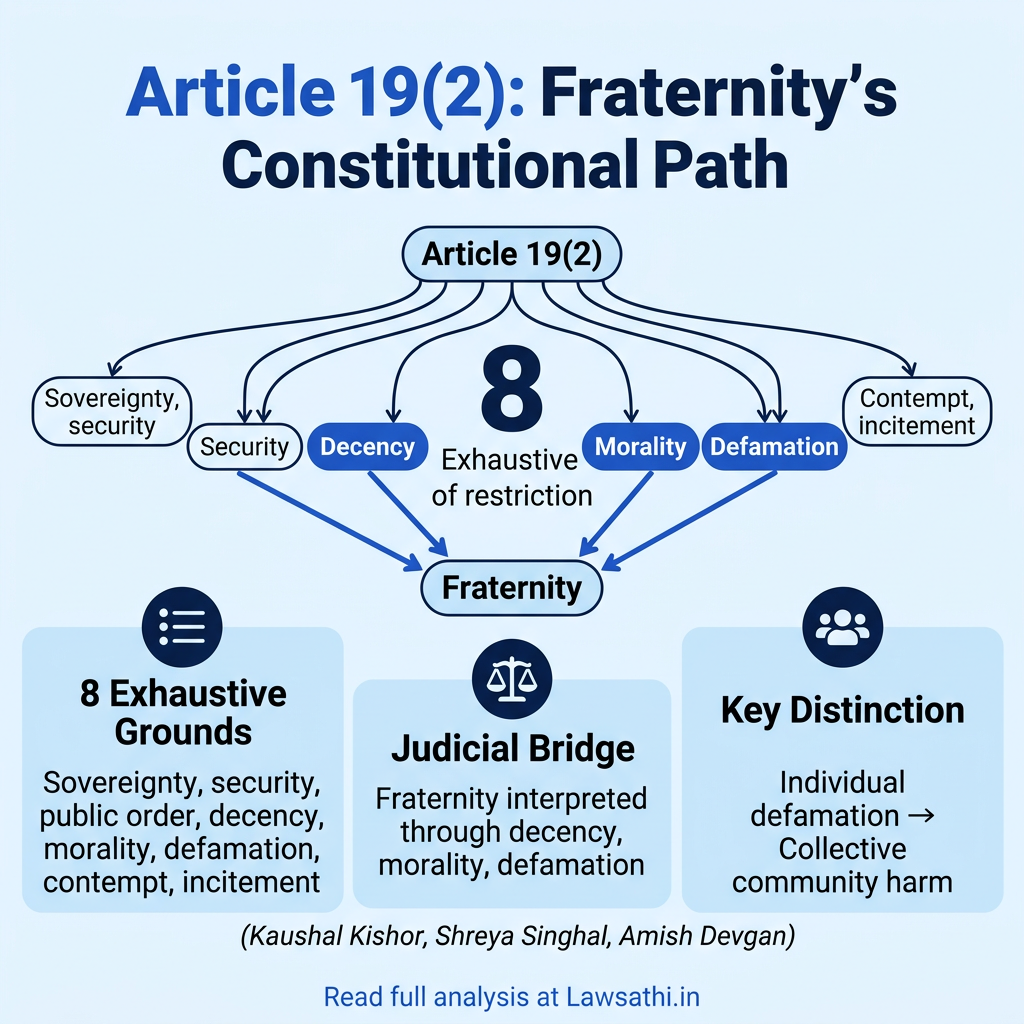
The legal analysis must grapple with Article 19(2) and its enumerated grounds for restricting free speech. The provision lists eight specific grounds. These include sovereignty, security, friendly relations, public order, decency, morality, contempt of court, defamation, and incitement to offence.
Where Does Fraternity Fit in Article 19(2)?
This question presents the most challenging aspect of the Supreme Court’s ruling. The landmark judgment in Kaushal Kishor v. State of Uttar Pradesh established that the grounds in Article 19(2) are exhaustive. A Constitution Bench held that additional restrictions cannot be imposed beyond those enumerated.
However, the Ghooskhor Pandat judgment navigates this constraint differently. The Court did not create a new ground of restriction. Instead, it interpreted existing grounds through the lens of constitutional fraternity. The approach reads fraternity into the concepts of decency, morality, and defamation.
The Defamation and Decency Arguments
Individual defamation has long been recognized as a valid ground under Article 19(2). The Court extended this concept to collective harm against communities. The argument is that stereotyping an identifiable community causes dignitary harm to all its members.
Furthermore, the concept of “decency or morality” received broader interpretation. Community dignity and harmony can be read into these concepts. The Court distinguished between public order concerns and dignity-based concerns.
Case Laws on the Balancing Test
The Court cited several landmark precedents in reaching its conclusion. Shreya Singhal v. Union of India (2015) 5 SCC 1 established that liberty of thought and expression is paramount in democracy. The judgment distinguished between discussion, advocacy, and incitement.
Additionally, the Court referenced Imran Pratapgadhi v. State of Gujarat (2026). This case held that freedom of speech is one of the most important fundamental rights. The balancing test requires weighing creative intent against potential social harm.
Implications for the CBFC and Filmmaking Industry
The Supreme Court’s ruling has significant implications for the Central Board of Film Certification. It also affects the broader entertainment industry. The CBFC operates under the Cinematograph Act, 1952. It certifies films according to guidelines mirroring Article 19(2) restrictions.
A New Subjective Test for Film Certification?
The ruling raises questions about whether courts have created a new subjective test for filmmakers. Previously, CBFC certification was considered sufficient for release. Now, even certified content may face judicial scrutiny on fraternity grounds.
According to analysis in Bar & Bench, the CBFC often operates as a “censorial body.” It functions rather than a certification authority. The Board applies its own sense of morality inconsistently. Recent examples include objections to character names and dialogue removal.
Self-Regulation Guidelines for Filmmakers
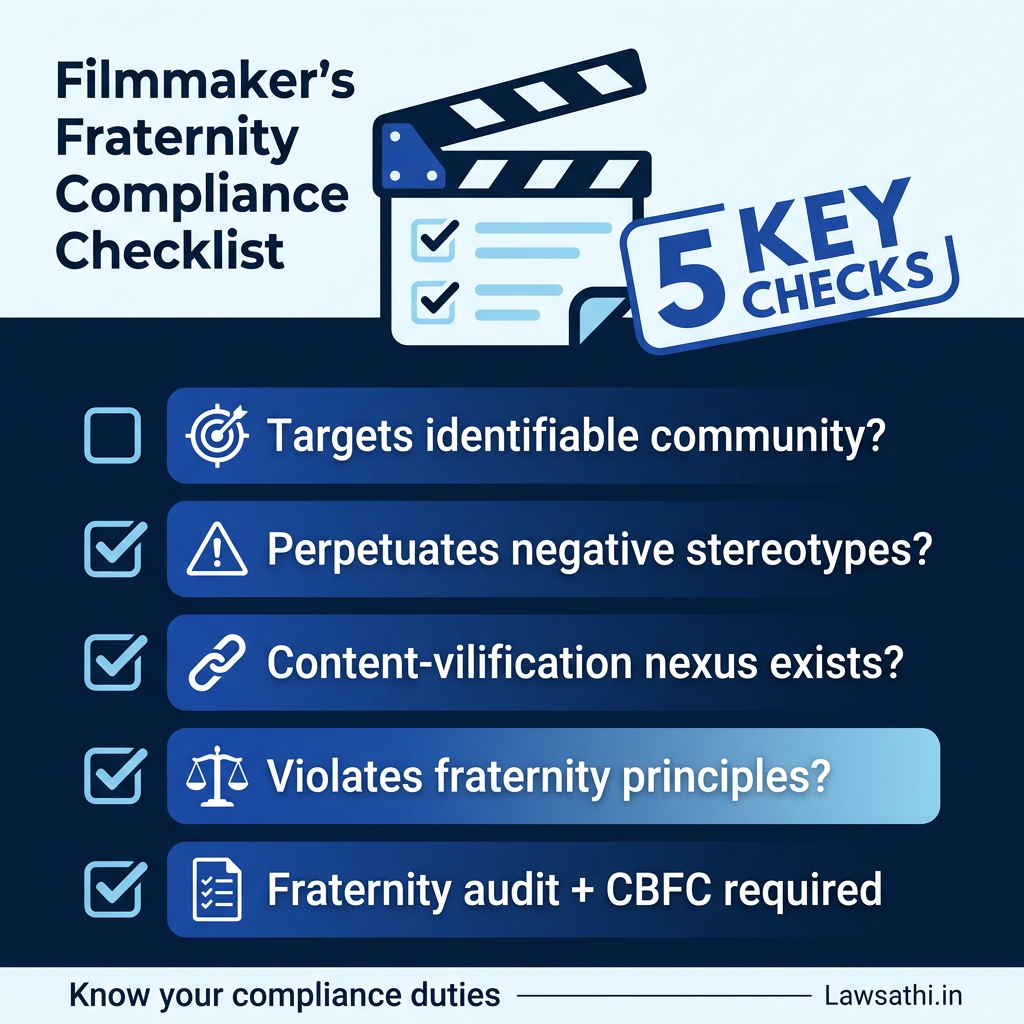
Filmmakers must now consider fraternity concerns during the creative process itself. The following checklist emerges from this ruling:
– Does the title or content target a specific identifiable community? – Does it create or perpetuate negative stereotypes about any group? – Is there a nexus between the content and community vilification? – Does the content violate constitutional fraternity principles?
Furthermore, studios should conduct “fraternity audits” before production. Documentation of creative justification may help in legal challenges. Community representation in the creative process could provide additional protection.
Impact on Satire and Political Films
Different film genres face varying levels of risk after this judgment. Satire, traditionally protected as creative expression, may face higher scrutiny if targeting identifiable communities. Political films discussing social issues must balance criticism with dignity concerns.
The Court’s comment that “being woke is one thing” suggests a nuanced approach. However, “denigrating public and creating this kind of unrest” is problematic, the Court noted. Creative expression reforming society differs from expression targeting communities. As LiveLaw noted, the Court stated that ministers and public figures have special responsibilities.
Comparative Analysis: Precedents and Judicial Evolution
The evolution of free speech jurisprudence in India shows a clear trajectory. It has moved from public order-centric to dignity-centric approaches. Understanding this progression helps practitioners anticipate future developments.
From Public Order to Dignity: A Paradigm Shift
The early phase of free speech jurisprudence focused primarily on public order concerns. Cases like Ramji Lal Modi v. State of UP (1957) examined whether speech causes law and order problems. The State’s security took precedence over individual dignity concerns.
However, the Supreme Court restrains Ghooskhor Pandat based on a different framework entirely. The shift towards a dignity-centric approach became visible in recent years. The Amish Devgan case (2020) defined hate speech parameters more precisely.
Distinguishing Hate Speech from Offensive Speech
The Court had to distinguish between hate speech and merely offensive speech. As SCC Online explained, hate speech requires both intent to harm and likelihood of proximate harm. Offensive speech may not meet this threshold.
In Ghooskhor Pandat, the Court acted pre-emptively on fraternity grounds. It did not wait for actual harm to occur. This differs from post-publication restrictions in earlier cases. The distinction between individual defamation and collective vilification played a crucial role.
The Emerging Test for Community Vilification
A new framework seems to be emerging from this jurisprudence. First, does the expression target an identifiable community? Second, does it perpetuate negative stereotypes? Third, does it cause dignitary harm to community members?
Additionally, the Court emphasized that public figures have heightened responsibilities. According to LiveLaw, the Court stated that those occupying high constitutional office have taken solemn oaths to uphold the Constitution. They cannot target particular communities based on religion, language, or caste.
Conclusion: Key Takeaways for Legal Practitioners
The Supreme Court restrains Ghooskhor Pandat judgment establishes important precedents for Indian lawyers. The ruling elevates constitutional fraternity to an enforceable principle. Courts can now restrain expression that vilifies communities, even before publication.
Key Legal Standards Established
First, fraternity is not merely an aspirational value in the Preamble. It forms part of constitutional duty under Article 51A(e). Therefore, it can be judicially enforced. Second, collective vilification of communities can be restrained. This applies even if individual defamation grounds may not directly apply. Third, CBFC certification is necessary but may not be sufficient protection against legal challenges.
For law firms handling media and entertainment litigation, several practical steps emerge. Pre-production due diligence should include fraternity audits of proposed content. Contractual safeguards should address title and content changes if legally challenged. Insurance coverage for release delays due to litigation should be considered.
The Future of Free Speech Litigation
The trajectory of Article 19(1)(a) litigation will likely see more petitions framed on fraternity grounds. Community-based organizations will increasingly approach courts as petitioners. Pre-release challenges will become more common in the entertainment industry.
Open questions remain for future cases. Can fraternity justify restrictions beyond the enumerated grounds in Article 19(2)? What threshold establishes “community vilification”? How can satire coexist with dignity concerns? These questions will shape future jurisprudence.
The Supreme Court restrains Ghooskhor Pandat ruling thus represents a turning point. It balances creative expression with constitutional duties in a diverse democracy. Legal practitioners must navigate this new terrain where fraternity concerns intersect with fundamental rights.
Stay updated on the latest Supreme Court judgments and manage your case law research effortlessly. Try LawSathi’s AI-powered legal research assistant for free today.