The Supreme Court OBC creamy layer judgment delivered on March 11, 2026, marks a watershed moment in India’s reservation jurisprudence. In Union of India v. Rohith Nathan, a two-judge bench comprising Justice PS Narasimha and Justice R Mahadevan delivered a significant ruling. The Court unequivocally held that excluding the “creamy layer” from OBC reservation benefits is not merely administrative policy. Rather, it is a constitutional mandate rooted in the equality code under Articles 14, 15, and 16 of the Constitution.
Furthermore, this landmark ruling resolves long-standing ambiguities regarding the treatment of PSU employees vis-à-vis government servants. It also establishes clear parameters for determining creamy layer status based on parental employment.
Introduction: Landmark Verdict on OBC Reservation Mechanics
The Supreme Court OBC creamy layer judgment arose from appeals filed by the Union of India. These appeals challenged decisions of the Madras High Court, Delhi High Court, and Kerala High Court. Previously, these courts had ruled in favor of Civil Services Examination candidates denied OBC reservation benefits.
The Department of Personnel and Training (DoPT) had counted parental salary income while assessing creamy layer status. Parents of these candidates were employed in PSUs, banks, or private organizations.
The Central Question Before the Court
The core issue was fundamental to reservation policy. Specifically, whether the exclusion of “creamy layer” from OBC reservation benefits is merely a policy directive or a constitutional mandate under Article 15(4) and Article 16(4). Additionally, the Court examined whether PSU and private sector employees could be treated differently from government employees. This distinction was critical for determining creamy layer status.
The petitioners included candidates like Rohith Nathan, who secured AIR 174 in CSE 2012. His father worked at HCL Technologies in the private sector. Similarly, another petitioner, G. Babu, secured Rank 629 in CSE 2013. His father served as Senior Executive Engineer at Neyveli Lignite Corporation, a PSU. Both were denied OBC reservation because their parents’ salary exceeded the prescribed threshold.
However, the Supreme Court ultimately dismissed all appeals filed by the Union. It upheld the decisions favoring the candidates as reported by SCC Online.
The Constitutional Mandate: Why Creamy Layer Exclusion is Non-Negotiable
The Supreme Court OBC creamy layer judgment firmly established that creamy layer exclusion flows directly from constitutional principles. Justice R Mahadevan, authoring the judgment, articulated this position with remarkable clarity. In fact, the Court held that the creamy layer principle is rooted in the equality code of the Constitution.
Foundation in the Equality Code
Articles 14, 15, and 16 collectively form the constitutional foundation for this ruling. Article 14 guarantees equality before law. Article 15(4), inserted by the First Constitutional Amendment in 1951, enables special provisions for socially and educationally backward classes. Additionally, Article 16(4) provides for reservation in public employment for backward classes.
The Court emphasized that these provisions must work harmoniously. Therefore, reservation benefits must reach those who are genuinely backward.
The judgment states: “The exclusion of the creamy layer among the backward classes is not a matter of mere policy preference but a constitutional imperative intended to ensure that the benefits of reservation reach those who are socially and educationally backward in the true sense of the phrase.”
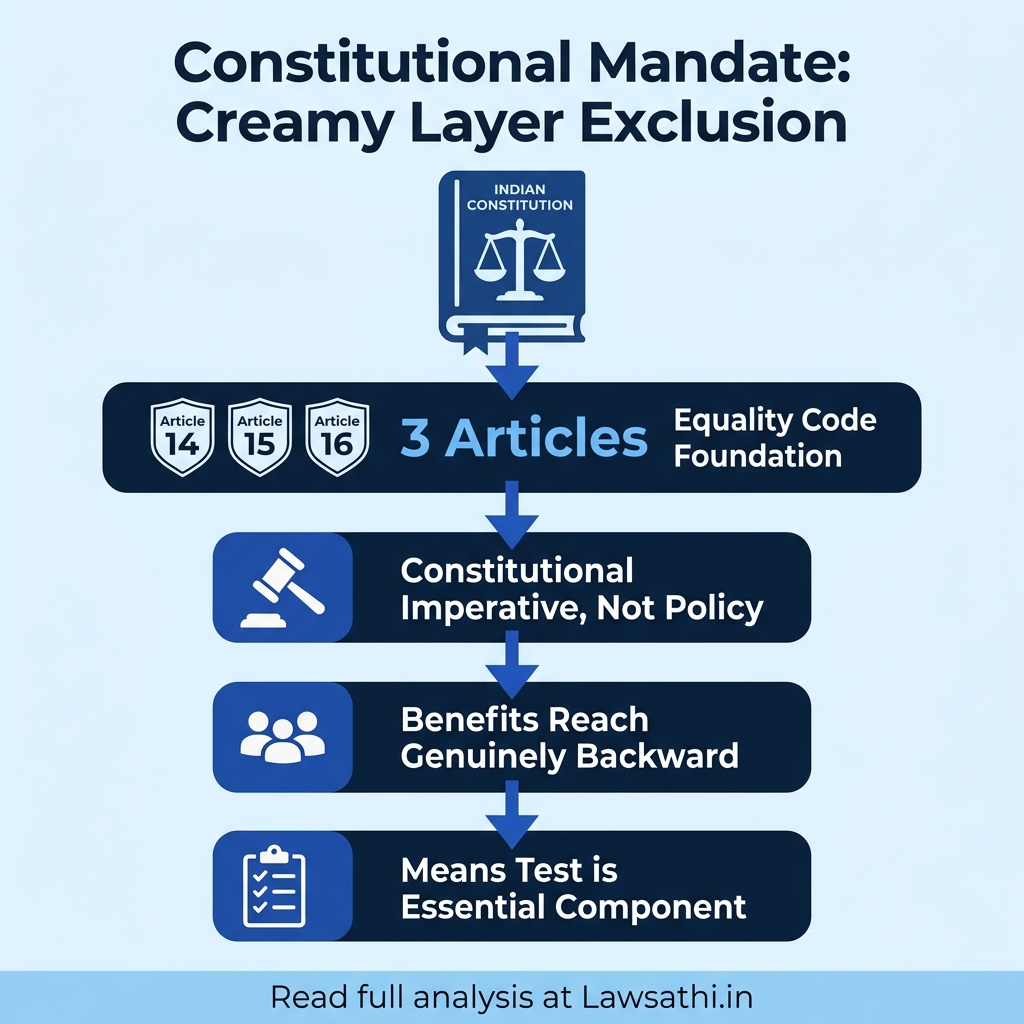
Consequently, this pronouncement elevates the creamy layer principle from administrative guidelines to constitutional doctrine according to the official judgment PDF.
Distinction Between Policy and Constitutional Command
The Court carefully distinguished between administrative policy and constitutional mandate. The 1993 Office Memorandum was issued pursuant to Supreme Court directions in Indra Sawhney. It was formulated after the Ram Nandan Prasad Committee’s recommendations. Moreover, the report was laid before both Houses of Parliament and underwent inter-ministerial consultation.
However, the constitutional imperative exists independently of this administrative framework.
Furthermore, the Court reaffirmed the “means test” and “principle of exclusion” as essential components. Caste may serve as an initial identifying marker. However, it cannot be the exclusive determinant of backwardness. Economic condition remains a relevant and rational refining criterion.
The judgment clarifies that reservation policy must balance social justice with broader societal interests. Consequently, preventing relatively advanced segments from monopolizing benefits becomes constitutionally mandated.
Bridging the Divide: No Distinction Between Government and PSU Employees
The Supreme Court OBC creamy layer judgment specifically addresses the parity between government and PSU employees. This aspect resolves a contentious issue that had created significant confusion. The Court rejected differentiation between these categories of employees for creamy layer determination.
The Problematic 2004 Clarification
The 1993 Office Memorandum established clear categories for creamy layer determination. Category II covers the service category with specific sub-categories. For example, Category II-A includes officers directly recruited to Class I/Group A posts. Category II-B covers officers entering Class I before age 40. Additionally, Category II-C extends these criteria to PSU, bank, insurance, and university employees in equivalent posts.
However, a clarificatory letter dated October 14, 2004, created ambiguity. Paragraph 9 stated that where equivalence had not been determined, income from salaries and other sources would be assessed separately. If either exceeded the limit, the candidate would be treated as creamy layer. This interpretation created a problematic distinction between government and PSU employees as highlighted by Bar and Bench.
Constitutional Violation Through Hostile Discrimination
The Court found this distinction constitutionally impermissible. It noted that Group C and Group D government employees exceeding income thresholds solely due to salary progression are not excluded from reservation. However, children of PSU or private employees in equivalent posts were being denied benefits merely because parental salary exceeded the limit.
The judgment states: “Treating the children of PSU or private sector employees as falling within the creamy layer solely on the basis of salary income, while the same principle is not applied to Government employees holding equivalent posts, would lead to hostile discrimination.”
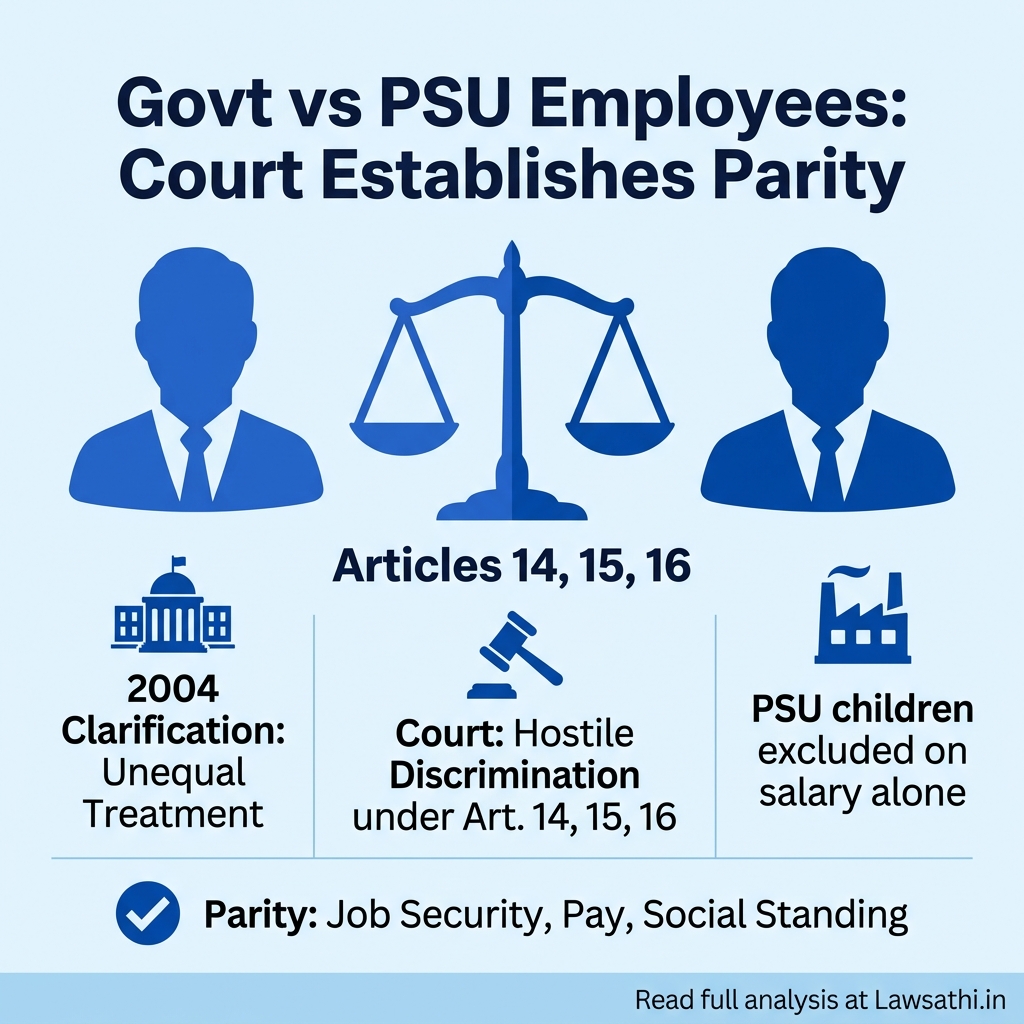
Such distinction amounts to treating equals unequally. Therefore, it attracts the rigor of the equality doctrine under Articles 14, 15, and 16 as reported by LiveLaw.
Rationale for Establishing Parity
The Court provided clear rationale for rejecting differentiation. First, government and PSU employees share similarity in job security. Second, their pay scales are comparable. Third, they enjoy equivalent social standing. Fourth, the nature of employment conditions remains the same. Therefore, treating them differently for creamy layer determination violates constitutional equality.
This ruling overturns previous ambiguities and conflicting high court interpretations. As a result, lawyers must now ensure parity between government and PSU employees. The Income/Wealth Test under Category VI specifically excludes salary income from computation. This principle applies uniformly regardless of employment sector.
Legal Precedents: Revisiting Indra Sawhney and Evolution of Law
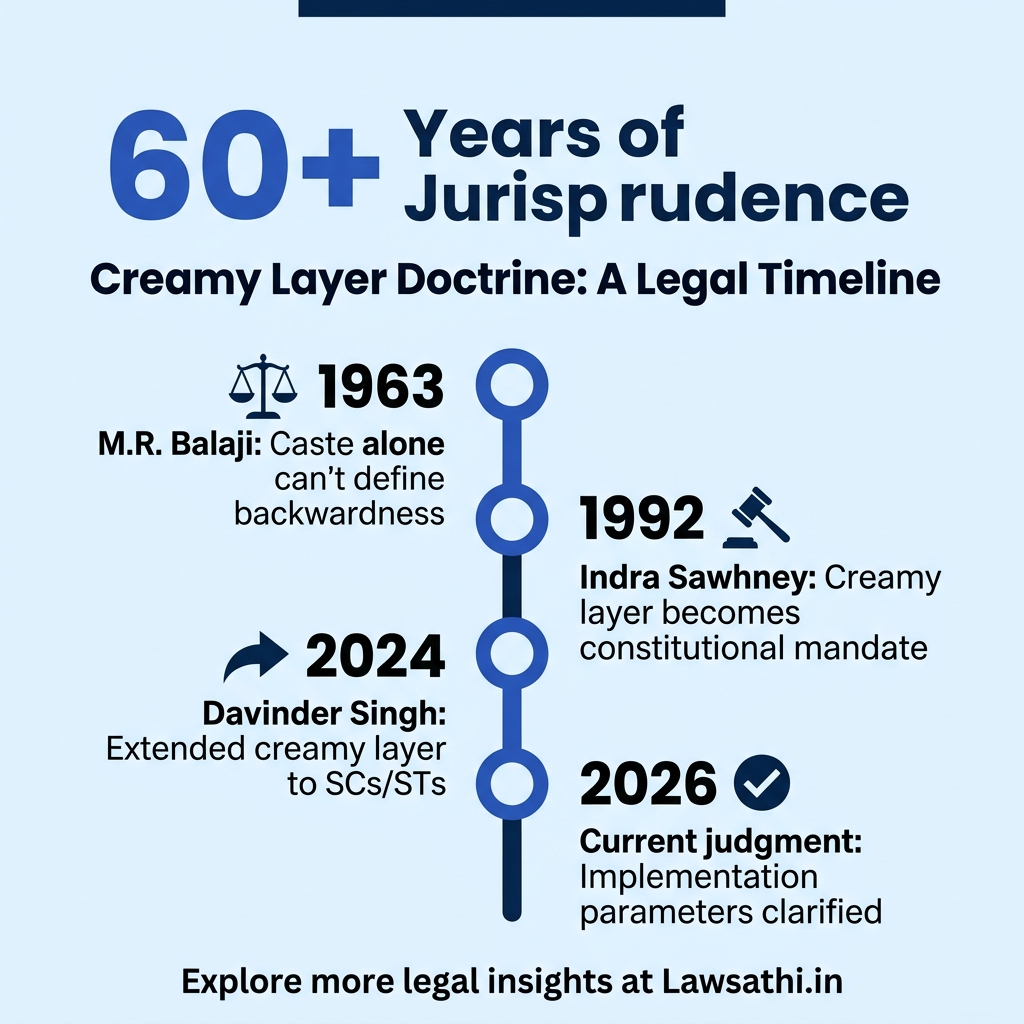
The Supreme Court OBC creamy layer judgment must be understood within the broader evolution of reservation jurisprudence. The foundational case remains Indra Sawhney v. Union of India (1992). This nine-judge bench decision crystallized the creamy layer concept.
The Foundation: Indra Sawhney Case
The Indra Sawhney judgment, cited as 1992 Supp (3) SCC 217, established several critical principles. First, 27% reservation for OBCs was upheld under Article 16(4). Second, total reservations should ordinarily not exceed 50%. Third, creamy layer must be excluded as a constitutional mandate. Fourth, backwardness is primarily social, not merely economic. Fifth, reservation in promotions is constitutionally impermissible.
Justice Sahai’s observation in paragraph 629 remains particularly significant. He stated: “The collectivity or the group may be backward class but the individuals from that class may have achieved the social status or economic affluence. Disentitle them from claiming reservation… Creamy layer, thus, shall stand eliminated.” This principle guides the current interpretation available on Indian Kanoon.
Evolution Through the Decades
The creamy layer doctrine has evolved through multiple judicial decisions. For instance, M.R. Balaji v. State of Mysore (1963) established that caste cannot be the sole test. K.S. Jayasree v. State of Kerala (1976) upheld income ceiling within backward classes. Additionally, K.C. Vasanth Kumar v. State of Karnataka (1985) endorsed periodic review and means test. Nair Service Society v. State of Kerala (2007) mandated state compliance with creamy layer requirements.
More recently, State of Punjab v. Davinder Singh (2024) extended creamy layer principles to SCs/STs. Justice Gavai’s opinion particularly emphasized this application. The current judgment builds upon this robust jurisprudential foundation. It reaffirms constitutional imperative while addressing practical implementation challenges.
Implications for State Laws and Reservation Policies
The Supreme Court OBC creamy layer judgment has significant implications for state-specific reservation laws. States must now ensure compliance with the clarified constitutional mandate. This may require substantial policy revisions.
Mandatory Review Requirements
State Commissions for Backward Classes must undertake comprehensive reviews. They must ensure salary income is excluded from creamy layer computation as per the 1993 OM. Equivalence between PSU posts and government posts must be determined formally. Status-based criteria should serve as the primary determinant. Income thresholds must be applied correctly.
The Court directed implementation within six months from the judgment date. This means compliance is required by approximately September 2026. States that fail to comply risk constitutional challenges to their reservation policies as noted in SCC Online’s analysis.
Potential for Future Litigation
The judgment may trigger substantial litigation regarding several issues. First, the definition of “backwardness” for various communities may face challenge. Second, periodic revision of creamy layer income ceiling could become contentious. Currently, the threshold stands at Rs. 8 lakh per annum.
Third, application of creamy layer to SCs/STs may see increased litigation following Davinder Singh. Fourth, state-specific equivalence determinations may face judicial scrutiny.
Lawyers must prepare for these emerging areas of dispute. The constitutional framework now demands rigorous, non-arbitrary criteria. Any deviation invites constitutional challenge under the equality doctrine.
Practical Guidance for Lawyers: Advising Clients Post-Judgment
The Supreme Court OBC creamy layer judgment requires lawyers to revise their advisory practices. Clients affected by previous incorrect determinations may now have valid claims. Additionally, lawyers handling ongoing service matters must reassess their strategies.
Determining Creamy Layer Status: A Practical Checklist
Lawyers should follow a systematic approach when advising clients. First, identify the parent’s employment category. Is the parent a government servant, PSU employee, bank or insurance employee, private sector employee, or self-employed professional? This classification determines the applicable criteria.
Second, determine post equivalence. Has equivalence been formally determined by the government? If yes, what is the equivalent government grade? If no, the Income/Wealth Test under Category VI applies.
Third, apply status-based criteria for government or equivalent posts. Parents directly recruited to Group A/Class I fall within creamy layer. Parents entering Group A before age 40 also qualify as creamy layer. However, parents entering Group A after age 40 remain outside creamy layer. Parents in Group B/C/D are non-creamy layer regardless of salary as clarified in the official judgment.
Key Principle for PSU Clients
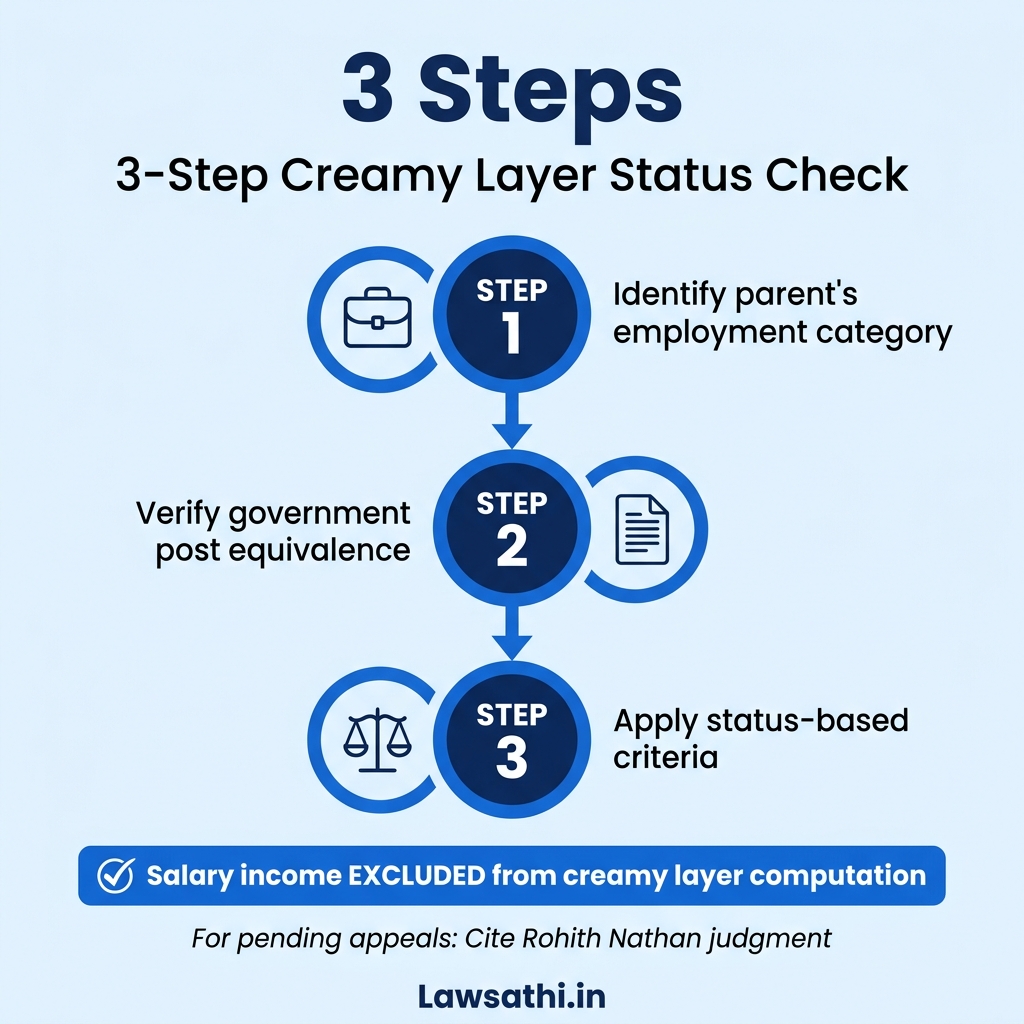
The critical principle from this judgment is clear. Salary income is excluded from creamy layer computation under the Income/Wealth Test. Lawyers must verify whether DoPT applied the incorrect 2004 Letter interpretation. Evidence of parental post classification must be gathered. Equivalence orders from State Government should be obtained where applicable.
Strategies for Pending Appeals
For pending appeals, cite the Rohith Nathan judgment as binding precedent. Emphasize the parity between government and PSU employees established by the Court. Challenge any determination based solely on parental salary.
The Court has allowed intervention by similarly affected candidates. Therefore, lawyers can file intervention applications citing this judgment. They may seek benefit of the ratio through Article 142 powers. Supernumerary posts creation can be requested where appropriate.
The Court explicitly stated: “We find no difficulty in directing the appellants to create such supernumerary posts, as required, to accommodate the candidates who satisfy the non-creamy layer criteria as clarified in the present judgment.” This provides powerful leverage for affected candidates as reported by Bar and Bench.
Conclusion: The Future of Affirmative Action in India
The Supreme Court OBC creamy layer judgment represents a significant milestone in reservation jurisprudence. It clarifies that creamy layer exclusion is constitutional, not merely policy-based. The ambiguity between the 1993 OM and 2004 clarification letter is definitively resolved. Furthermore, PSU-government parity is now established as a constitutional requirement.
Balancing Social Justice and Administrative Efficiency
The judgment strikes a careful balance between competing interests. It protects genuinely backward sections from being crowded out. The creamy layer cannot monopolize reservation benefits intended for the truly disadvantaged. However, qualitative criteria based on status prevail over purely quantitative income-based determinations.
This approach aligns with the constitutional vision of substantive equality. The Court recognized that adopting interpretations disadvantaging one segment without rational justification violates equality. Such interpretations become the antithesis of equality, the cornerstone of our Republic.
Anticipating Future Developments
Several legislative and executive clarifications are expected. The income ceiling limits may undergo revision. Currently, the threshold stands at Rs. 8 lakh per annum. Formal equivalence determinations for PSU posts should follow. Extension of creamy layer to SCs/STs remains a developing area following Davinder Singh.
For legal practitioners, this judgment provides essential clarity. The constitutional framework for creamy layer exclusion is now unambiguous. Lawyers must ensure their clients receive proper assessment under the corrected constitutional standard. Therefore, the path forward requires vigilance, proper documentation, and strategic litigation where necessary.
Stay ahead of critical legal updates. Use LawSathi’s AI-powered case management to track landmark judgments and automate your legal research. Start your free trial today.