Introduction: A Landmark Verdict on Equality
The Supreme Court OBC creamy layer judgment delivered on March 11, 2026, marks a pivotal moment in India’s reservation jurisprudence. In Union of India v. Rohith Nathan 2026 SCC OnLine SC 352, the Court struck down an artificial distinction. This distinction had long disadvantaged children of public sector employees.
Therefore, this ruling fundamentally reinterprets how creamy layer status must be determined under the constitutional framework of equality.
The Core Legal Issue at Hand
For over two decades, the Department of Personnel and Training (DoPT) treated government servants and PSU employees differently. Specifically, this difference arose when determining their children’s OBC reservation eligibility.
While government employees’ salary income was excluded from the creamy layer test, PSU employees’ salaries were counted against the income threshold. Consequently, this created a stark disparity between similarly placed candidates.
Why This Judgment Matters
The Supreme Court OBC creamy layer judgment addresses this inequity directly. The Court held that such differentiation violates Articles 14 and 16 of the Constitution.
Moreover, the Court observed that the source of employment does not alter the social backwardness of a candidate’s family. Whether the employer is government or public sector makes no difference. Therefore, the judgment paves the way for uniform application of reservation policies across all employment categories.
Background: The ‘Creamy Layer’ Concept in Indian Law
Origin in the Indra Sawhney Case
The creamy layer concept originated in the landmark Indra Sawhney v. Union of India judgment of 1992. A nine-judge Constitution Bench delivered this historic ruling.
The Supreme Court held that while a class may be backward, certain individuals within that class must be excluded. Specifically, those who have achieved higher social or economic status cannot claim reservation benefits. As a result, this ensures that affirmative action reaches the truly disadvantaged sections.
The Rule of Exclusion Explained
The Court mandated exclusion of “socially advanced persons” from the OBC quota. Justice Sahai notably observed that the creamy layer must be eliminated. This elimination ensures genuine backward class members benefit from reservations.
Therefore, this principle forms the bedrock of all subsequent creamy layer determinations in India.
The 1993 Office Memorandum Framework
Following the Indra Sawhney directive, the Government issued an Office Memorandum on September 8, 1993. The Department of Personnel and Training released this memorandum, available on the NCBC website.
It established six categories for identifying creamy layer status. Notably, Category VI prescribed an Income/Wealth Test with a crucial explanation.
Critical Feature: Exclusion of Salary Income
Explanation (i) to Category VI stated a key principle. It specified that “income from salaries or agricultural land shall not be clubbed” with income from other sources.
This meant that salary income was explicitly excluded from the income calculation for determining creamy layer status. However, the application of this principle became mired in controversy.
Current Income Criteria
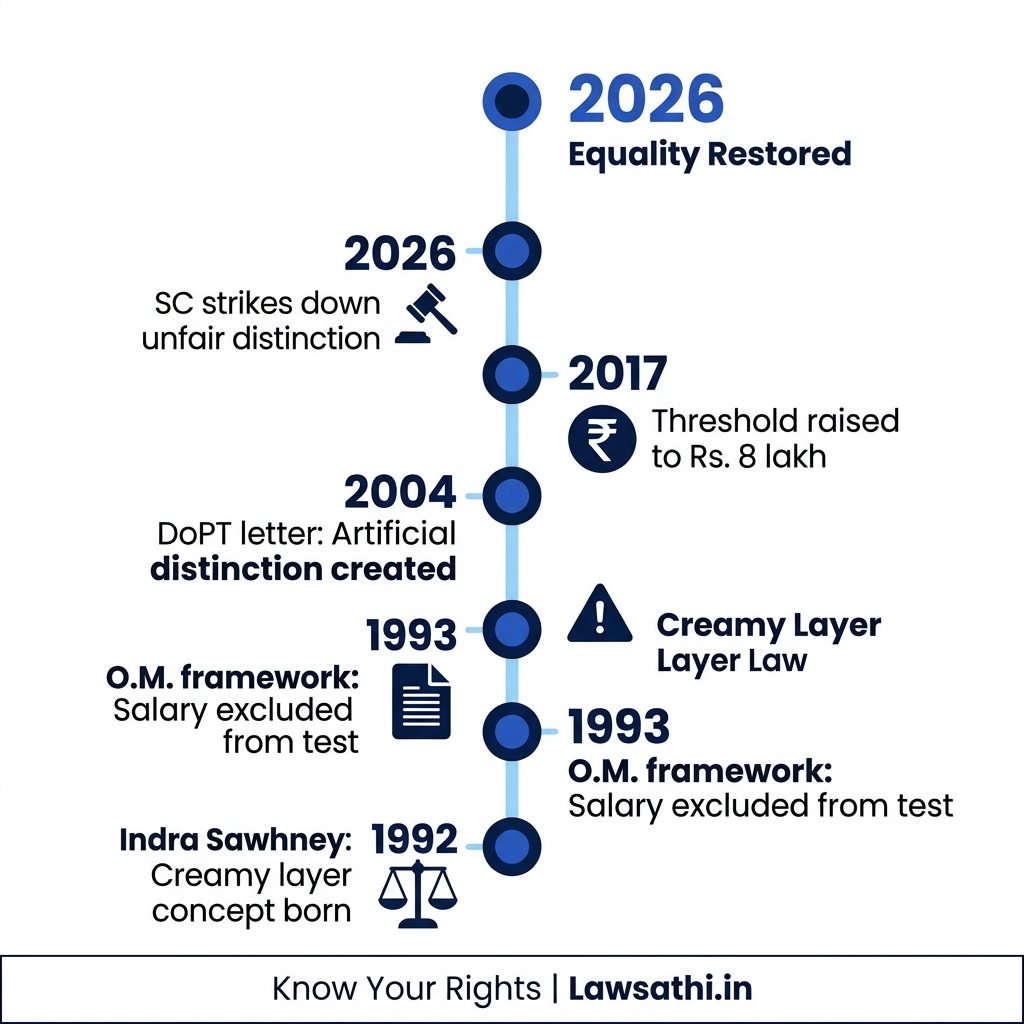
The income threshold has evolved significantly over the years. It increased from Rs. 1 lakh in 1993 to Rs. 8 lakh per annum as of 2017.
Candidates whose parents earn above this limit from sources other than salaries fall within the creamy layer. Consequently, they lose OBC reservation benefits.
The Dispute: Govt vs. PSU Employee Classification
The Problematic 2004 Clarificatory Letter
The controversy stemmed from a DoPT clarificatory letter dated October 14, 2004. Paragraph 9 of this letter introduced a problematic distinction.
It stated that where equivalence of posts between government and PSU positions had not been determined, the salary income of parents would be counted. This counting applied to creamy layer determination. As a result, this created an immediate disadvantage for PSU employees’ children.
How the Distinction Played Out
Consider this practical scenario to understand the impact. A Group C government employee’s salary was not counted toward the income test.
However, a PSU employee holding an equivalent position faced different treatment. Their salary income was added to other sources. This addition often pushed them above the Rs. 8 lakh threshold.
Consequently, their children were denied OBC reservation despite the parents holding similar-status positions.
The Challenge Before Courts
Multiple candidates challenged this discriminatory treatment before various forums. For instance, in the Rohith Nathan case, the father worked in HCL Technologies.
In another case, the father was a Senior Executive Engineer at Neyveli Lignite Corporation. These candidates were denied OBC benefits solely because their parents’ employers fell outside direct government service.
Petitioners’ Core Arguments
The petitioners argued before the Supreme Court with two main contentions. First, they claimed the 2004 letter was merely clarificatory. Therefore, it could not override the substantive 1993 Office Memorandum.
Furthermore, they contended that the distinction violated Article 14 of the Constitution. It treated equals unequally, which is constitutionally impermissible.
However, the Union Government maintained a different position. It argued that the 2004 letter merely clarified the application of the income test where equivalence was undetermined.
Supreme Court’s Analysis and Reasoning
The “Artificial Distinction” Observation
The Supreme Court OBC creamy layer judgment decisively rejected the government’s position. Justice R. Mahadevan wrote the judgment for the Bench, which comprised Justice P.S. Narasimha and himself.
The Court held that the distinction was “artificial” and legally unsustainable. As reported by LiveLaw, the Court made a significant observation. It stated that treating PSU employees differently from government employees amounts to “hostile discrimination.”
Status-Based vs. Income-Based Determination
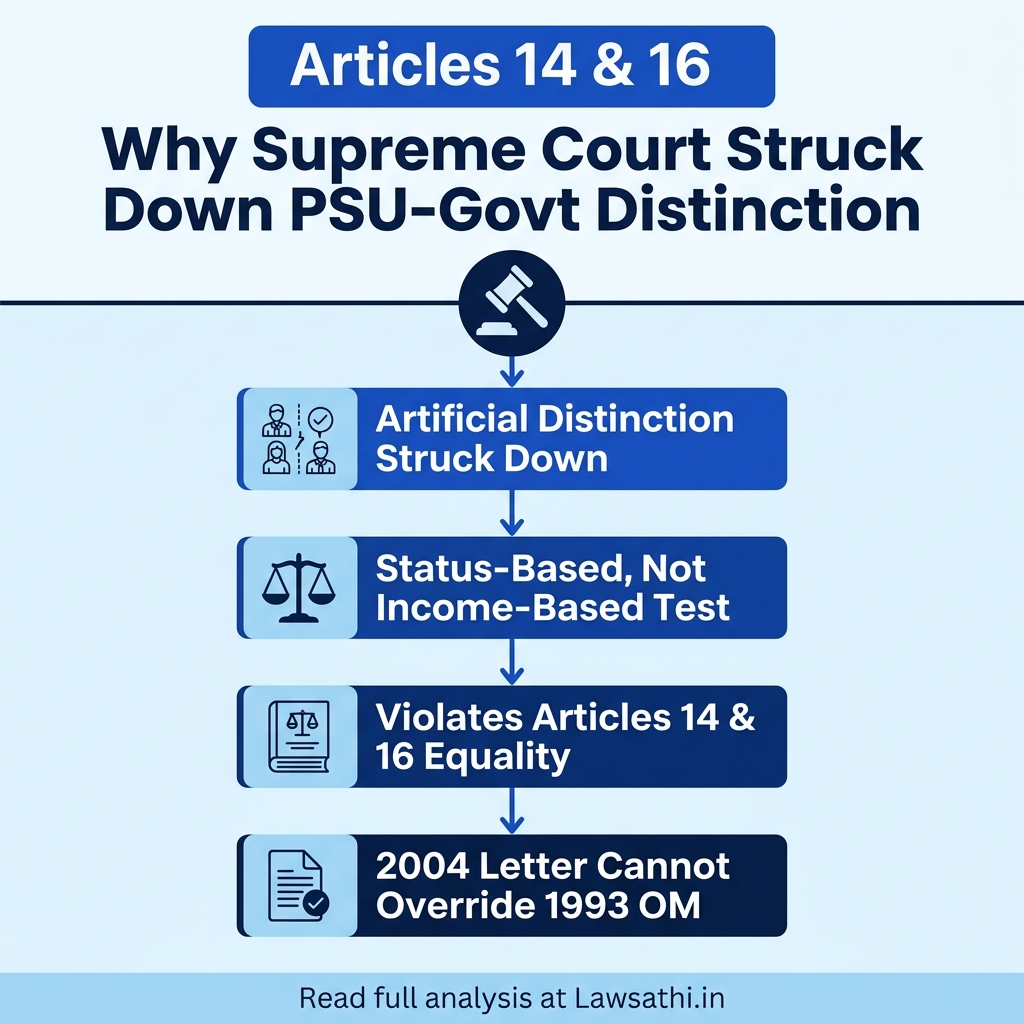
The Court emphasized an important principle in its reasoning. Creamy layer determination under Categories I to III of the Schedule is status-based, not purely income-based.
The category of post held by a candidate’s parent reflects social progression. This status remains independent of fluctuating salary levels. Therefore, the judgment establishes that status must take precedence over mere income figures.
Key Quote on Equality
The Supreme Court observed a fundamental principle. It stated: “If PSU/private employees are treated differently from Government employees holding equivalent posts, it would amount to hostile discrimination.”
This treatment, the Court noted, violates Articles 14 and 16 of the Constitution. Therefore, this reasoning directly addresses the constitutional infirmity in the administrative practice.
The 2004 Letter Cannot Override the 1993 OM
A crucial aspect of the Supreme Court OBC creamy layer judgment involves the nature of executive instructions. The Court held that a clarificatory letter cannot introduce substantive conditions absent in the parent policy.
Specifically, the 2004 letter effectively amended the 1993 Office Memorandum. However, it did so without following proper procedure. As a result, the letter cannot stand.
Article 14 and 16 Violation
The Court found that the classification lacked intelligible differentia. Furthermore, it lacked rational nexus with the policy’s objective.
Article 16(4), the Court noted, is a structural reflection of substantive equality. This equality is embodied in Article 16(1). Therefore, any interpretation resulting in unequal treatment of similarly placed OBC candidates would be constitutionally impermissible.
Parliamentary Committee Findings
The judgment also cited the 21st Report of the Parliamentary Committee on Welfare of Other Backward Classes (2018-19). This committee had observed that the 2004 letter “has done more to confuse the position than to clarify it.”
Additionally, the committee noted a concerning fact. The origin of Paragraph 9 could not be traced in official records.
Practical Implications for Legal Practitioners
The Court’s Directions
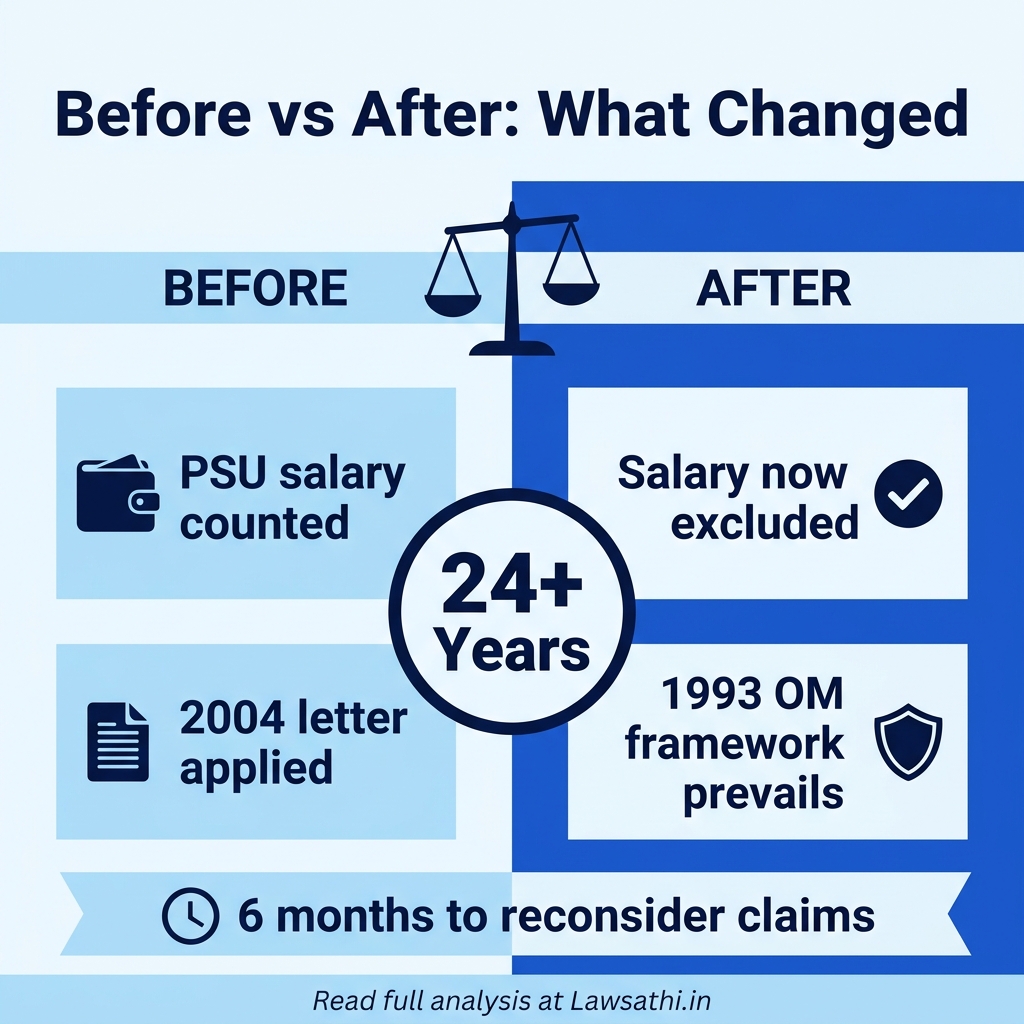
The Supreme Court directed implementation within six months from the judgment date. DoPT must reconsider claims of affected candidates in accordance with the judgment’s principles.
Where necessary, supernumerary posts must be created. The Government had given this assurance to the Parliamentary Committee.
Impact on Recruitment Rules
Recruitment rules for Public Sector Banks, PSUs, and government undertakings require immediate revision. Equivalence of posts must be determined to properly apply Category II-C of the creamy layer criteria.
Until such equivalence is formalized, only the Income/Wealth Test under Category VI applies. Importantly, this test applies without including salary income.
Advisory for OBC Candidates in PSUs
Clients working in PSUs should understand a key principle. Their salary income cannot be the sole basis for creamy layer determination.
The category or status of the post held by their parents must be considered. For example, if parents hold posts equivalent to Group C or D in government, their children qualify for Non-Creamy Layer status. This qualification applies regardless of salary exceeding the threshold.
Precedent Value for Future Cases
This judgment establishes significant precedent for future litigation. First, executive letters cannot override Office Memoranda issued under Article 162.
Second, status-based criteria take precedence over purely income-based determinations. Third, valid OBC certificates issued by competent authorities cannot be lightly disregarded by recruiting bodies.
Comparative Analysis: Post-Judgment Scenario
Pre-Judgment vs. Post-Judgment Position
| Aspect | Pre-Judgment Practice | Post-Judgment Position | |————|—————————|—————————| | Primary criterion | Salary income for PSU employees | Status/category of parent’s post | | PSU employees | Salary counted if equivalence undetermined | Salary excluded; only other income considered | | Government employees | Only post status considered | Same principle applies to PSU equivalents | | 2004 Clarificatory Letter | Paragraph 9 applied | Cannot override 1993 OM framework | | Equivalence of posts | Undetermined for 24+ years | Urgent determination required |
Timeline of Key Developments
The dispute spanned nearly three decades. The 1993 Office Memorandum established the framework initially.
However, the 2004 clarificatory letter created ambiguity. Multiple High Courts, including Madras, Delhi, and Kerala, ruled in favor of candidates between 2014 and 2017.
Subsequently, the Cabinet approved equivalence norms in August 2017. Yet implementation remained incomplete. Finally, the Supreme Court OBC creamy layer judgment resolved the matter on March 11, 2026.
Broader Implications for Private Sector
The judgment’s reasoning extends beyond PSUs to private sector employees as well. The principle of substantive equality requires identical treatment for children of parents working in comparable positions.
This holds true regardless of the employer type. Whether government, public sector, or private enterprise makes no difference.
Conclusion: Towards a Uniform Reservation Policy
Summary of the Court’s Directive
The Supreme Court OBC creamy layer judgment dismisses the artificial distinction between government and PSU employees. All affected candidates’ claims must be reconsidered under the 1993 Office Memorandum principles.
Implementation must occur within six months. Additionally, supernumerary posts must be created where required.
Reinforcing Constitutional Equality
This judgment reinforces the constitutional goal of equality of opportunity. It prevents artificial distinctions within the same backward class from undermining reservation benefits.
Furthermore, the ruling limits executive overreach. It holds that clarificatory letters cannot alter substantive rights.
Anticipated Administrative Changes
The Government must urgently complete equivalence determination exercises. These exercises have been pending for over 24 years.
State Governments will likely need to issue similar equivalence orders for State PSUs. Moreover, DoPT may revise verification procedures to align with the judgment. Recruitment bodies must update their practices accordingly.
Final Thoughts for Legal Practitioners
For law firms monitoring reservation law developments, this judgment offers critical insights. The Supreme Court has affirmed that equality principles cannot be compromised by administrative convenience.
Moreover, affected clients with pending claims should file appropriate applications seeking relief under this judgment. The six-month implementation deadline provides a clear timeline for compliance.
Stay ahead with the latest legal updates. Streamline your practice and manage case research effortlessly with LawSathi. Start your free trial today.