
Navigating matrimonial law requires a deep understanding of the grounds for divorce under the Hindu Marriage Act, 1955. For decades, Indian courts viewed marriage as a sacred and indissoluble bond. However, the law has evolved significantly. It now provides practical legal remedies for broken marriages. Today, practitioners must balance traditional statutory interpretations with progressive judicial shifts. This guide explores the essential grounds and procedures every lawyer needs to master in 2026.
Introduction: Navigating Matrimonial Laws in India
The Hindu Marriage Act (HMA), 1955, transformed Hindu law by introducing codified divorce provisions. Originally, the Act emphasized fault-based litigation. Over time, amendments in 1976 introduced mutual consent. This change reflected a move toward modern social realities.
From Sacrament to Legal Remedy
Marriage was once considered an eternal union. Now, the law recognizes that dissolution is the proper resolution when a relationship dies emotionally. Recent trends in 2024 and 2025 show a significant shift. For example, courts now prioritize the well-being of individuals over maintaining empty shells of marriages. Therefore, practitioners must understand both fault-based and no-fault pathways.
The Practitioner’s Evolving Role
Litigation in 2026 is increasingly digital and evidence-heavy. Specifically, WhatsApp logs and email chains now form the backbone of many contested cases. As a result, lawyers must be adept at handling electronic evidence. Furthermore, they must navigate the intense emotional complexities of family law.
Section 13(1): Fault-Based Grounds for Divorce
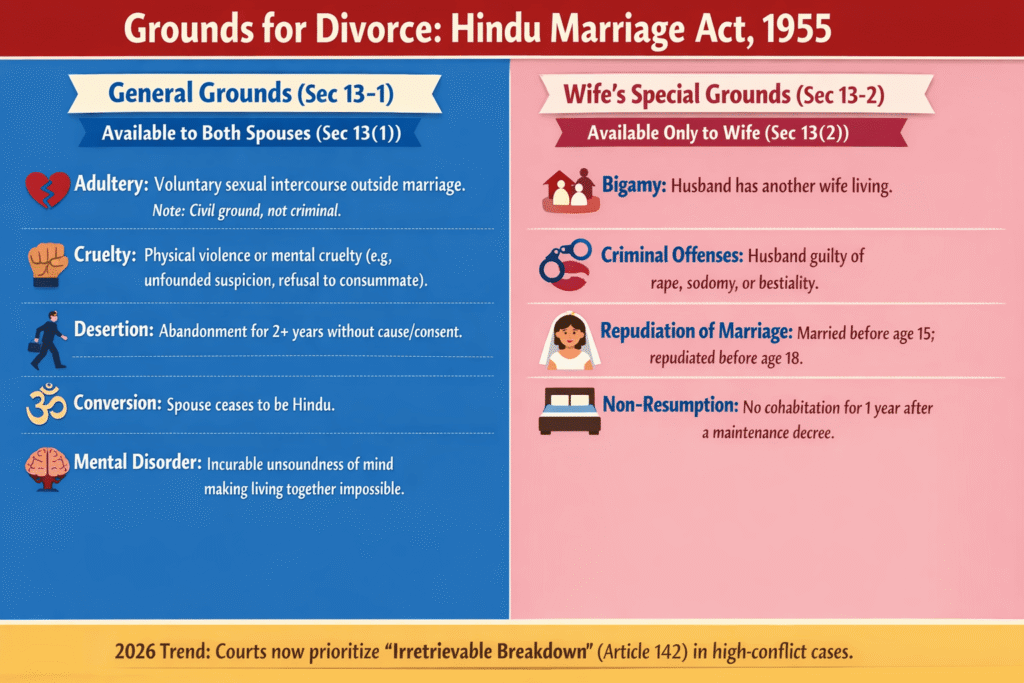
Section 13(1) of the HMA provides the primary grounds for divorce under the Hindu Marriage Act for contested cases. These grounds require the petitioner to prove specific misconduct by the other spouse. Consequently, the burden of proof lies heavily on the person seeking the decree.
Proving Cruelty and Mental Harm
Cruelty remains the most frequently cited ground. It includes both physical violence and mental cruelty. For instance, the Kerala High Court ruled in October 2025 on this matter. It stated that constant unfounded suspicion and monitoring movements constitutes mental cruelty.
Furthermore, the Delhi High Court recently held that the wilful refusal to consummate a marriage is a form of cruelty. Therefore, lawyers must gather specific instances of behavior. These instances must cause a reasonable apprehension of harm.
Adultery and Evidence Standards
Adultery is no longer a criminal offense in India. However, it remains a valid civil ground for divorce. Proving adultery requires a “preponderance of probability.” In other words, you do not need proof beyond a reasonable doubt. Since direct evidence is rare, courts often rely on circumstantial evidence. For example, hotel records or DNA tests can establish such claims.
Desertion and Abandonment
Desertion requires the spouse to leave for a continuous period of at least two years. The petitioner must prove animus deserendi. This term refers to the specific intention to desert. Additionally, this separation must occur without reasonable cause. Most importantly, it must happen without the petitioner’s consent.
Conversion and Mental Health
If a spouse ceases to be a Hindu by conversion to another religion, it creates a ground for divorce. Similarly, Section 13(1)(iii) covers incurable unsoundness of mind. However, the mental disorder must be extremely severe. As a result, the petitioner must be unable to reasonably live with the respondent.
Special Grounds Available to the Wife Under Section 13(2)
The Act provides additional protections exclusively for wives under Section 13(2). These provisions recognize specific vulnerabilities. Moreover, they address the historical contexts of matrimonial disputes.
Bigamy and Criminal Conduct
A wife may file for divorce if the husband has another wife living from a previous marriage. Moreover, grounds include the husband being guilty of rape, sodomy, or bestiality. These grounds often overlap with criminal proceedings. Therefore, professional coordination between legal teams is essential.
Repudiation and Non-Resumption
If a girl was married before the age of fifteen, she may repudiate the marriage. She must do this after turning fifteen. However, she must act before reaching eighteen. Additionally, a wife can seek divorce if cohabitation has not resumed for a year. This applies specifically after a maintenance decree was passed.
Mutual Consent Divorce: Section 13B Requirements
The most streamlined grounds for divorce under the Hindu Marriage Act fall under Section 13B. This allows parties to end the marriage peacefully by mutual agreement. However, specific procedural mandates must be followed strictly to ensure validity.
The Separation Mandate
Parties must have lived separately for a period of one year or more. They must also state that they cannot live together any longer. Consequently, the court requires a joint petition to initiate the legal process.
Waiting Periods and Waivers
The law traditionally requires a six-month “cooling-off” period between the first and second motions. However, the Supreme Court issued a vital ruling in Amardeep Singh v. Harveen Kaur. It ruled that this period is directory rather than mandatory. Therefore, courts can waive this wait if the parties have already been separated for a long time.
Irretrievable Breakdown of Marriage
In landmark cases like Shilpa Sailesh v. Varun Sreenivasan, the Supreme Court used Article 142 powers. It can now grant a divorce if the marriage is irretrievably broken. While this power belongs to the apex court, it sets a pragmatic tone. Consequently, lower courts now handle high-conflict cases with more flexibility.
Essential Documentation for Filing a Divorce Petition
Success in matrimonial litigation depends on meticulous paperwork. Indian courts are increasingly strict about documentation. This is especially true regarding financial disclosures and asset proofs.
Identity and Marriage Proof
First, lawyers must secure the marriage certificate or wedding photographs. An invitation card can also serve as proof of Hindu rites. Second, valid identity and residency proofs of both parties are mandatory. These documents help to establish the court’s jurisdiction over the matter.
Financial Affidavits: Rajnesh v. Neha
The Supreme Court recently mandated a comprehensive affidavit of assets and liabilities. This occurred in the Rajnesh v. Neha case. This filing is crucial for determining alimony and child support. Significantly, concealing financial facts can lead to the quashing of maintenance orders.
Sustaining Evidence
For contested cases, you need medical reports for cruelty or police complaints (FIRs). Furthermore, chat logs and bank statements are essential. Specifically, maintaining an organized list of Streedhan is vital. This ensures a fair distribution of joint assets during the final settlement.
Jurisdictional Challenges and Filing Procedures
Determining where to file is the first hurdle in any divorce case. Section 19 of the HMA defines the correct Family Court jurisdiction.
Where to File
Generally, the petition is filed where the marriage was solemnized. Alternatively, it can be filed where the respondent resides. However, it can also be filed where the parties last lived together. If the respondent lives outside India, the petitioner may file where they currently reside.
The Role of Mediation
Most Family Courts now mandate counseling or mediation sessions. These sessions aim to explore reconciliation. Alternatively, they facilitate a peaceful settlement. Therefore, lawyers should prepare their clients for these interactions. This preparation helps to avoid unnecessary delays during the trial.
Interim Relief and Maintenance
Under Section 24, a spouse can apply for maintenance pendente lite. This provides financial support while the litigation is ongoing. Because these applications take time, you should file them early. This is vital for the client’s financial survival during the case.
Streamlining Matrimonial Litigation with LawSathi
Managing the grounds for divorce under the Hindu Marriage Act involves high volumes of data. It also requires meeting tight deadlines. LawSathi offers AI-powered tools designed for the modern Indian practitioner.
Document and Evidence Management
LawSathi helps you categorize years of digital evidence. For example, you can use folders like “Cruelty” or “Evidence of Adultery.” This keeps your case files organized and ready for trial. Moreover, you can store sensitive client documents in a secure digital vault.
Automated Alerts and Research
Never miss an interim maintenance hearing again. Our platform automates client updates and hearing notifications. Additionally, LawSathi’s research tools allow you to find recent precedents. Within seconds, you can access 2025 and 2026 matrimonial rulings. This ensures your arguments are always backed by the latest High Court decisions.
Conclusion
Understanding the grounds for divorce under the Hindu Marriage Act is only half the battle. Successful practitioners must also master the art of documentation. Above all, you must ensure procedural compliance. By staying updated on recent Supreme Court landmarks, you can provide superior representation.
Managing divorce cases requires meticulous documentation and empathy. Furthermore, it requires efficient organization. Let LawSathi handle your case management and scheduling. As a result, you can focus on securing justice for your clients. Schedule a demo today.