
The landscape of Indian litigation has changed forever. In a landmark Supreme Court ruling 2026 virtual hearings have moved from a temporary convenience to a mandatory constitutional right. Chief Justice and the bench have redefined how justice reaches the common citizen. This decision ensures that no court in India can deny a litigant the right to appear virtually. Therefore, lawyers must now prepare for a future where the courtroom has no geographic boundaries.
Introduction: The Landmark 2026 Verdict on Digital Justice
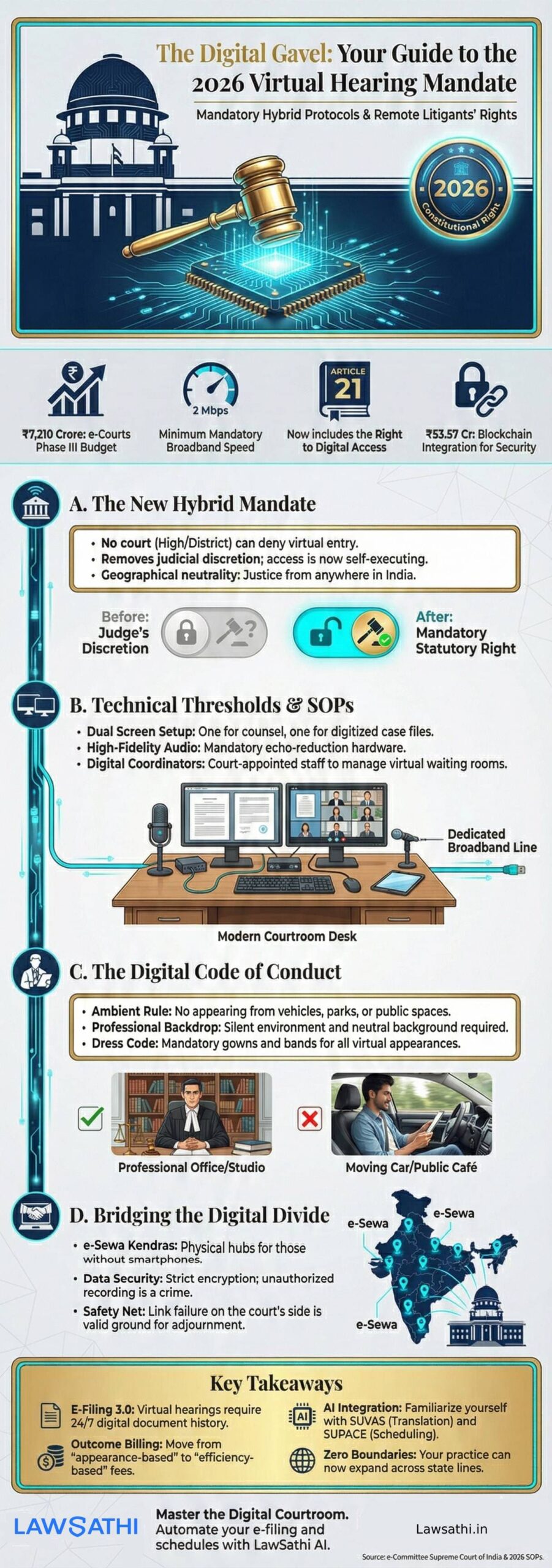
The Supreme Court of India officially ushered in a new era of digital justice in early 2026. This ruling builds upon the e-Courts Project Phase III, a central scheme with a massive budget of ₹7,210 Crore. Previously, hybrid hearings were often at the discretion of individual judges. However, the 2026 verdict makes hybrid accessibility a mandatory statutory requirement for all High Courts and District Courts.
Moving Toward Geographical Neutrality
This legal shift focuses on geographical neutrality. Litigants from remote corners of India no longer need to travel days for a five-minute hearing. For example, the Court emphasized that “Access to Justice from Anywhere” is the new standard. Consequently, the physical location of a person no longer limits their ability to seek legal remedies.
From Discretionary to Mandatory Access
In the past, many courts viewed virtual platforms as emergency measures. This perception has changed. The 2026 ruling follows the precedent set in Sarvesh Mathur v. Registrar General, which prohibited High Courts from stopping virtual access. Now, the Supreme Court ruling 2026 virtual hearings protocol removes all judicial discretion to deny remote entry.
New Mandatory Criteria for ‘Hybrid Mode’ Access
The court has released a strict Standard Operating Procedure (SOP) for all judicial officers. Lawyers no longer need to prove “exceptional circumstances” or medical emergencies to argue virtually. Instead, the process is now self-executing through the court’s portal. Furthermore, the Supreme Court e-committee has set specific technical benchmarks.
Technical Thresholds for Every Courtroom
Efficiency requires high-quality infrastructure. To illustrate, every courtroom must now maintain a minimum 2 Mbps dedicated broadband connection. Judges are required to use dual-screen setups. One screen displays the remote counsel. Meanwhile, the other screen shows the digitized case files. Additionally, ports must ensure high-fidelity audio to prevent common echo issues.
The Role of Digital Coordinators
To manage this transition, courts have appointed “Digital Coordinators.” These officials assist the Court Master in managing virtual waiting rooms. They ensure that remote participants enter the session only when their case is called. Moreover, they help elderly litigants or those unfamiliar with the software. This role reduces technical delays and keeps the daily board moving smoothly.
Etiquette and the “Ambient Environment” Rule
While access is a right, decorum remains a duty. The updated SOPs strictly forbid appearing from inappropriate locations. For instance, following past incidents in the Gujarat High Court, appearing from a vehicle or a public park is now grounds for contempt. Specifically, lawyers must ensure a professional backdrop and a silent environment during proceedings.
Legal Rights of Remote Litigants: A Constitutional Perspective
The 2026 ruling anchors digital access within our fundamental rights. Specifically, the Court has re-interpreted Article 21 of the Constitution to include the “Right to Digital Access.” In cases like Amar Jain v. Union of India (2025), the bench held that digital exclusion is a form of systemic injustice.
Protection Against Technological Exclusion
The State is now constitutionally obligated to bridge the digital divide. For example, if a litigant lacks a smartphone, the court must provide an e-Sewa Kendra within reach. These centers act as physical bridges to the virtual court. Therefore, poverty or lack of technology cannot be a reason for denying a hearing.
Privacy and Data Security Protocols
Digital hearings involve sensitive evidence and personal testimonies. Consequently, the 2026 guidelines include strict data privacy protocols. Unauthorized recording of court proceedings is now a punishable offense. Additionally, the court uses encrypted servers to store evidence. This ensures that remote submissions are as secure as physical ones.
Impact on Legal Practitioners and Law Firm Operations
For Indian lawyers, the Supreme Court ruling 2026 virtual hearings mandate requires a total change in business strategy. Traditional billing models often counted “appearance fees” based on time spent in court. Now, firms are shifting toward outcome-based billing. Because travel time is gone, clients expect more efficiency and faster turnaround.
Mandatory e-Filing and Digital Readiness
Hybrid hearings are now tied to digital filing. Specifically, you cannot request a virtual hearing unless you have used the e-Filing 3.0 portal. This system allows for 24/7 document uploads. As a result, law firms must digitize their entire case history to stay relevant in this ecosystem.
Managing Remote Advocacy and Ethics
Advocacy skills must also adapt to the screen. For example, the Bar Council of India has issued clear dress code guidelines. Attorneys must wear their gowns and bands even when calling from home offices. Most importantly, lawyers must learn how to perform cross-examinations effectively through video conferencing platforms.
Challenges in Implementation: Infrastructure and The Digital Divide
Despite the bold mandate, challenges remain in rural or “mofussil” courts. There is a visible disparity between Tier-1 city courts and those in remote blocks. While the Union Cabinet has approved massive funding, building infrastructure takes time. Consequently, many rural courts still face frequent power outages and slow internet.
Technical Glitches as Valid Legal Grounds
The 2026 ruling provides a safety net for technical failures. New precedents confirm that a link failure on the court’s side is a valid ground for adjournment. For instance, the “Right to be Heard” cannot be sacrificed because of a server crash. Thus, judges are now more patient with connectivity issues than they were in previous years.
The Role of Bar Councils in Training
Digital literacy is the biggest hurdle for senior practitioners. Therefore, various State Bar Councils have launched training modules. These programs teach lawyers how to use digital signatures and e-filing tools. Additionally, Madras High Court rulings remind trial courts they must help lawyers with these facilities.
Future Outlook: Towards a Paperless and Borderless Judiciary
Looking ahead, the road to 2030 points toward the “Unified Digital Legal Ecosystem.” The Supreme Court is currently testing AI-driven tools like SUPACE. These tools help in case-ranking and smart-scheduling. Furthermore, AI helps in real-time translation of judgments into regional languages through the SUVAS portal.
Blockchain and Secure Records
Security is the top priority for the e-Committee. To combat record tampering, the government has earmarked ₹53.57 Crore for blockchain integration. This technology will secure digitized court records from District Courts to the Supreme Court. In other words, the authenticity of a digital document will be beyond doubt.
Final Thoughts for Practitioners
The Supreme Court ruling 2026 virtual hearings is not just a procedural update. It is a fundamental shift in how law is practiced in India. Lawyers who embrace these digital protocols early will find their practice expanding across state borders. Conversely, those who resist may find themselves excluded from the modern judicial system.
Stay ahead of the digital curve. Automate your e-filing alerts with LawSathi’s AI-powered practice management tools. Additionally, manage hybrid hearing schedules seamlessly. Book a free demo today.