
The Indian legal landscape changed forever on July 1, 2024. On this date, the Bharatiya Sakshya Adhiniyam blockchain evidence standards replaced the century-old Indian Evidence Act (IEA).
This shift modernizes how courts handle digital records. Specifically, it addresses decentralized technology. Lawyers now face a critical question regarding this new framework. Can immutable blockchain logs serve as valid secondary evidence in court?
This blog explores the new High Court guidelines. Furthermore, it analyzes the transition to the Bharatiya Sakshya Adhiniyam (BSA).
Introduction: The Shift from IEA to Bharatiya Sakshya Adhiniyam (BSA)
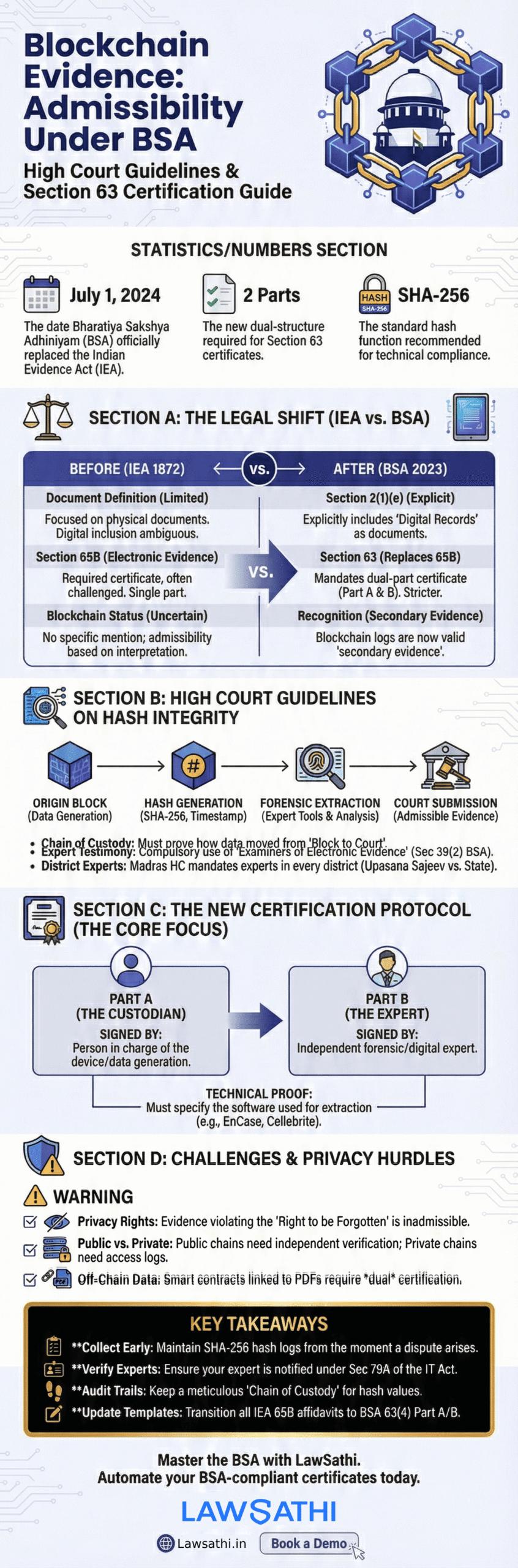
The BSA marks a significant departure from the Indian Evidence Act of 1872. Specifically, it explicitly includes “electronic and digital records” within the definition of a document under Section 2(1)(e). This change is vital for modern litigation.
Why Decentralized Ledgers Matter Now
Decentralized ledger technology (DLT) is becoming common in Indian business disputes. For example, supply chain tracking and smart contracts generate massive amounts of data.
In fact, these records are permanent and transparent. Consequently, they provide a reliable narrative for legal teams.
Defining the Evidence Problem
Previously, lawyers struggled to categorize blockchain logs under the IEA. Many practitioners wondered if these records qualified as primary or secondary evidence.
The BSA clarifies this by creating a specific framework for electronic records. Therefore, modern litigators must understand how to present these digital fingerprints.
The primary goal is to prove the integrity of the data. Use of Bharatiya Sakshya Adhiniyam blockchain evidence requires a deep understanding of hash values.
Understanding Electronic Records as Secondary Evidence under BSA
Under the new regime, Section 58 of the BSA defines secondary evidence. This section mirrors the old Section 63 of the IEA. However, Section 63 of the BSA is now the most critical provision for digital data.
Categorizing Blockchain Hash Values
A blockchain hash function acts as a digital fingerprint. If anyone alters the data, the hash changes immediately. Therefore, the BSA recognizes hash values as valid tools to ensure document authenticity.
Primary vs. Stored Blockchain Logs
In fact, the BSA treats electronic records as secondary evidence. However, they gain the status of primary evidence if you prove data integrity. You must follow the certification protocol outlined in Section 63(4).
Furthermore, the law distinguishes between the original data and the logs. An exported blockchain receipt is often viewed as a copy of the ledger. Thus, you must satisfy the court that the copy accurately reflects the decentralized source.
Recent High Court Guidelines on Blockchain Admissibility
Indian High Courts are currently refining how DLT data enters the courtroom. For instance, the Madras High Court recently addressed the lack of digital experts.
This is crucial for practitioners using Bharatiya Sakshya Adhiniyam blockchain evidence. Specifically, lawyers must now meet higher standards of technical proof.
Proving Hash Integrity
Courts now demand proof of a “chain of custody.” This means you must show how the data moved from the block to the court. Specifically, you should use expert witnesses to explain decentralized data structures.
The Role of Expert Witnesses
Section 39(2) of the BSA allows courts to seek opinions from the Examiner of Electronic Evidence. This examiner is usually notified under Section 79A of the IT Act. Most importantly, courts rely on these experts for complex technical data.
Specifically, in the case of Upasana Sajeev vs. State, the Madras High Court noted a gap. There are very few notified experts in India. As a result, the court directed the government to notify more experts in every district.
The New Certification Protocol: Section 63(4) of the BSA
The old Section 65B(4) IEA certificate is now gone. It has been replaced by the Section 63(4) BSA certificate. This new certificate has two distinct parts.
Part A and Part B Requirements
First, Part A must be signed by the person in charge of the device. For example, this could be your client. Alternatively, it could be their IT manager. Second, Part B requires the signature of an independent expert.
Finding a Blockchain Custodian
Identifying a “custodian” for a decentralized blockchain is difficult. No single person owns the network. Consequently, legal experts suggest that the person who generated the specific block hash should sign Part A.
Moreover, the person verifying the node data usually signs Part B. Therefore, law firms must identify forensic auditors early in the litigation process. This ensures that the Bharatiya Sakshya Adhiniyam blockchain evidence remains admissible.
Practical Challenges for Lawyers: Immutability vs. Admissibility
Blockchain is famous for being immutable. However, being unchangeable does not make it automatically admissible. Lawyers face several hurdles when presenting this data in a court of law.
The Right to be Forgotten
India’s privacy laws may conflict with permanent blockchain records. If a ledger contains sensitive personal info, it might violate privacy rights.
In fact, the Madras High Court emphasized a key point. Evidence obtained via privacy violations is inadmissible. As a result, permanent data can become a legal liability.
Public vs. Private Blockchains
Public blockchains like Ethereum are easier to verify independently. In contrast, private blockchains require more extensive documentation. Specifically, you must prove who had access to the private network. This proof must correspond to the time of the transaction.
Handling Off-Chain Data
Many smart contracts reference data stored “off-chain.” For example, a PDF contract might be stored on a server. However, its hash remains on the blockchain.
Therefore, you must provide certificates for both sources. You need one for the off-chain file. Most importantly, you need one for the on-chain record.
Best Practices for Indian Law Firms using Blockchain Records
To succeed under the BSA, law firms must change their workflows. You should start collecting hash function logs immediately. Specifically, use SHA-256 or similar standards as mentioned in the BSA Schedule.
Maintaining Forensic Trails
Always maintain a clear record of how your firm accessed the data. This record is often called a “Chain of Custody.” It proves that the evidence was not tampered with during collection.
Preparing BSA-Compliant Affidavits
Update your affidavit templates to match the dual-part certificate system. Ensure your expert mentions the specific software used to extract data. Additionally, explain the technical terms in simple language for the judge.
Using AI and Legal Tools
Managing digital exhibits can be overwhelming. Therefore, using AI-powered platforms can help organize files. These tools ensure your Bharatiya Sakshya Adhiniyam blockchain evidence meets all procedural requirements.
Ultimately, the BSA provides a clearer path for digital evidence. By following High Court guidelines, you can leverage blockchain’s immutability to win cases.
Stay ahead of the new criminal laws with LawSathi. Our AI-driven platform helps you manage digital evidence. Additionally, we automate BSA-compliant certifications. Book a demo today.