
Protecting Bona Fide Third Parties in Property Forfeiture
The transition from the old CrPC to the new Bharatiya Nagarik Suraksha Sanhita (BNSS) has changed how police seize assets. Specifically, the Section 105 BNSS guidelines issued by the Supreme Court in 2026 now provide a vital shield for citizens.
These rules prevent the government from arbitrarily snatching away property without proper legal cause. Consequently, understanding these changes is essential for every property owner.
Introduction: The Shift from CrPC to Section 105 of the BNSS
In the past, police used Section 102 of the CrPC to seize suspicious items. However, the new BNSS has significantly expanded these powers. Section 105 now allows for the systematic attachment and forfeiture of what the law calls “proceeds of crime.”
Addressing Investigative Overreach in 2026
By early 2026, the Supreme Court noticed a worrying trend. Investigating agencies were freezing bank accounts without showing a clear link to any crime. Therefore, the Court intervened to set strict limits on these expansive powers.
As a result, investigators must now prove a direct connection before taking action. This protects individuals from facing unfair financial freezes.
Defining the Proceeds of Crime
The law defines proceeds of crime as any property derived directly from an offence. It can also include assets of “equivalent value” if the original loot is hidden. Furthermore, recent judgments like State of West Bengal v. Anil Kumar Dey clarify how these powers work. Specifically, they explain how Section 105 coexists with other special acts.

Step-by-Step Procedural Safeguards Established by the Supreme Court
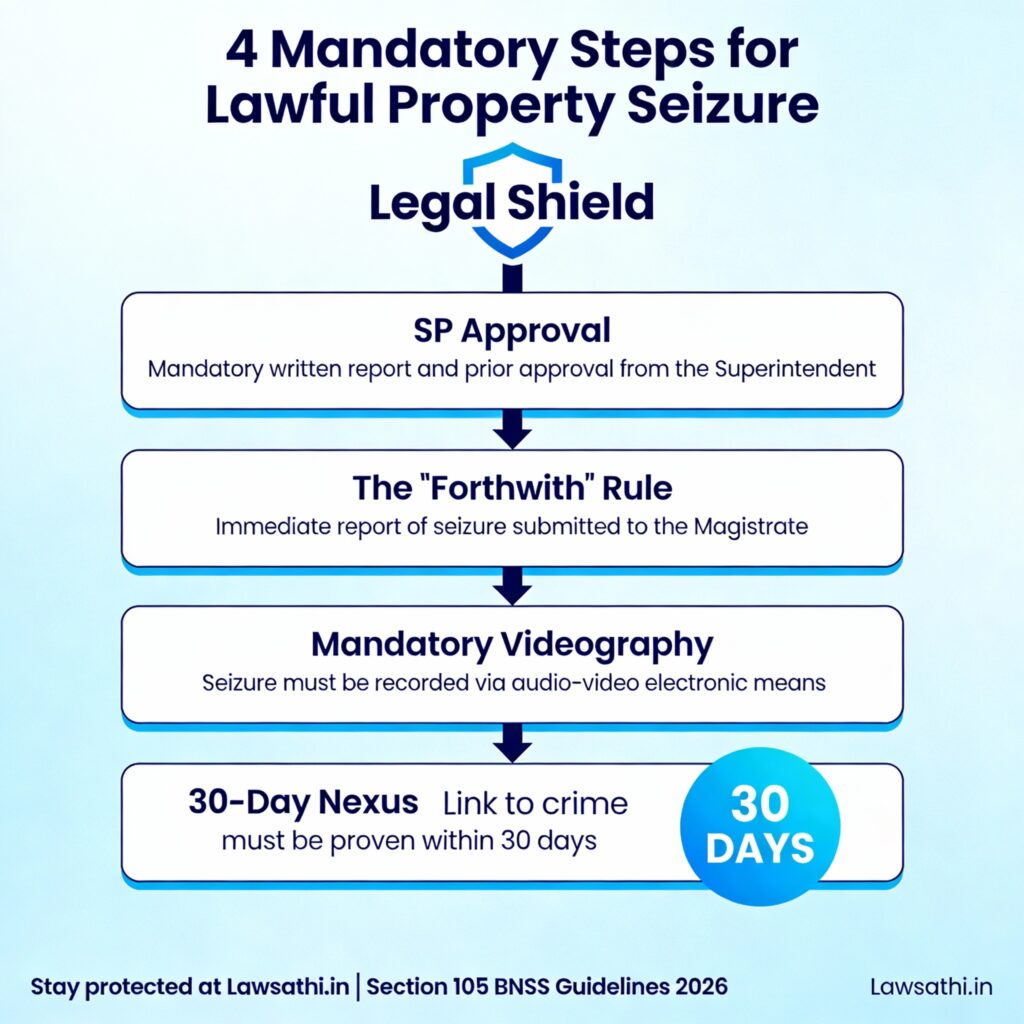
The 2026 Section 105 BNSS guidelines mandate a strict protocol. Police can no longer seize property based on verbal orders alone. Instead, they must follow a paper trail that justifies their every move. This transparency prevents the misuse of police authority.
Mandatory Reports and Approvals
First, an investigating officer must draft a detailed written report. Specifically, they must get prior approval from a senior officer, such as a Superintendent of Police. This ensures that a second pair of eyes reviews the case. Most importantly, the senior officer must verify the “nexus” between the asset and the alleged crime.
Strict Timeline Constraints for Police
Additionally, the police must report any seizure to the Magistrate “forthwith.” In fact, recent High Court rulings suggest that attachments face automatic scrutiny if the nexus isn’t proved within 30 days.
Consequently, property cannot be held indefinitely in a legal vacuum. Therefore, owners can challenge delays that exceed these strict time limits.
The Mandatory Videography Rule
Moreover, Section 105 requires the recording of search and seizure through audio-video electronic means. If the police fail to record the process, the entire attachment may be declared void in court.
Subsequently, digital evidence has become the gold standard for legal validity. This rule ensures that the seizure process remains fair and documented.
Protecting the Innocent: Rights of Bona Fide Third Parties
A major achievement of the 2026 guidelines is the protection of innocent outsiders. Often, banks or genuine buyers find their interests caught in a criminal web they did not create. These individuals are known as “Bona Fide Third Parties.”
The Knowledge and Diligence Test
To reclaim property, a third party must pass a two-part test. First, they must prove their interest in the property existed before the crime. For example, a mortgage signed two years prior is usually protected.
Second, they must show they performed proper “due diligence” like KYC checks. In other words, they must prove they acted in good faith.
Remedies for Banks and Genuine Buyers
If the state attaches your asset, you can use Section 105(4) to show cause. Courts now emphasize that PMLA-style forfeitures should not supersede secured interests of innocent banks.
Therefore, honest financiers have a clear path to seek the release of their collateral. To illustrate, banks can petition the court based on their prior registered mortgage.
Confiscation vs. Attachment: Understanding the 2026 Legal Distinction
Lawyers must distinguish between “interim attachment” and “final forfeiture.” Attachment is a temporary freeze during an investigation. Conversely, forfeiture is the permanent transfer of property to the State after a conviction.
Due Process and Show-Cause Notices
Because forfeiture is permanent, the law requires a 30-day notice period. This notice allows the owner to explain why the property is “clean.” In the 2026 framework, violating this period is a ground for immediate legal challenge. Furthermore, the court must hear the owner’s side before making a final decision.
The Principle of Proportionality
Specifically, the value of the seized asset must match the crime. If a suspect is accused of a ₹5 lakh fraud, the police cannot freeze a ₹5 crore factory.
The Supreme Court has ruled that such excessive actions violate the Right to Property under Article 300A. Similarly, the court will likely strike down any attachment that is clearly excessive.

Practical Implications for Criminal Defense and Trial Lawyers
For defense lawyers, the Section 105 BNSS guidelines offer new tools for litigation. You can now challenge nearly any attachment that lacks digital evidence. Additionally, you can target cases that miss proper senior approval.
Seeking the Release of Property
Lawyers can file for “Supurdari” or interim release of property. This is especially useful for perishable goods or commercial vehicles. If the owner suffers “undue hardship,” the court may release the property against a bond. Consequently, businesses can continue operating while the legal case proceeds.
Using Writ Petitions for Procedural Violations
Moreover, if the police bypass the statutory stages of the BNSS, you can file a Writ Petition. High Courts are increasingly proactive in quashing illegal bank account freezes. Specifically, they focus on cases that ignore Section 107 safeguards.
The Role of Legal Tech in Navigating BNSS Transitions
The new laws introduce complex timelines that are hard to manage manually. For instance, the 14-day limit for preliminary enquiries requires constant monitoring. This is where modern legal technology becomes essential for a busy practice.
Managing Digital Evidence with LawSathi
Since BNSS mandates videography, lawyers must handle massive amounts of digital data. LawSathi’s AI-powered tools help you organize these recordings efficiently.
For example, you can link videos directly to case diaries. Furthermore, you can track every procedural step to ensure compliance.
Tracking Case Law Updates
The jurisprudence around the Bharatiya Nagarik Suraksha Sanhita is evolving daily. LawSathi helps you stay updated with the latest High Court and Supreme Court digests. Consequently, you will never miss a critical precedent that could win your case. In fact, real-time alerts keep your practice competitive.
Conclusion: Balancing Investigative Power and Fundamental Rights
The 2026 Section 105 BNSS guidelines represent a major win for the rule of law. While the police have the power to track crime money, they must now do so with transparency.
By enforcing videography and senior approvals, the Court has created a much-needed balance. Therefore, both investigators and citizens must learn these new rules.
As we move deeper into this new era, understanding these procedural nuances is vital. Whether you are a lawyer or a property owner, knowing your rights is the first step toward justice.
Stay ahead of the new criminal laws. Use LawSathi’s AI-driven research and case management tools to navigate BNSS procedures with confidence. Schedule your demo today!