
Modern litigation in India has changed forever. As of January 2026, the transition to the Bharatiya Sakshya Adhiniyam (BSA) is complete. Consequently, lawyers can no longer rely on old habits from the Indian Evidence Act era.
Specifically, proving Section 63 BSA Digital Evidence requires meeting strict new technical standards. This guide explains how to navigate High Court protocols. Moreover, it will help you ensure your digital records remain admissible.
The Evolution from Section 65B IEA to Section 63 BSA: A 2026 Perspective
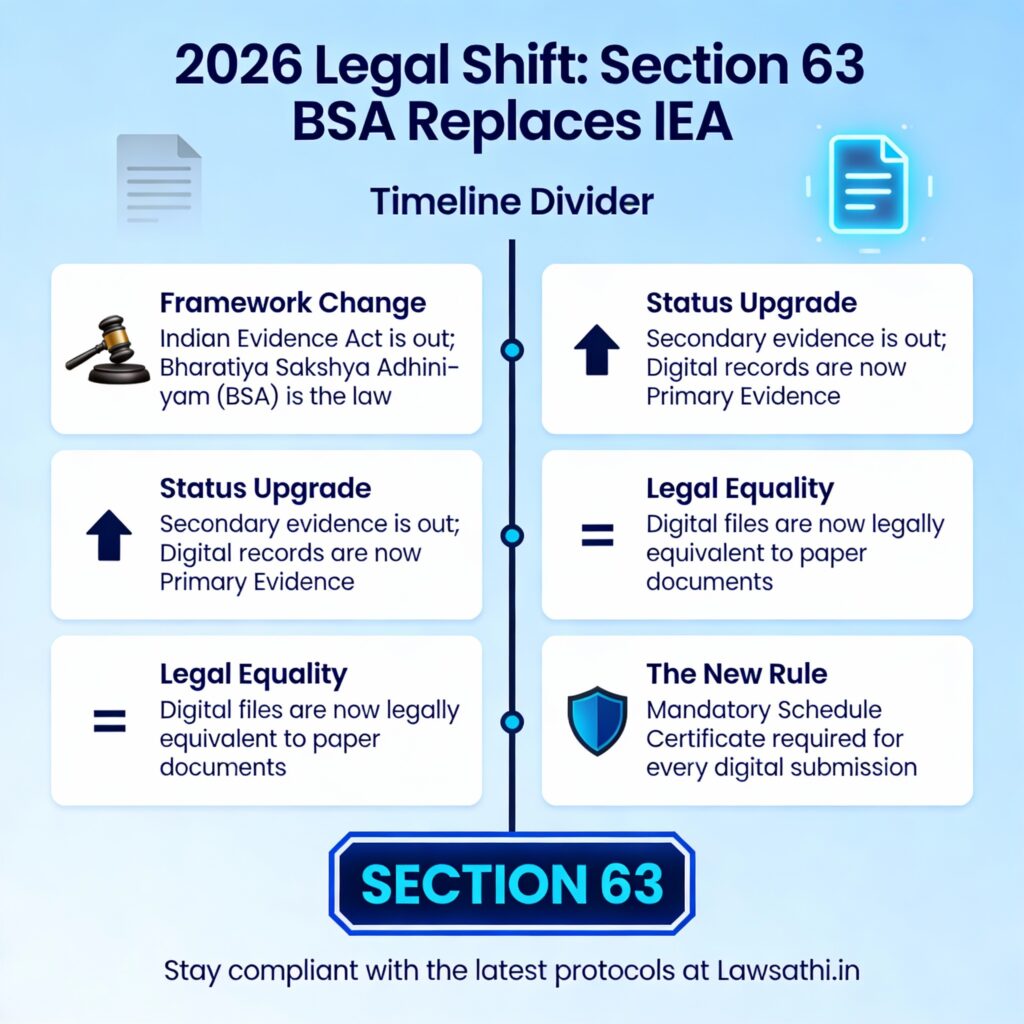
The Bharatiya Sakshya Adhiniyam, 2023, has officially replaced the Indian Evidence Act. Therefore, Section 63 of the BSA is now the “Primary Protocol” for all electronic records in Indian courts. This section treats digital files as documents rather than merely secondary evidence.
Why 2026 Marks a Legal Turning Point
Earlier, courts were lenient during the initial rollout of the new laws. However, by 2026, High Courts have mandated full compliance with new technical protocols.
As a result, any evidence filed today must strictly follow the BSA framework. This is necessary to be “deemed” a valid document. Above all, you must prepare for a more rigorous judicial review of your technical filings.
Defining Section 63 as the Primary Protocol
Under the old law, Section 65B was often seen as a procedural hurdle. In contrast, Section 63 BSA acts as a comprehensive code. It establishes that electronic records have the same legal standing as paper documents.
Most importantly, lawyers must accompany every digital record with a mandatory Schedule Certificate. This document is essential to prove the authenticity of the file. Failure to include this will likely lead to immediate dismissal of the evidence.
New High Court Protocols for Validating WhatsApp Chats
WhatsApp messages are the most common form of digital evidence today. Nevertheless, simple screenshots are no longer enough to satisfy the court. In 2026, High Courts require specific metadata for every chat produced.
Moving Beyond Simple Screenshots
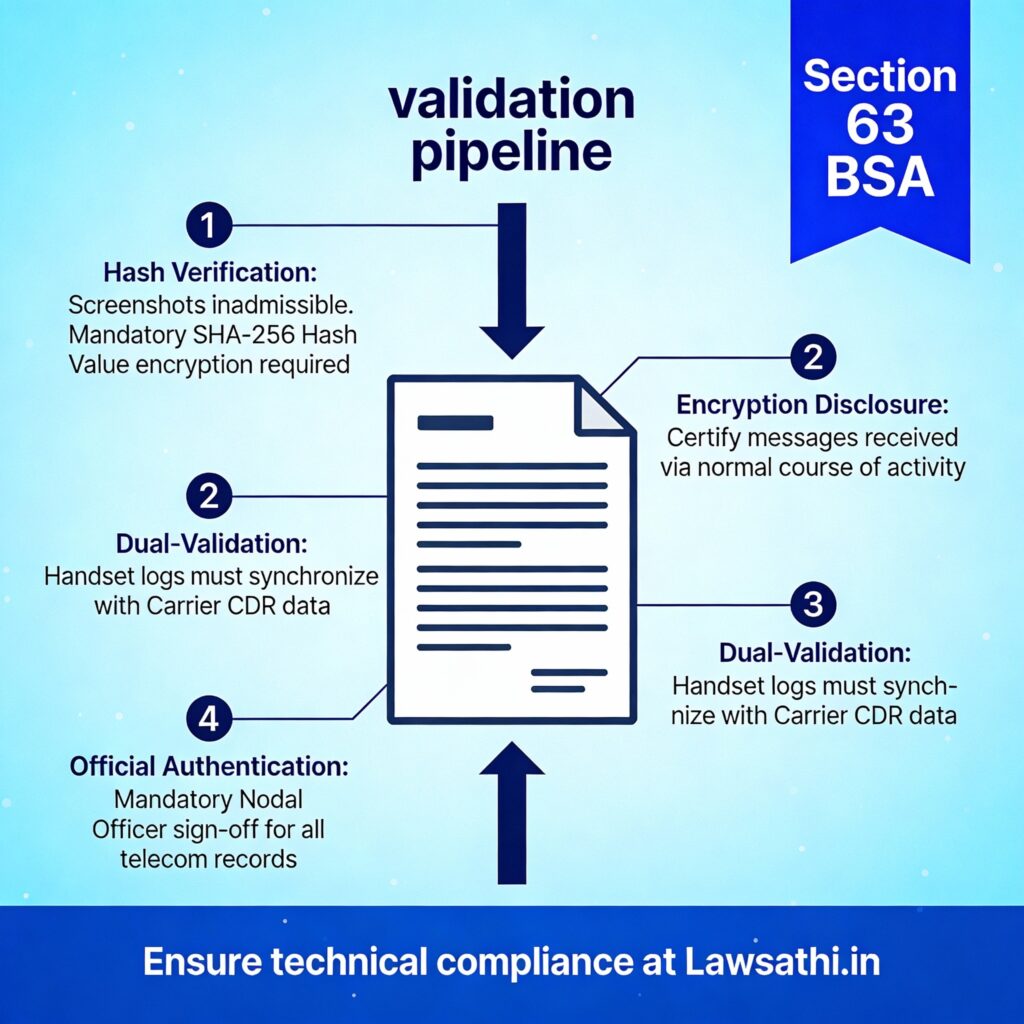
Screenshots are easily manipulated. Because of this, courts now demand “Hash Value” verification for message integrity. For example, the Delhi High Court has emphasized a critical point.
Specifically, screenshots without a proper certificate are inadmissible. You must now prove that the device was operating properly at the time. In other words, you must show the messages were received in the normal course of activity.
Hash Values and Digital Fingerprints
Every digital file possesses a unique “Hash Value.” Generally, you should think of it as a digital fingerprint. Specifically, you should use algorithms like SHA-256 to lock the file’s state.
If a single byte changes, the Hash Value will differ completely. Therefore, generating these values at the time of extraction is now a mandatory standard. This process validates Section 63 BSA Digital Evidence for the court’s eyes.
End-to-End Encryption Disclosures
Furthermore, certificates must now address the nature of encrypted platforms. You must certify that the message stayed in the ordinary course of the device’s activity. To illustrate, your certificate should state that the platform’s encryption remained intact.
This ensures that no third party tampered with the communication during the transfer. Consequently, it builds a stronger foundation for the reliability of the evidence.
Call Log Evidence: Technical Standards and CDR Integration
Call logs are vital in both criminal and civil trials. However, modern standards require more than just a list of numbers. In 2026, courts widely apply the “Dual-Validation” rule for call records.
Synchronizing Handset Logs with CDRs
First, you must produce the call log from the physical handset. Second, you must match this against the Call Detail Records (CDR) from the provider.
This cross-verification proves the call actually occurred on the network. As a result, missing one of these elements can weaken your case significantly. In fact, courts may view isolated logs with extreme skepticism.
Mandatory Nodal Officer Authentication
Telecom companies play a bigger role in 2026 litigation. For instance, any CDR submitted must be signed by a Nodal Officer. This officer must use the Part B format of the Section 63 certificate.
In addition, this confirms the data came directly from a secure billing server. Above all, this protocol prevents the use of forged call logs. Therefore, obtaining these signatures early in the trial process is vital.
Validating VOIP and Signal Calls
Standard CDRs do not exist for WhatsApp or Signal calls. To solve this, lawyers must now rely on metadata logs. These are usually extracted through forensic tools. These logs capture the duration and timestamp of internet-based calls.
Additionally, the Telecommunications Amendment Rules 2025 have further strengthened the verification process. This law focuses specifically on mobile identities and digital verification.
The New ‘Certificate 65B Equivalent’: Formats and Fields
The old Certificate 65B is gone. In its place, the BSA introduces a standardized Schedule divided into two parts. Understanding who signs which part is crucial for any practicing advocate.
Breaking Down Part A and Part B
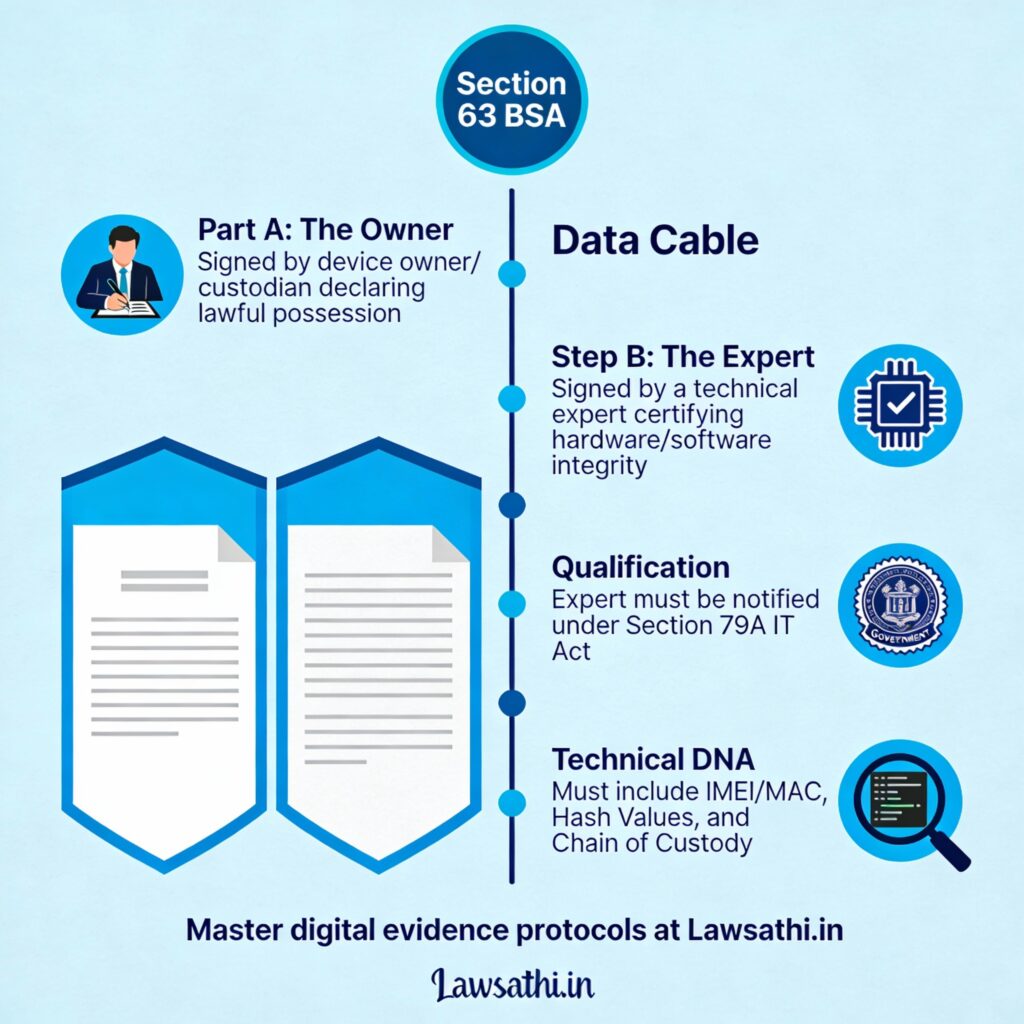
Part A is for the person in charge of the device. For example, your client would sign this part to declare they own the phone. Conversely, Part B requires a technical expert.
This expert must certify the hardware’s integrity. Consequently, skipping Part B often leads to the immediate rejection of evidence. You must ensure both parts are correctly filed to satisfy the court.
Who Qualifies as a Technical Expert?
Identification of the right expert is a common challenge in 2026. The Madras High Court recently ordered the government to notify more electronic evidence experts.
Generally, these are experts notified under Section 79A of the IT Act. Therefore, you must check if your expert is legally authorized to sign Part B. Using an unauthorized expert could render your entire evidence package void.
Common Pitfalls in Certificate Drafting
Many lawyers face rejection because they miss mandatory fields. Specifically, you must include the device’s IMEI or MAC address. Furthermore, you must list the hashing algorithm used.
In fact, vague statements about “proper working condition” are no longer sufficient. You must provide a clear “Chain of Custody” for the record. This tracking must span from extraction all the way to the courtroom.
Hardware vs. Software: Technical Neutrality in the BSA Era
The BSA embraces technical neutrality. This means the law applies to data anywhere. For example, it covers data on a physical chip or the cloud. However, this creates new hurdles for proving the “Chain of Custody.”
Validating Evidence in the Cloud
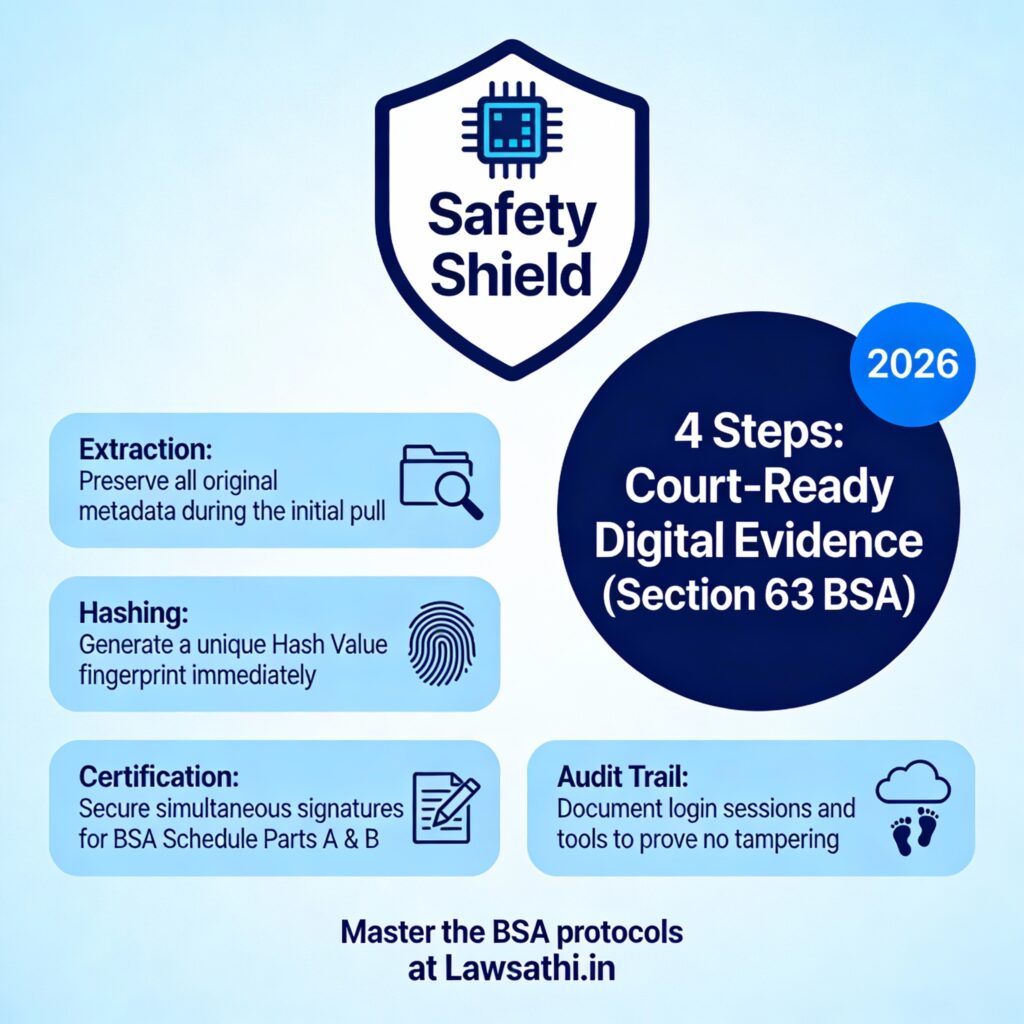
Evidence is rarely stored only on a phone nowadays. For example, Google Drive or iCloud storage is common. To validate this, your Section 63 certificate must describe the cloud login session.
Moreover, you must prove how you accessed the data. You must also show that the remote server’s integrity was maintained. This requires a detailed technical breakdown of the download process.
The Critical Role of Forensic Examiners
Forensic examiners have become essential partners for lawyers. They provide the forensic audit trail needed for contested cases.
Additionally, they use specialized software to ensure no metadata is lost. As a result, their expert testimony often determines the outcome of high-stakes digital litigation. In fact, their reports are now the backbone of digital proof.
Strategic Steps for Lawyers to Ensure Admissibility
To succeed in 2026, you must be as tech-savvy as you are legally skilled. Preparing Section 63 BSA Digital Evidence starts long before you reach the courtroom. Follow this checklist to stay ahead.
Pre-filing Checklist for Digital Records
First, extract the file with all its original metadata intact. Second, generate a Hash Value immediately using tools like WinMD5. Third, secure the Part A signature from your client.
Finally, ensure an authorized expert signs Part B. Following these steps consistently will protect your evidence from technical objections. Specifically, it creates a robust defense against claims of data tampering.
Handling Cross-Examination of Digital Proof
When facing digital evidence, you must ask the right technical questions. For example, ask if the Hash Value was generated at the time of seizure. Additionally, verify if the expert who signed the certificate is properly notified.
If the chain of custody is broken even for a minute, the evidence may be discarded. Therefore, you must scrutinize the opposing counsel’s technical documentation with great care.
Conclusion: Mastering the New Era
Proving Section 63 BSA Digital Evidence is now a specialized skill. By understanding Hash Values and Dual-Validation, you can protect your client’s interests. Similarly, the new certificate formats require your full attention.
The 2026 landscape demands precision and technical accuracy in every filing. Finally, stay updated with High Court rulings to ensure your practice remains compliant with the evolving standards of the BSA.
Streamline your Section 63 BSA compliance with LawSathi’s AI-powered Digital Evidence Vault. Automate your certificate generation and ensure your evidence is court-ready. Book a demo today.