
The landscape of Indian criminal law has undergone a seismic shift. This change occurred with the transition to the Bharatiya Nagarik Suraksha Sanhita (BNSS), 2023. As we navigate through 2026, the legal fraternity is witnessing a transformative era. Specifically, custodial jurisprudence is evolving rapidly. One of the most significant changes involves the old Section 167 of the CrPC. This provision is now reimagined under Section 187 of the BNSS.
A Shift in Detention Philosophy
Consequently, lawyers and judges are grappling with a new reality. They must now master the Section 167 BNSS police custody rules. The primary concern remains the balance between effective investigation and individual liberty. Therefore, this article explores how High Courts are interpreting these changes in 2026. We will focus on the controversial “staggered” custody. Additionally, we will examine the newly defined 90-day window.
Introduction: The Evolution of Custody Jurisprudence under BNSS
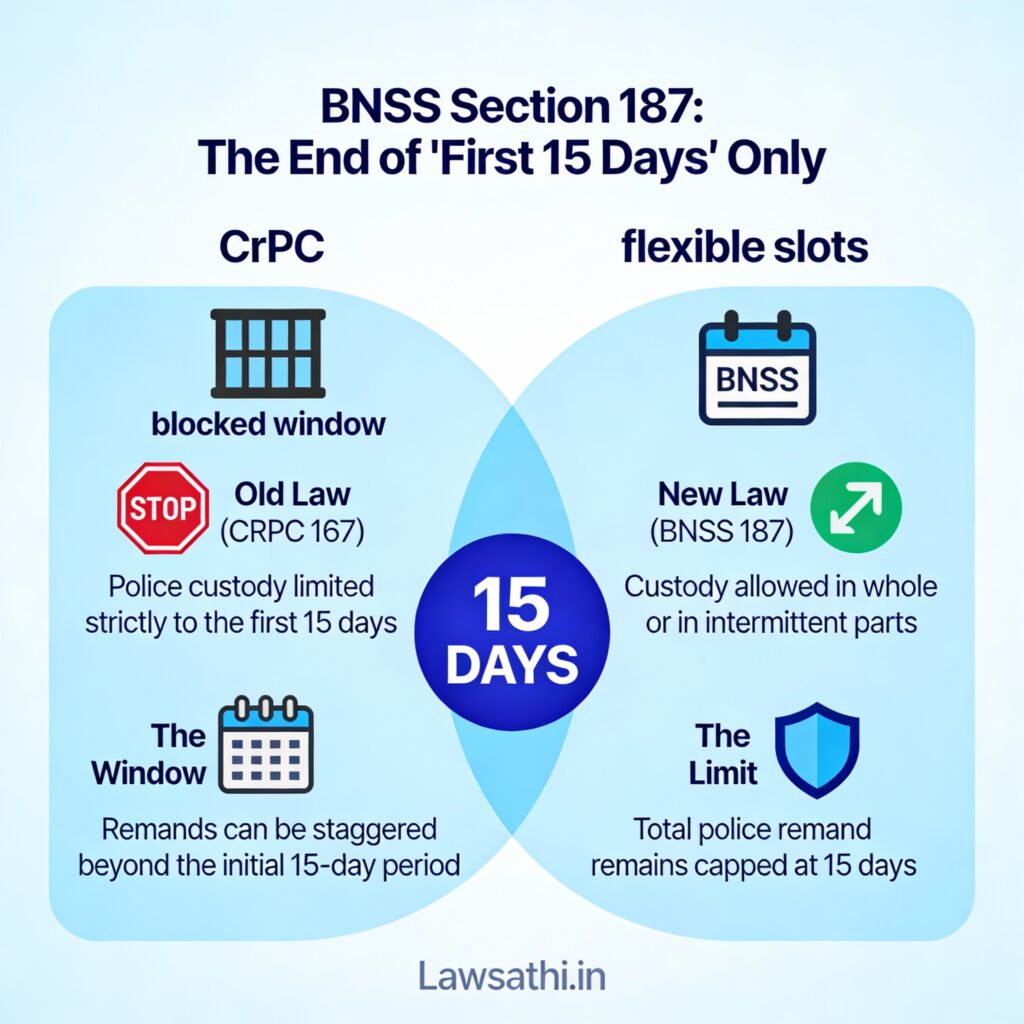
The most striking departure from the CrPC is the flexibility regarding police remand. Previously, police custody was strictly limited to the first 15 days following an arrest. However, under Section 187 of the BNSS, the police can now request custody in smaller portions. This “intermittent custody” can be spread across a longer period.
Understanding the Staggered Remand
Specifically, the new framework allows the 15-day custody period to be utilized “in whole or in parts.” This change caters to modern investigative needs. For example, an accused might be hospitalized immediately after arrest. This situation often prevented interrogation in the past. As a result, the police frequently lost their chance for custody entirely.
Why 2026 is a Landmark Year
Furthermore, 2026 marks the period where initial ambiguities are being settled. Judicial precedents are now providing much-needed clarity. Early analysis of the BNSS suggests that this shift is a highly litigated area. High Courts are now establishing the “rules of the game” for this extended window. Most importantly, they are ensuring that the spirit of the law is maintained.
Decoding the 90-Day Window: Recent High Court Directives in 2026
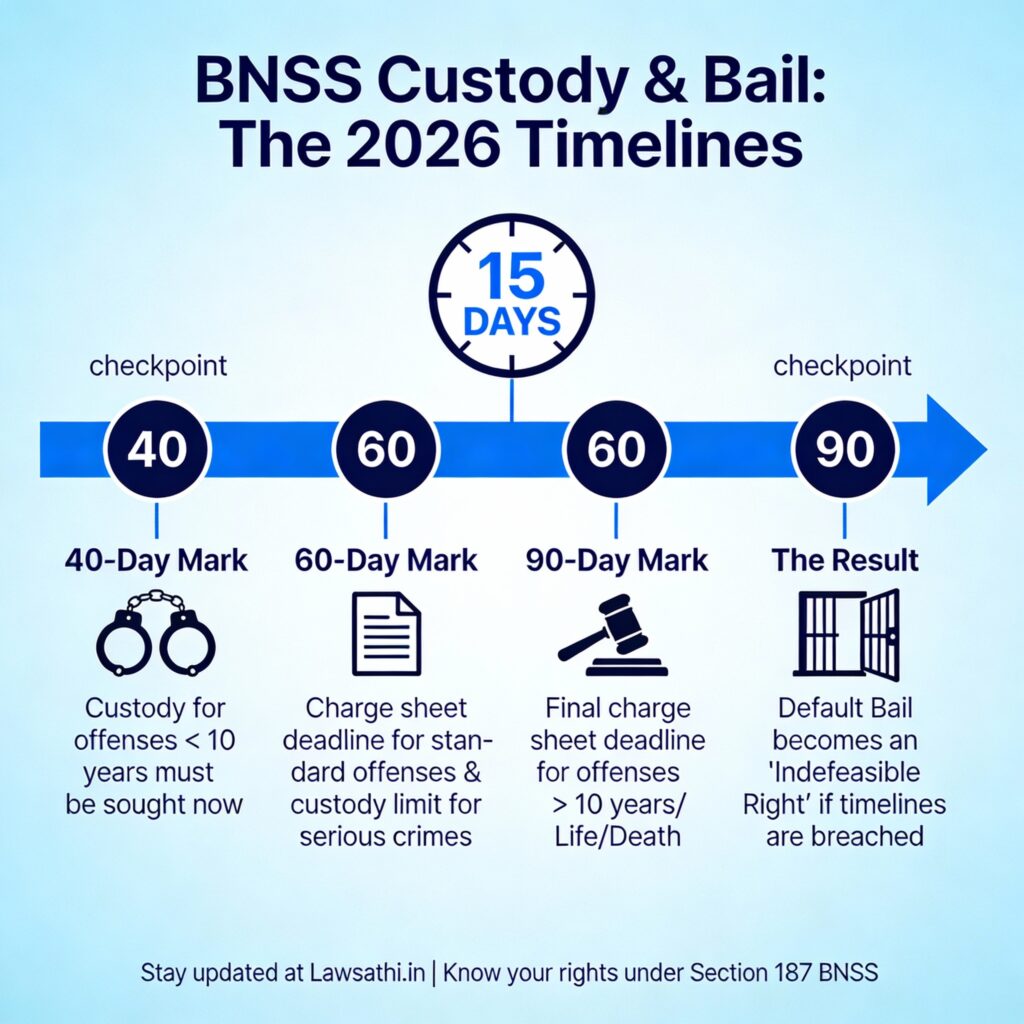
The BNSS has refined the timelines for filing charge sheets. For offenses involving punishment of 10 years or more, the limit is 90 days. For other offenses, the limit remains 60 days. However, a critical development involves the “40/60 day” rule for seeking police custody.
The 40 and 60 Day Cut-offs
High Courts swallowed a vital procedural deadline. For offenses punishable by up to 10 years, police custody must be sought within the first 40 days. In contrast, for more serious offenses, this window extends to 60 days. For instance, the Supreme Court recently affirmed a High Court judgment regarding this rule. This ruling reinforces these specific timelines as non-negotiable.
The Problem of Intermittent Custody
Additionally, courts are wary of the “intermittent custody” provision. Some agencies have tried to use this to keep investigations open indefinitely. Therefore, 2026 directives emphasize that Section 167 BNSS police custody is not an absolute right. Prosecutors must prove that new evidence necessitates a fresh round of custody. Moreover, they must do this within the 40 or 60-day window.
Judicial Discretion in Complex Investigations: When Can Custody be Extended?
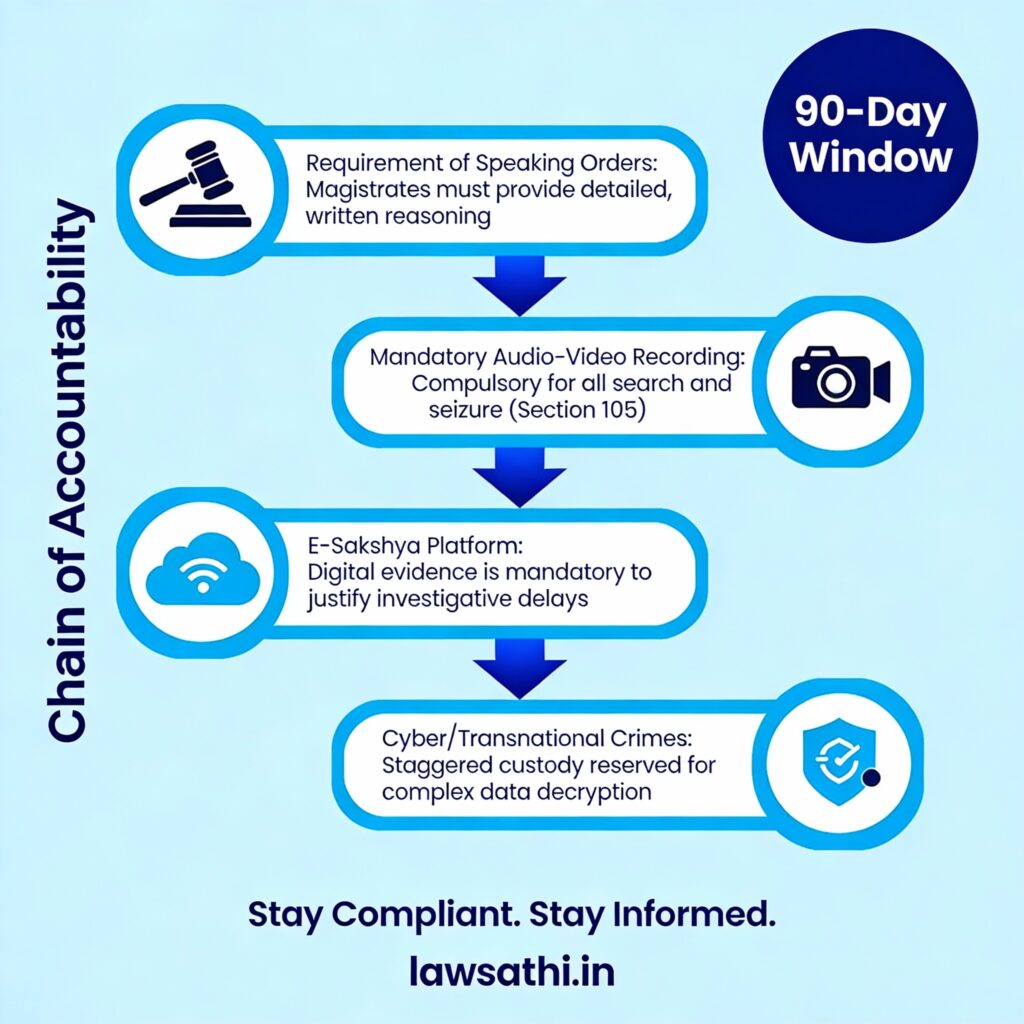
Judicial discretion remains the primary safeguard against the misuse of power. In 2026, Magistrates are under stricter scrutiny than ever before. They must pass “speaking orders” when granting or extending remand. This means they must explain their reasoning clearly.
Defining Complexity in 2026
What constitutes a “complex investigation” today? Usually, this involves transnational financial fraud or sophisticated cybercrime. For example, a suspect might hide encrypted data. In such cases, the police may argue for staggered custody during decryption. However, the Bombay High Court recently ruled against vague custody approvals. They stated a Magistrate cannot just mark “seen” on an application.
Transparency and Reasoned Orders
In fact, the Court granted default bail because the lower court failed to provide a reasoned order. This highlights a shift toward higher accountability. Magistrates must now justify why continued detention is necessary. Without this justification, the accused’s right to liberty prevails. Consequently, judicial officers must be more diligent in their paperwork.
The Section 187 BNSS Overlap: Clarifying the Maximum Limit of Police Remand
There is often confusion regarding the interplay between the old and new laws. Specifically, Section 187 of the BNSS is the direct successor to Section 167 of the CrPC. Lawyers must understand this overlap to protect their clients.
Default Bail remains Sacrosanct
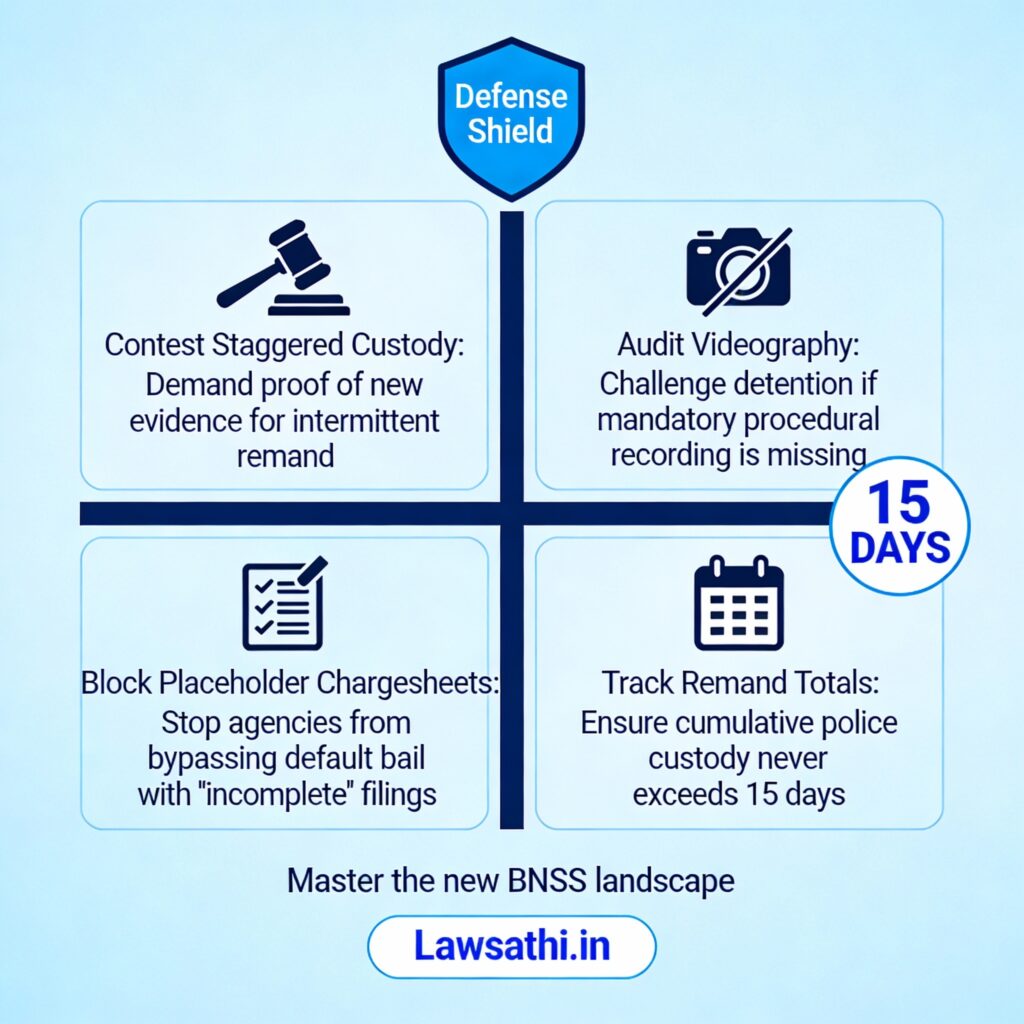
Moreover, the right to default bail remains an “indefeasible” right under Article 21. If the police fail to file a charge sheet, the accused must be released. Some agencies attempt to file “preliminary” charge sheets to block bail. However, the Delhi High Court has clarified this issue. They ruled that “further investigation” cannot be used to bypass default bail rights.
Maximum Remand Duration
Consequently, the total duration of police remand generally remains capped at 15 days. While these 15 days can be split, they cannot be exceeded. Lawyers must be vigilant in calculating the total days spent in Section 167 BNSS police custody. This diligence helps to prevent illegal over-detention.
Practical Challenges for Defense Lawyers: Strategies for 2026
Defense strategies in 2026 must be as tech-savvy as the new laws. One effective tactic is contesting “staggered” custody applications. If the police already had the accused for several days, why do they need him again?
Arguing Against Staggered Custody
Therefore, defense counsel should demand that the prosecution show “supervening circumstances.” For example, the request should be opposed if no new evidence has appeared. Additionally, LawSathi research indicates that challenging “necessity” is a winning strategy. Physical presence is not always required for all investigative steps.
Leveraging Procedural Lapses
Furthermore, lawyers can use procedural failures to their advantage. The law now mandates digital platforms for recording evidence. If the police fail to use these platforms, their plea for more time weakens. In 2026, the absence of digital proof is often seen as a sign of a sluggish investigation.
Impact of Digital Forensics on Investigative Timelines
The BNSS places a heavy emphasis on technology. Section 105 of the BNSS now mandates the audio-video recording of search and seizure. This is fundamentally changing how the 90-day window is managed.
Mandatory Videography and Evidence
For instance, the Kerala High Court recently mandated strict adherence to forensic documentation. If a crime scene was not videographed, the defense has strong grounds for a challenge. This can lead to earlier bail for the accused. As a result, procedural compliance is now a major battleground.
Forensics as a Double-Edged Sword
While digital forensics can provide clarity, they can also cause delays. However, 2026 High Court directives suggest that a delay in laboratory reports is not a valid excuse to deny bail. If the police were not diligent in sending samples via the e-Sakshya platform, they cannot claim the investigation is still pending.
Conclusion: The Future of Custodial Rights under LawSathi’s Lens
The shift from CrPC to BNSS has certainly expanded the state’s power. Specifically, they can now seek Section 167 BNSS police custody in a staggered manner. Nevertheless, the High Courts in 2026 are acting as a necessary check. By enforcing tight windows and requiring reasoned orders, the judiciary protects the right to liberty.
In this rapidly evolving legal environment, staying updated is no longer optional. For defense lawyers, mastering the nuances of Section 187 is crucial. As digital forensics become central to every case, technology will define success in the courtroom.
Stay ahead of BNSS updates and manage your landmark cases seamlessly. Experience the power of AI-driven legal research and practice management with LawSathi. Book a free demo today.