
The transition to the Bharatiya Nagarik Suraksha Sanhita (BNSS) marks a new era for Indian family law. Most importantly, Section 144 of the BNSS has now replaced the familiar Section 125 of the CrPC. Therefore, understanding the Section 144 BNSS maintenance procedure is essential for every practitioner.
This provision continues to serve as a vital tool for social justice. For example, it prevents vagrancy among vulnerable family members. However, the new law introduces specific timelines and broader eligibility criteria. Specifically, you must master these changes to represent your clients effectively.
Introduction: Transitioning from Section 125 CrPC to Section 144 BNSS
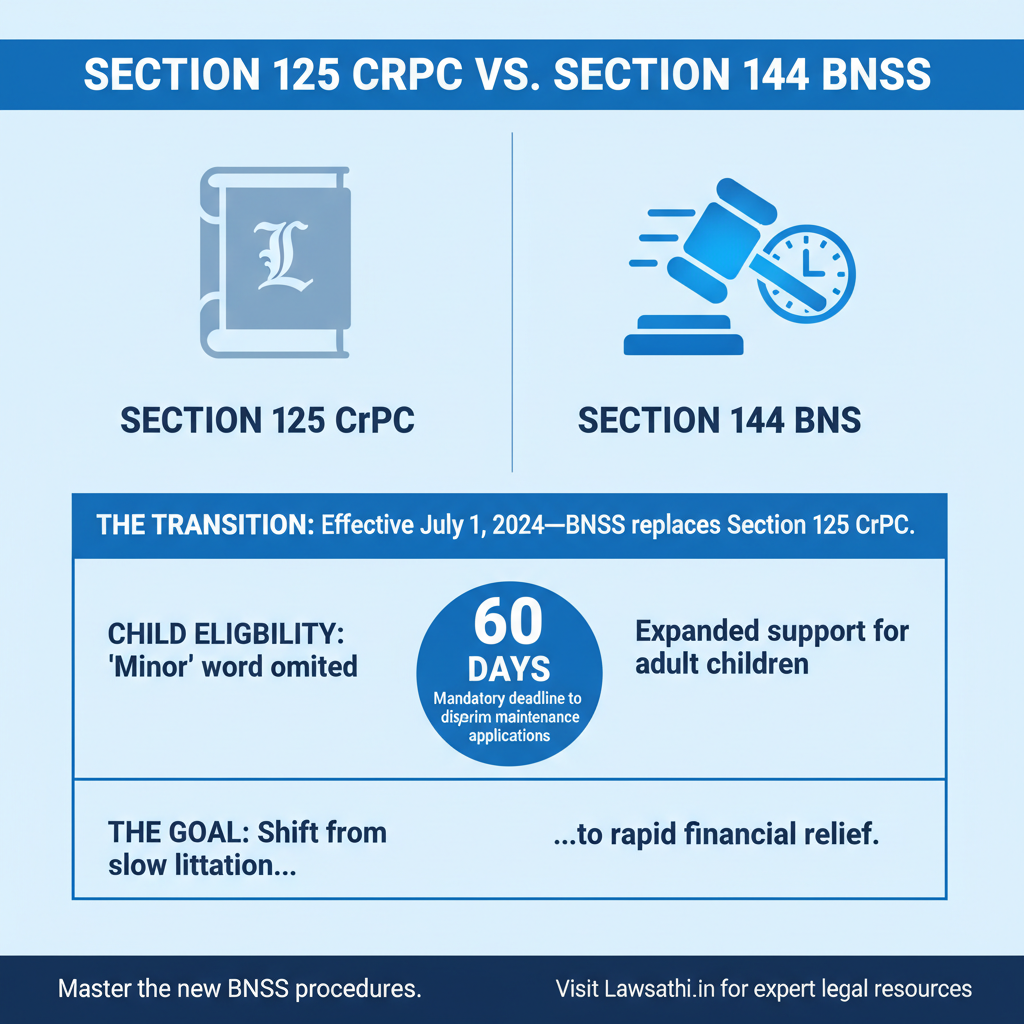
Section 144 of the BNSS officially took effect on July 1, 2024. It serves as the legal successor to Section 125 of the CrPC. Consequently, lawyers must adapt to several procedural improvements. For instance, the BNSS now focuses heavily on the speed of adjudication. It ensures that dependents do not suffer while cases linger in court.
Key Improvements in Adjudication Speed
The most significant change is the 60-day mandate for interim applications. According to the Bharatiya Nagarik Suraksha Sanhita, courts must now dispose of interim maintenance requests quickly. Specifically, this must happen within 60 days from the date of service of notice. This shift aims to provide immediate financial relief to claimants.
Broadening the Scope of Social Justice
The primary objective remains the prevention of destitution. However, the BNSS has expanded its reach significantly. In fact, a major change is the omission of the word “minor” in certain clauses. This change suggests that adult children may now find it easier to claim support. Consequently, children who cannot maintain themselves are better protected.
Who is Eligible to Claim Maintenance under Section 144 BNSS?
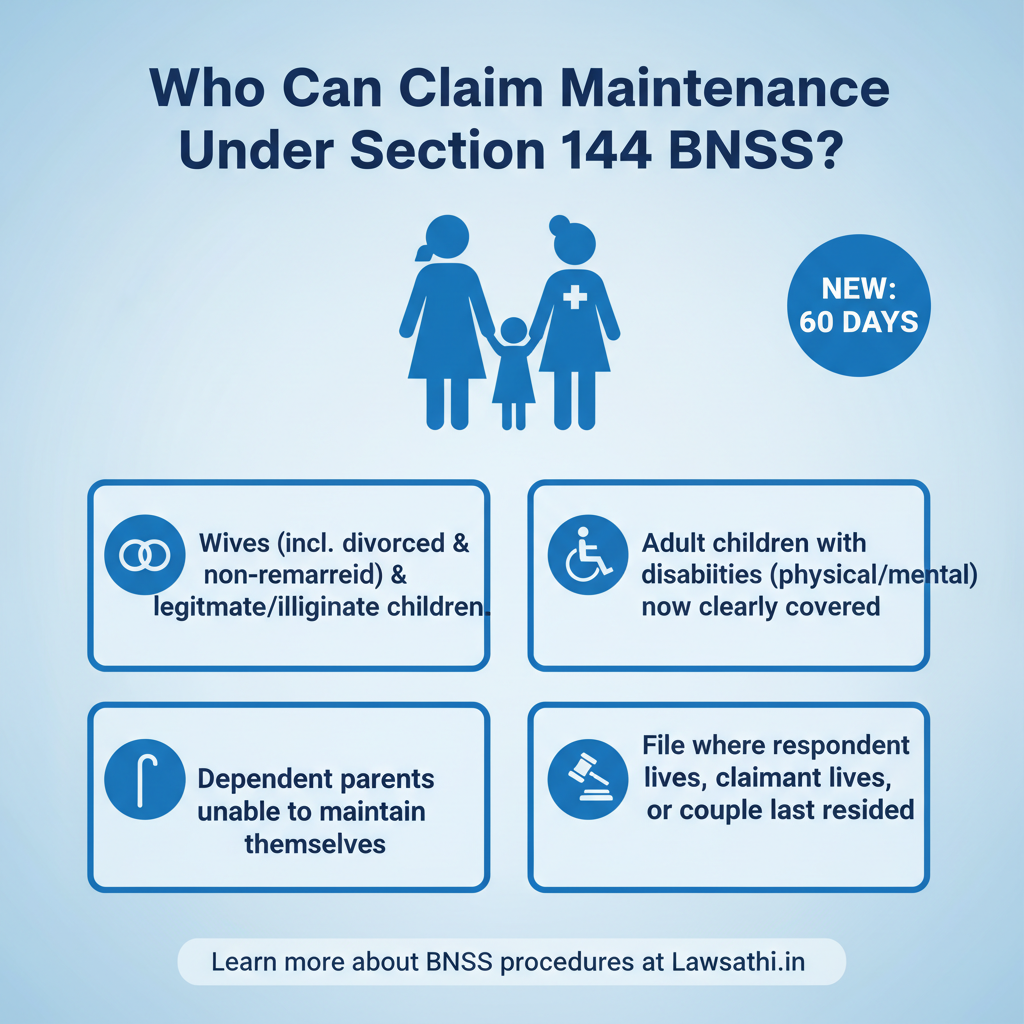
Eligibility remains a cornerstone of the Section 144 BNSS maintenance procedure. Therefore, you must identify if your client falls within the protected categories. The law protects wives, children, and parents.
Defining the “Wife” and “Children”
A “wife” includes a woman who has been divorced and has not remarried. Furthermore, courts held that prenuptial agreements cannot override this statutory right. Regarding children, the law covers both legitimate and illegitimate offspring. Additionally, it provides for adult children with physical or mental disabilities.
Understanding “Unable to Maintain Themselves”
The claimant must prove they cannot support themselves. However, “capacity to earn” is not the same as “actual earning.” For instance, a highly educated wife may still be entitled to maintenance. This applies if she is not currently employed. Moreover, it applies if she lacks a steady income.
Jurisdiction and Court Filing Requirements
First, you must determine the correct forum for your application. Generally, the Judicial Magistrate of the First Class handles these matters. In cities with Family Courts, the Principal Judge assumes this authority.
Territorial Jurisdiction Rules
The BNSS offers flexible territorial jurisdiction. You can file the application in any district where the respondent resides. Alternatively, you may file where the claimant resides. Furthermore, you can file where the couple last resided together. This flexibility helps wives who move back to their parental homes.
Preliminary Documentation and Fees
Maintenance proceedings are quasi-criminal. As a result, they usually attract only a nominal court fee. You should check the specific court fee rules in your state. Generally, the process requires an application supported by a thorough affidavit.
Step-by-Step Procedure for Filing the Application
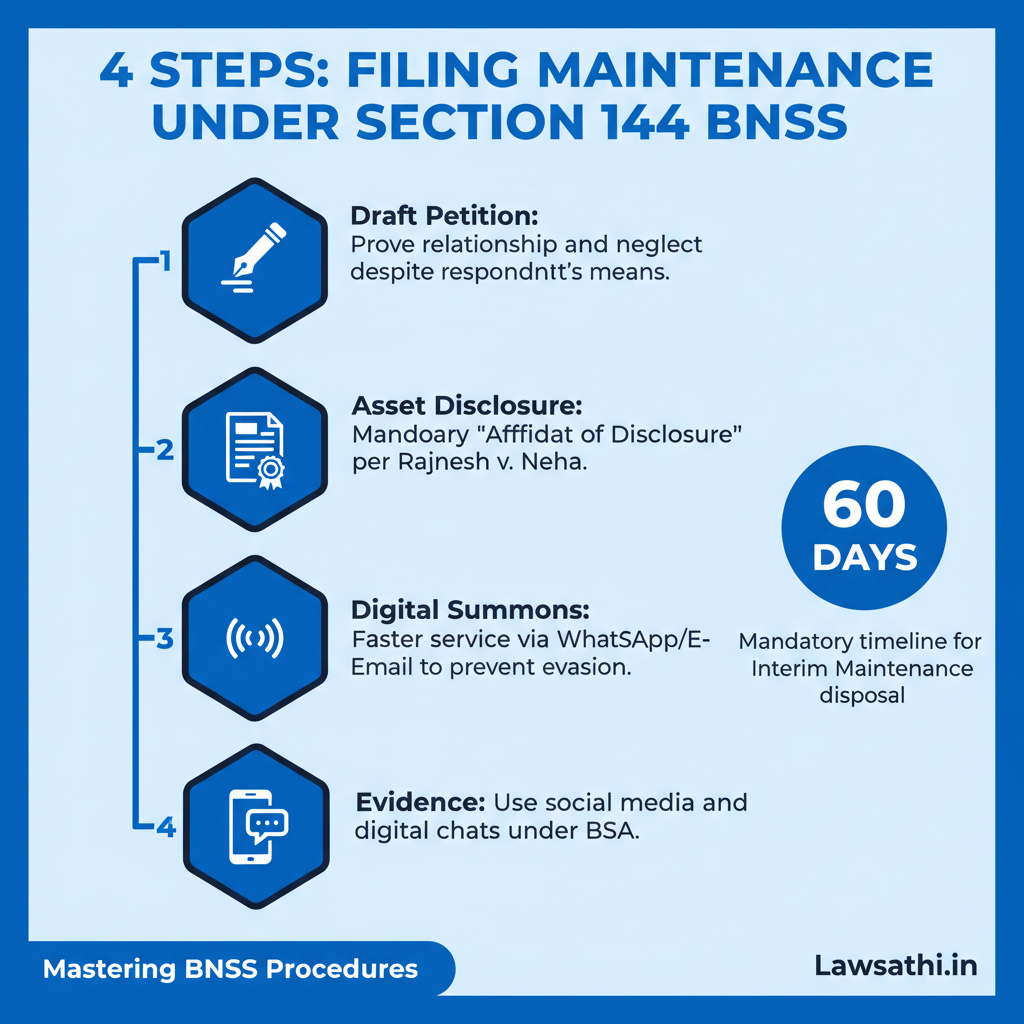
Drafting is the most critical stage of the Section 144 BNSS maintenance procedure. You must clearly state the respondent’s “sufficient means.” Most importantly, you must allege their “neglect or refusal” to pay.
Drafting the Main Petition
Your petition should include proof of marriage or parentage. For example, attach marriage photographs or birth certificates. Additionally, provide details of the respondent’s lifestyle and income. This helps the court establish the appropriate quantum of maintenance.
The 60-Day Rule for Interim Maintenance
You should always file an “Application for Interim Maintenance” simultaneously. Under Section 144, the court must decide this within 60 days of notice. To illustrate, Punjab and Haryana High Court rulings emphasize these timelines. As a result, this 60-day limit is the biggest procedural shift from the old CrPC.
Evidence and Burden of Proof
In these proceedings, the standard of proof is the “preponderance of probabilities.” Therefore, you do not need to prove the case “beyond reasonable doubt.” This is a lower threshold than standard criminal trials.
Proving Sufficient Means
You must prove that the respondent has the financial capacity to provide support. For instance, use bank statements or property records. Moreover, the Bharatiya Sakshya Adhiniyam allows for modern electronic evidence. This includes WhatsApp chats that might reveal the respondent’s luxury lifestyle.
Admissibility of Electronic Documents
Digital evidence is now highly relevant. For example, social media posts can prove a respondent’s spending habits. Consequently, you should gather all digital communication regarding financial neglect. This strengthens the claim for a higher maintenance amount.
The Trial Process: From Summons to Final Order
The BNSS modernizes how courts interact with parties. For instance, summons can now be served through electronic means. This reduces delays caused by respondents evading service.
Mandatory Assets and Liabilities Affidavit
The Supreme Court guidelines in Rajnesh v. Neha still apply strictly. Both parties must file a comprehensive Affidavit of Disclosure. This document details all assets and debts. Additionally, it lists monthly expenses. In fact, if a party fails to file this, they may face adverse consequences.
Handling Ex-Parte Proceedings
Sometimes, the respondent fails to appear despite receiving notice. In such cases, the court can pass an ex-parte order. However, even in ex-parte matters, the court requires an affidavit from the claimant. Specifically, this ensures the maintenance amount remains fair and realistic.
Enforcement of Maintenance Orders
Obtaining an order is only half the battle. Consequently, the Section 144 BNSS maintenance procedure includes strong enforcement mechanisms. If the respondent refuses to pay, you must move for execution.
Warrants and Imprisonment
Under Section 144(3), the Magistrate can issue a warrant for levying the amount. Each breach can lead to imprisonment for up to one month. However, the claimant must apply for these arrears within one year. Therefore, you must track payment deadlines diligently for your clients.
Attachment of Assets
The court has the power to attach the respondent’s property. For example, it can attach salary income or bank accounts to recover arrears. This provides a powerful deterrent against non-compliance. Furthermore, courts increasingly mandate short-interval hearings to ensure effective recovery.
Conclusion: Best Practices for Legal Practitioners
Navigating the Section 144 BNSS maintenance procedure requires both legal knowledge and technical efficiency. First, ensure your financial discovery is thorough from day one. Use the Rajnesh v. Neha format carefully to avoid rejections. Second, stay updated on the evolving case law. In fact, you must monitor how High Courts interpret the new BNSS clauses.
Most importantly, keep the 60-day interim maintenance deadline in focus. Timely service of notice is key to starting this clock. Specifically, by leveraging modern legal technology, you can ensure that your filings are accurate. Therefore, your deadlines will never be missed.
Simplify your BNSS compliance and case management with LawSathi. Our AI-powered platform helps you track 60-day interim maintenance deadlines and automate drafting. Sign up for a free trial today!