
The legal battle over the Dhar Bhojshala-Kamal Maula Mosque reached a critical turning point in 2026. Recently, the Supreme Court of India intervened with a significant directive. The Court ordered the unsealing of the Bhojshala ASI survey report. This move ensures transparency for all litigating parties. Furthermore, this decision marks a shift toward procedural openness in cases involving sensitive religious sites.
Understanding the Supreme Court’s Directive
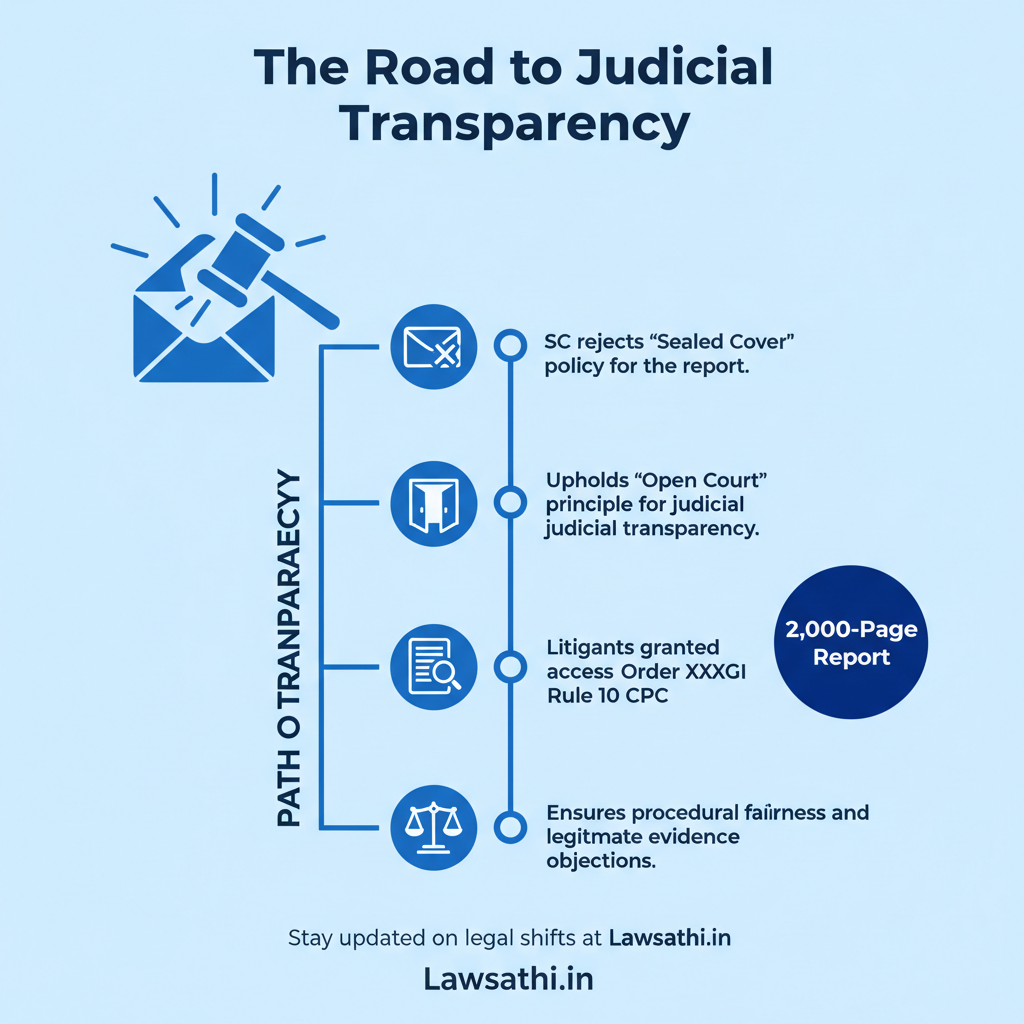
The Supreme Court emphasized that justice must be visible. Therefore, it directed the Indore Bench of the MP High Court to share the 2,000-page report. This report will go to both Hindu and Muslim sides. Initially, the report remained under a sealed cover to prevent communal tensions. However, the apex court ruled that parties cannot file objections without seeing the evidence first.
Context of the Legal Dispute
The 11th-century structure is a site of deep historical contestation. Hindus revere it as a temple dedicated to Goddess Vagdevi. Conversely, Muslims recognize it as the Kamal Maula Mosque. Since 2003, the Archaeological Survey of India (ASI) has managed a shared arrangement. Specifically, Hindus perform puja on Tuesdays, while Muslims offer Namaz on Fridays. This delicate balance is now being tested in the courts.
Understanding the MP High Court’s Role and the Initial Sealing Order
The current legal phase began on March 11, 2024. At that time, the Indore Bench of the MP High Court directed the ASI to conduct a scientific investigation. The court stated that the monument’s character needs to be demystified. Consequently, the ASI used Ground Penetrating Radar (GPR) and carbon dating to examine the site.
The Logic Behind Sealing the Report
Initially, the High Court favored keeping the findings confidential. It aimed to prevent media trials and public unrest. Furthermore, the court wanted to evaluate the scientific data before it became public record. This approach is common in high-stake litigations involving religious monuments in India.
Challenges to Procedural Secrecy
The Maulana Kamaluddin Welfare Society challenged the survey itself. They argued it violated the existing religious status quo. Meanwhile, the Hindu Front for Justice pushed for total disclosure. They claimed that the Bhojshala ASI survey report would confirm the site’s original Hindu identity. As a result, these conflicting views forced the Supreme Court to prioritize the “Open Court” principle.
Legal Analysis: Why the SC Mandated the Unsealing of the Report
The Supreme Court relied on the principle of procedural fairness. In civil litigation, expert evidence determines the subject matter of the suit. Therefore, litigants have a fundamental right to access such documents. Without access, parties cannot exercise their right to cross-examine or object.
The Principle of Open Court
A “sealed cover” policy is often an exception, not the rule. The Court noted that transparency is a high constitutional value. Specifically, it protects the integrity of the trial. If the Bhojshala ASI survey report stayed sealed, the parties would be litigating in the dark. Consequently, the SC ruled that communal issues do not justify bypassing standard legal procedures.
Right to File Objections
Under Order XXVI Rule 10 of the CPC, an ASI report is considered evidence. However, it is not final or binding. Parties can question the methodology and the findings of the court-appointed commissioner. To do this effectively, the lawyers must have the full report. Thus, unsealing the document is essential for a fair trial.
The Intersection with the Places of Worship (Special Provisions) Act, 1991
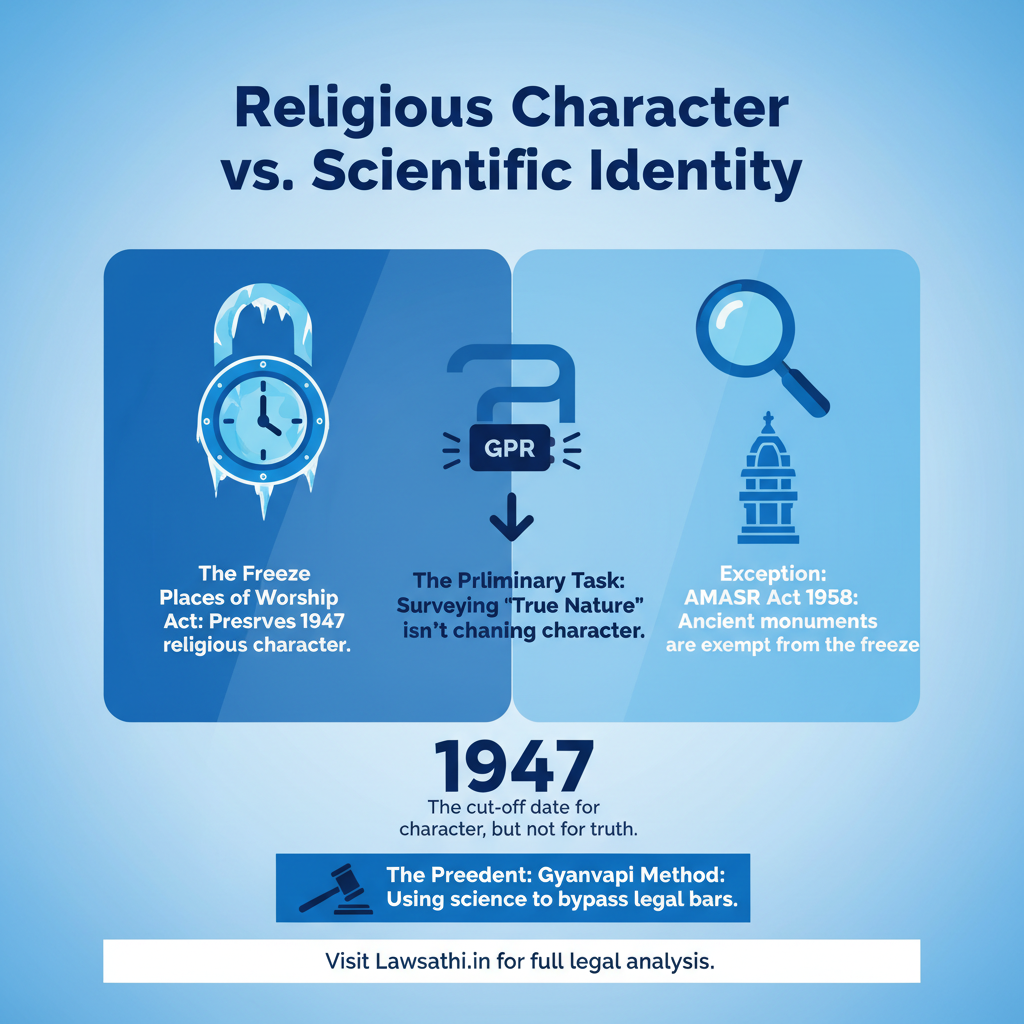
A major hurdle in this case is the Places of Worship Act, 1991. This Act generally freezes the religious character of a site. It looks at the status as it existed on August 15, 1947. However, Section 4(3) of the Act provides an important exemption. Specifically, it does not apply to ancient monuments covered by the AMASR Act, 1958.
Character vs. Identity
Courts are now distinguishing between “changing” a character and “identifying” it. For example, in the Gyanvapi case, surveys were allowed. The courts argued that finding the “true nature” of a site is a preliminary task. In other words, a survey does not automatically change the site’s status. It simply provides the court with necessary facts.
Implications for Future Litigation
This distinction is vital for Indian practitioners. It allows for scientific investigation even when the 1991 Act is cited as a bar. As a result, the Bhojshala ASI survey report serves as a legal precedent. It shows that historical monuments might be exempt from certain prohibitions. This could influence many other pending cases across India.
The Evidentiary Value of ASI Reports in Land Title Suits
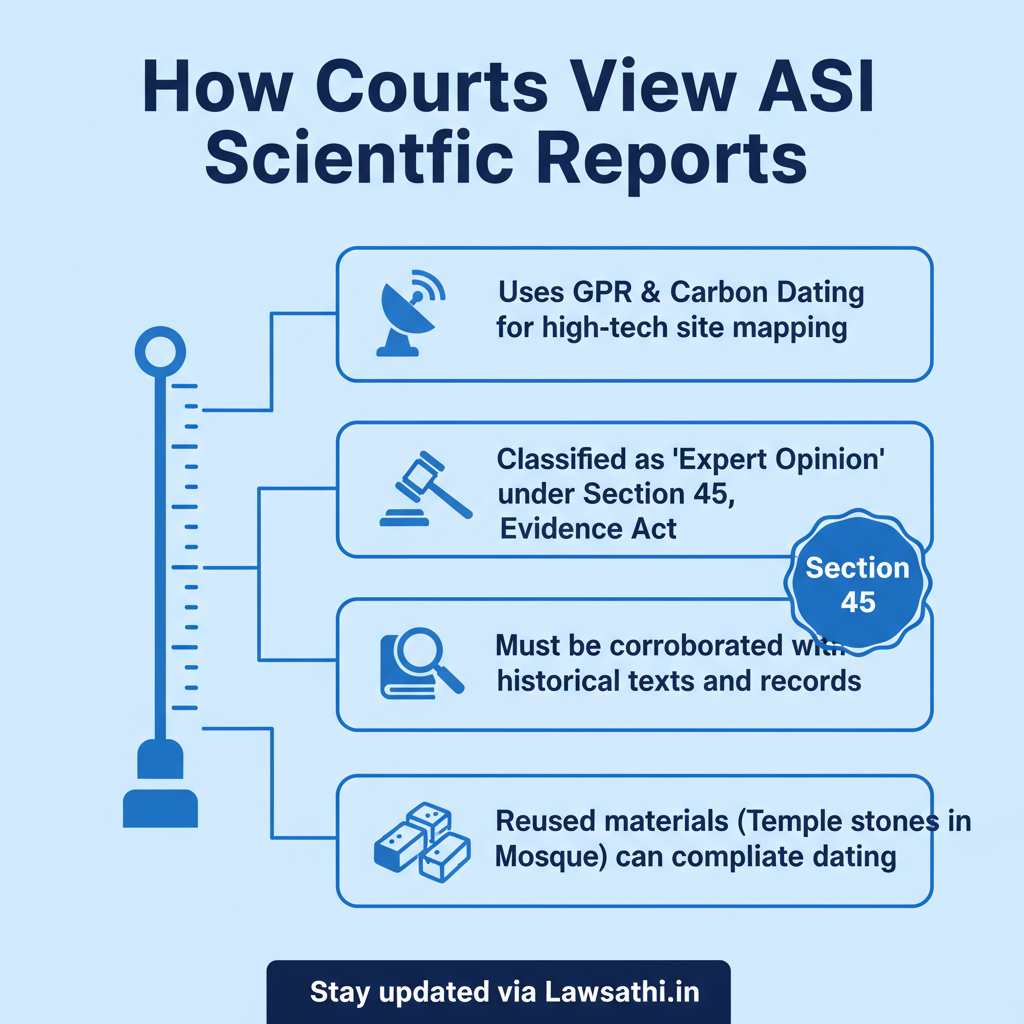
In Indian courts, an ASI report is treated as “Expert Opinion.” This falls under Section 45 of the Indian Evidence Act. While it carries heavy weight, it is merely corroborative. For instance, judges often compare findings with historical texts. Therefore, the report is a tool for the court rather than a final judgment.
Challenges in Scientific Interpretation
Scientific tools like GPR and Carbon Dating are not always infallible. Litigants often point out that “reused materials” can skew results. For example, a mosque might be built using stones from an older temple. In such cases, carbon dating the stone gives the age of the temple. Consequently, lawyers must be prepared to argue these technical nuances.
The Process of Filing Objections
Once the report is unsealed, the “Objection Phase” begins. Both sides will likely hire independent archaeologists. These experts will scrutinize the ASI’s findings for any bias or error. Moreover, the legal battle moves from historical claims to scientific methodology. Lawyers must now manage large sets of data to prove their case.
Timeline of Significant Legal Milestones in the Bhojshala Case
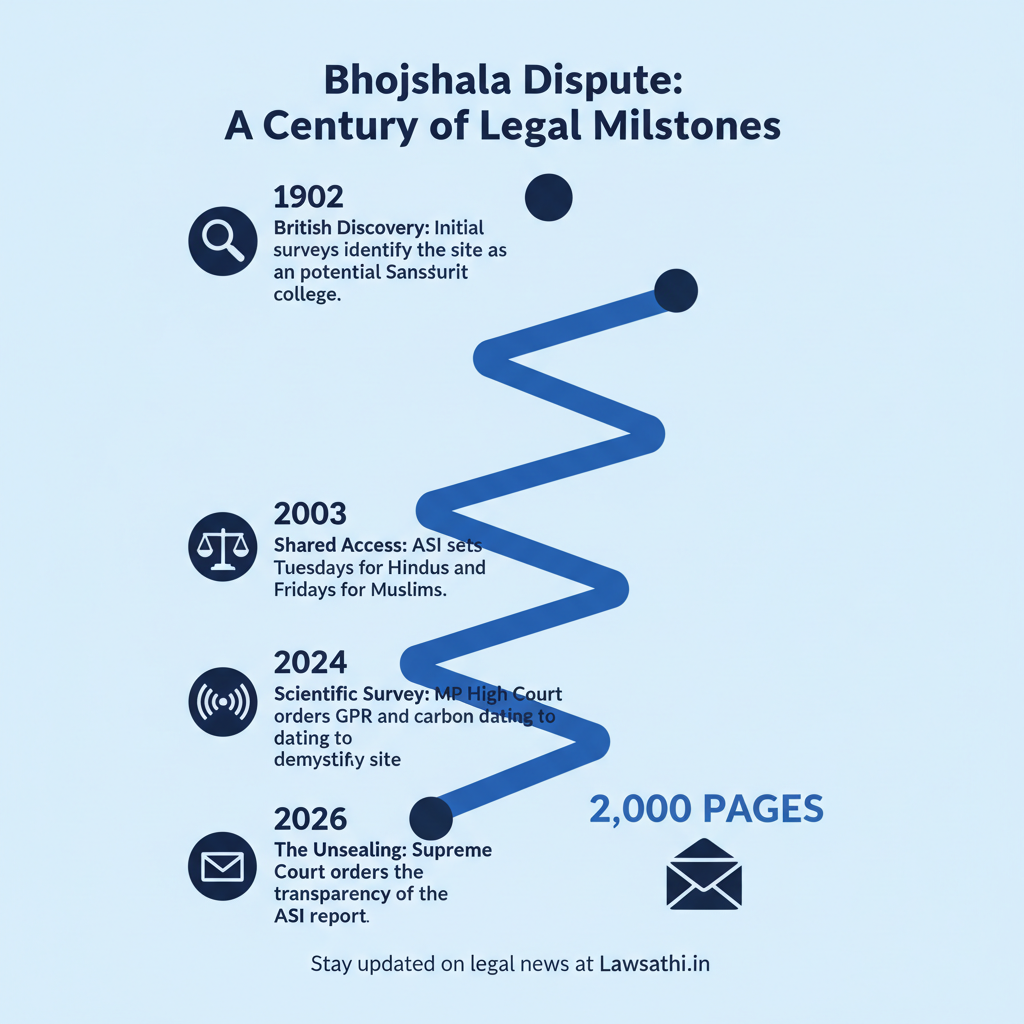
The history of this dispute spans over a century. Early surveys were conducted in 1902 during the British Raj. At that time, experts identified the site as a potential Sanskrit college. This historical foundation paved the way for modern litigation.
From 2003 to the Present
In 2003, the ASI established the current prayer schedule. This arrangement worked for two decades without major judicial interference. However, in March 2024, the High Court ordered a modern scientific survey. This shifted the dispute from administrative management to a judicial determination of identity.
Recent Developments in 2026
By late 2025, the ASI completed its difficult task. The report reached the High Court in a sealed envelope. Finally, the Supreme Court’s intervention in early 2026 ensures the contents are public. This move brings the case into its final evidentiary stage. Litigants must now analyze thousands of photos included in the Bhojshala ASI survey report.
Impact on the Legal Fraternity: Managing High-Stake Litigations
For lawyers, cases like the Bhojshala dispute are incredibly complex. They involve thousands of documents and high communal stakes. Therefore, practitioners must balance their duty to the client with the need for harmony. Moreover, the sheer volume of scientific data requires modern management tools.
Role of Technology and Ethics
Legal teams are increasingly using AI to organize case data. For example, AI can cross-reference architectural motifs quickly. This helps in building a stronger historical argument. Above all, handling a Bhojshala ASI survey report requires high ethical standards. Lawyers must ensure that findings do not incite public disorder.
Conclusion
The Supreme Court’s decision to unseal the ASI report is a landmark. It reinforces the idea that litigants must have access to all evidence. While the dispute is far from over, the move toward transparency is positive. Litigants can now examine the findings and present their cases fairly.
Stay ahead of high-profile litigation updates. LawSathi’s AI-powered research tools help you analyze complex survey reports and case laws in seconds. Streamline your practice today.