
# Filing a Cyberstalking Complaint under BNS and DPDP Act: A Guide for Tech-Litigation Lawyers
The legal landscape for digital crimes in India has changed drastically since 2024. As a result, tech-litigation lawyers must now navigate a sophisticated intersection of new criminal codes and data privacy regulations. This guide explores the modern cyberstalking complaint procedure under BNS. Specifically, these steps will help you protect your clients effectively in a digital environment.
Introduction: The New Legal Framework for Digital Harassment
India transitioned from the Indian Penal Code (IPC) to the Bharatiya Nyaya Sanhita (BNS) in July 2024. Consequently, the legal definition of digital harassment has evolved. Lawyers can no longer rely on old precedents alone. Furthermore, you must now integrate criminal prosecution with the Digital Personal Data Protection (DPDP) Act 2023.
From Physical to Digital Stalking
In the past, stalking often implied physical following. However, the law now recognizes that monitoring electronic communication is equally damaging. Therefore, a dual understanding of the BNS and the DPDP Act is essential for modern litigation. This framework ensures that both the individual harasser and the negligent data platform face legal consequences.
Why Tech-Lawyers Must Adapt
Digital evidence is fragile and easily manipulated. Moreover, the transition to the Bharatiya Nagarik Suraksha Sanhita (BNSS) has changed how we file FIRs. To succeed, you must master the new procedural nuances of the cyberstalking complaint procedure under BNS.
Substantive Law: Analyzing Section 78 of Bharatiya Nyaya Sanhita (BNS)
The heart of cyberstalking litigation lies in Section 78 of the BNS. This provision replaces the old Section 354D of the IPC. Specifically, it criminalizes the act of monitoring a woman’s use of the internet without consent. It also covers all digital communication.
Key Components of Section 78
First, the prosecution must show that the accused attempted to contact the victim repeatedly. Second, there must be a clear indication of disinterest from the victim. Section 78 of the BNS focuses on the persistence of the monitoring. For example, a single “like” on an old photo might not qualify. In contrast, sending multiple unsolicited messages across different platforms constitutes a clear violation.
Punishment and Cognizability
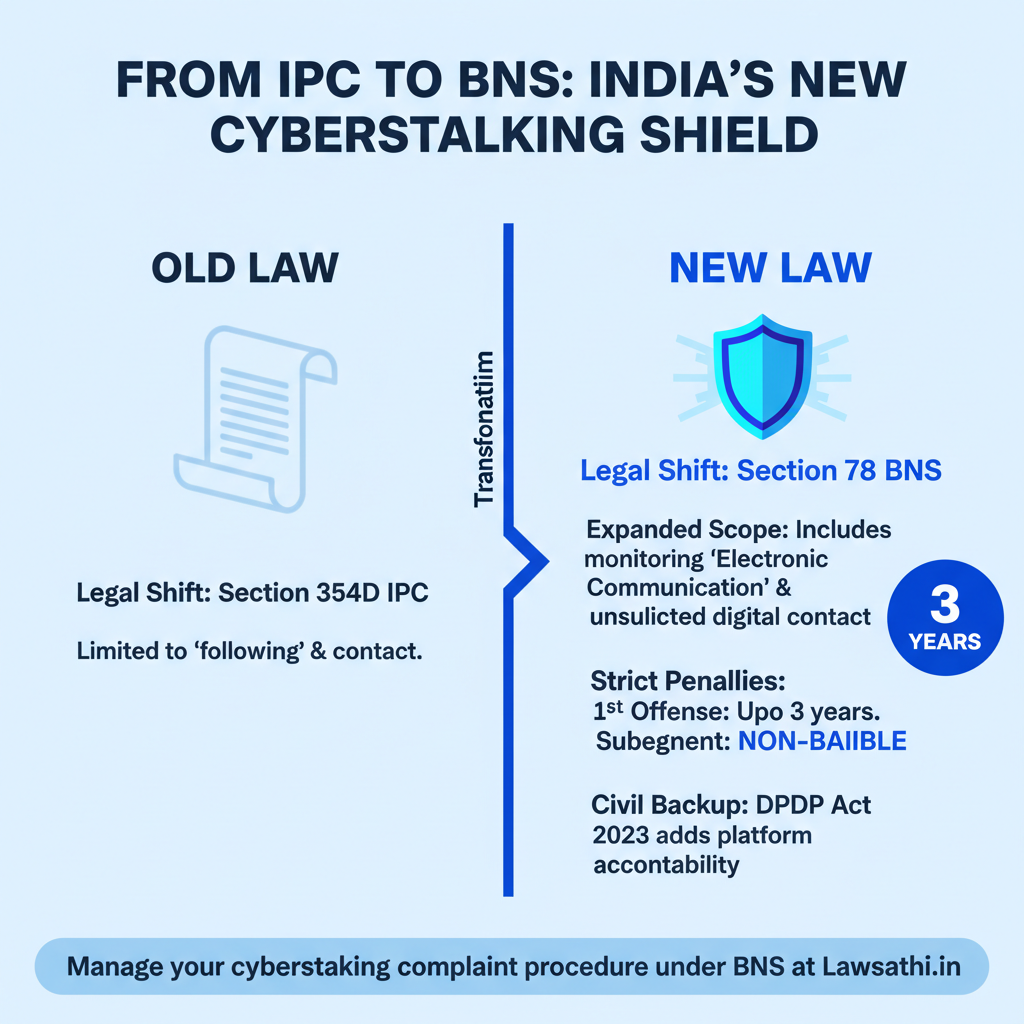
For a first conviction, the offender faces up to three years of imprisonment. Additionally, the court may impose a significant fine. Most importantly, the first offense is cognizable but bailable. However, subsequent offenses are non-bailable. Lawyers should inform clients that the law treats repeat offenders with increased severity.
One-Time Contact vs. Persistent Monitoring
Courts often distinguish between accidental contact and targeted harassment. For instance, the Bombay High Court has observed that objectionable posts can attract stalking charges. Therefore, you must document the frequency of the digital contact. This helps build a strong case regarding intent.
The Role of Digital Personal Data Protection (DPDP) Act in Cyberstalking
The DPDP Act 2023 adds a powerful civil dimension to your litigation strategy. Frequently, stalkers obtain a victim’s private information through data leaks or platform vulnerabilities. In such cases, the platform or “Data Fiduciary” may be liable. Specifically, they may be responsible for failing to protect the data.
Accountability for Data Fiduciaries
If a dating app or social media site leaks a user’s phone number, they violate the DPDP Act. Consequently, the victim can seek recourse through the Data Protection Board. This creates a multi-pronged approach. Specifically, the police pursue the criminal under BNS while the Board penalizes the data fiduciary for security lapses.
Data Principal Rights for Victims
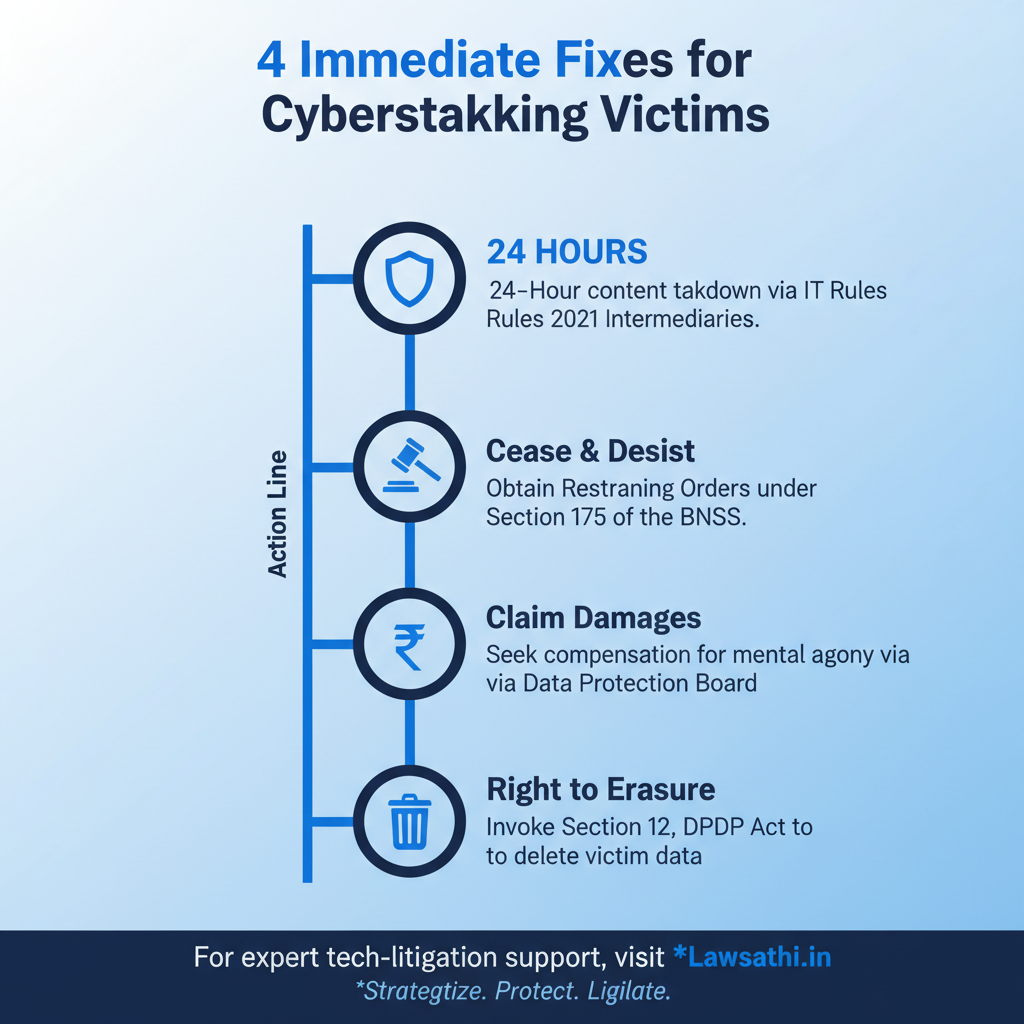
Victims have the “Right to Erasure” under Section 12 of the DPDP Act. This allows them to demand that platforms delete their personal data once stalking begins. Furthermore, parental consent is now mandatory for processing children’s data. These rights help prevent further harassment by limiting the stalker’s access to information.
Civil Penalties vs. Criminal Prosecution
The DPDP Act does not send anyone to jail. However, it imposes massive financial penalties of up to ₹250 Crores. Therefore, combining an FIR with a DPDP complaint pressures platforms to cooperate with investigators. This strategy is vital when dealing with ghosts in the machine on dating apps.
Step-by-Step Procedure for Filing the Complaint
Executing the cyberstalking complaint procedure under BNS requires precision. Errors in the initial filing can lead to the loss of critical digital evidence. Therefore, you must follow these steps to ensure the complaint is legally sound.
Drafting the Written Complaint
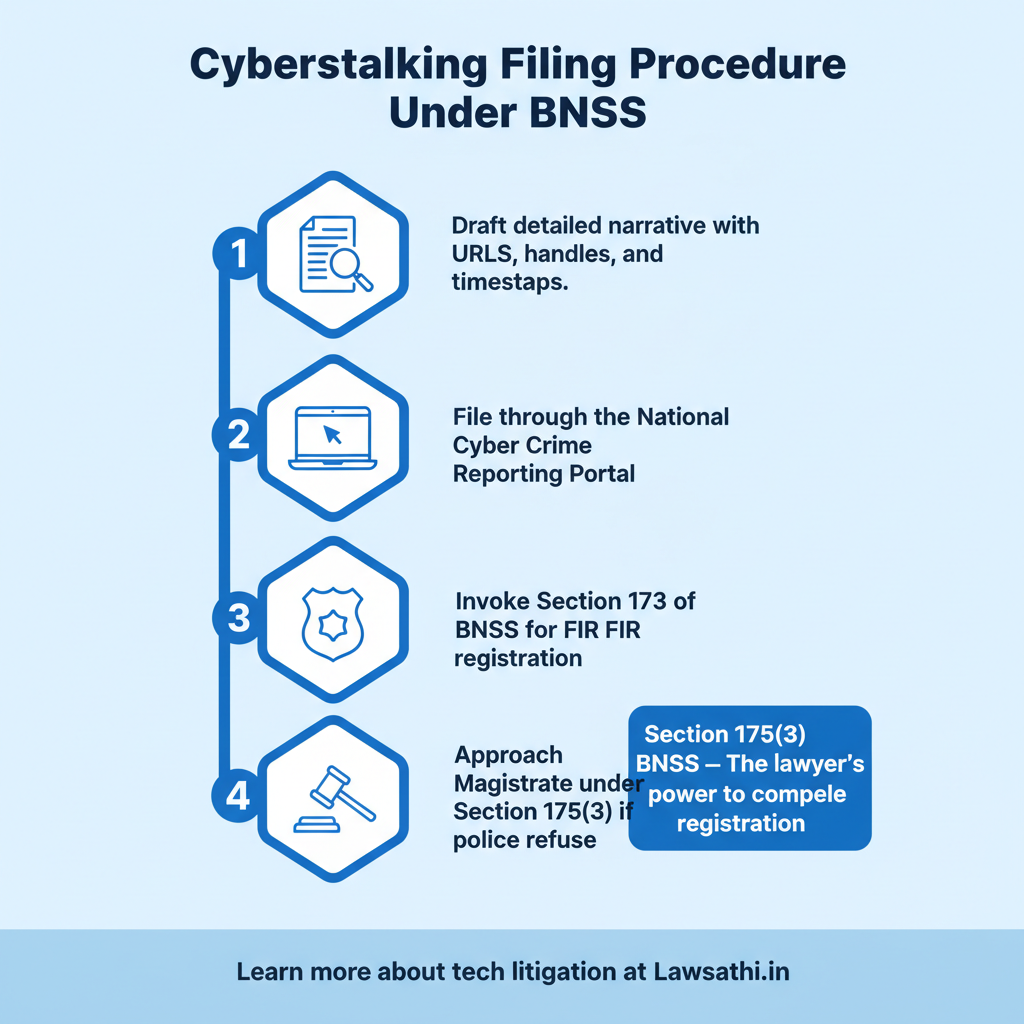
First, draft a detailed narrative of the harassment. Include essential digital identifiers like URLs, profile handles, and specific timestamps. Always mention the IP addresses if they are visible in email headers. Specifically, use the National Cyber Crime Reporting Portal for a faster response.
Invoking Section 173 of BNSS
The procedure for registering an FIR has changed under Section 173 of the BNSS. Police may now conduct a preliminary inquiry for certain offenses. This usually applies to crimes punishable by 3 to 7 years. Thus, you must argue that the stalking requires immediate FIR registration. The Supreme Court has clarified these procedural shifts.
Role of the Magistrate
If the police refuse to register an FIR, you can move the Magistrate. Specifically, use Section 175(3) of the BNSS. The Magistrate can direct an investigation and order the preservation of digital logs. Therefore, this judicial oversight is a critical safety net for your clients.
Evidence Management: Digital Forensics and Admissibility
Evidence is the backbone of any cyberstalking case. Under the new Bharatiya Sakshya Adhiniyam (BSA), rules for electronic records have changed. You must comply with these rules to ensure your evidence is admissible in court.
Section 63 of the BSA
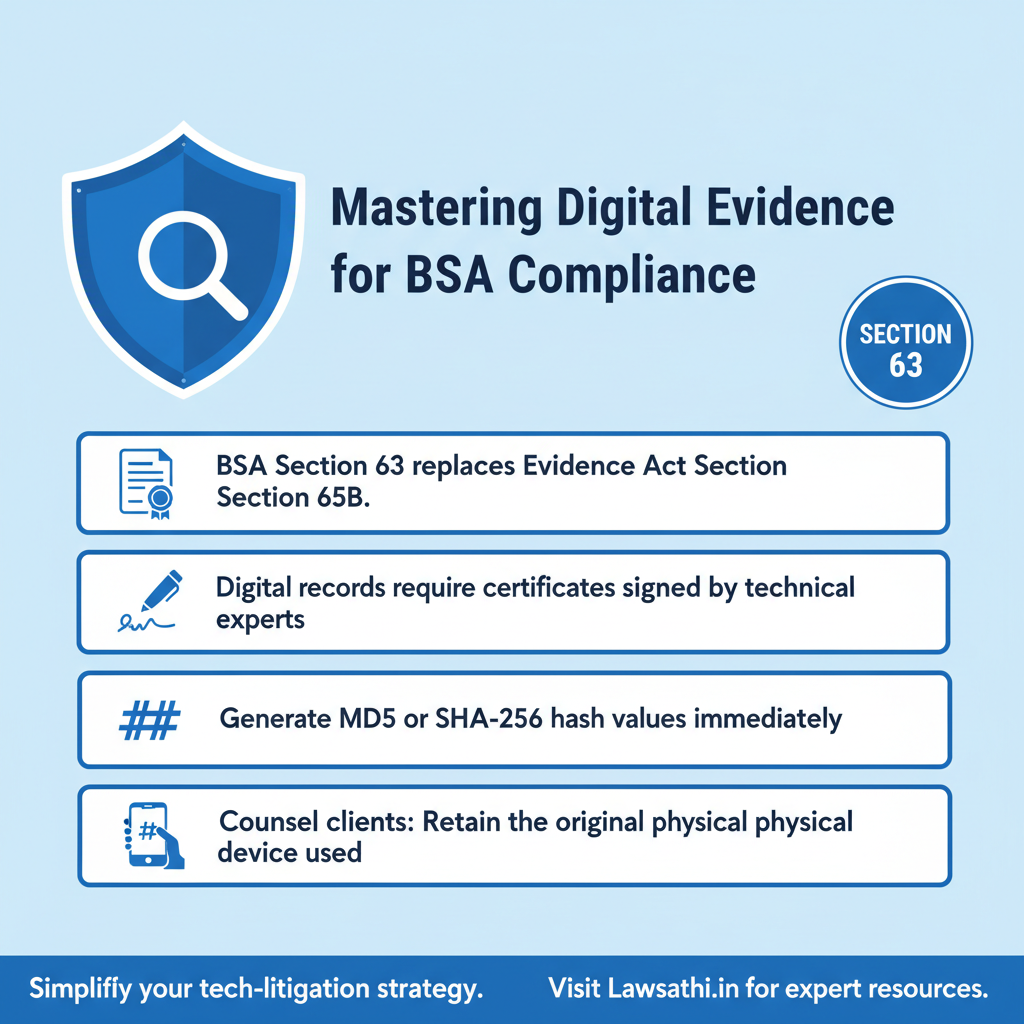
Section 63 of the BSA replaces the old Section 65B of the Evidence Act. It requires a specific certificate to accompany all digital records. Moreover, Section 63 DNA certificates must now be signed by an expert. For example, the Madras High Court has directed the notification of electronic evidence experts.
Preserving Metadata and Screenshots
Screenshots alone are often insufficient. Therefore, you should preserve the metadata of the files. Metadata provides information about when and where a file was created. Additionally, generate MD5 or SHA-256 hash values for every screenshot. These values act as digital fingerprints to prove the evidence has not been changed.
Legal Validity of Hash Values
If a file’s content changes by even one pixel, its hash value changes completely. Consequently, hash values provide undeniable proof of authenticity. Navigating these legal shifts is essential for any tech-litigation lawyer. Finally, always advise your clients to keep the original device used to receive messages.
Interim Relief and Protection Orders
Victims of cyberstalking often need immediate protection before the trial begins. The law provides several avenues for interim relief. These measures help stop the harassment quickly. Furthermore, they help remove harmful content from the internet.
Content Takedown Orders
Under the IT Rules 2021, intermediaries must remove certain types of content quickly. For instance, if a stalker posts private images, the platform must act within 24 hours. For general harassment, the window is usually 72 hours. Therefore, you should send notices to the platform’s grievance officer immediately.
Restraining Orders under BNSS
Lawyers can seek protection orders under Section 175 of the BNSS. The Magistrate can order the stalker to cease all digital contact. Moreover, the court can direct the police to provide physical protection if the threat increases. These orders are crucial for safety during the cyberstalking complaint procedure under BNS.
Compensation for Mental Agony
The DPDP Act allows victims to seek compensation for data breaches. While the criminal court focuses on punishment, the Data Protection Board focuses on system failures. Thus, you can build a comprehensive claim. This covers both the psychological impact and the breach of privacy.
Challenges in Tech-Litigation: Jurisdictional Issues
Technology often moves faster than the law. Consequently, lawyers face several hurdles when prosecuting cyberstalkers. Understanding these challenges will help you manage your client’s expectations effectively.
Anonymous Profiles and VPNs
Stalkers frequently hide behind VPNs or fake identities. To counter this, you must request the Cyber Cell to issue Section 94 BNSS notices. These notices compel ISPs to release connection logs. However, tracing an anonymous user takes time and requires technical expertise.
Cross-Border Data Requests
Many social media platforms are based in the United States. Therefore, retrieving data often requires Mutual Legal Assistance Treaties (MLATs). This process can take many months. As a lawyer, you must be persistent in following up with the Ministry of Home Affairs.
Limitation Periods
Digital evidence can be deleted in seconds. Although the BNS has specific limitation periods for crimes, ISPs often delete logs after one year. Therefore, you must act swiftly. Filing a complaint immediately ensures that volatile evidence is preserved before it is lost forever.
Conclusion: Mastering the New Paradigm
The transition to BNS, BNSS, and the DPDP Act has created a more robust framework. By following the correct cyberstalking complaint procedure under BNS, lawyers can provide holistic relief. This involves a combination of criminal FIRs and digital forensic excellence.
Success in tech-litigation requires staying updated with landmark rulings and legislative shifts. By integrating these new laws, you can ensure accountability. Digital harassers can no longer hide in the modern age.
Managing complex tech-litigation requires organized evidence and precise deadlines. Use LawSathi’s AI-powered case management to streamline your BNS and DPDP Act filings today.