
The legal battle over property ownership often hinges on long-standing occupation. Specifically, in the landmark case of Jyoti Sharma vs. Vishnu Goyal, the Supreme Court has finally settled a critical debate. Can a tenant’s long-term stay eventually turn into ownership?
This specific judgment provides much-needed clarity for landlords and civil lawyers across India. For example, it addresses whether permissive possession can ever evolve into a hostile claim of adverse possession. For years, tenants have used “hostile possession” as a defense to delay eviction. However, the Apex Court has now reinforced the boundaries of property law to protect rightful owners.
Why This Ruling Matters for Property Law
The core dispute in this case questioned if a tenant could challenge a landlord’s title after decades of stay. Many property litigation cases in India suffer from such frivolous claims. Consequently, this ruling serves as a vital precedent for future eviction suits. It ensures that the “ownership threshold” in rent disputes remains distinct from complex title suits.
The Facts of the Case: Jyoti Sharma vs. Vishnu Goyal
The history of this dispute dates back several decades. In 1953, Ramji Das, the plaintiff’s father-in-law, inducted the defendants’ father as a tenant in a shop. This relationship continued peacefully for nearly half a century.
In 1999, Ramji Das executed a Will. He bequeathed the shop to his daughter-in-law, Jyoti Sharma. Shortly after his death, the legal battle began. Jyoti Sharma sought eviction based on her bona fide requirement to expand her own business. Furthermore, she demanded the payment of rent arrears that had accumulated over time.
The Tenant’s Claim of Hostile Possession
The tenants did not simply deny the need for eviction. Instead, they claimed they had “perfected title” over the property. They argued that the property actually belonged to a paternal uncle, Sua Lal.

The tenants asserted that their long stay made them the actual owners through adverse possession. Additionally, they challenged the validity of the Will. They claimed they were no longer bound by the original tenancy terms.
The Journey Through the Courts
Initially, the Trial Court and the High Court dismissed the eviction suit. These courts questioned the lack of a formal “attornment” or acknowledgment of the new landlord. Moreover, they suggested that the Will required stricter proof.
However, the Supreme Court viewed these findings as “perverse.” According to the 2025 LiveLaw (SC) 1081 report, the lower courts relied on conjecture. The Apex Court noted that the tenants had paid rent for 50 years. Therefore, they could not suddenly claim to be owners.
Understanding Adverse Possession in the Indian Legal Context
Adverse possession India laws are governed by a strict legal standard. This standard is known as “nec vi, nec clam, nec precario.” In simple terms, possession must be without force, without secrecy, and without permission.
Under the Limitation Act, 1963, specifically Articles 64 and 65, a person can claim ownership after 12 years. This possession must be open and continuous. In addition, it must be hostile to the true owner. However, meeting this burden of proof is extremely difficult for a tenant.
The 12-Year Rule and Tenancy
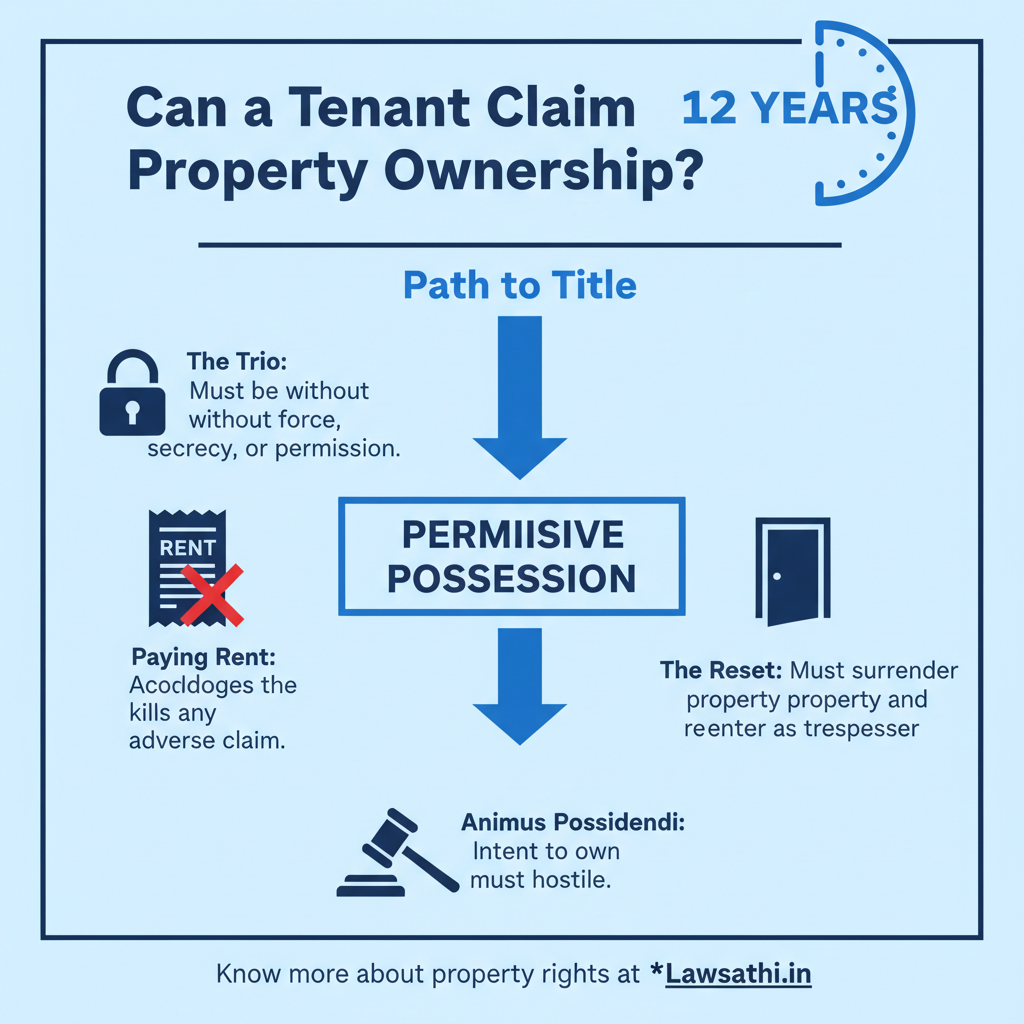
A tenant enters a property with the owner’s permission. Therefore, the law defines this as “permissive possession.” Permission is the opposite of “hostility.” Because the entry was lawful, the stay cannot become “adverse” unless the tenant first surrenders the property.
As noted in Brij Narayan Shukla vs. Sudesh Kumar (2024), a tenant must re-enter as a trespasser to start the 12-year clock. Simply staying for a long time does not change the legal status. Consequently, the claim in Jyoti Sharma vs. Vishnu Goyal failed this fundamental test.
The Doctrine of Estoppel: Section 116 of the Evidence Act
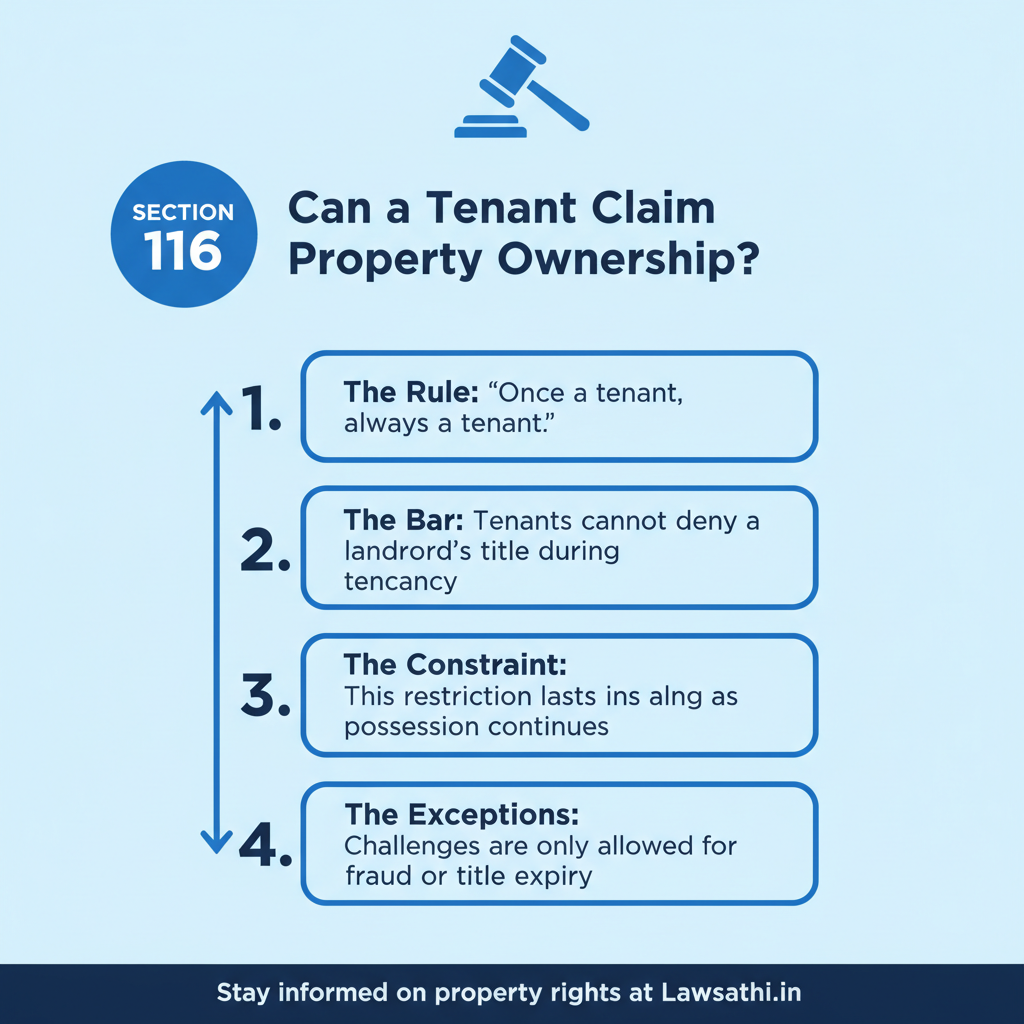
A major pillar of this judgment is Section 116 of the Indian Evidence Act, 1872. This section creates what is known as “Tenant Estoppel.” Specifically, it prevents a tenant from denying the landlord’s title during the period of the tenancy.
The principle is simple: “Once a tenant, always a tenant.” In fact, the Indian Evidence Act explicitly bars a tenant from claiming the landlord was not the owner. This bar remains active at the start of the lease. Furthermore, it stays active as long as the tenant remains in possession.
Can a Tenant Ever Challenge a Title?
There are very few exceptions to this rule. For example, a tenant might challenge the title if they were induced by fraud. Another exception occurs if the landlord’s title ended after the tenancy began.
In this case, the tenants tried to claim a “title paramount” through an uncle. However, they failed to provide any solid evidence. As a result, the Court held that they remained barred from challenging Jyoti Sharma’s right as a legatee.
Key Takeaways from the Supreme Court Judgment
The ruling in Jyoti Sharma vs. Vishnu Goyal provides several vital lessons for the legal community. First, the Court emphasized the “animus possidendi,” or the intention to possess. A tenant who pays rent acknowledges the owner’s superior right. Consequently, this acknowledgement destroys any claim of adverse possession.
Second, the Court clarified the rules regarding Wills and Probate. While probate is not mandatory in all of India, it carries significant weight. Recently, the Court ruled that a probate order obtained during a trial must be accepted. Specifically, it is additional evidence under Order XLI Rule 27 CPC/view).
Bona Fide Requirement for Landlords
Moreover, the judgment supports landlords’ rights to use their property. Jyoti Sharma wanted to expand her business into the adjacent unit. Therefore, the Court ruled that this was a legitimate “bona fide” need.
Significantly, the judges noted that courts should not act as “business advisors” to landlords. If a landlord wants to grow their business, the court should not dictate management. As a result, the tenant’s resistance was deemed legally unsustainable.
Practical Implications for Property Lawyers and Landlords
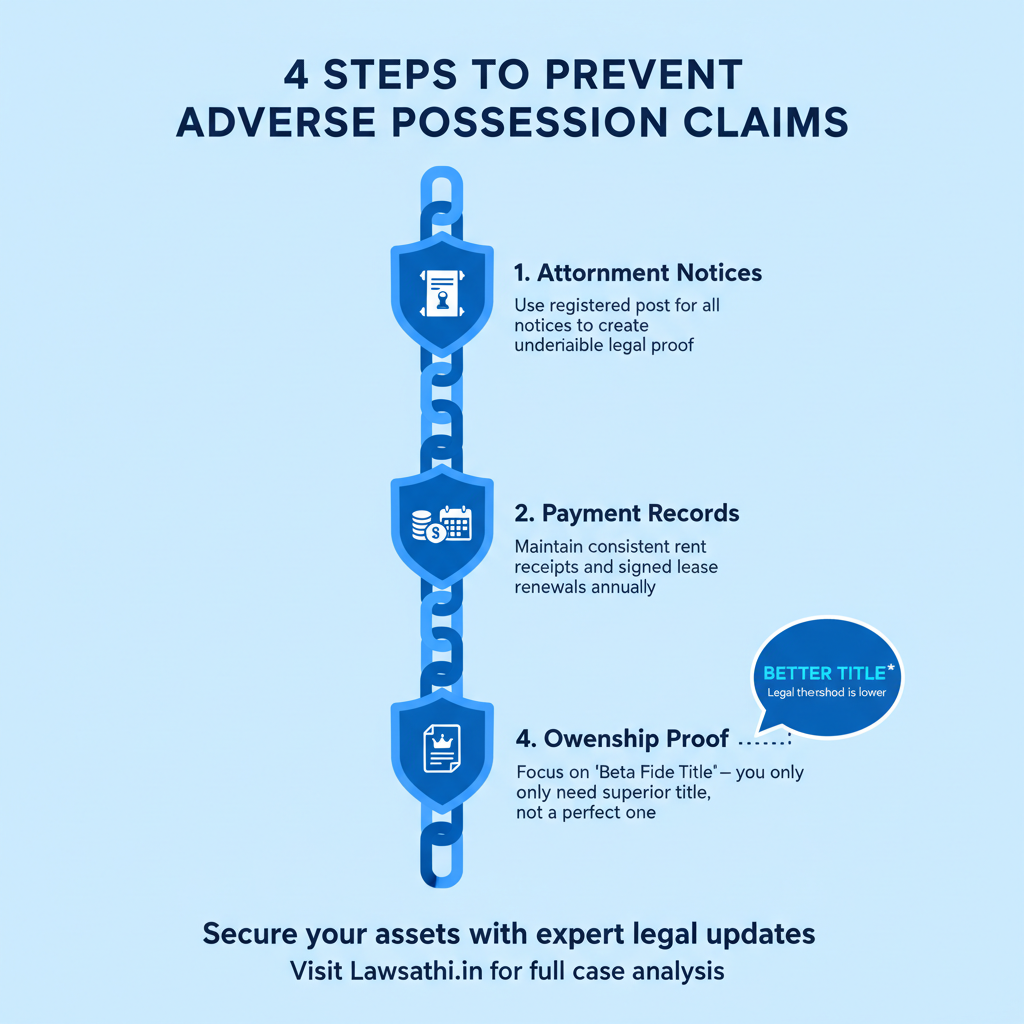
This judgment simplifies the path for Supreme Court ruling on tenant ownership disputes. It confirms that landlords do not need to prove “perfect title” like in a property suit. Instead, showing a “better title” than the tenant is sufficient for eviction.
For lawyers, this means fewer collateral trials. You can use this case to strike down tenant defenses. Many defenses attempt to turn rent disputes into complex title litigations. In other words, this ruling prevents tenants from using the “adverse possession” card to stop legitimate evictions.
Strategies to Prevent Adverse Possession Claims
Landlords should take proactive steps to protect their properties. First, always use registered post for all attornment notices. This triggers a legal presumption of delivery.
Second, maintain consistent rent receipts or periodic lease renewals. These documents prove the “permissive” nature of the stay. Finally, ensure that any change in ownership via a Will or Gift is communicated clearly. These legal strategies can save years of litigation.
Conclusion: Strengthening Property Rights in India
The decision in Jyoti Sharma vs. Vishnu Goyal strikes a fair balance between tenant protection and owner rights. In fact, it reinforces the idea that long-term occupation is not a shortcut to ownership. By upholding Section 116 of the Evidence Act, the Court has reduced frivolous title claims.
As Indian real estate law evolves, this precedent will serve as a shield for property owners. It ensures that the “permissive” nature of tenancy is respected. Consequently, landlords can now approach the courts with more confidence.
Streamline your property litigation research with LawSathi’s AI-driven tools. Book a free demo today to see how we assist Indian lawyers in staying ahead of Supreme Court precedents.