
# Land Acquisition Act 2013 Compensation: 4X Rural Disputes & Infrastructure Impact
Developing modern India requires vast stretches of land for highways, railways, and smart cities. However, the transition to the Land Acquisition Act 2013 compensation regime has created a unique legal paradox.
While the law promises fairness, it also triggers intense litigation across the country. Therefore, stakeholders must understand how these rules impact both farmers and developers.
Introduction: The Paradox of the 2013 LARR Act
In 2013, the Right to Fair Compensation and Transparency in Land Acquisition, Rehabilitation and Resettlement (RFCTLARR) Act replaced the archaic 1894 Act. Specifically, this shift aimed to correct historical injustices. It moved from a regime of “eminent domain” to one of “humane displacement.”
The Core Promise of Rural Compensation
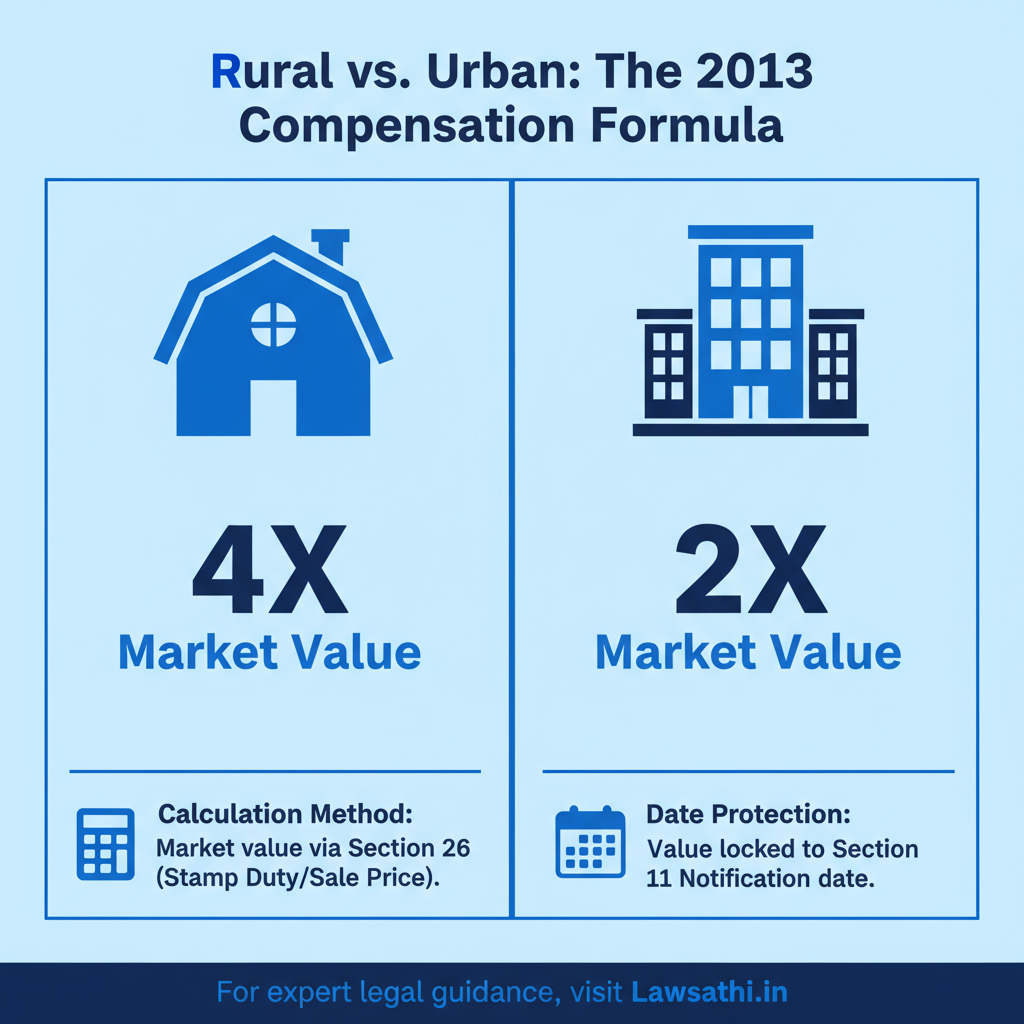
The primary highlight of the new law is the compensation multiplier. Rural landowners can receive up to 4x the market value of their land. In contrast, urban owners typically receive 2x the market value. Consequently, this difference has become a central point of contention in 2026.
Infrastructure Urgency vs. Agrarian Rights
Currently, the Indian government aims for rapid expansion through projects like “Gati Shakti” and “Bharatmala.” For example, MoRTH reports indicate high targets for road construction.
However, this urgency often clashes with stringent Social Impact Assessment (SIA) requirements. Therefore, lawyers must balance the need for national growth with protecting farmer livelihoods. In fact, most disputes today center on this delicate balance.
The 4X Compensation Formula: Judicial Interpretations and Flaws
Calculating the “market value” under Section 26 is a complex task for any revenue lawyer. The Act looks at stamp duty rates or the average sale price of similar land. Furthermore, authorities often use outdated circle rates to keep costs low.
The Sliding Scale Dispute
Many states use a “sliding scale” to determine the rural multiplier. For instance, developers might define “rural” based on the distance from city limits.
Moreover, farmers frequently challenge these definitions in High Courts. They argue that peri-urban land should not be treated as remote land for minimal payouts. Specifically, they seek the full 4x benefit for land near developing zones.
Latest Supreme Court Rulings on Section 26
In the case of Sumitraben Singabhai Gamit v. State of Gujarat (2025), the Supreme Court provided clarity. The Court ruled that market value must be determined as of the date of the Section 11 Notification.
As a result, authorities cannot use older rates to minimize Land Acquisition Act 2013 compensation payouts. Consequently, this protects owners from inflation-related losses during long delays.
Why Farmers are Protesting: Beyond the Multiplier
Compensation is not the only issue fueling farmer protests across India. In fact, many disputes arise from the “Lapse” clause found in Section 24(2). This section states that acquisition under the 1894 Act lapses if compensation was not paid. It also applies if the state never took physical possession.
The Section 24(2) Controversy
However, recent judgments have tightened the interpretation of this clause. For example, in HSIIDC v. M/s Janta Oil Company (2025), the Court clarified a major point.

The Court stated that depositing money in a treasury counts as “paid.” As a result, many “lapse” claims are now harder to prove in court. Furthermore, this ruling prevents landowners from reopening settled cases based on technicalities.
Social Impact Assessment (SIA) Waivers
Additionally, the waiver of SIA for “public purpose” projects causes significant legal friction. Many state amendments now exempt linear projects like highways from transparency clauses.
Surprisingly, even the Supreme Court has upheld some of these state-specific laws as legitimate exercises. Therefore, the requirement for community consent is often bypassed for national interest projects.
Government’s Perspective: Balancing Mega-Projects with Fiscal Constraints
The rising cost of land is a major hurdle for the government. Currently, land acquisition costs constitute nearly 25-35% of total project expenses. Therefore, the state often seeks ways to reduce the financial burden of the 4X formula.
Inconsistent State Amendments
States like Tamil Nadu and Telangana have passed their own laws to bypass certain Central Act rigors. For instance, the Tamil Nadu Land Acquisition Laws (Revival) Act allows the state to use local rules.
Consequently, lawyers must carefully check which state laws apply to their specific case. In fact, following the wrong procedure can lead to the entire acquisition being quashed.
Fiscal Impact on Ease of Doing Business
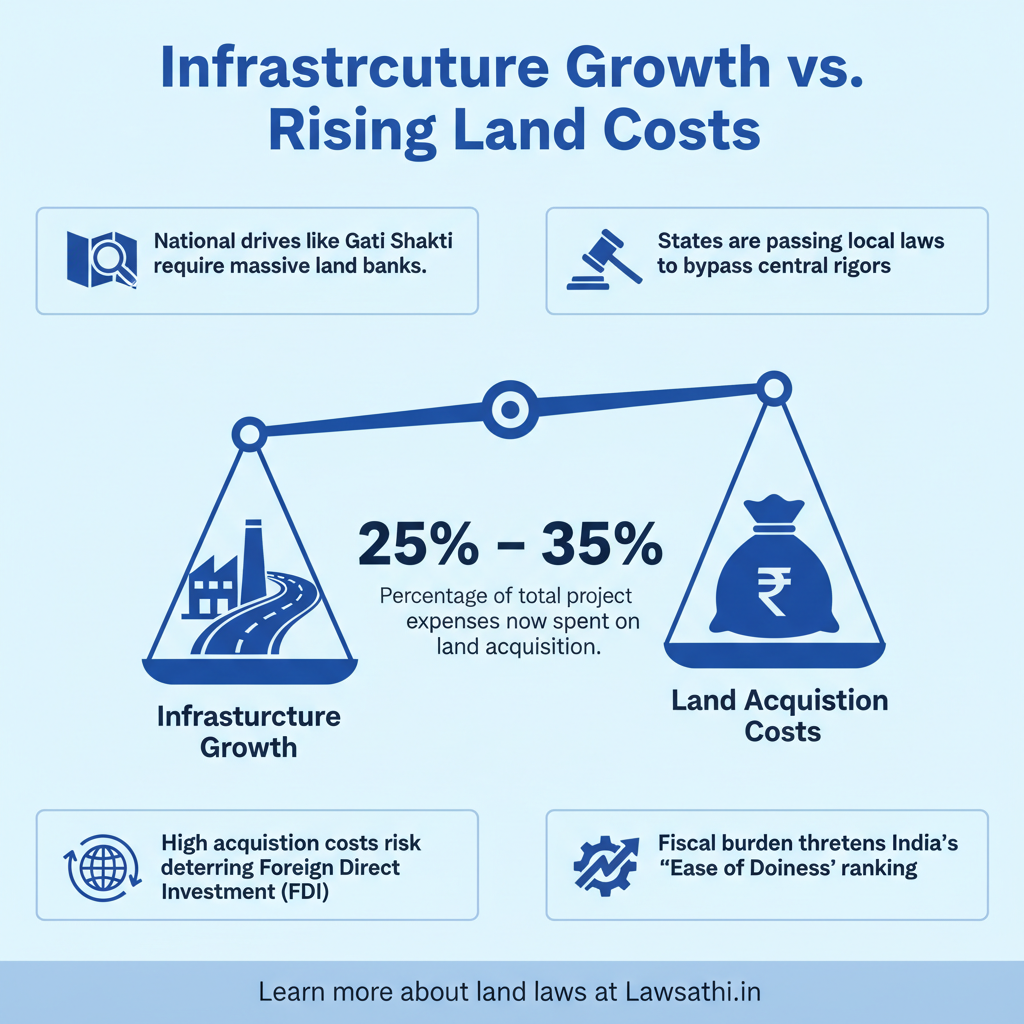
High compensation demands sometimes lead to project delays or alignment shifts. Moreover, the government struggles to maintain “Ease of Doing Business” while following strict laws.
For example, the Economic Survey 2024-25 highlights how land remains a tricky factor. Specifically, the Survey notes that high land costs can deter foreign direct investment in manufacturing.
Key Challenges for Revenue Lawyers in 2026
Modern revenue practice requires more than just knowledge of the law. Specifically, lawyers must manage massive amounts of documentation. This includes ancient title deeds and inheritance proofs. Additionally, they must audit local registry data that often contain errors.
Managing Retrospective Applications
Lawyers are increasingly arguing for retrospective application in delayed cases. For example, in Suresh Kumar v. State of Haryana (2025), the Court made an important ruling.
The Court held that delay is no reason to deny fair compensation. Therefore, property rights remain protected under Article 300A of the Constitution. Most importantly, this ensures justice for those who were unaware of their legal rights initially.
Strategies for Multi-Client Representation
Handling village-wide petitions is another significant challenge for legal professionals. Furthermore, the lawyer must reconcile 100-year-old mutation records with active digital IDs.
Effective strategies involve using “condonation of delay” as a right. In other words, lawyers must ensure no farmer is left behind due to paperwork issues. Consequently, collective bargaining has become a common tool in land disputes.

The Future of Revenue Law: AI and Digital Land Records
The future of Land Acquisition Act 2013 compensation disputes lies in technology. For instance, the Digital India Land Records Modernization Programme (DILRMP) has digitized nearly 99% of land records.
As a result, this creates a more transparent environment for lawyers and clients alike. In contrast to the old paper system, digital records are harder to manipulate.
AI and Market Value Discovery
Predictive AI is now being integrated into portals like Bhu-Naksha. These tools help estimate fair compensation based on recent historical sale trends.
Consequently, this helps eliminate arbitrary “circle rate” fixing by local collectors. Moreover, it provides lawyers with data-driven evidence for court arguments. Specifically, it narrows the gap between government offers and market realities.
The Impact of the Registration Bill 2025
Moreover, the Registration Bill 2025 introduces online registration. This system will likely standardize how compensation is calculated across different states.
As a result, the scope for local-level corruption will reduce significantly. Finally, this move toward automation will speed up the disbursement of award money to rightful owners.
Conclusion
The Land Acquisition Act 2013 compensation framework continues to evolve through judicial scrutiny. While infrastructure projects are vital for India’s growth, protecting property rights is equally essential.
Therefore, lawyers who master the 4X formula and digital records will lead the way in 2026. Above all, transparency and technology will define the future of land law.
Tired of managing voluminous land acquisition files? Use LawSathi’s AI-powered practice management tools to organize your revenue cases. Specifically, you can automate client updates and access case laws in seconds. Book a demo today!