
The Supreme Court of India recently issued a historic clarification regarding manual sewer cleaning death compensation. This landmark ruling ensures that families of victims receive adequate financial justice. Most importantly, it applies regardless of when the tragedy occurred. Therefore, legal practitioners must understand how these retrospective payments function in practice.
Introduction: The Supreme Court’s Stance on Retrospective Compensation
The Supreme Court has now solidified the mandate for a uniform manual sewer cleaning death compensation of ₹30 Lakhs. Specifically, this clarification targets cases that occurred before the 2023 Balram Singh vs Union of India judgment.
Previously, many states hesitated to apply newer compensation rates to older incidents. However, the Court has ruled that if a death remains uncompensated, the current rate applies. Consequently, the judiciary is moving beyond the limited scope of the 1993 and 2013 Acts.
Identifying Unpaid Deaths from the Past
The core of this ruling addresses deaths occurring between 1993 and 2023. Many families received either nothing or only the earlier rate of ₹10 Lakhs.
In recent proceedings like Asha v. State of Haryana (2025), the Court warned officials. Specifically, they must not use “cleverly worded” affidavits.
The Court will not tolerate administrative delays in identifying victims. As a result, states must now actively find uncompensated families to fulfill their legal obligations.
Why Retrospective Application Matters
For example, a death in 2015 might have only qualified for ₹10 Lakhs under older rules. However, the Court now views the ₹30 Lakhs figure as the current value of human life.
This shift ensures that economic inflation does not diminish the value of justice. Furthermore, it places a heavy burden on municipal corporations to maintain accurate fatality records.
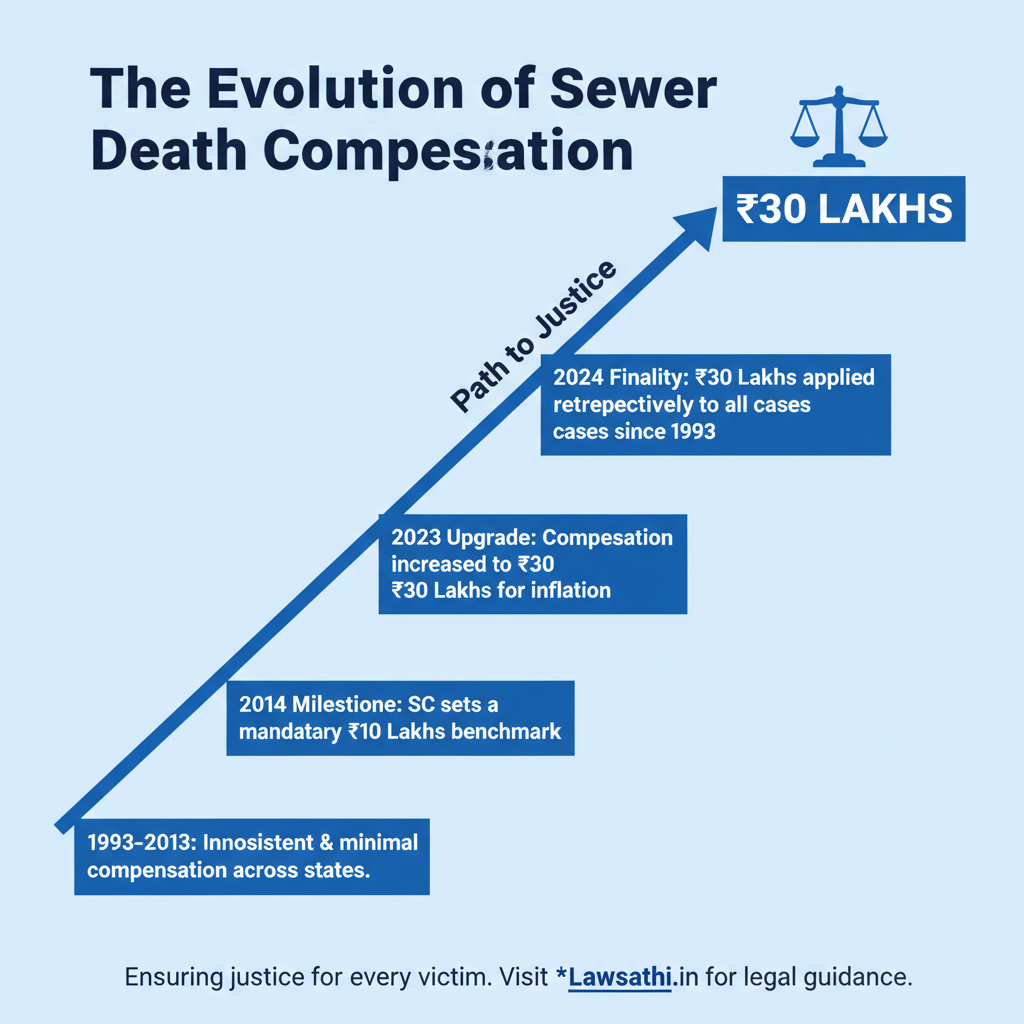
Background: From Rs 10 Lakhs to Rs 30 Lakhs
The journey toward fair compensation began with Safai Karamchari Andolan v. Union of India (2014). This case set a mandatory benchmark of ₹10 Lakhs for every sewer death.
At that time, this was a significant victory for human rights. Yet, over the next decade, the economic reality in India changed significantly. Therefore, the Balram Singh (2023) judgment enhanced the amount to ₹30 Lakhs.
The Evolution of Victim Benefits
Initially, the law focused primarily on basic rehabilitation. However, the judiciary realized that ₹10 Lakhs was no longer sufficient for a family’s survival.
As a result, the 2023 enhancement provides a “dignified life” to survivors. The Court noted that the previous amount was fixed nearly three decades ago. Consequently, failing to increase it would be an injustice to those suffering today.
Closing the 1993–2023 Legal Gap
The Supreme Court highlighted a massive gap in how states handled older claims. Many families were stuck in a legal limbo. Specifically, this happened because their loved ones died before the 2023 ruling.
To solve this, the Court clarified that the ₹30 Lakhs rate is the “current equivalent” of justice. This means the date of death does not limit the amount of manual sewer cleaning death compensation.
The Legal Clarification: Addressing the ‘Unpaid’ Contingency
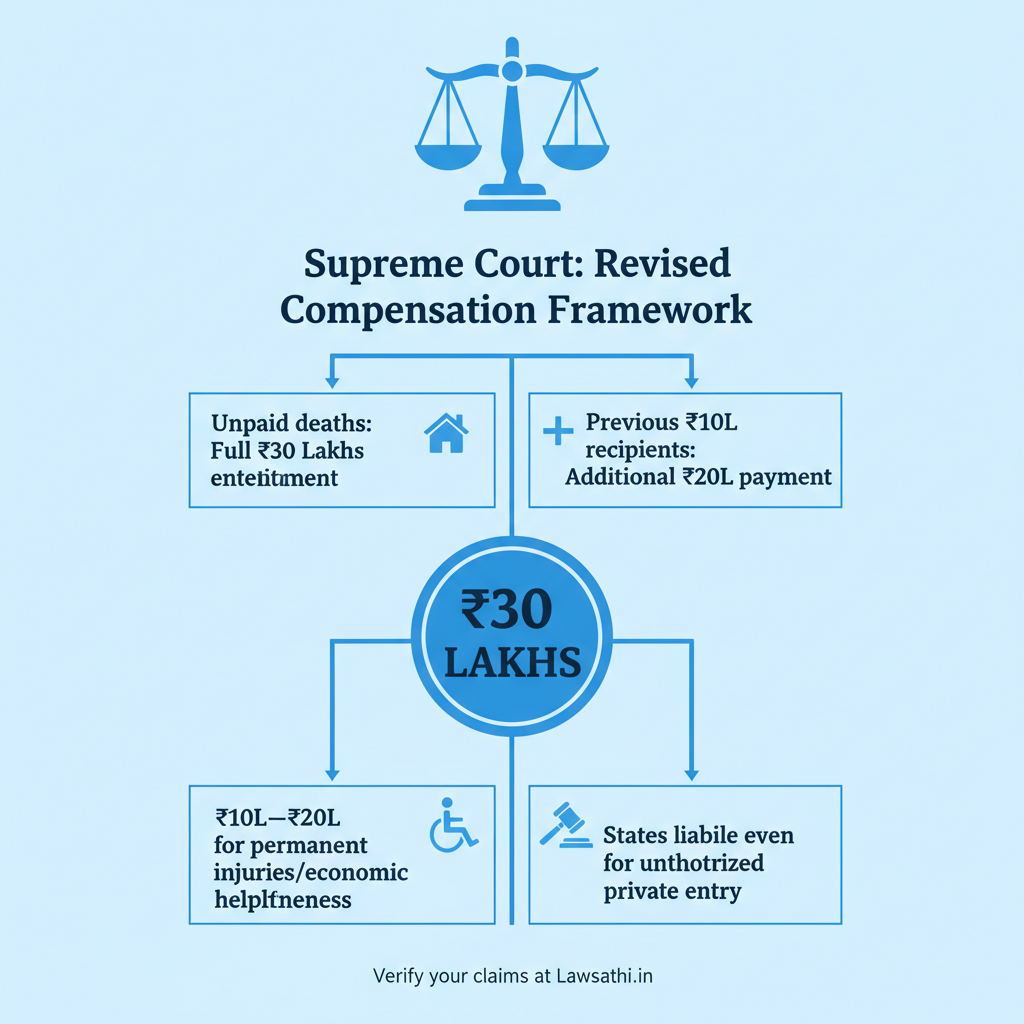
The most critical part of the recent update is the “unpaid” principle. If a family has already received ₹10 Lakhs, they are not excluded from further help.
Instead, they are now entitled to an additional ₹20 Lakhs to meet the new standard. This was recently confirmed in cases like Maya Kaur v. Union of India (2024).
Constitutional Basis for Higher Payouts
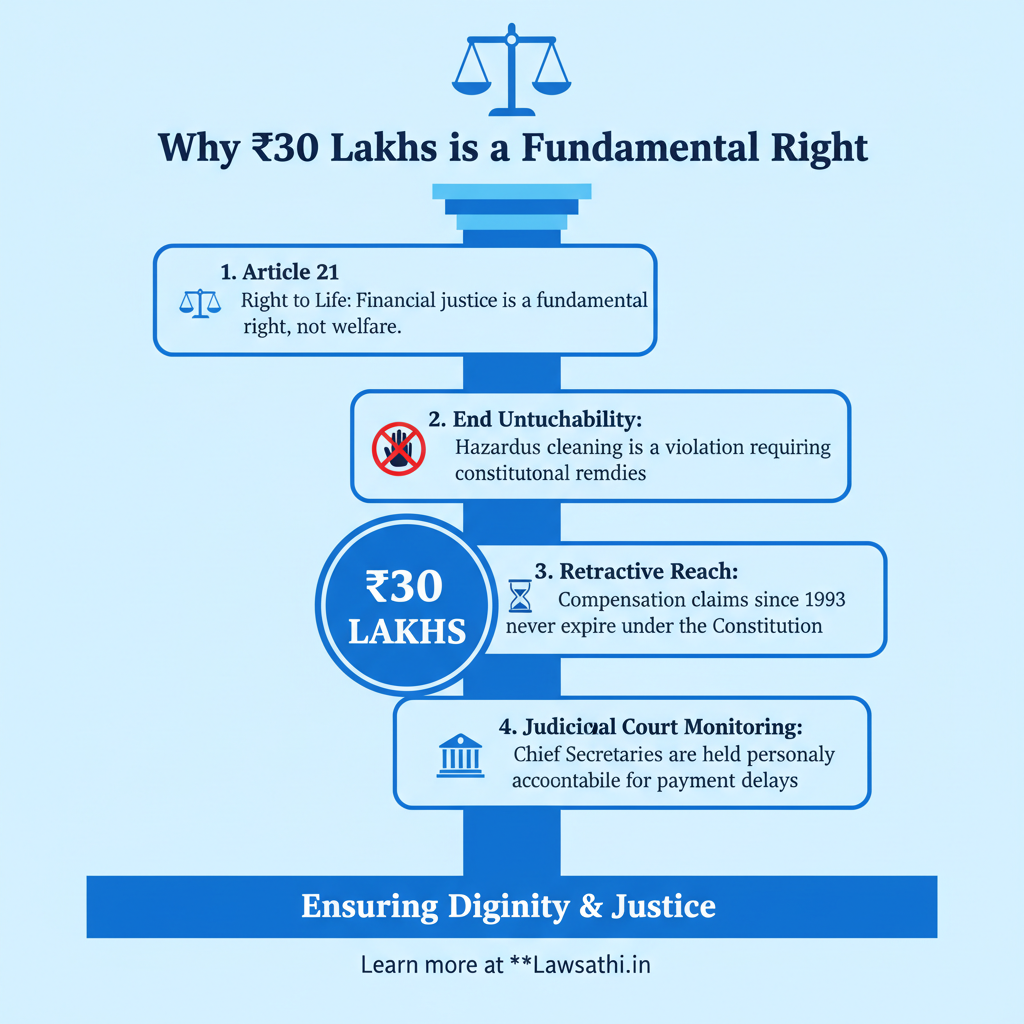
These mandates are rooted in Article 21 of the Constitution. This article guarantees the Right to Life. Additionally, the Court views hazardous cleaning as a form of untouchability under Article 17.
Therefore, compensation is not just a welfare measure. In fact, it is a constitutional remedy for the violation of fundamental human rights.
Denying the “Private Entry” Defense
States often try to escape liability by claiming the victim entered the sewer without permission. However, the Supreme Court has rejected this “unauthorized private entry” argument.
The Court held that the mere existence of manual scavenging proves a failure of the State. Consequently, municipal bodies are held strictly liable for every manual sewer cleaning death compensation claim.
Key Implications for Legal Practitioners and Litigants
For Indian lawyers, these updates present a massive opportunity to provide pro-bono or legal aid. First, you should know that there is no “expiry date” for these claims since 1993.
While statutes of limitations usually apply to civil suits, they do not block these constitutional claims. However, proving employment in decades-old cases remains a significant procedural hurdle.
Necessary Evidence for Old Claims
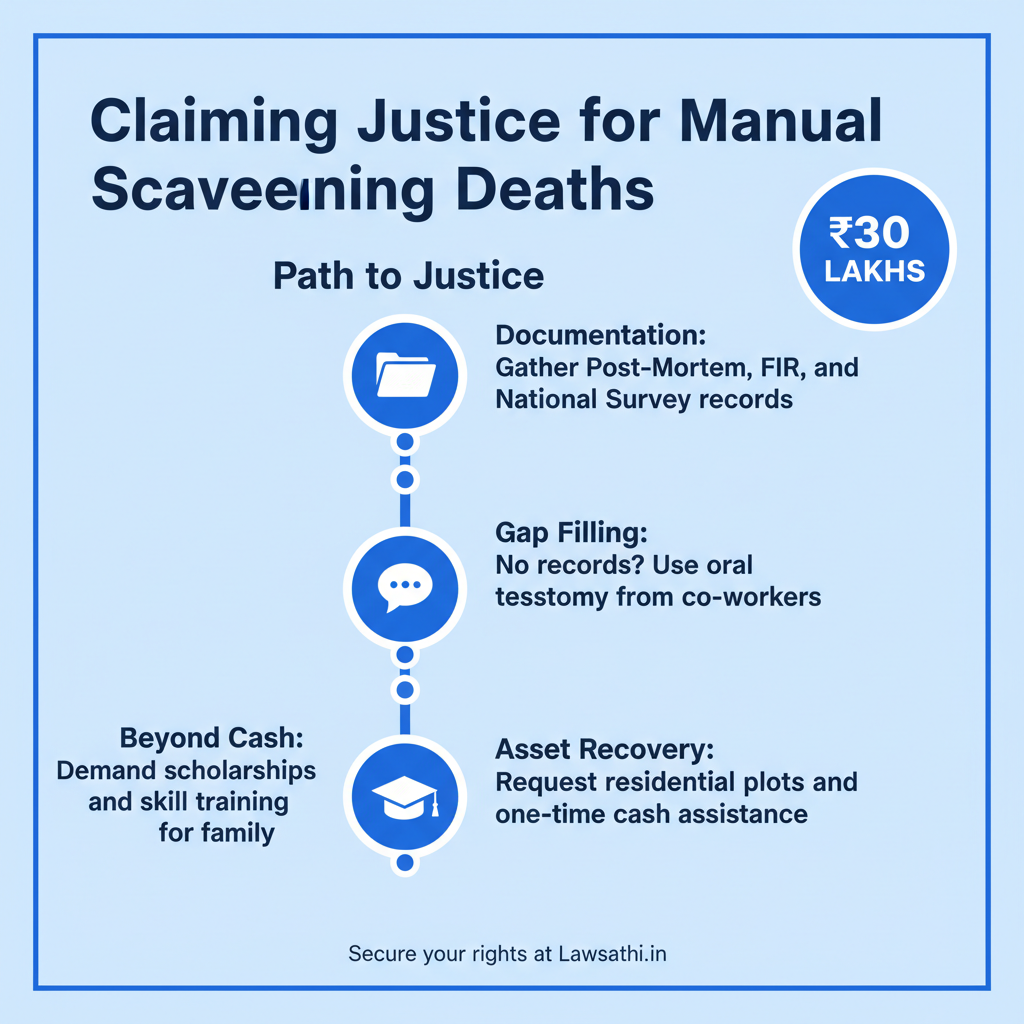
To win a case, lawyers must gather specific documentation. For example, post-mortem reports and FIRs are essential.
Additionally, practitioners can rely on National Survey data or reports from District Collectors. In cases where records are missing, oral testimony from co-workers can sometimes suffice. Most importantly, the Court has ordered a new National Survey to bridge these data gaps.
Compensation for Non-Fatal Injuries
It is also important to note that compensation is not limited to death. The Court has scaled payments for permanent disabilities as well.
Specifically, victims with non-fatal but debilitating injuries should receive at least ₹10 Lakhs. If the victim is rendered economically helpless, the amount increases to ₹20 Lakhs. Lawyers should advise clients on these specific tiers of relief.
Prohibition of Manual Scavengers Act, 2013: A Recap
The Manual Scavenging Act of 2013 defines “hazardous cleaning” very strictly. It refers to any person entering a sewer without protective gear.
Furthermore, the Act mandates more than just cash. For instance, families are entitled to scholarships for children. They also qualify for skill training for at least one member.
Mandatory Rehabilitation Measures
Legal practitioners should ensure their clients receive the full package of benefits. This includes one-time cash assistance and allotment of residential plots.
In many states, local authorities often ignore these non-cash benefits. Therefore, a lawyer’s role is to demand a holistic rehabilitation plan through the District Collector’s office.
Recent Judicial Oversight and Amendments
As of early 2026, the Supreme Court remains in “active monitoring” mode. This means the Court frequently summons Chief Secretaries to verify compliance.
In fact, the judiciary is now the primary catalyst for executive action. For example, recent orders require metro cities to pay dues within four weeks.
Conclusion: The Path Forward for Eradicating Manual Scavenging
The Supreme Court’s clarification on the ₹30 Lakhs manual sewer cleaning death compensation is a triumph for dignity. By making the payment retrospective, the Court is correcting decades of systemic neglect.
However, money alone cannot solve the problem. The ultimate goal remains the 100% mechanization of sewer cleaning across all Indian states.
The Role of Lawyers in Social Change
Lawyers and legal aid clinics must now act as bridges for the affected families. Many victims come from marginalized backgrounds. Consequently, they cannot navigate complex bureaucracies alone.
Therefore, helping them file for their rightful dues is a vital service to justice. By applying the Balram Singh principles, we can ensure that no family is left behind.
Stay updated on landmark Supreme Court judgments with LawSathi’s AI-powered legal updates. Streamline your research and case management today—try LawSathi for free.