
# Medical Negligence under Consumer Protection Act 2019: A Lawyer’s Guide to Evidence & Filing
Navigating a medical malpractice claim in India requires more than just clinical knowledge. It demands a deep understanding of evolving statutes and rigorous judicial standards.
As a legal practitioner, you must master the nuances of medical negligence under Consumer Protection Act 2019. Doing so will help you to protect your clients effectively.
Introduction: The Shift from 1986 to the Consumer Protection Act 2019
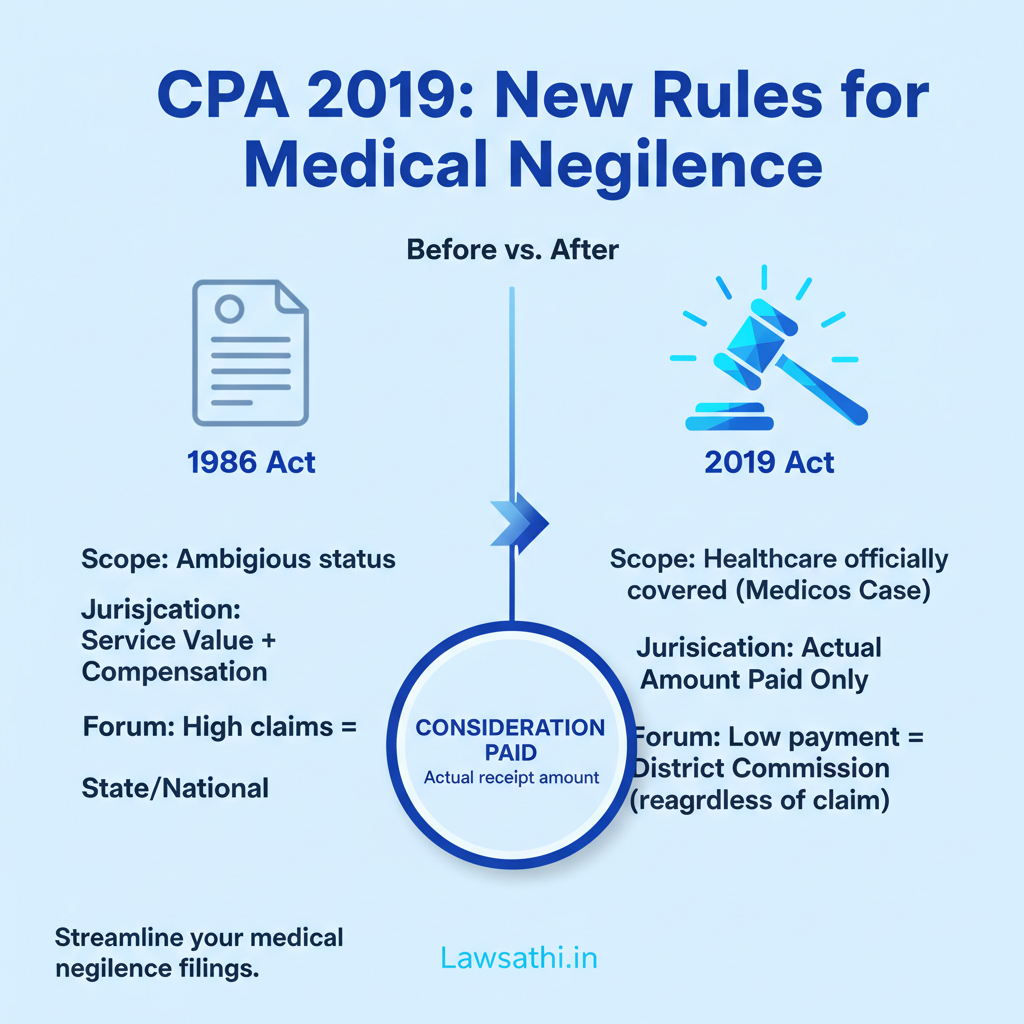
The transition from the 1986 Act brought significant changes for healthcare litigation. Specifically, the definition of “service” remained a point of intense legal debate for many years.
Healthcare as a Service Under the New Law
Initially, the 2019 Act omitted “healthcare” from its explicit list of services. However, the Supreme Court clarified this in Medicos Legal Action Group v. Union of India.
The court affirmed that health care services provided by doctors are covered under the new Act. Consequently, medical professionals remain liable for deficiencies. This applies unless the service is provided entirely free of charge.
New Rules for Pecuniary Jurisdiction
Furthermore, the criteria for selecting the correct forum have shifted drastically. Previously, jurisdiction depended on the value of service plus the compensation claimed.
Now, the law looks only at the value of consideration paid by the consumer. Therefore, if a patient pays ₹10 Lakhs for surgery, the case stays in the District Commission.
This rule applies even if the lawyer claims ₹5 Crores in damages. Most importantly, this change prevents lawyers from inflating claims to bypass lower commissions.
Establishing ‘Deficiency in Service’: The Legal Benchmark
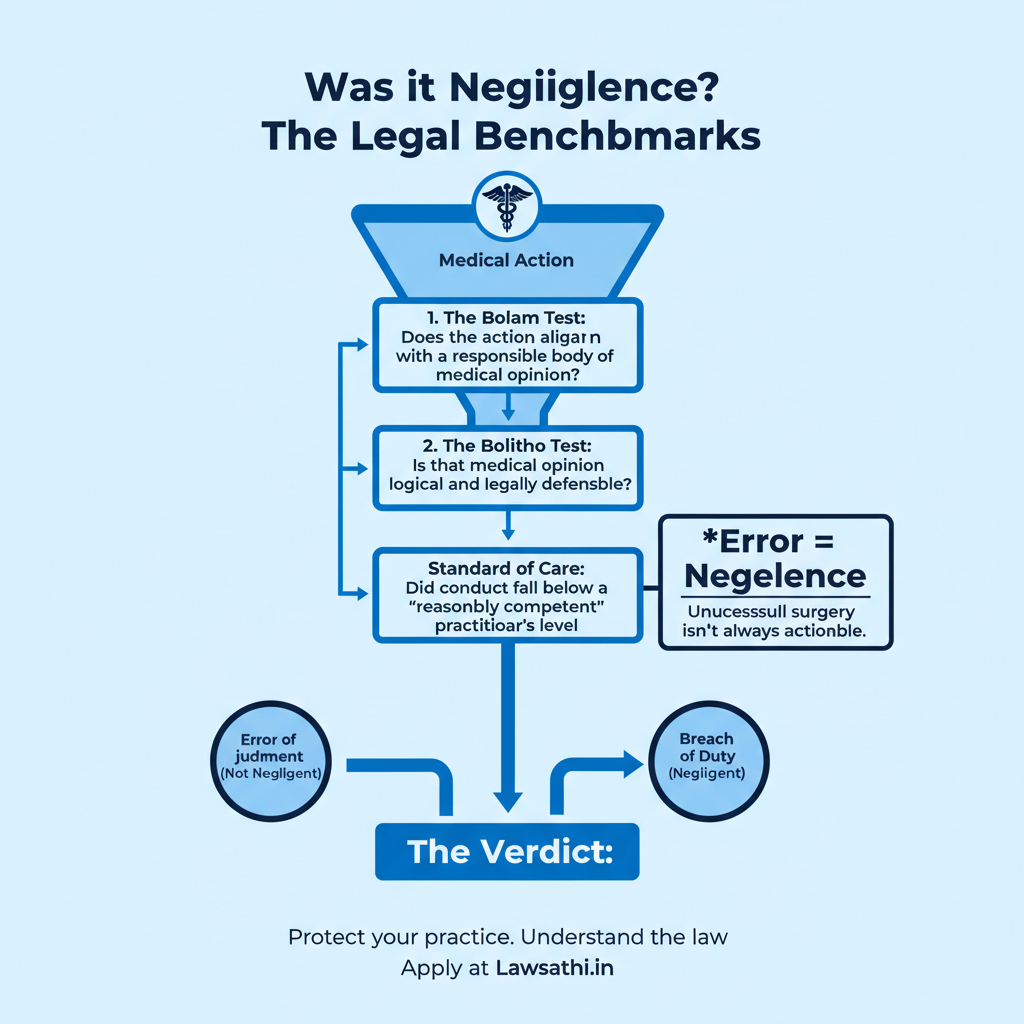
To win a case regarding medical negligence under Consumer Protection Act 2019, you must prove a specific breach of duty. Indian courts predominantly rely on the “Bolam Test” to judge medical skill.
The Bolam vs. Bolitho Standards
Under the Bolam Test, a doctor is not negligent if they acted according to a responsible body of medical opinion. However, the modern “Bolitho Test” adds a layer of logical analysis.
For example, a court may reject a medical opinion if it does not withstand logical scrutiny. Consequently, you must prove the doctor failed to act as a reasonable professional.
Error of Judgment vs. Actionable Negligence
Additionally, you must distinguish between a simple mistake and actual negligence. An unsuccessful surgery does not always imply a deficiency.
In Jacob Mathew v. State of Punjab, the court held that a mere error of judgment is not negligence. To succeed, you must demonstrate the doctor’s conduct fell below the standard of a reasonably competent practitioner.
The Pre-Litigation Checklist: Preparing the Strongest Foundation
Success in medical litigation depends on your preparation before filing. First, you must secure all relevant evidence. You should do this before the hospital can modify any records.
Securing Medical Records Promptly
Fortunately, patients have a legal right to their information. Under National Medical Commission (NMC) guidelines, hospitals must provide complete medical records within 72 hours of a request.
If a hospital refuses the request, this alone constitutes a deficiency in service. Therefore, lawyers should send formal requests immediately to preserve the evidence trail.
The Power of the Preliminary Medical Opinion
Moreover, it is wise to obtain an independent expert opinion before filing. Specifically, the prosecution of doctors requires medical opinion in criminal cases.
Expert opinions are equally vital in consumer courts. A “Prima Facie” expert review helps your case survive the admission stage. As a result, your filing will carry more weight in the District Commission.
Essential Evidence: Documenting the Breach of Duty
Proving medical negligence under Consumer Protection Act 2019 requires a robust paper trail. You must gather discharge summaries, prescriptions, and lab reports.
Managing Electronic Records under New Laws
In 2026, most medical records are digital. Therefore, you must follow the Bhartiya Sakshya Adhiniyam (BSA) 2023 for admissibility.
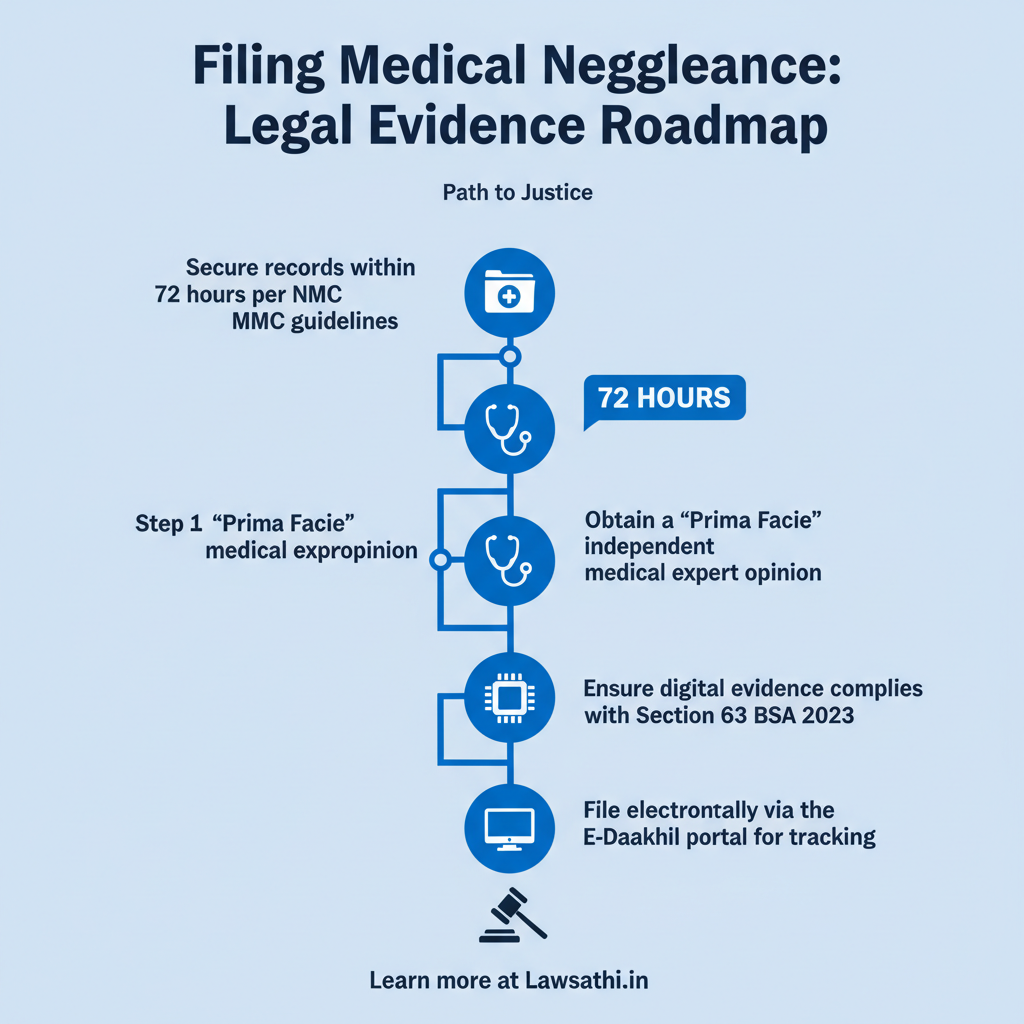
Specifically, Section 63 of the BSA now governs electronic evidence. You must attach the required certificates. These documents prove that digital lab results are authentic.
When Evidence Speaks for Itself
In some cases, the negligence is so obvious that the doctrine of Res Ipsa Loquitur applies. For example, leaving surgical gauze inside a patient is an undeniable breach.
In such instances, the burden of proof shifts to the hospital. They must explain how the error occurred. For complex clinical issues, however, you should always cite standard protocols like ROP screening for infants.
Drafting the Complaint: Forum Selection and Strategy
Once your evidence is ready, you must draft a strong complaint. Emphasize the “Balance of Probabilities” in your arguments. Consumer courts operate on this standard rather than the strict criminal rule.
Using E-Daakhil for Online Filing
The 2019 Act introduced the E-Daakhil portal for streamlined filing. This allows you to file complaints and pay fees online from your office.
Consequently, you can track the status of your medical negligence claim in real-time. This digital shift has greatly improved the efficiency of consumer litigation in India. Furthermore, it saves significant time for both lawyers and clients.
Quantifying Damages Correctly
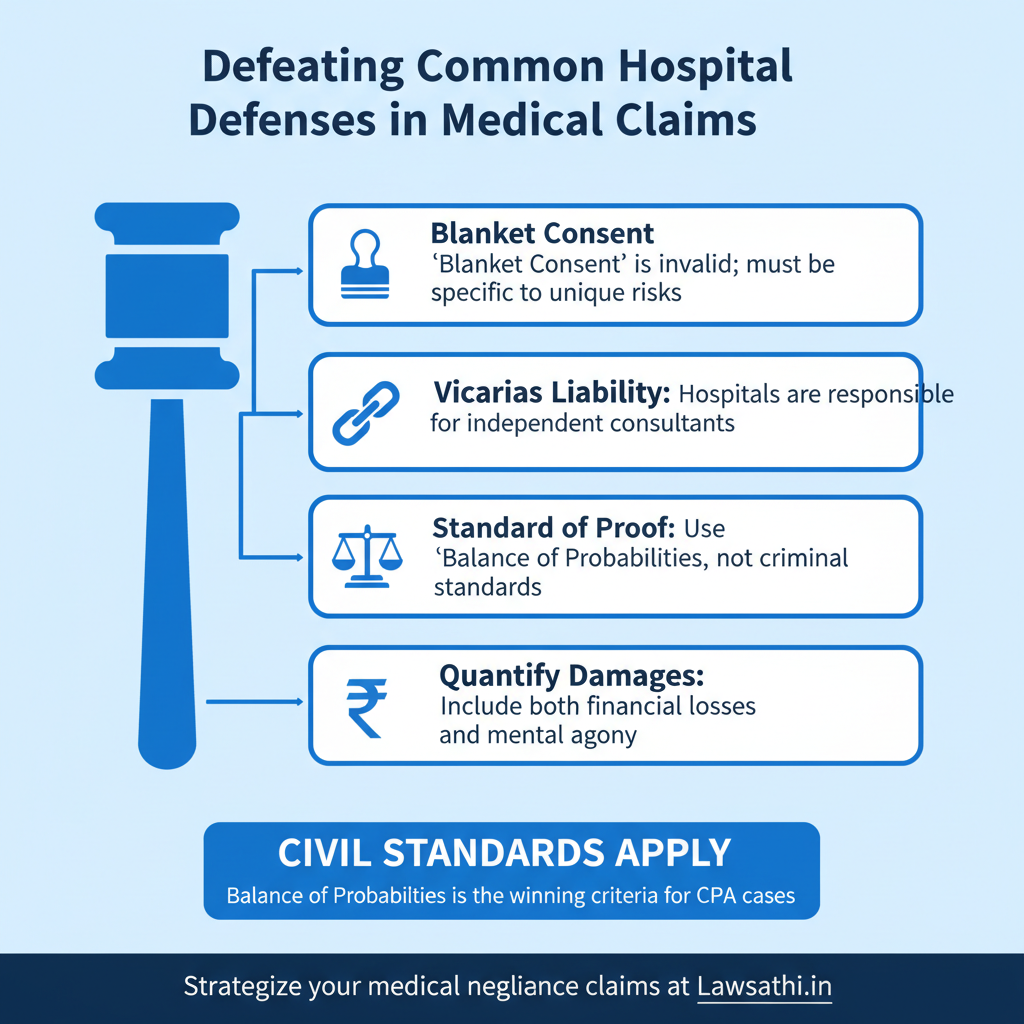
Additionally, you must meticulously calculate the compensation. Include “Pecuniary” damages like medical bills and lost wages.
Also, do not forget “Non-Pecuniary” damages for pain and mental agony. For instance, the Supreme Court has enhanced compensation for homemakers. They did this by recognizing the economic value of their daily work.
Common Defense Strategies and How to Counter Them
Hospitals often rely on “Informed Consent” as their primary defense. They will argue the patient signed a waiver for all risks.
Challenging Blanket Consent Forms
However, a generic “Blanket Consent” form is often legally invalid. You should argue that consent must be specific. It must cover the exact procedure and its unique risks. For example, doctors cannot perform a different surgery than discussed. If they do, the hospital is liable for deficiency.
Proving Vicarious Liability
Hospitals frequently try to distance themselves from “independent consultant” doctors. Nevertheless, the Supreme Court consistently upholds a hospital’s vicarious liability for its doctors.
If the patient sought treatment from the hospital, the facility is responsible. Specifically, they are liable for the conduct of all staff and consultants.
Conclusion
Mastering claims of medical negligence under Consumer Protection Act 2019 is essential for the modern Indian lawyer. First, you must understand the new pecuniary limits and the E-Daakhil process.
Second, you must gather rigorous evidence. This includes digital records certified under the BSA 2023. Finally, you must be prepared to counter standard defenses. By following this guide, you can ensure your clients receive the justice they deserve.
Streamline your medical negligence casework with LawSathi’s AI-powered document indexing. Start your free trial today to simplify complex litigation.