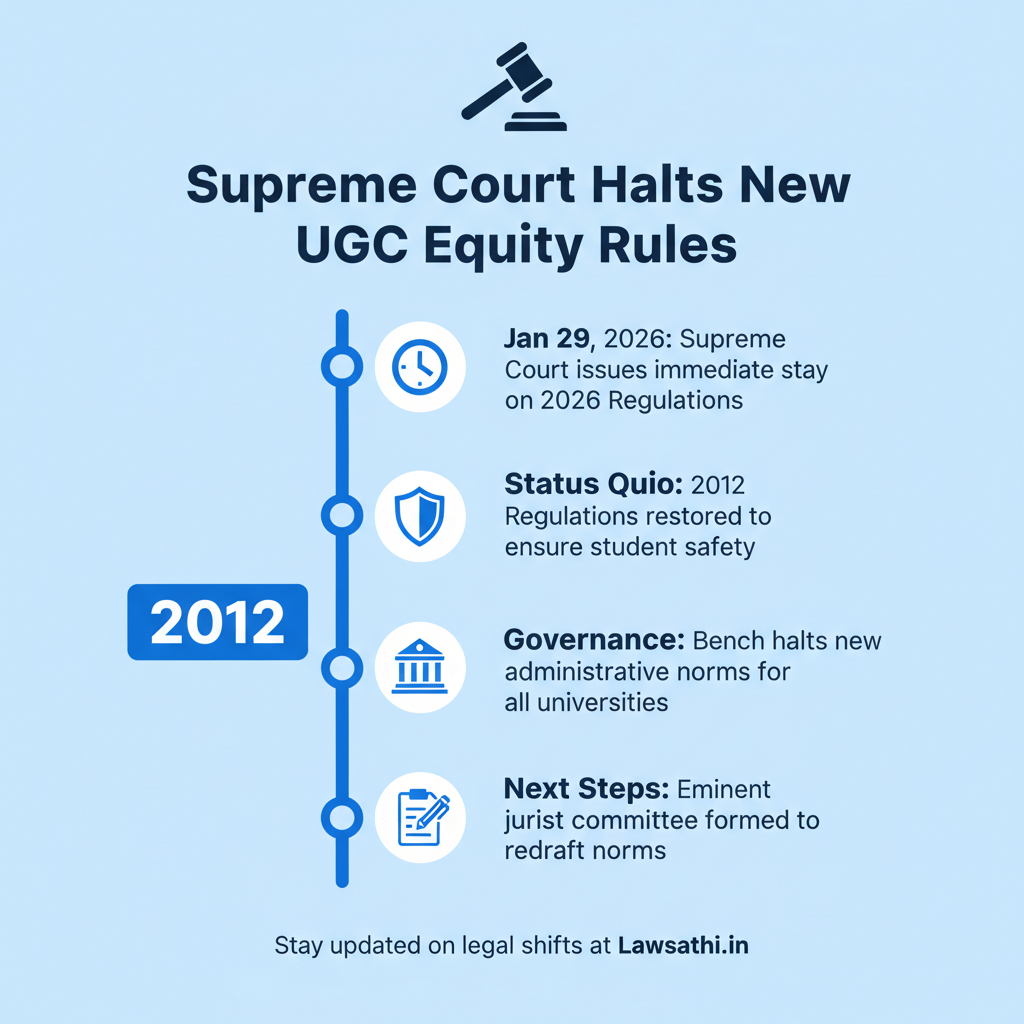
On January 29, 2026, the legal landscape for Indian universities shifted dramatically. The Supreme Court issued a significant UGC Equity Regulations 2026 stay. This order effectively halted new administrative norms immediately. Additionally, these regulations aimed to address campus discrimination. However, the Court raised serious concerns about their clarity and constitutional validity.
The Brief Context of the Stay Order
A bench led by CJI Surya Kant and Justice Joymalya Bagchi placed the regulations in abeyance. Specifically, these norms were meant to replace the 2012 guidelines. They stemmed from a 2019 petition filed by the mothers of Rohit Vemula and Payal Tadvi. While the goal was noble, the Court found the execution flawed.
Resolving the Governance Conflict
There is a constant tug-of-war between administrative oversight and institutional autonomy. Therefore, the Court had to intervene to prevent potential misuse of the new rules. To ensure student safety, the Court invoked Article 142. Consequently, the 2012 Regulations will remain active during the stay period.
Understanding the ‘Doctrine of Vagueness’ in Administrative Law
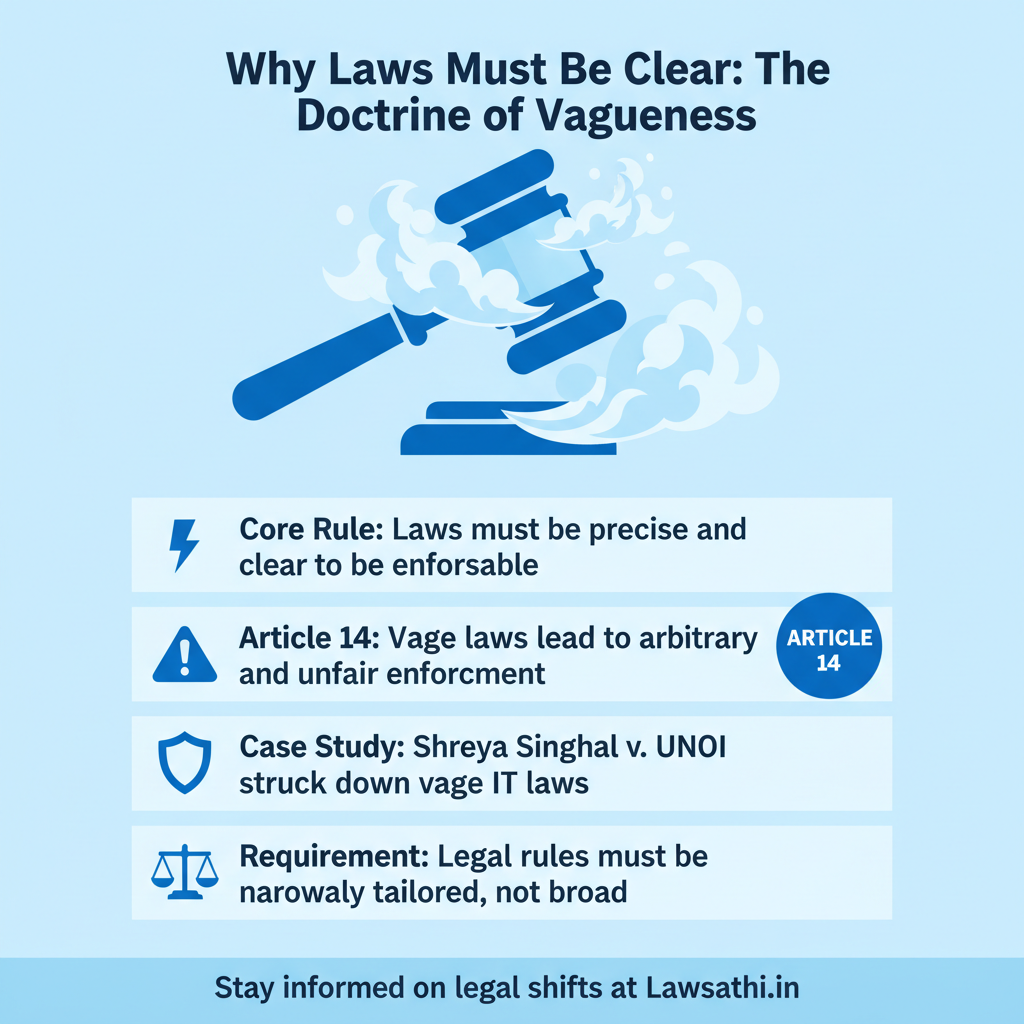
The primary reason for the UGC Equity Regulations 2026 stay was the “Doctrine of Vagueness.” In Indian law, any regulation must be clear and precise. If a law is too broad, it violates Article 14 of the Constitution. Therefore, the Court noted that these regulations lacked the necessary specificity to be enforceable.
Constitutional Basis under Article 14
Article 14 guarantees equality before the law. For a law to be valid, it must provide a clear understanding of what is prohibited. However, the 2026 draft contained several “ambiguities” that the Court found deeply troubling. In fact, the bench warned that these rules could divide society rather than unite it.
Precedents for Striking Down Vague Laws
The Indian judiciary has a history of striking down vague legislation. For example, in Shreya Singhal v. Union of India, the Court struck down Section 66A of the IT Act. Similarly, in the recent Kunal Kamra v. Union of India case, the Bombay High Court reinforced this principle. It ruled that state-made rules must be narrowly tailored. This prevents arbitrary enforcement by authorities.
Key Provisions of the UGC Equity Regulations 2026 Under Fire
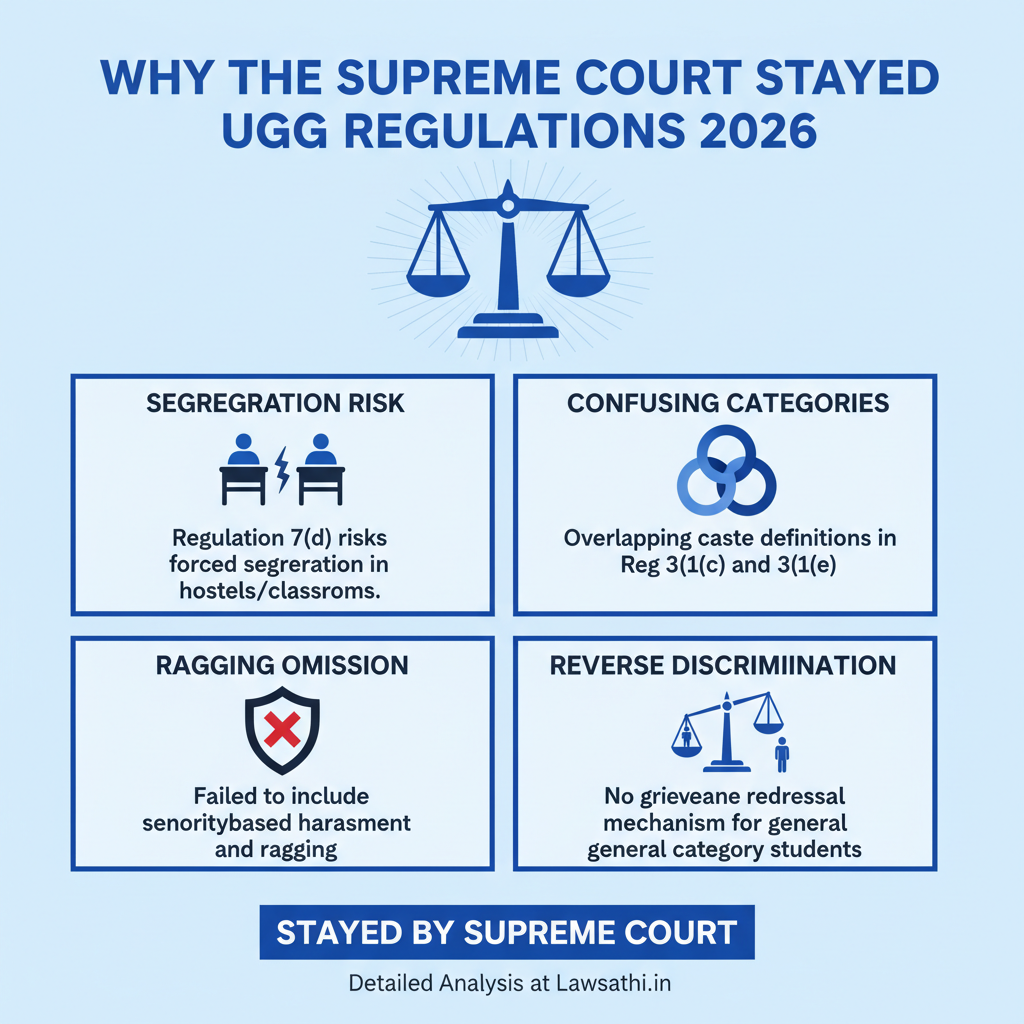
Several specific clauses in the 2026 draft drew sharp criticism from the bench. Most notably, Regulation 7(d) mentioned “segregation” in hostels and classrooms. Consequently, the CJI expressed shock at this terminology. He remarked that students should stay together regardless of their backgrounds.
Ambiguous Definitions of Equity
Additionally, the Court questioned the definition of caste-based discrimination in Regulation 3(1)(c). This clause applied only to SC, ST, and OBC members. However, Regulation 3(1)(e) already offered a broader definition. As a result, the Court asked why the UGC created overlapping and confusing categories.
The Omission of Campus Ragging
Furthermore, the Bench was surprised by the omission of “ragging” from the new framework. Seniority-based harassment often causes significant campus trauma. By leaving this out, the UGC missed a vital component of student equity. Moreover, the punitive powers granted to the UGC seemed overly harsh. These triggers remained vague and lacked proper definitions.
Arguments from the Petitioners: Why Law Firms Challenged the Move
Law firms representing various stakeholders argued that the regulations created “regulatory cholesterol.” They claimed that mandatory committees would impose heavy compliance burdens on private universities. Specifically, petitioners like Mritunjay Tiwari and Advocate Vineet Jindal challenged the exclusionary nature of the draft.
Concerns of Reverse Discrimination
Counsel argued that the regulations presumed discrimination only works in one direction. This, they claimed, left general category students without any grievance redressal mechanism. Consequently, they viewed the move as a violation of the principle of caste neutrality. These arguments highlight the immense pressure on Higher Education Institutions (HEIs) to balance diverse interests.
Exceeding the UGC Mandate
Finally, petitioners argued that the UGC overstepped its mandate under the UGC Act, 1956. They believe the commission lacks the authority to enforce such specific social engineering. This is especially true regarding administrative rules. Therefore, they petitioned the Court to step in. They wanted to prevent what they termed “impermissible State discrimination.”
The Government’s Stand and the Road Ahead
The Ministry of Education defended the regulations as a necessary step. Specifically, they cited the tragic history of student suicides as a reason for targeted measures. However, the Solicitor General must now seek new instructions. He will help in forming a committee of eminent jurists to redraft the norms.
Timelines for the Final Hearing
The Supreme Court has scheduled the next hearing for March 19, 2026. Until then, the UGC Equity Regulations 2026 stay remains in force. Furthermore, the government must now file counter-affidavits. They must present a revised draft that satisfies the Court’s transparency requirements.
Advice for University Clients
Law firms should advise their university clients to maintain the status quo. Universities must continue following the UGC 2012 equity guidelines. This is a direct order by the Court. Most importantly, HEIs should pause any structural changes initiated under the 2026 draft. This includes actions like creating separate hostel wings.

Implications for Legal Practitioners and Education Law
This stay order serves as a reminder of the judiciary’s role. Courts must vet subordinate legislation carefully. For legal practitioners, it highlights the importance of precise drafting in administrative law. Moreover, this case showcases the trend of “Redrafting via Judiciary” in India.
Compliance Checklist for HEIs
During this “stay status quo,” lawyers should help HEIs audit their existing policies. First, ensure Equal Opportunity Cells are functional under the 2012 norms. Second, maintain standard anti-ragging protocols as a primary defense. Finally, review any active inquiries. Procedures started solely under the 2026 draft may be legally vulnerable.
Leveraging Legal Tech in Regulatory Shifts
Staying updated on such rapid shifts is difficult for busy practitioners. However, AI-powered tools can help track updates to Higher Education Law in India. Specifically, using data-driven insights allows firms to provide more accurate advice. This helps university boards and educational trusts navigate the changes.
In summary, the UGC Equity Regulations 2026 stay emphasizes the need for clarity. The Supreme Court has chosen to prioritize the “Doctrine of Vagueness.” This prevents administrative overreach in social legislation. As we wait for the March hearing, the focus remains on creating a sound campus environment.
Stay ahead of rapid legal developments with LawSathi’s AI-powered case tracking. Simplify your research on Supreme Court stays and administrative law updates today.