
A nine-judge Constitution Bench of the Supreme Court will hear a landmark reference on March 17-18, 2026. They will reinterpret the definition of “industry” under Section 2(j) of the Industrial Disputes Act, 1947. Indeed, this hearing marks one of the most significant developments in Indian labour law jurisprudence in decades. Consequently, the Supreme Court nine-judge bench industry definition reference could reshape how millions of workers access labour courts and tribunals across India.
The matter involves interpreting whether government departments, hospitals, and educational institutions fall within the ambit of “industry.” Other welfare-oriented entities are also under scrutiny. For lawyers practising in labour law, therefore, this hearing demands close attention. Furthermore, the outcome will affect pending litigation, compliance strategies, and advisory services for years to come.
Introduction: A Landmark Constitutional Bench Hearing
The Schedule and Significance
First, Chief Justice Surya Kant announced the hearing schedule on February 16, 2026. Specifically, the Court has listed the matter for final hearing before a nine-judge bench on March 17-18, 2026. Written submissions were required by February 28, 2026. Additionally, petitioners have been allocated three hours for arguments plus one hour for rejoinder.
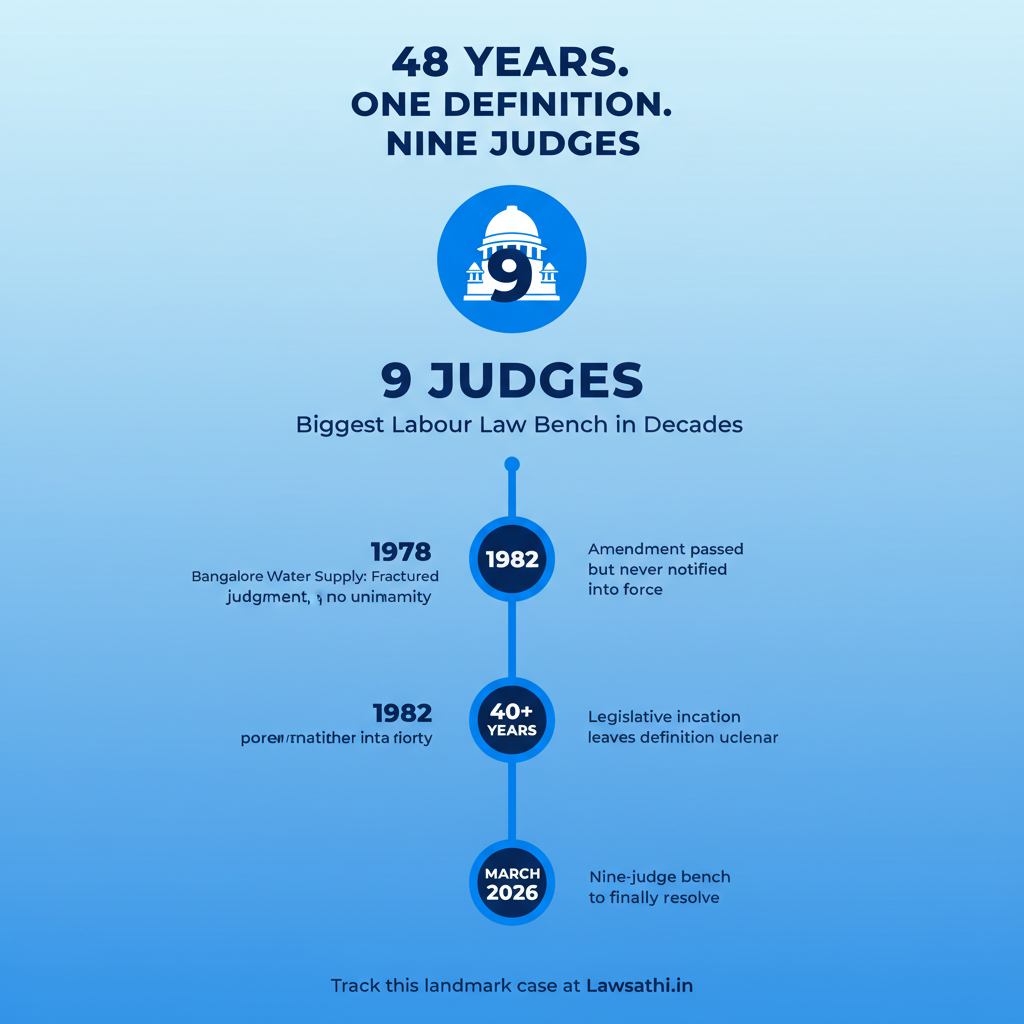
This reference traces back to 2005. At that time, a five-judge bench in State of U.P. v. Jai Bir Singh referred the matter to a larger bench. Subsequently, in 2017, a seven-judge bench further referred it to a nine-judge bench. In fact, the progression signals the complexity and importance of the legal questions involved.
Why This Reference Matters for Lawyers
The core issue involves interpreting Section 2(j) of the Industrial Disputes Act, 1947. Currently, the interpretation stems from the landmark Bangalore Water Supply case decided in 1978. However, that judgment lacked unanimity among the seven judges. Additionally, the legislative amendment of 1982 was never notified into force.
For legal practitioners, consequently, this creates uncertainty. As a result, conflicting precedents have emerged from different High Courts. However, the nine-judge bench hearing offers an opportunity to settle the law authoritatively. Therefore, lawyers advising government bodies, public sector undertakings, hospitals, and educational institutions must track this case closely.
Historical Context: The Evolution of ‘Industry’ in Indian Jurisprudence
The Landmark Bangalore Water Supply Case
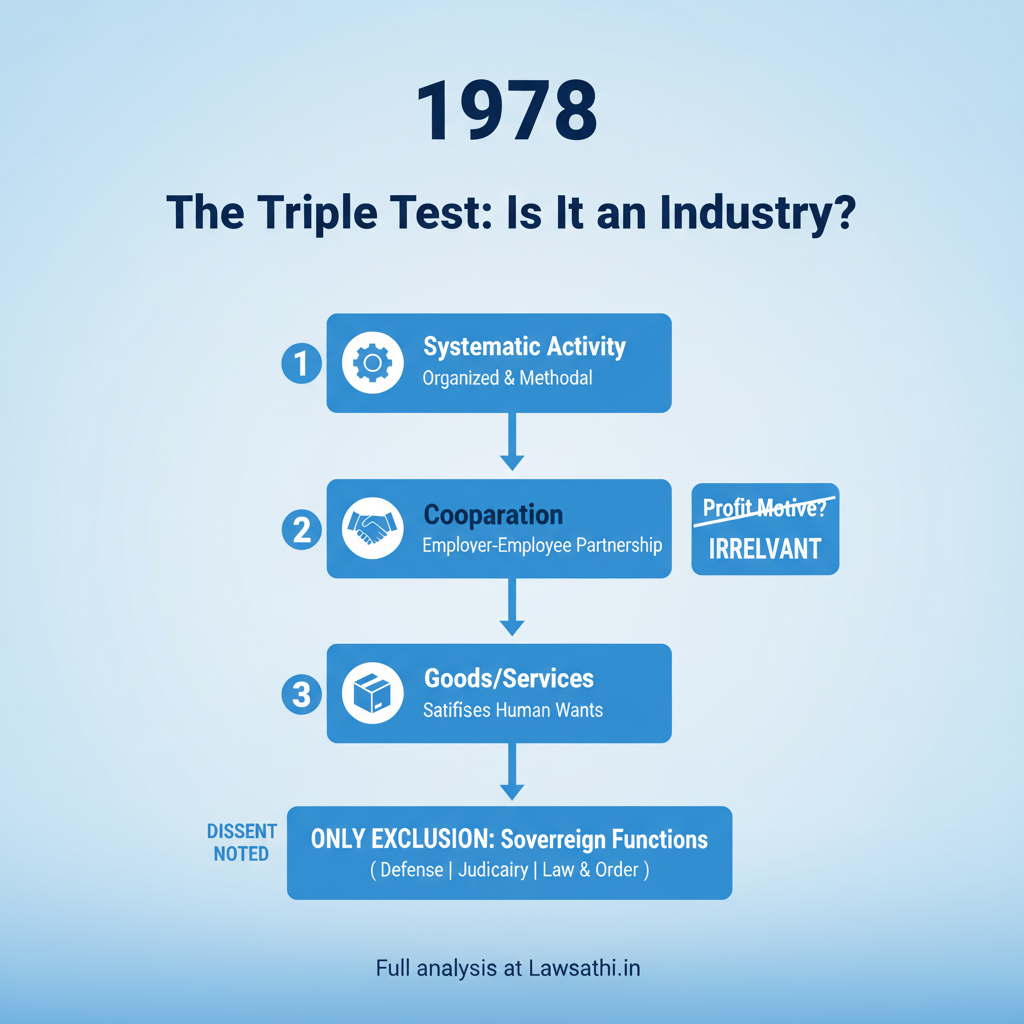
In 1978, a seven-judge Constitution Bench decided Bangalore Water Supply & Sewerage Board v. A. Rajappa. The case established what became known as the “triple test” for determining whether an entity constitutes an “industry.” Specifically, Justice Krishna Iyer, writing for the majority, laid down three criteria.
First, there must be systematic activity organized methodically. Second, the activity must involve employer-employee cooperation. Third, it must relate to production or distribution of goods and services calculated to satisfy human wants.
Importantly, the judgment held that profit motive is irrelevant. Government departments engaged in welfare activities could be “industry.” Hospitals, educational institutions, research institutes, clubs, and even professions were included. However, the only exclusion was for “sovereign functions strictly understood.”
Internal Divisions and Judicial Uncertainty
However, the Bangalore Water judgment was far from unanimous. Justice Krishna Iyer delivered his opinion for himself, Justice Bhagwati, and Justice Desai. Notably, Justice Beg, the then Chief Justice, expressed reservations on his last working day before retirement.
Furthermore, Justice Chandrachud delivered a separate opinion after Beg CJ’s retirement. Most significantly, Justice Jaswant Singh, writing for himself and Justice Tulzapurkar, dissented. They advocated a narrower interpretation limited to commercial activities undertaken by private entrepreneurs.
Consequently, the lack of unanimity created confusion. Courts struggled to apply the “triple test” consistently. As a result, different benches reached contradictory conclusions on similar facts. This judicial uncertainty persisted for nearly five decades.
The Legislative Response That Never Came
In response, Parliament enacted the Industrial Disputes (Amendment) Act, 1982. The amendment sought to narrow the definition of “industry.” Specifically, it excluded sovereign functions of the State and certain welfare activities.
However, the amended definition of “industry” was never notified into force. Section 1(2) of the Amendment Act requires a notification to bring provisions into effect. Yet, over 40 years later, no such notification has been issued. In contrast, other provisions, like Section 17B regarding payment of full wages pending proceedings, were notified in 1984.
Consequently, the unamended definition continues to operate. The legislative intent remains unfulfilled. Courts must still apply the expansive Bangalore Water interpretation, despite its acknowledged shortcomings. Therefore, this gap between legislative intent and judicial interpretation forms a key issue before the nine-judge bench.
The Core Issue: Sovereign Functions vs. Commercial Activities
Understanding the Sovereign Function Exception
The Supreme Court nine-judge bench industry definition reference centres on distinguishing sovereign functions from commercial or business activities. Under the traditional view from Bangalore Water, only “inalienable functions” of the State were excluded from “industry.” For example, these inalienable functions include law and order, legislation, judiciary, defence, and core administration.
Welfare activities undertaken by the State were not considered sovereign functions. Therefore, government departments engaged in welfare schemes fell within the definition of “industry.” However, employers have argued for a broader interpretation of sovereign functions.
In a constitutional democracy, they contend, all welfare activities should qualify as sovereign. Specifically, those undertaken under Directive Principles of State Policy. This argument could exclude numerous government schemes from labour law protection.
Confusion Regarding Specific Entities
Hospitals and Healthcare Institutions
First, Government hospitals have long been a contested category. In Hospital Mazdoor Sabha v. State of Bombay (1960), the Supreme Court held government hospitals could be “industry.” Later, in Safdarjung Hospital (1970), a narrower view excluded non-commercial activities.
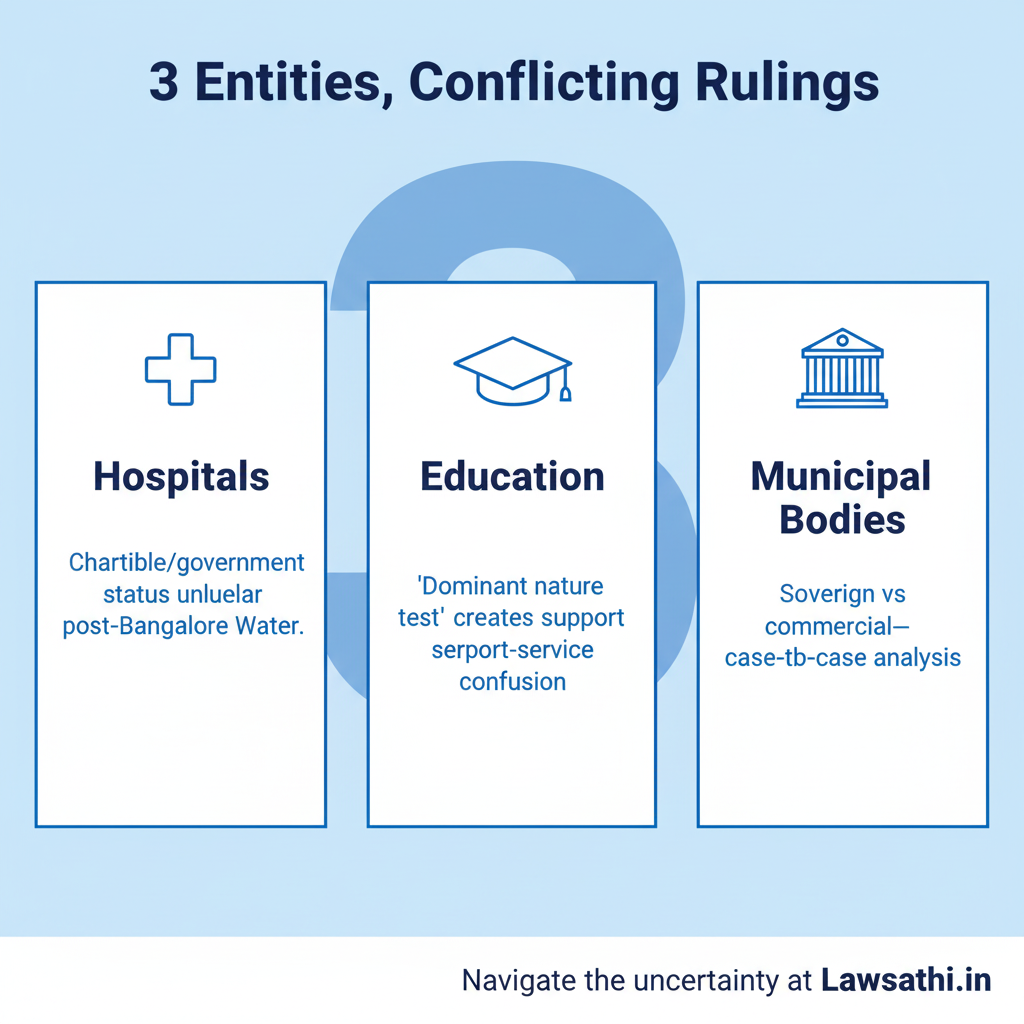
Bangalore Water overruled Safdarjung Hospital. It brought hospitals within the definition of “industry.” Yet confusion persists regarding charitable hospitals and government hospitals performing welfare functions. Consequently, lawyers advising healthcare institutions face uncertainty about ID Act applicability.
Educational Institutions and Universities
Similarly, educational institutions present conflicting precedents. In University of Delhi v. Ram Nath (1963), the Supreme Court held educational institutions were not “industry.” Bangalore Water reversed this position, including educational institutions within the definition.
Moreover, the “dominant nature test” adds further complexity. If an institution’s predominant activity is education, support services may or may not be covered. Universities engaging in research, consultancy, and commercial activities face additional uncertainty.
Municipal Bodies and Local Authorities
In addition, municipal corporations perform diverse functions ranging from sanitation to property management. In D.N. Banerji v. P.R. Mukherjee (1953), the Supreme Court held municipal corporations could be “industry” for certain activities.
However, identifying which municipal functions qualify remains disputed. For instance, core sovereign functions like law enforcement clearly fall outside. But commercial activities like running markets, rental properties, and transport services may qualify. Therefore, lawyers advising municipal bodies must analyse each function separately.
Case Background: What Triggered the Reference?
The Dispute in State of U.P. v. Jai Bir Singh
The reference originated from a dispute involving the Social Forestry Department of Uttar Pradesh. Employees claimed benefits under the Industrial Disputes Act. The central question was whether this welfare scheme constituted an “industry.”
However, conflicting precedents complicated the matter. In Chief Conservator of Forests v. Jagannath Maruti Kondhare (1996), a three-judge bench applied Bangalore Water expansively. It held the Social Forestry Department was an “industry.” Conversely, in State of Gujarat v. Pratamsinh Narsinh Parmar (2001), a two-judge bench took a narrower view. It held the Social Forestry Department was not an “industry.”
Why the Five-Judge Bench Referred the Matter
In State of U.P. v. Jai Bir Singh, Justice Dharmadhikari identified fundamental problems with Bangalore Water. First, no unanimity existed among the seven judges. Second, different opinions were delivered at different times, some after judicial retirements.
Third, judges themselves described the interpretation as “tentative” pending legislative intervention. Fourth, the legislative amendment of 1982 was enacted but never notified. Consequently, the helplessness of both legislature and executive in bringing the amendment into force compelled the Court to refer the matter.
The Procedural Journey to a Nine-Judge Bench
The five-judge bench referred the matter to a seven-judge bench in 2005. Since Bangalore Water was decided by a seven-judge bench, a larger bench was necessary. In 2017, the seven-judge bench further referred the matter to a nine-judge bench.
According to Bar & Bench reports, this progression reflects the Court’s recognition of the matter’s importance. A nine-judge bench decision will carry the highest authoritative weight. Thus, it can conclusively settle the legal position that has remained uncertain for nearly five decades.
Implications for Legal Practice and Client Advisory
Impact on Labour Court Jurisdiction
The nine-judge bench’s interpretation will directly affect Labour Court jurisdiction. Under the current expansive interpretation from Bangalore Water, Labour Courts enjoy wide jurisdiction. Many government departments, public sector undertakings, and statutory bodies are amenable to the ID Act.
However, a narrower interpretation could significantly contract this jurisdiction. Entities previously considered “industry” might fall outside the ID Act’s coverage. Consequently, workers in these establishments would lose access to Labour Courts and Industrial Tribunals.
For lawyers, this creates strategic considerations. Should clients pursue claims aggressively before the judgment? Or should they await clarity on jurisdictional questions? In short, each approach carries risks depending on the eventual outcome.
Advisory Considerations for Employers
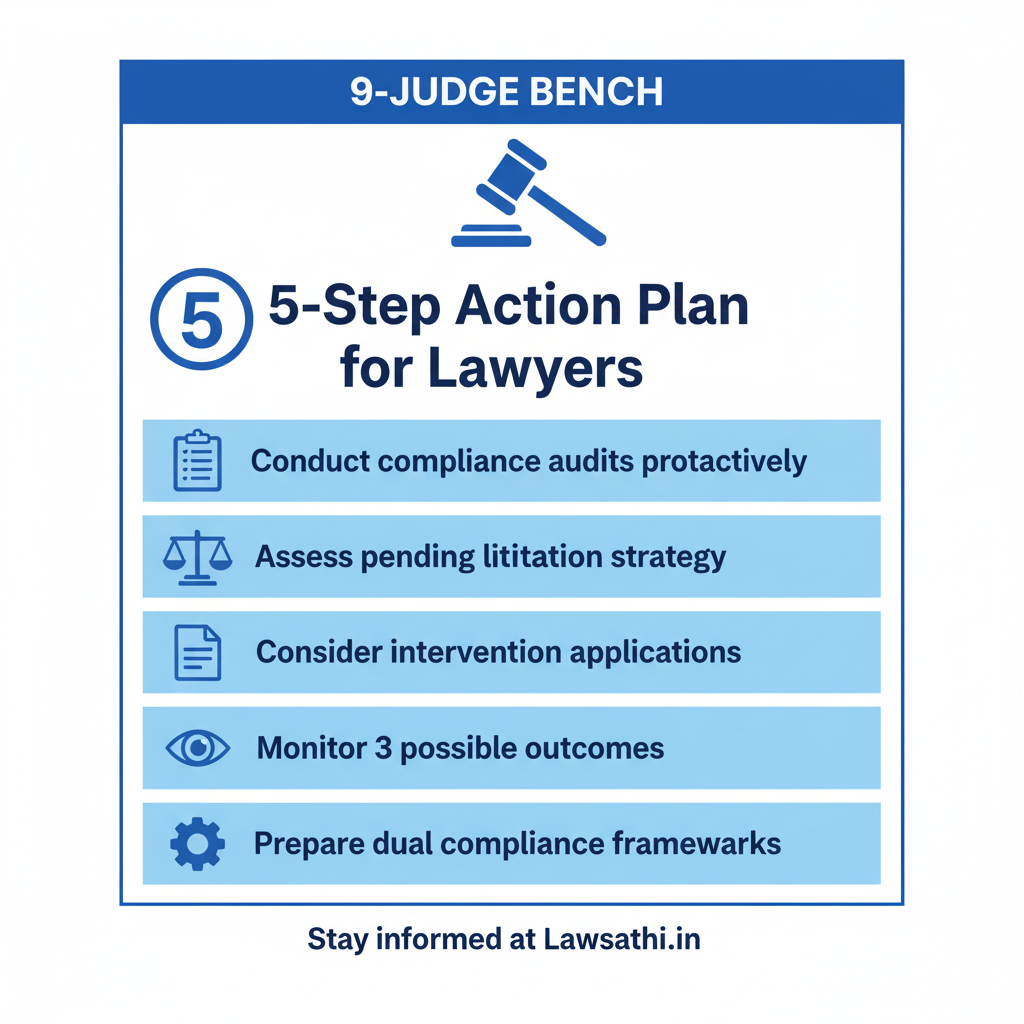
Corporate clients and government bodies need proactive advisory services. Therefore, lawyers should conduct compliance audits examining current workforce engagement practices. If a narrower interpretation emerges, restructuring workforce engagement may become necessary.
For instance, consider reviewing retrenchment, lay-off, and closure procedures currently in place. Alternative dispute resolution mechanisms like arbitration clauses could provide protection if ID Act coverage contracts. Additionally, internal grievance mechanisms become more important when external forums may become unavailable.
Handling Pending Litigation
Thousands of cases currently pending before Labour Courts involve the definition of “industry.” Therefore, the nine-judge bench judgment will affect these cases significantly. Lawyers must assess whether to stay current proceedings or pursue claims.
If the Court applies the judgment prospectively, past judgments and settlements remain undisturbed. However, if applied retrospectively, previous determinations could be reopened. In fact, the Court has used prospective application in landmark constitutional cases before.
For practical examples, consider a hospital facing multiple claims before a Labour Court. If the nine-judge bench excludes hospitals from “industry,” those claims may become non-maintainable. Alternatively, if Bangalore Water is reaffirmed, the hospital must continue defending such claims.
What Lawyers Should Watch For During the Hearing
Issues Framed for Determination
LiveLaw reports that the Court has framed specific issues for the nine-judge bench. First, the Court will examine the tests laid down by Justice Krishna Iyer in Bangalore Water Supply case (paras 140-144). Specifically, it asks whether they lay down correct law.
Second, it considers the Industrial Disputes (Amendment) Act, 1982. The Court asks if this unnotified Act and the Industrial Relations Code, 2020 have legal impact. Third, whether social welfare activities undertaken by Government Departments can be construed as industrial activities.
Fourth, what State activities will be covered and whether such activities fall outside Section 2(j). Fifth, any other question arising during hearing. In summary, these issues provide a roadmap for arguments lawyers can expect.
Key Arguments from Different Perspectives
Union of India’s Position
First, the Government will likely argue that legislative intent should guide interpretation. The 1982 Amendment reflected Parliament’s view that Bangalore Water went too far. Welfare activities of the State should arguably fall outside “industry.”
Additionally, the Solicitor General may clarify the Government’s position on notification of the Amendment. Why was the amendment never notified despite enactment over 40 years ago? The answer could influence the Court’s approach to legislative intent.
Employers’ Arguments
In contrast, employers may support a narrower interpretation. The expansive Bangalore Water interpretation caused uncertainty and compliance burdens. Non-commercial entities like hospitals and educational institutions face litigation risks inappropriate to their welfare orientation.
Additionally, the broad interpretation may inhibit employment generation. Private enterprises might hesitate to engage workers if compliance requirements become excessive. As a result, self-employment and informal sector engagement could increase as alternatives.
Employees’ and Trade Unions’ Arguments
On the other hand, workers’ representatives will likely argue for reaffirming Bangalore Water. Stare decisis principles suggest settled law for 40+ years should not be disturbed. After all, millions of workers have relied on this interpretation for accessing labour courts.
Legislative inaction cannot defeat workers’ rights, they may contend. If Parliament wanted to narrow the definition, it should have notified the amendment. Courts cannot assume legislative intent when the legislature itself has not acted.
Timeline and Bench Composition
The hearing is scheduled for March 17-18, 2026. However, constitution bench judgments typically take time for pronouncement. Therefore, lawyers should monitor court proceedings through legal databases and court transcripts.
The nine-judge bench composition will be notified by administrative order. Furthermore, CJI Surya Kant has confirmed the bench will be constituted. The composition may influence the eventual ratio. This is because different judges may bring varying perspectives on labour welfare and jurisprudence.
Conclusion: Preparing for a Potential Paradigm Shift
Possible Outcomes and Their Impact
The Supreme Court nine-judge bench industry definition reference could produce three broad outcomes. First, the Court may reaffirm Bangalore Water’s expansive interpretation. This maintains status quo and preserves Labour Court jurisdiction over government departments and welfare entities.
Second, the Court may partially modify Bangalore Water. For example, it could refine the “triple test” and clarify sovereign functions exception. This middle path would provide clearer guidance while balancing worker protection with practical realities.
Third, the Court could overrule Bangalore Water and adopt a narrow interpretation. This would limit “industry” to commercial and trade activities. Welfare activities of the State, professions, and charitable activities would fall outside. Consequently, this represents a paradigm shift in labour law.
Long-Term Implications for Indian Labour Law
The judgment’s impact extends beyond immediate disputes. Specifically, it will affect millions of workers in government departments, public sector undertakings, hospitals, and educational institutions. Access to Labour Courts and collective bargaining rights hang in the balance.
For employer-employee relations, therefore, clarity may finally emerge after decades of uncertainty. Investment decisions and employment practices could shift based on compliance requirements. Furthermore, the ease of doing business in India could be influenced.
Final Thoughts for Legal Practitioners
Therefore, law firms must prepare for multiple scenarios. Track the hearings closely through legal media and court records. Next, assess client portfolios to identify affected industries and entities. Prepare advisory notes explaining potential outcomes and their implications.
Additionally, consider intervention applications if client interests are significantly affected. Update compliance frameworks to address both expansive and narrow interpretations. This case represents perhaps the most significant labour law development in decades.
Stay ahead of critical legal developments. Use LawSathi’s AI-powered case tracking and legal research tools to monitor this landmark judgment and manage your labour law practice efficiently. Start your free trial today.