The Supreme Court creamy layer PSU employees judgment delivered on March 11, 2026, marks a watershed moment. It represents a turning point in India’s reservation jurisprudence.
In Union of India v. Rohith Nathan & Others, a two-judge bench settled a long-standing ambiguity. Justice P.S. Narasimha and Justice R. Mahadevan presided over the case. They addressed how creamy layer status should be determined for candidates whose parents work in Public Sector Undertakings 2026 INSC 230.
The ruling addresses a critical question that has plagued PSU recruitment for years. Can parental salary alone determine whether an OBC candidate falls within the “creamy layer”? Can such candidates thus lose reservation benefits? The Court’s answer is unequivocal: no, it cannot.
Introduction: Settling the Ambiguity on Creamy Layer in PSUs
The Central Legal Question
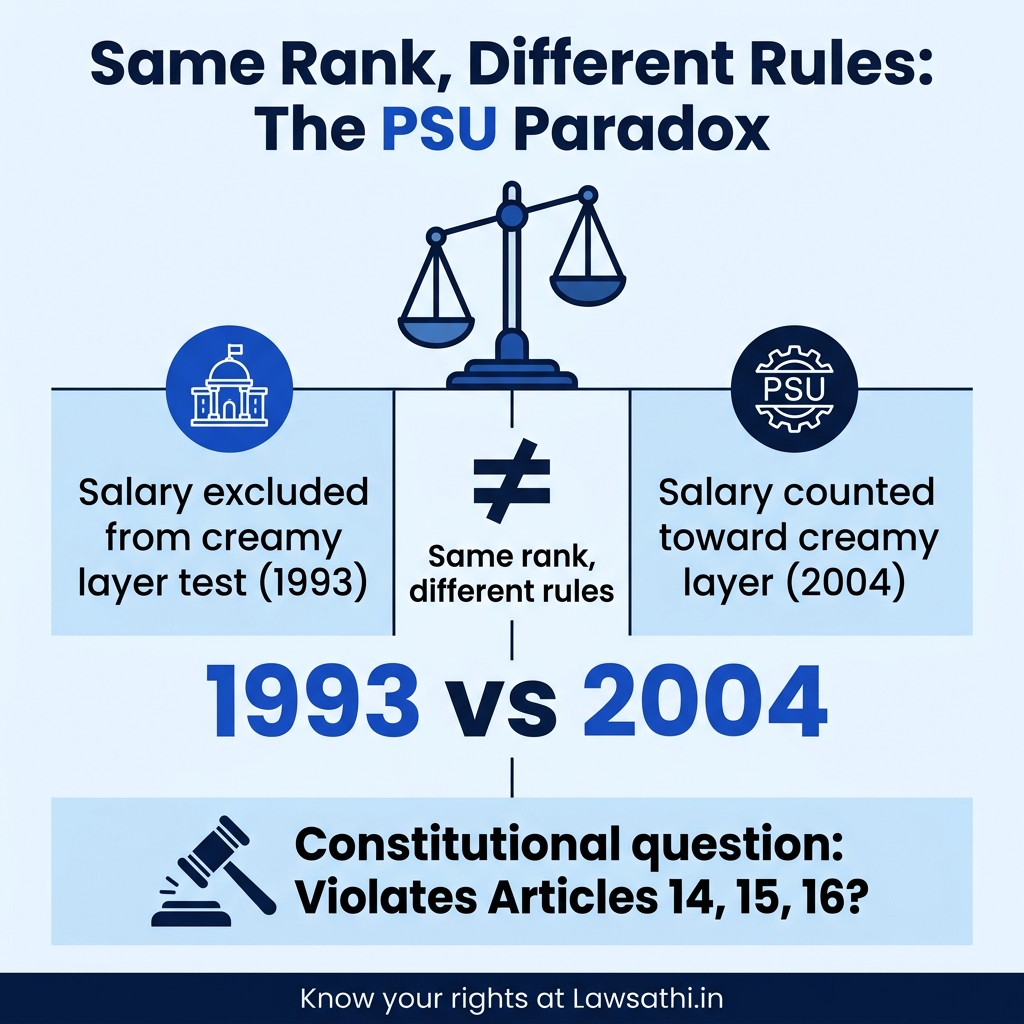
At the heart of this dispute lay a fundamental inconsistency. The creamy layer exclusion was being applied unevenly across different sectors. For government employees, the 1993 Office Memorandum expressly excluded salary income from the Income/Wealth Test. However, a clarificatory letter dated October 14, 2004, created confusion. Specifically, it affected PSU and private sector employees.
The central question before the Court was clear. Could this distinction stand constitutional scrutiny? Could children of PSU employees be denied OBC reservation benefits solely based on parental salary? Meanwhile, could children of government servants holding equivalent posts remain eligible?
Significance for Reservation Policies
This ruling carries profound implications for reservation in promotions India. It also affects fresh appointments across government-owned corporations. Major PSUs like ONGC, BHEL, SAIL, NTPC, and IOCL must now revisit their recruitment policies.
Furthermore, the judgment impacts candidates previously denied benefits under the erroneous interpretation. The Court has directed the creation of supernumerary posts where necessary. Implementation has been mandated within six months.
Background: The Concept of ‘Creamy Layer’ in Indian Jurisprudence
Origin in Indra Sawhney Case
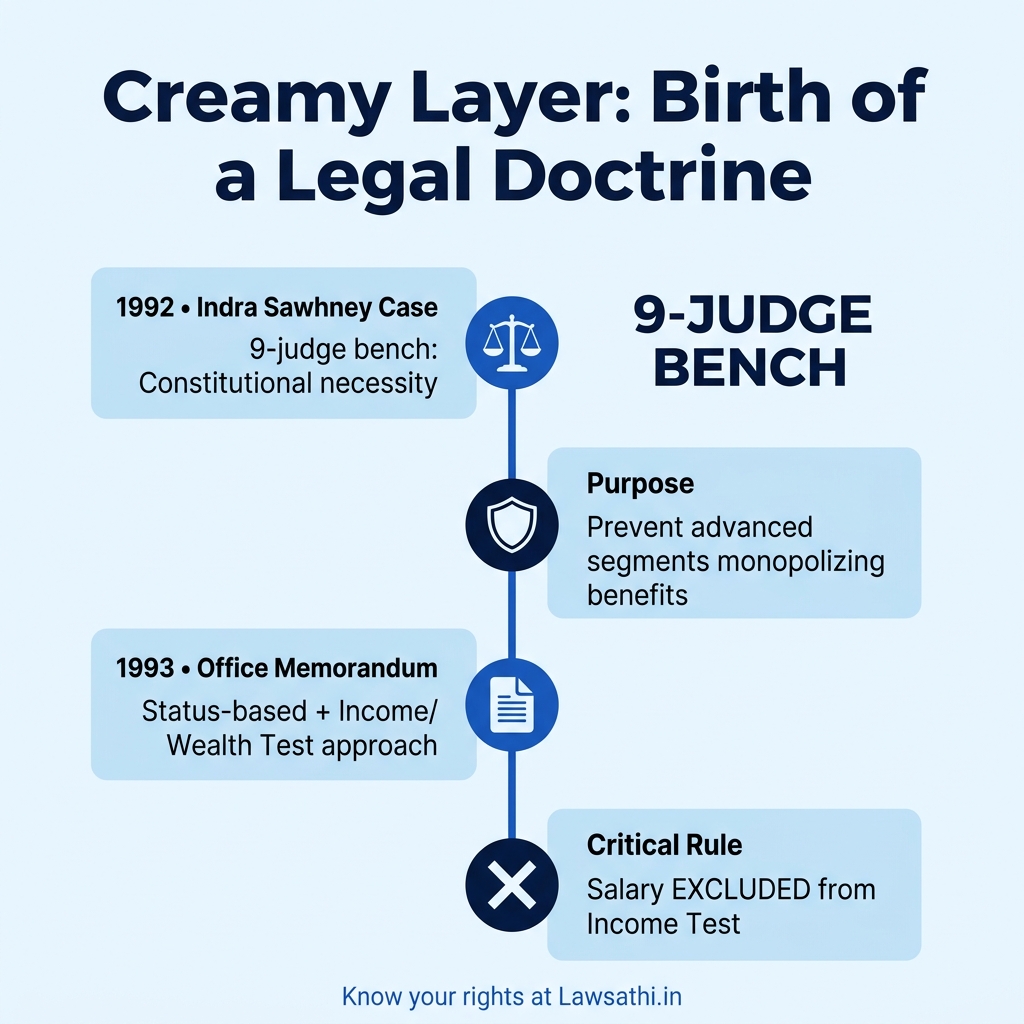
The creamy layer concept traces its origins to a landmark judgment. In Indra Sawhney v. Union of India, a nine-judge Constitution Bench delivered the ruling on November 16, 1992 1992 Supp (3) SCC 217. The Supreme Court held that excluding socially advanced sections among backward classes was a constitutional necessity.
This exclusion ensures that reservation benefits actually reach the truly disadvantaged. The Court recognized an important fact. Within any backward class, certain segments may have advanced socially and educationally.
The Rationale Behind Exclusion
The principle serves a vital constitutional purpose. It prevents relatively advanced segments from monopolizing affirmative action benefits. These benefits are meant for the genuinely backward.
As the Court observed in the present judgment, “the principle seeks to prevent relatively advanced segments within the backward classes from siphoning off the advantages of affirmative action.” This rationale formed the foundation for the government’s subsequent implementation framework.
The 1993 Office Memorandum Framework
Following the Indra Sawhney directions, the Government of India issued an Office Memorandum. This occurred on September 8, 1993. The document established detailed criteria for identifying the creamy layer among OBCs.
The framework adopted a two-pronged approach. First, a status-based exclusion applied to specific categories of posts and positions. Second, an Income/Wealth Test served as a residual criterion. This test covered cases not addressed by status-based categories.
Critical Provision: Salary Exclusion
Importantly, the 1993 OM expressly excluded salary income from the Income/Wealth Test computation. Agricultural income was also excluded. This exclusion recognized that salary levels alone do not determine social advancement.
The status-based approach reflected an important understanding. Position in the service hierarchy indicates social progression. This understanding remained consistent with Indra Sawhney‘s broader philosophy.
The Supreme Court Verdict: Key Observations and Rationale
The Factual Matrix
The cases before the Court presented strikingly similar circumstances. For instance, Rohith Nathan secured All India Rank 174 in the Civil Services Examination 2012. He applied under the OBC category. His father worked at HCL Technologies Ltd., a private organization SCC Online Blog. His salary exceeded the creamy layer threshold.
Similarly, G. Babu secured Rank 629 in the Civil Services Examination 2013. His father served as a Senior Executive Engineer at Neyveli Lignite Corporation, a PSU. Both candidates were denied OBC reservation benefits. The denial was based solely on their fathers’ salary exceeding the prescribed limit.
The Problematic 2004 Clarificatory Letter
The Department of Personnel and Training (DoPT) had issued a clarificatory letter on October 14, 2004. Paragraph 9 of this letter stated something significant. Where equivalence between PSU posts and government posts had not been determined, salary income could be considered under the Income/Wealth Test.
This clarification effectively created a new substantive condition. Consequently, it treated PSU and private sector employees differently from government servants. The difference related to creamy layer determination.
Court’s Reasoning on Parity of Status
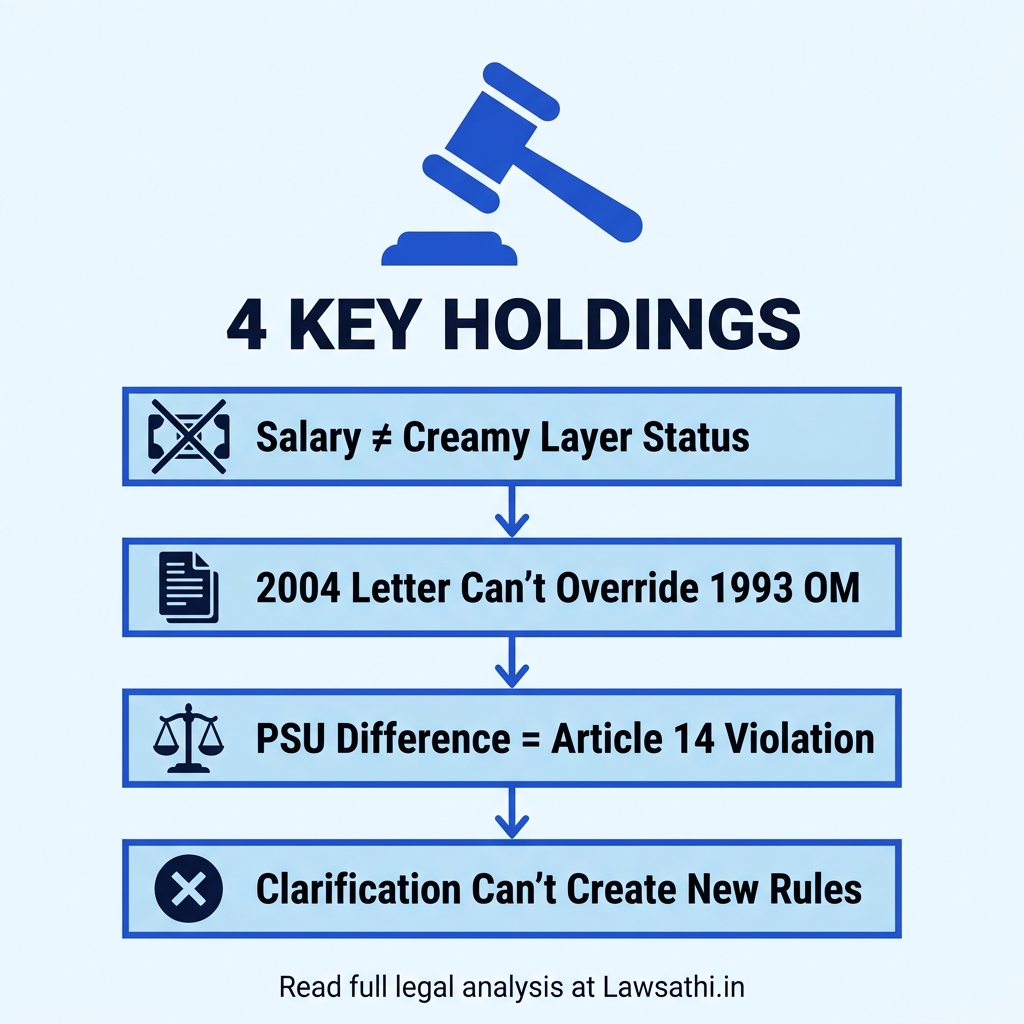
The Supreme Court rejected this differential treatment outright. It held that the scheme of exclusion under the 1993 OM was “primarily status-based rather than purely income-based.” This reflected the policy understanding that advancement within the service hierarchy denotes social progression LiveLaw.
Furthermore, the Court emphasized a critical point. Treating children of PSU employees as creamy layer solely on salary income amounts to hostile discrimination. This violates Articles 14, 15, and 16 of the Constitution.
Key Holding on Executive Instructions
The Court made a crucial observation about the nature of executive instructions. “A clarificatory instruction cannot introduce a substantive condition that does not exist in the parent policy,” the judgment stated Bar & Bench.
If such an instruction alters rights or liabilities, it ceases to be clarificatory. Instead, it assumes the character of an amendment. This requires proper procedural compliance.
Reference to Parliamentary Committee
The Court also noted the 21st Report of the Parliamentary Committee on Welfare of OBCs. This report covered the period 2018-19. The committee had observed that the 2004 Letter had “done more to confuse the position than to clarify it” SCC Online.
Additionally, the committee had recorded an important finding. Determining exclusion solely on salary income would be inconsistent with the 1993 OM framework. The Supreme Court endorsed this parliamentary view.
Implications for PSU Management and HR Policies
Immediate Impact on Recruitment
The Supreme Court creamy layer PSU employees ruling demands immediate attention. PSU management across India must take notice. All ongoing recruitment drives must now align with the status-based creamy layer determination framework Department of Public Enterprises.
HR departments can no longer rely solely on parental income. They cannot use this to determine creamy layer status among OBC applicants. The Income/Wealth Test cannot include salary income as a criterion.
Revision of Internal Criteria
PSU boards must urgently revisit their existing criteria. Specifically, they must review criteria for identifying creamy layer candidates. This revision requires a comprehensive understanding of the 1993 OM framework.
Additionally, PSUs must establish mechanisms to determine equivalence. This equivalence should be between their posts and corresponding government posts. Without such equivalence determination, Category II-C of the 1993 OM remains inoperative for exclusion purposes.
Affected PSUs and Organizations
This ruling impacts a wide range of public sector entities. Maharatna companies face the most significant compliance requirements. Examples include ONGC, BHEL, SAIL, NTPC, and IOCL.
Moreover, Navratna and Miniratna companies must similarly revise their policies. Public sector banks, insurance organizations, and universities also fall within the judgment’s scope.
Administrative Actions Required
The Department of Public Enterprises must coordinate with DoPT. Together, they must withdraw or modify Paragraph 9 of the 2004 clarificatory letter. A comprehensive exercise to formulate equivalence tests for PSU posts is essential PIB Government of India.
Furthermore, all pending claims must be reconsidered. This applies to OBC candidates previously denied benefits. The correct 1993 OM framework must govern such reconsideration.
Potential for Increased Litigation
Legal practitioners should anticipate a surge in litigation following this ruling. Employees previously denied promotions or appointments will seek remedies. The denial was based on erroneous creamy layer determination.
PSUs must prepare for writ petitions. They must also prepare for Central Administrative Tribunal applications. Robust documentation of revised policies will help defend against potential challenges.
Critical Analysis: Balancing Social Justice and Administrative Efficiency
Alignment with Substantive Equality
The Supreme Court judgment creamy layer analysis reveals a deep commitment. Specifically, it shows commitment to substantive equality. Article 16(4) represents a structural reflection of the equality principle embodied in Article 16(1) SCC Online.
Any interpretation resulting in unequal treatment would be constitutionally impermissible. This applies to similarly placed OBC candidates. The Court firmly rejected such discriminatory application.
Supporting Precedent from Haryana Case
This ruling follows the Supreme Court’s earlier judgment on August 25, 2021. In that case, the Court quashed Haryana’s 2016 Notification. The notification had attempted to introduce economic criterion as the sole basis for creamy layer identification.
The Court had held that “the basis of exclusion of ‘creamy layer’ cannot be merely economic.” This precedent reinforced the status-based approach. The present judgment applies this same approach.
Potential Criticisms and Concerns
However, critics may argue that the ruling ignores certain economic realities. Government and PSU pay scales may differ significantly. This applies to posts that are nominally equivalent.
The implementation challenge cannot be understated. Determining equivalence across diverse PSU structures presents difficulties. Different PSUs have vastly different organizational hierarchies and pay structures.
The Administrative Burden
PSUs face a substantial administrative task. They must establish comprehensive equivalence mechanisms. This exercise requires careful comparison with government service classifications.
Nevertheless, the Court has made its position clear. Administrative convenience cannot override constitutional requirements. The burden of compliance must fall on the state apparatus.
Broader Signal to Judiciary and Legislature
This ruling sends an important signal. It concerns the tightening of reservation criteria interpretation. The judiciary emphasizes strict constitutional compliance over executive convenience.
Consequently, the legislature may need to intervene. Standardizing criteria across all PSUs requires appropriate legislation. This would provide greater certainty and uniformity.
Practical Guidance for Legal Practitioners
Advising Employee Clients
For lawyers representing PSU employees, this ruling provides significant leverage. These employees are claiming reservation benefits. The key argument is straightforward. Creamy layer status cannot be determined solely on parental salary Supreme Court Judgment PDF.
Practitioners should first examine whether proper equivalence determination exists. This applies to the parent’s PSU post. In the absence of such determination, Category II-C cannot apply for exclusion.
Checklist for Proving Non-Creamy Layer Status
Lawyers representing affected employees should follow this systematic approach:
First, obtain and verify the valid OBC certificate. Ensure it was issued by competent authority. Verify that all procedural requirements have been met in its issuance.
Second, document the precise category and nature of the parent’s post. This applies to the PSU or private organization. Gather service records and pay scale details.
Third, argue that salary income cannot be considered under Category VI of the 1993 OM. The express exclusion of salary from income computation remains binding.
Fourth, demonstrate that similarly placed government employees’ children are not excluded on salary grounds. This establishes hostile discrimination under Articles 14 and 16.
Checklist for PSU Management Counsel
Lawyers advising PSU management must help their clients achieve compliance. The following steps are essential:
First, thoroughly review existing reservation policies. Compare them against the 1993 OM framework. Identify any provisions that rely on income-based determination.
Second, establish a formal mechanism to determine equivalence. This should cover PSU posts with government posts. The exercise should involve HR, legal, and administrative experts.
Third, ensure all HR personnel understand a critical point. Salary income must be excluded from creamy layer computation. Training programs may be necessary.
Fourth, document the rational classification to survive Article 14 scrutiny. Any policy must withstand constitutional challenge.
Procedural Remedies Available
Affected employees have multiple procedural avenues for seeking remedies. The forum hierarchy depends on the nature of employment. It also depends on the relief sought.
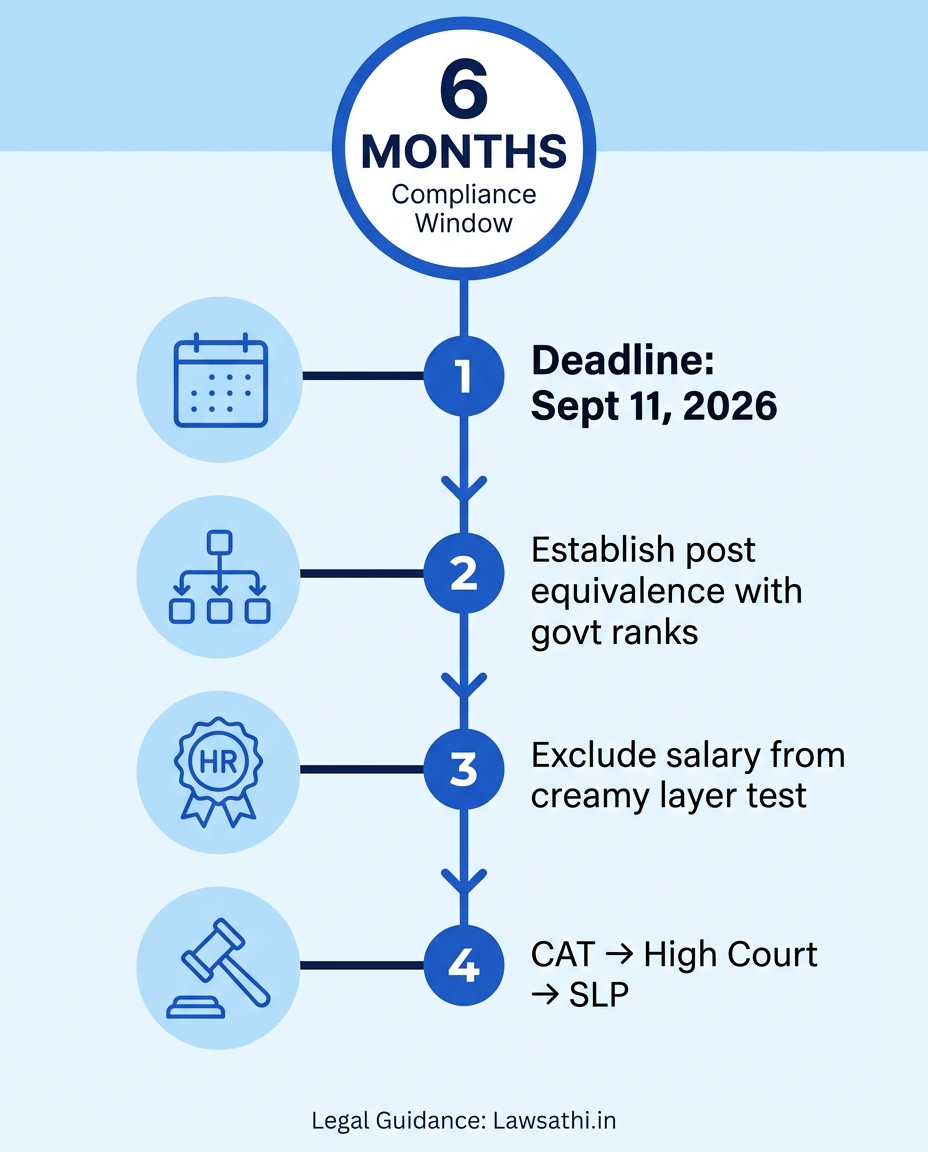
Central Government PSU employees should approach the Central Administrative Tribunal. This serves as the first forum. State PSU employees may need to approach the appropriate State Administrative Tribunal.
Alternatively, High Courts exercise writ jurisdiction under Article 226. This applies to constitutional violations. The Supreme Court remains available through Special Leave Petition under Article 136.
Relevant Case Law for Arguments
Practitioners should cite R.P. Bhardwaj v. Union of India, (2005) 10 SCC 244. This case held that an executive letter cannot amend or override an existing Office Memorandum. This precedent directly supports the current Supreme Court’s reasoning.
Additionally, the Indra Sawhney implementation case from 1999 provides valuable guidance (2000) 1 SCC 168. It addresses the proper interpretation of creamy layer criteria.
Conclusion: The Way Forward for Reservation Law in India
Summary of Legal Position
The Supreme Court creamy layer PSU employees judgment establishes several clear principles. First, the 1993 Office Memorandum prevails over the 2004 clarificatory letter. This applies to determining creamy layer status.
Second, status-based determination remains the primary approach. Income serves only as a secondary criterion. Salary income must be excluded from creamy layer computation for all categories of employees.
Furthermore, PSU and private sector employees cannot be treated differently. This applies to comparison with government servants holding equivalent posts. Such differential treatment violates the constitutional guarantee of equality.
Need for Executive Action
The executive must now undertake several urgent actions. First, DoPT should formally withdraw or modify Paragraph 9 of the 2004 clarificatory letter.
Second, a comprehensive exercise must commence. This exercise should determine equivalence of PSU posts with government posts. It will bring clarity and uniformity to creamy layer determination.
Third, clear guidelines for HR departments across all PSUs should be issued. These guidelines must reflect the judgment’s constitutional reasoning.
Timeline for Implementation
The Court has mandated implementation within six months from March 11, 2026. Supernumerary posts must be created where necessary. This accommodates wrongly denied candidates.
PSUs must act promptly to avoid contempt proceedings. Legal practitioners should monitor compliance closely. This should be done on behalf of affected clients.
Evolving Affirmative Action Jurisprudence
This ruling reinforces an important principle. Reservation is about substantive equality, not mere formal equality. Economic criterion alone cannot determine social advancement.
The judgment represents another milestone in India’s evolving affirmative action jurisprudence. It balances two important factors. First, the constitutional mandate for social justice. Second, the need for rational classification.
Stay ahead of critical legal developments. Use LawSathi’s AI-powered case law research and document drafting tools. Analyze Supreme Court judgments and advise your clients with confidence. Try LawSathi for free today.