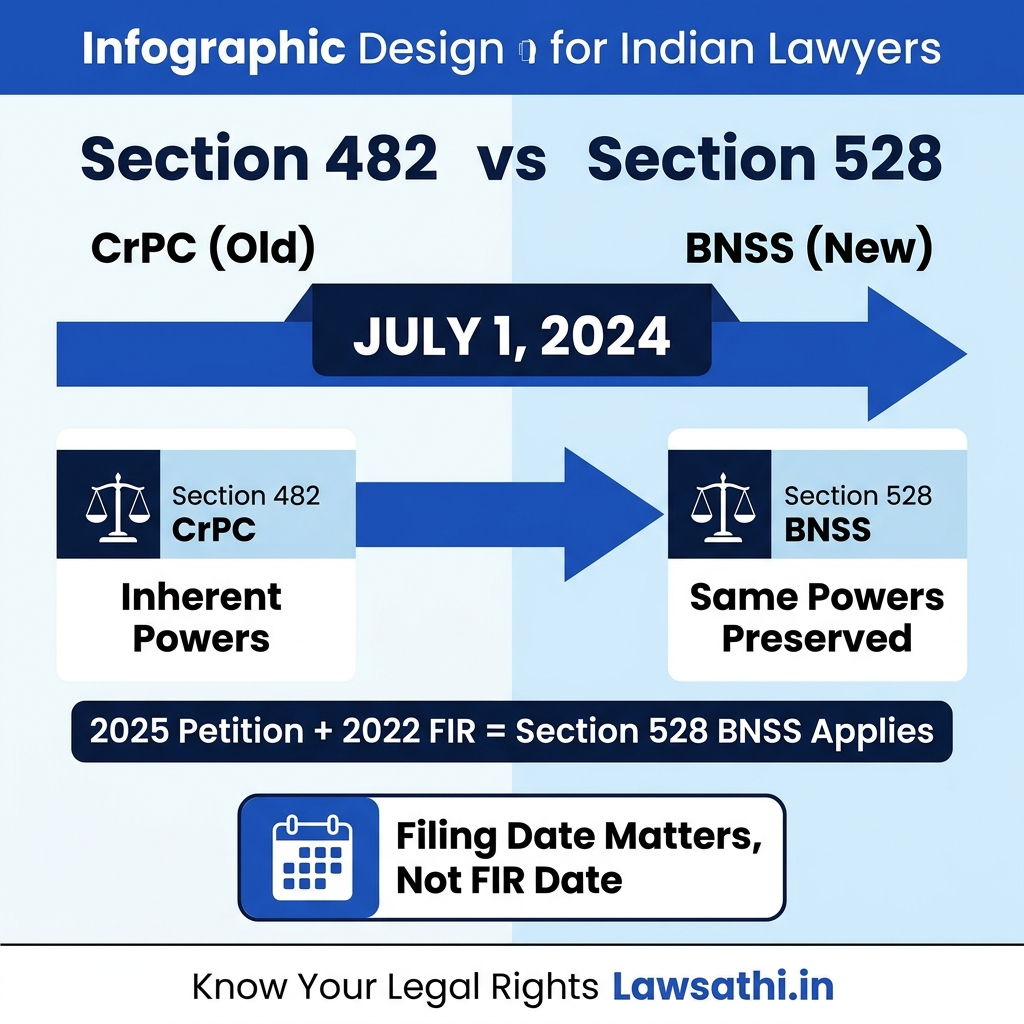
The criminal justice landscape in India witnessed a historic transformation on July 1, 2024. On this date, the Bharatiya Nagarik Suraksha Sanhita (BNSS) replaced the Code of Criminal Procedure, 1973. For criminal defense lawyers, understanding Section 528 BNSS quashing of FIR proceedings has become essential for effective practice. This provision preserves the inherent powers of the High Court. Furthermore, it continues the legacy of Section 482 CrPC while adapting to the new legislative framework.
Introduction: The Transition from Section 482 CrPC to Section 528 BNSS
The BNSS 2023 represents India's comprehensive overhaul of criminal procedure laws. Furthermore, it modernizes procedural mechanisms while maintaining core judicial principles. Section 528 BNSS serves as the successor to the well-established Section 482 CrPC.
Identical Language, New Framework
The text of Section 528 BNSS mirrors its predecessor almost exactly. According to Indian Kanoon's official text of Section 528, the provision states:
> "Nothing in this Sanhita shall be deemed to limit or affect the inherent powers of the High Court to make such orders as may be necessary to give effect to any order under this Sanhita, or to prevent abuse of the process of any Court or otherwise to secure the ends of justice."
Therefore, the fundamental nature of inherent powers remains unchanged. However, the procedural context has shifted significantly.
Determining Which Law Applies
A critical question emerged after BNSS implementation. Specifically, which law governs quashing petitions? The Sikkim High Court in Deepam Pradhan v. Krishna Kumari Bhandari (2025) provided crucial clarity.
Any petition filed on or after July 1, 2024, falls under BNSS jurisdiction. Consequently, a quashing petition filed in 2025 for an FIR lodged in 2022 would be governed by Section 528 BNSS. It would not fall under Section 482 CrPC. This distinction matters significantly for procedural compliance and citation practices.
Scope of Inherent Powers under Section 528 BNSS
Section 528 operates as a "saving clause" rather than a conferring provision. In other words, it preserves inherent jurisdiction that the High Court already possesses as the highest court of the state.
Three-Fold Objectives of Inherent Powers
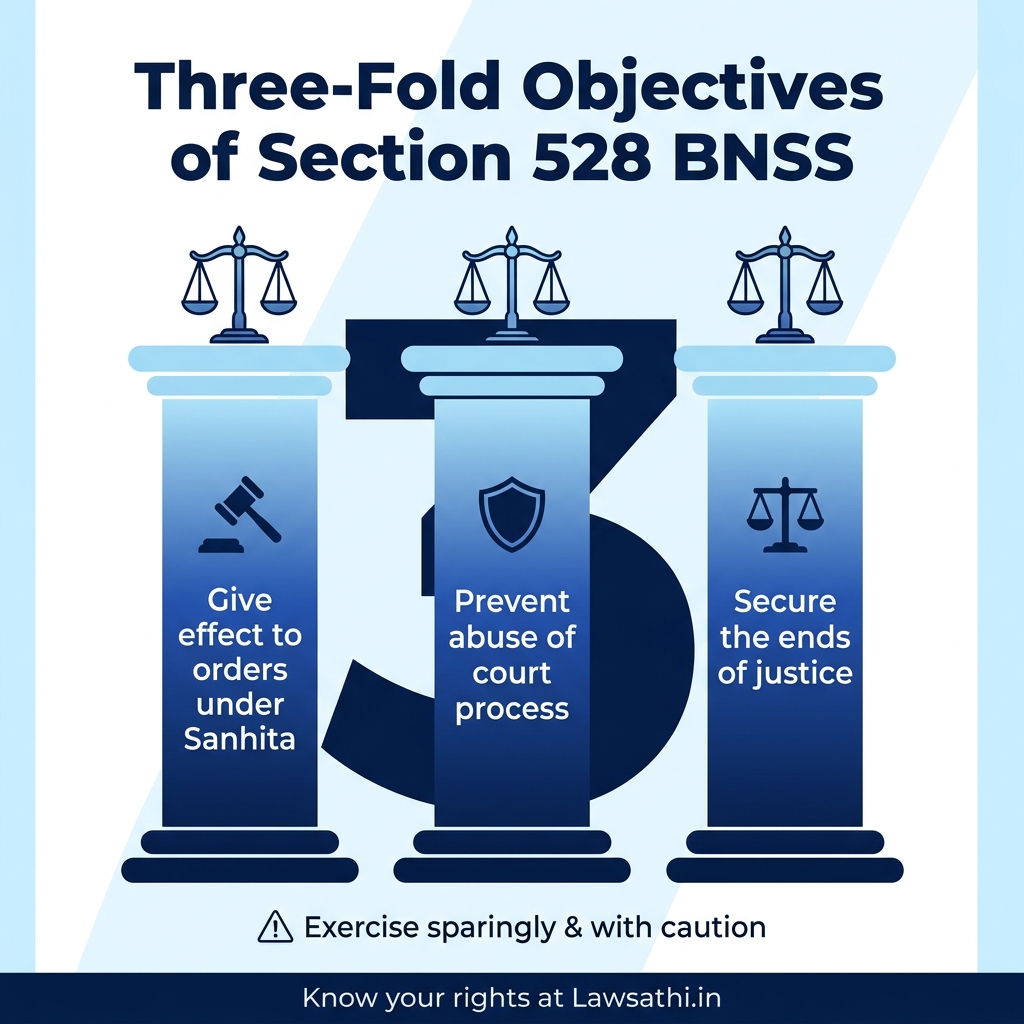
The provision serves three distinct purposes, as analyzed in SCC Online's comprehensive study on inherent powers:
1. To give effect to any order under the Sanhita 2. To prevent abuse of the process of any Court 3. To secure the ends of justice
These objectives guide courts in exercising their inherent jurisdiction. Additionally, they provide the foundational framework for quashing petitions.
Nature and Limitations of Inherent Jurisdiction
Inherent powers differ fundamentally from statutory powers. Unlike appellate or revisional jurisdiction, inherent jurisdiction flows from the constitutional position of High Courts. However, this power is not unlimited.
The Supreme Court has consistently emphasized restraint. For instance, in Madhu Limaye v. State of Maharashtra, the Court held that inherent powers cannot be used to circumvent express statutory bars. Similarly, in Divine Retreat Centre v. State of Kerala, the Court cautioned against arbitrary exercise of this jurisdiction.
When Courts Should Refrain from Interference
Several limitations govern the exercise of Section 528 powers. First, courts generally avoid interference when investigation is ongoing. Second, inherent powers cannot substitute for trial court functions. Third, the existence of alternative remedies may preclude invocation.
Most importantly, courts must exercise these powers "sparingly, carefully, and with caution." The objective is preventing abuse, not creating new avenues for litigation.
Grounds for Quashing an FIR: Legal Parameters
Understanding when courts will exercise inherent powers requires familiarity with established legal parameters. The Section 528 BNSS quashing of FIR framework relies heavily on precedent.
The Bhajan Lal Categories
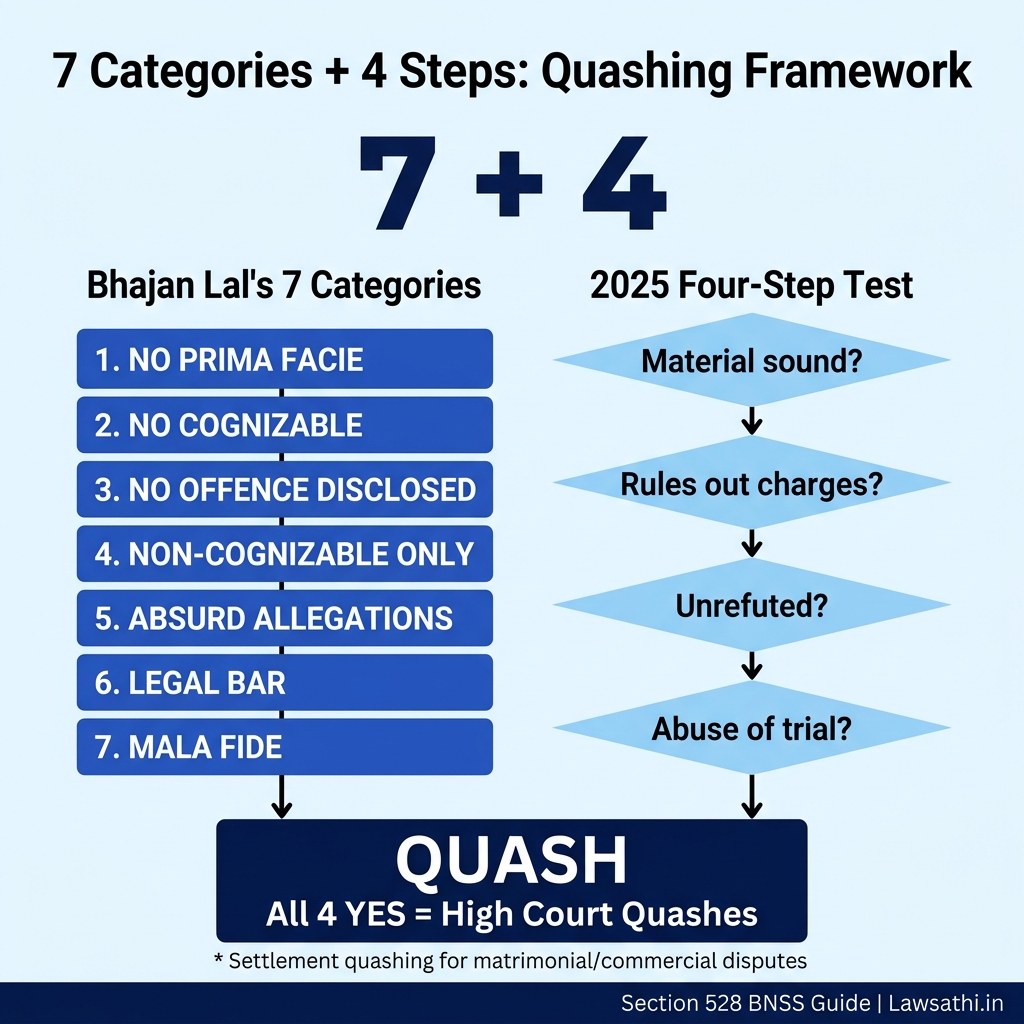
The landmark judgment in State of Haryana v. Bhajan Lal remains the cornerstone of quashing jurisprudence. The Supreme Court identified seven categories where inherent powers can be invoked:
| Category | Description | |----------|-------------| | (a) | Allegations do not prima facie constitute any offence | | (b) | Allegations do not disclose a cognizable offence | | (c) | Uncontroverted allegations and evidence disclose no offence | | (d) | Only a non-cognizable offence is disclosed | | (e) | Allegations are absurd and inherently improbable | | (f) | Express legal bar exists | | (g) | Proceeding is mala fide or has ulterior motive |
These categories continue to guide High Courts under the BNSS framework. Therefore, lawyers must structure their petitions around relevant categories.
The Supreme Court's New Four-Step Test (2025)
In September 2025, the Supreme Court added analytical rigor to the quashing analysis. As reported by LiveLaw on the four-step test, Justices Pardiwala and Mehta established a sequential inquiry:
Step 1: Is the material sound, reasonable, and indubitable?
Step 2: Does the material rule out the assertions in charges?
Step 3: Has the material not been refuted by prosecution?
Step 4: Would proceeding with trial result in abuse of process?
If all four answers are affirmative, the High Court should quash proceedings. Consequently, defense lawyers must present "sterling quality" evidence meeting these thresholds.
Quashing in Settlement Cases
For non-compoundable offences, quashing remains possible in specific circumstances. The Gian Singh v. State of Punjab principles apply to cases with "civil flavour."
In particular, matrimonial disputes, commercial conflicts, and financial matters often qualify for settlement-based quashing. The Sikkim High Court's 2025 decision demonstrated this approach. The Court quashed an FIR despite non-compoundable charges, based on a comprehensive settlement agreement.
Procedural Strategy for Filing the Petition
Successful Section 528 BNSS quashing of FIR petitions require meticulous preparation. Therefore, lawyers must follow a systematic approach.
Pre-Filing Requirements
Before drafting, gather all essential documents. First, obtain a certified copy of the FIR. Second, analyze the charge sheet if one has been filed. Third, collect all supporting evidence that demonstrates the case fits within Bhajan Lal categories.
Additionally, identify which jurisdictional High Court rules apply. Different High Courts may have varying procedural requirements under the BNSS framework.
Essential Documents for Filing
The following documents are typically mandatory:
- Petition with proper cause title - Court fee stamp (Rs. 2.65 for CRM-M petitions) - Certified copy of FIR - Charge sheet copy (if filed) - Supporting documentary evidence - Affidavit in support - Vakalatnama - Index of documents
According to the Punjab & Haryana High Court fee structure, petitioners in custody pay no court fee. This exemption ensures access to justice for incarcerated individuals.
Drafting the Petition
Effective drafting requires strategic structuring. Begin with a clear statement of facts. Then, identify the specific Bhajan Lal category or categories that apply. Furthermore, address the four-step test from the 2025 Supreme Court judgment.
Many lawyers invoke Article 226 alongside Section 528 BNSS. However, note that Article 226 cannot be used to quash a chargesheet after cognizance has been taken. In such cases, Section 528 provides the exclusive remedy.
Formatting Requirements
High Courts maintain strict formatting rules. The Punjab & Haryana High Court rules specify:
- English language requirement - Typed on legal size paper (80 GSM or above) - Font: Thorndale or Times New Roman, size 14 - Double-spaced text - Specific margin requirements
Non-compliance can result in rejection or administrative objections. Therefore, careful attention to formatting prevents unnecessary delays.
Critical Judicial Precedents Interpreting Inherent Powers (2024-2026)
The evolving jurisprudence under Section 528 BNSS provides valuable guidance for practitioners.
Key High Court Decisions
Several important judgments have clarified the BNSS framework:
Deepam Pradhan v. Krishna Kumari Bhandari (Sikkim HC, 2025): Confirmed that quashing petitions filed after July 1, 2024, must invoke Section 528 BNSS. This applies regardless of when the FIR was registered.
Prince v. State of NCT Delhi (Delhi HC, 2024): Established that bail applications filed post-implementation must follow BNSS procedures.
Supreme Court Guidance on Abuse of Process
The Supreme Court's September 2025 ruling in Nitin Ahluwalia addressed counterblast FIRs. The Court emphasized that High Courts must appreciate the background context when evaluating quashing petitions.
Additionally, the Court noted that criminal law cannot serve as a shortcut for civil remedies. This principle is particularly relevant in commercial disputes where parties misuse criminal processes.
Emerging Trends in Quashing Jurisprudence
Several patterns have emerged since BNSS implementation:
1. Courts increasingly scrutinize delayed complaints 2. Greater focus on whether FIRs are counterblasts to civil disputes 3. Enhanced willingness to quash in genuine settlement scenarios 4. Stricter application of the four-step test
Practical Tips for Criminal Defense Lawyers
Effective advocacy under Section 528 BNSS requires both legal knowledge and practical strategy.
Managing Client Expectations

Clients often expect immediate relief when filing quashing petitions. However, lawyers must communicate reality clearly.
Inherent powers are exercised sparingingly. Success depends on fitting cases within established parameters. Furthermore, quashing at the FIR stage proves more difficult than after charge sheet filing. Settlement-based petitions have higher success rates.
Strategic Use of Stay Applications
File stay applications alongside quashing petitions to preserve the status quo. Stays prevent coercive action during the petition's pendency. However, courts grant interim protection only in appropriate cases.
Therefore, demonstrate compelling circumstances warranting immediate relief. This might include imminent arrest, harassment, or irreparable harm.
Timeline Considerations
No fixed timeline exists for quashing petition disposal. Urgent matters may be listed within 1-2 days. However, regular hearings depend on court backlog.
Complex cases can take months or even years. Consequently, manage client expectations regarding realistic timelines.
Leveraging Legal Technology
Modern practice demands efficiency. Legal tech platforms assist with case law research, document drafting, and deadline management. Moreover, AI-powered tools can identify relevant precedents and suggest argument structures.
For Section 528 BNSS quashing of FIR petitions specifically, technology helps track the growing body of BNSS jurisprudence. This proves especially valuable given the rapid evolution of case law.
Conclusion: Securing Justice through Inherent Jurisdiction
The transition to Section 528 BNSS represents continuity rather than change in substance. The inherent powers of High Courts remain fundamentally preserved. However, practitioners must adapt to the new procedural framework.
Successful quashing petitions require thorough preparation, precise legal analysis, and strategic advocacy. The Bhajan Lal parameters continue to provide the foundational framework. Additionally, the Supreme Court's 2025 four-step test offers clearer guidance for evaluating cases.
For criminal defense lawyers, mastering Section 528 BNSS is essential for effective practice. The provision serves as a vital safeguard against abuse of legal process. Furthermore, it ensures that courts can secure the ends of justice when statutory remedies prove inadequate.
As BNSS jurisprudence evolves, staying current with judicial developments becomes increasingly important. The inherent powers doctrine remains a cornerstone of criminal procedure. Ultimately, it protects both legitimate prosecution and individual rights.
Streamline your criminal defense practice. Use LawSathi's AI-powered drafting tools to prepare Section 528 BNSS petitions faster and manage case deadlines effortlessly. Start your free trial today.