
The R. Iyyappan v. Union of India Supreme Court judgment marks a significant turning point in administrative law jurisprudence. The Supreme Court recently set aside a Madras High Court ruling concerning the appointment of a Vigilance Commissioner under the Central Vigilance Commission Act, 2003. This decision clarifies critical questions about judicial review in statutory appointments. Furthermore, it reinforces the boundaries between judicial oversight and executive discretion.
Introduction: Apex Court Clarifies Tenure and Appointment Protocols
The Supreme Court’s decision to overturn the Madras High Court’s ruling sends a clear message. Specifically, it addresses the limits of judicial intervention in appointment matters. This case involved a challenge to the appointment of a Vigilance Commissioner. The High Court had allegedly quashed the appointment on technical grounds related to vacancy requirements under the CVC Act.
Significance for Administrative Law
At its core, the R. Iyyappan v. Union of India Supreme Court judgment addresses a fundamental question. It examines how courts should interpret statutory provisions governing high-level appointments. The Central Vigilance Commission serves as India’s apex anti-corruption body. Therefore, appointments to this institution carry immense significance for governance and accountability.
The case required the Supreme Court to examine whether the Madras High Court exceeded its jurisdiction. Additionally, the Court had to determine the correct interpretation of vacancy provisions under the CVC Act.
The Core Legal Question
The central issue revolved around the interpretation of statutory vacancies and appointment terms. Specifically, the Court examined whether the High Court correctly understood the distinction between mandatory statutory requirements and matters of administrative discretion.
This judgment builds upon established precedents. In particular, it references Centre for PIL & Anr. v. Union of India & Anr.. In that case, the Supreme Court first laid down comprehensive guidelines for CVC appointments.
Background of the Dispute: The Madras High Court Verdict
To understand the Supreme Court’s intervention, we must first examine what transpired at the Madras High Court. The original writ petition challenged the appointment of a Vigilance Commissioner on multiple grounds. These grounds related to the Central Vigilance Commission Act, 2003.
The Original Challenge
The petitioner before the Madras High Court argued that the appointment violated specific provisions of the CVC Act. The challenge primarily focused on the composition requirements under Section 4 of the Act. Furthermore, the petitioner contended that the appointment process failed to meet statutory standards for transparency and eligibility.
According to the challenge, the government had not properly followed the mandate regarding vacancy requirements. The High Court, after examining these contentions, reportedly quashed the appointment.
High Court’s Interpretation
The Madras High Court’s ruling reportedly interpreted the CVC Act provisions strictly. It held that statutory requirements for appointments to constitutional bodies must be followed literally. Any deviation, according to the High Court’s reasoning, would render the appointment void.
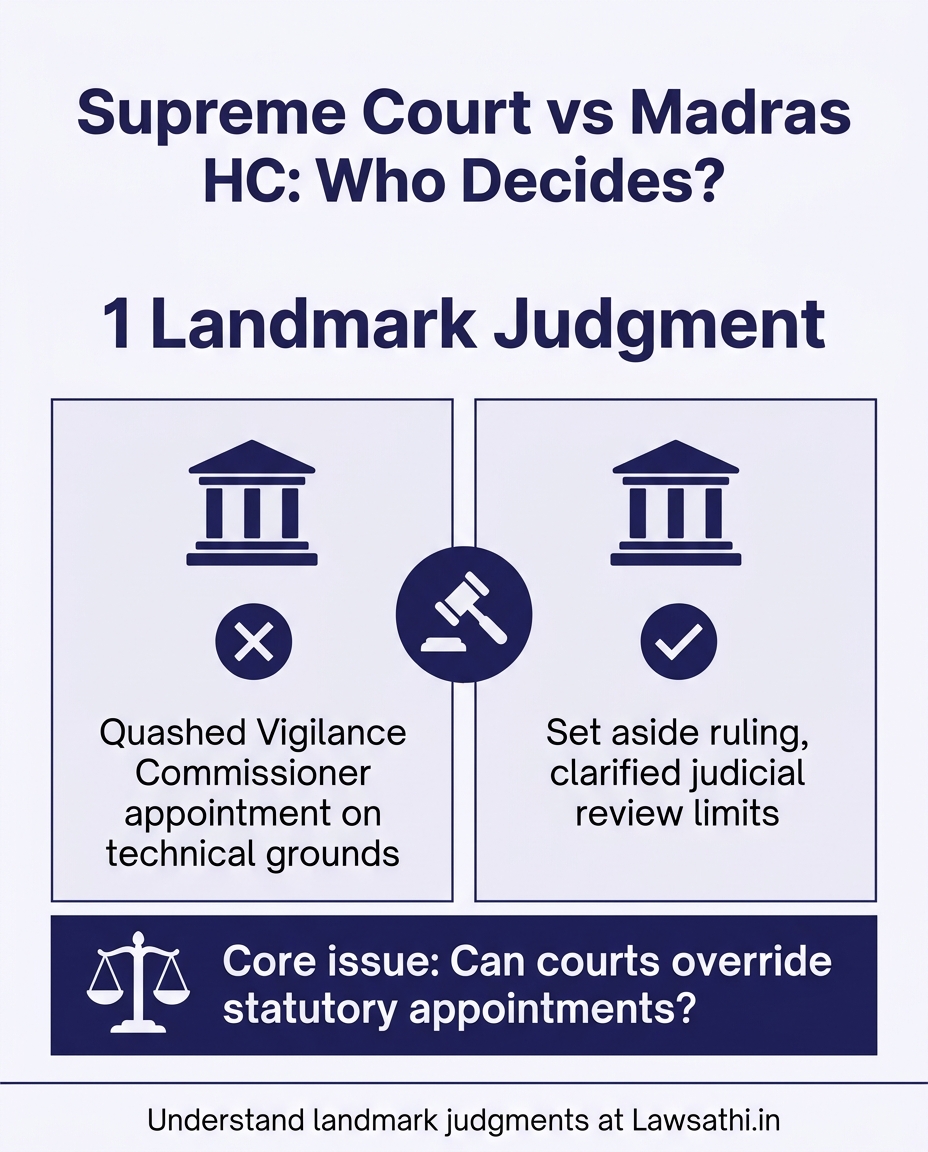
However, this approach raised concerns about judicial overreach. The Supreme Court has previously cautioned against courts substituting their judgment for that of the executive. This applies particularly in matters of policy and administrative expediency.
In Common Cause v. Union of India, the Supreme Court emphasized an important distinction. Courts must distinguish between reviewing the legality of an appointment and reviewing its merit. The former falls within judicial purview, while the latter does not.
Supreme Court Analysis: Interpretation of the CVC Act
The Supreme Court’s analysis in R. Iyyappan v. Union of India Supreme Court judgment provides crucial guidance on statutory interpretation. The Court examined Section 4 and its provisos carefully to determine the correct approach.
Section 4: Mandate or Guideline?
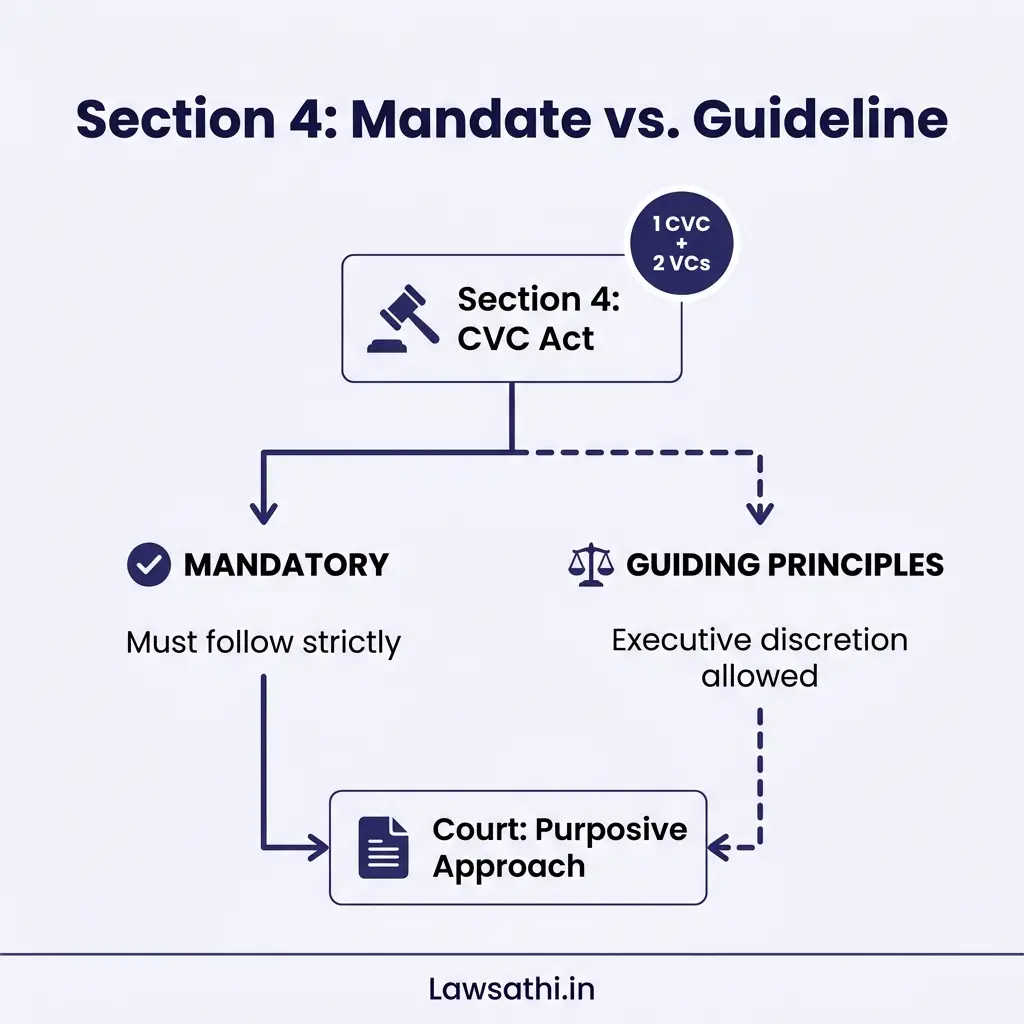
Section 4 of the Central Vigilance Commission Act, 2003 governs the composition of the Commission. It provides for a Central Vigilance Commissioner and not more than two Vigilance Commissioners. The Selection Committee recommends appointments to the President. This committee comprises the Prime Minister, Home Minister, and Leader of Opposition.
The Supreme Court had to determine whether certain provisions were mandatory conditions precedent. Alternatively, they could be merely guiding principles. This distinction is crucial in administrative law. Mandatory provisions must be strictly followed. Guiding principles, however, allow for reasonable administrative discretion.
Statutory Mandate vs. Administrative Expediency
The Court drew a clear line between statutory mandates and administrative expediency. Statutory mandates are non-negotiable requirements that the executive must fulfill. Administrative expediency, however, involves policy choices that remain within executive discretion.
As the Supreme Court stated in Centre for PIL (2011), “Government is not accountable to the courts in respect of policy decisions. However, they are accountable for the legality of such decisions.”
This principle guided the Court’s analysis in the present case. The judgment reaffirms that courts must not confuse procedural irregularities with substantive violations of statutory mandates.
Procedural Integrity Standard
The Court emphasized the importance of procedural integrity in appointment processes. In its landmark 2011 judgment, the Supreme Court had laid down specific guidelines:
> “All civil servants and other persons empaneled shall be outstanding civil servants or persons of impeccable integrity.”
The empanelment process must follow rational criteria. Furthermore, authorities must record reasons for their selections. However, these requirements serve to ensure fairness. They do not create grounds for technical challenges.
Key Legal Principles Established by the Supreme Court
The R. Iyyappan v. Union of India Supreme Court judgment reinforces several foundational principles of administrative law. These principles will guide future litigation involving statutory appointments.
Judicial Review in High-Level Appointments
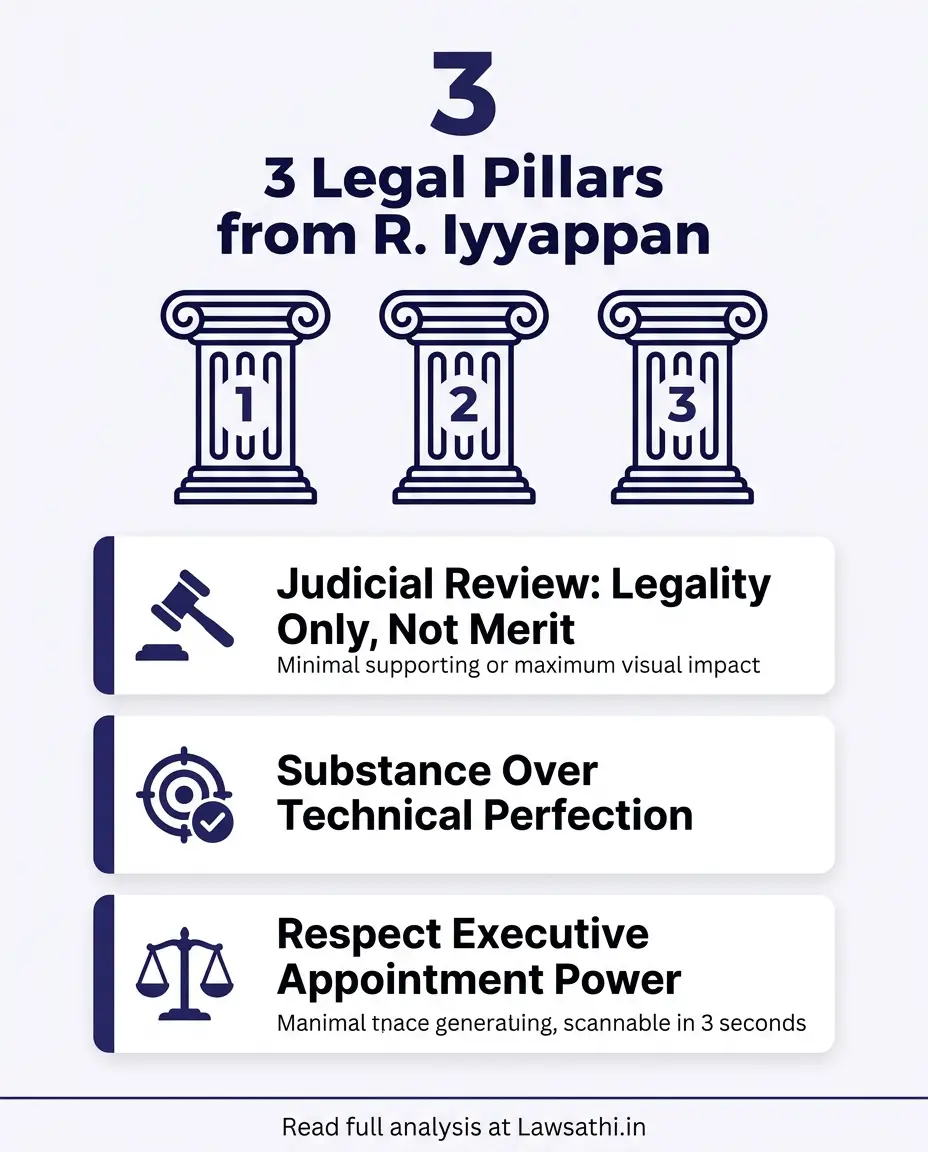
The first principle concerns the scope of judicial review in appointments to constitutional bodies. Courts can examine whether the appointment process violated legal requirements. However, they cannot substitute their judgment on the suitability of candidates.
This distinction between legality review and merit review is fundamental. In M. Manohar Reddy v. Union of India, the Supreme Court clarified the difference. It distinguished between eligibility and suitability. Eligibility is a matter of fact that courts can review. Suitability, however, involves matters of opinion within the domain of the appointing authority.
Substantive Compliance vs. Literal Compliance
The judgment establishes an important distinction. It differentiates between substantive and literal compliance with statutory provisions. Literal compliance demands exact adherence to every word of the statute. Substantive compliance requires fulfilling the essential purpose and requirements of the law.
The Supreme Court rejected an overly literal interpretation. Such an interpretation would defeat the purpose of the CVC Act. Instead, it adopted a purposive approach. This approach respects legislative intent while maintaining procedural safeguards.
Separation of Powers Doctrine
The Court’s ruling significantly impacts the doctrine of separation of powers. It addresses the relationship between the judiciary and executive. By setting aside the Madras High Court’s order, the Supreme Court reinforced an important principle. Courts must respect executive prerogatives in appointment matters.
The executive branch bears responsibility for selecting suitable candidates. Courts cannot assume this role without undermining constitutional balance. However, this does not mean the executive enjoys unchecked power. Judicial review remains available to correct illegalities and constitutional violations.
In Common Cause (2018), the Court upheld CVC appointments after examining procedural integrity. The key question was whether complete material was placed before the High Power Committee. It was not about the correctness of the selection itself.
Implications for Litigants and Legal Practitioners
The R. Iyyappan v. Union of India Supreme Court judgment offers valuable guidance for lawyers handling similar challenges. Understanding these implications is essential for effective advocacy.
Higher Threshold for Challenges
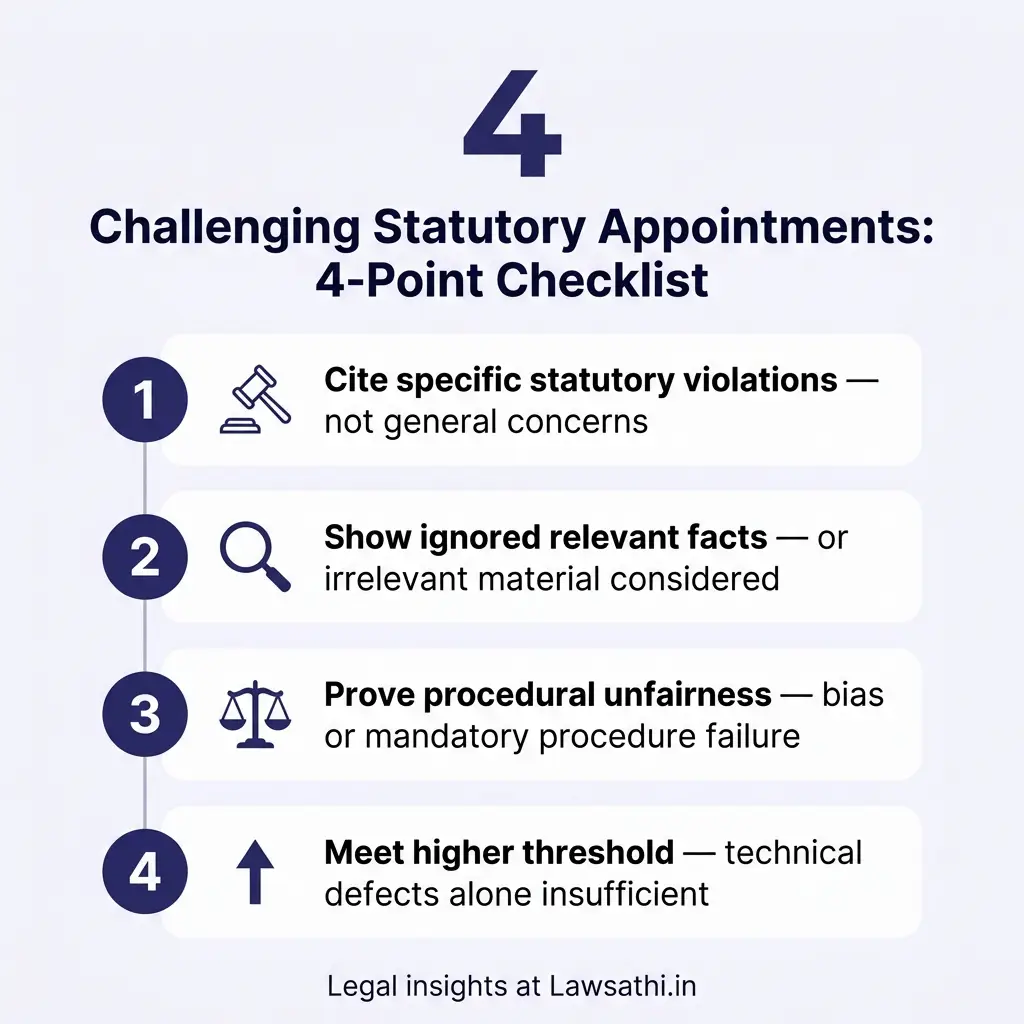
Future challenges to appointments of constitutional functionaries will face a higher threshold. Petitioners must demonstrate clear violations of mandatory statutory requirements. Technical defects or procedural irregularities alone will not suffice.
Lawyers must carefully distinguish between mandatory and directory provisions in their pleadings. They should identify specific statutory violations. Raising general concerns about administrative process will not be enough.
Drafting Effective Writ Petitions
When drafting writ petitions challenging administrative appointments, practitioners should focus on concrete violations. The checklist from Centre for PIL (2011) provides guidance:
– Demonstrate violation of specific statutory provisions – Show non-consideration of relevant material – Establish consideration of irrelevant material – Prove procedural unfairness or bias – Identify failure to follow mandatory procedures
Petitioners must provide evidence that the appointing authority ignored crucial information. As noted in earlier precedents, the integrity of the decision-making process matters more than technical perfection.
Standard of Review for Lawyers
Lawyers must understand the limited scope of judicial review in appointment matters. They cannot simply argue that a better candidate existed. Nor can they argue that the selection was suboptimal. Instead, they must demonstrate that the process itself was fundamentally flawed.
The Supreme Court has consistently held that institutional integrity matters. However, this concept relates to the appointment process. It does not concern the personal characteristics of appointees beyond what the statute specifies.
Practical Guidance for Practitioners
Understanding the practical applications of this judgment helps lawyers serve their clients better. Here are key takeaways for legal practice.
Pre-Litigation Assessment
Before filing challenges to statutory appointments, conduct thorough preliminary assessment. Review the applicable statute carefully to identify mandatory requirements. Distinguish between conditions precedent and procedural guidelines.
Evaluate whether any alleged violation actually undermines the integrity of the appointment process. Minor procedural issues typically cannot invalidate appointments to high constitutional offices.
Evidence Gathering Strategies
Focus evidence gathering on demonstrating substantive violations. Obtain information about the selection process through RTI applications where applicable. Document any failure to consider relevant material. Additionally, document any consideration of irrelevant factors.
Remember that courts require concrete evidence, not mere allegations. The standard of proof remains high for challenges to official appointments.
Strategic Considerations
Consider whether litigation is the most effective remedy. Sometimes, alternative approaches may be more appropriate. For example, representation to authorities or media attention might work better. Evaluate the likelihood of success based on established precedents.
Conclusion: Restoring Balance in Administrative Law
The R. Iyyappan v. Union of India Supreme Court judgment represents a measured approach to judicial review. By setting aside the Madras High Court’s ruling, the Supreme Court has restored balance. It balances judicial oversight against executive discretion.
Final Order and Relief
The Supreme Court allowed the appeal and set aside the Madras High Court’s order. The High Court had quashed the appointment. The Supreme Court held that the High Court exceeded its jurisdiction. It did so by substituting its interpretation for that of the executive authority.
Broader Message to High Courts
This judgment sends an important message to High Courts across India. Courts must exercise restraint when reviewing matters within executive competence. Intervention is appropriate only when clear illegality or constitutional violation exists.
The stability of tenure for statutory bodies depends on this balanced approach. Constant judicial intervention would undermine the effectiveness of institutions like the Central Vigilance Commission.
Future Implications
As India’s administrative law landscape evolves, this judgment will serve as an important precedent. It clarifies the boundaries of judicial review while maintaining accountability mechanisms. Legal practitioners must adapt their strategies accordingly.
The Supreme Court has reaffirmed that the CVC requires stable leadership. The CVC is India’s apex integrity institution. Disrupting appointments on technical grounds serves neither governance nor accountability.
Stay ahead of critical legal developments. Use LawSathi’s AI-powered case law tracker to analyze how recent Supreme Court judgments impact your ongoing litigation. Start your free trial today.