
The Supreme Court cancels bail in dowry death cases when courts prioritize procedural technicalities over substantive justice. In a significant ruling on April 30, 2026, the Apex Court set aside a bail order granted by the Allahabad High Court. The case involved a young woman who died under suspicious circumstances within five years of her marriage. The High Court had granted bail primarily based on an alleged delay in filing the FIR.
However, the Supreme Court strongly disapproved of this approach. It emphasized that procedural delays cannot override the gravity of a heinous offense like dowry death. This judgment in Mahesh Chand v. State of U.P. 2026 SCC OnLine SC 793 addresses a critical question for criminal law practitioners. Does a delay in filing the FIR automatically entitle an accused to bail in dowry death cases?
The Court answered with a resounding “no.” Furthermore, the ruling serves as a stern reminder to lower courts. They must not apply procedural defaults as a “golden formula” to grant bail in serious crimes against women.
Case Background: Facts and the High Court’s Reasoning
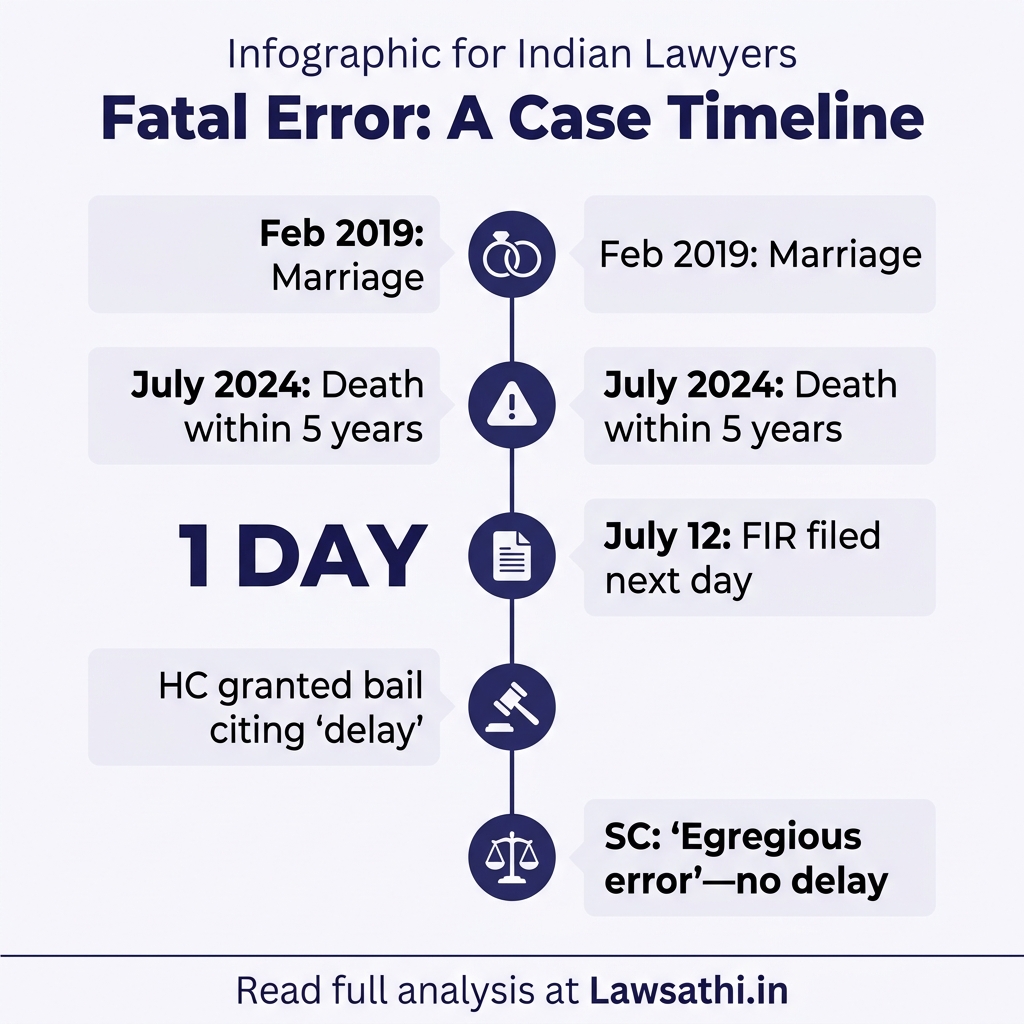
The case involves tragic facts that highlight the persistent menace of dowry in Indian society. The deceased was married in February 2019. Sadly, she died on July 11, 2024, within five years of her marriage. Her father filed the FIR on the very next day, July 12, 2024. He alleged continuous harassment and cruelty for dowry demands.
The Factual Matrix of the Case
The complainant had given a substantial dowry at the time of marriage. This included a car, cash, jewelry, and household articles. However, the in-laws allegedly demanded a Fortuner car and Rs. 10 lakhs more. The FIR detailed physical assault, starvation, and threats to kill the deceased.
On the day of her death, she spoke to her father in a distressed condition. She reported being beaten and threatened. Subsequently, her body was found in a hospital with visible injuries. Notably, none of her in-laws were present at the hospital.
The police charged the accused under Sections 80, 85, 115(2), 351(2), and 352 of the Bharatiya Nyaya Sanhita (BNS). They also invoked the Dowry Prohibition Act, 1961. The Sessions Court had initially rejected the bail application. However, the Allahabad High Court granted bail in August 2025.
High Court’s Erroneous Reasoning
The High Court granted bail on two primary grounds. First, it noted an alleged “delay” in lodging the FIR. Second, it observed that the cause of death was recorded as asphyxia due to hanging.
The High Court seemingly differentiated between the incident and the FIR registration. It failed to adequately consider the serious allegations of cruelty and dowry demand. Moreover, it did not address the statutory presumption under Section 118 of the Bharatiya Sakshya Adhiniyam (BSA). This presumption is crucial in dowry death cases. The Supreme Court later termed this oversight by the High Court as an “egregious error.”
Supreme Court’s Analysis: Why Delay in FIR is Not a ‘Golden Formula’
The Supreme Court’s analysis provides critical insights into bail jurisprudence for crimes against women. The Bench, comprising Justice J.B. Pardiwala and Justice Vijay Bishnoi, delivered a scathing critique of the High Court’s order. They questioned the very premise of the “delay” argument.
No Actual Delay in FIR Registration
The Court first addressed the factual accuracy of the High Court’s observation. It pointed out that there was no delay in filing the FIR. The deceased died on July 11, 2024. The parents learned of the death and immediately lodged the FIR on July 12, 2024.
The Court asked, “Where is the delay in the registration of the FIR?” as per the LiveLaw report. Therefore, the premise of the High Court’s order was factually incorrect.
Societal Context and Trauma
Even assuming there was a delay, the Court clarified that it cannot justify bail. It observed that delay in lodging FIRs is a common phenomenon in Indian society. Victims’ families often need time to process the trauma. They must also navigate complex social and familial pressures.
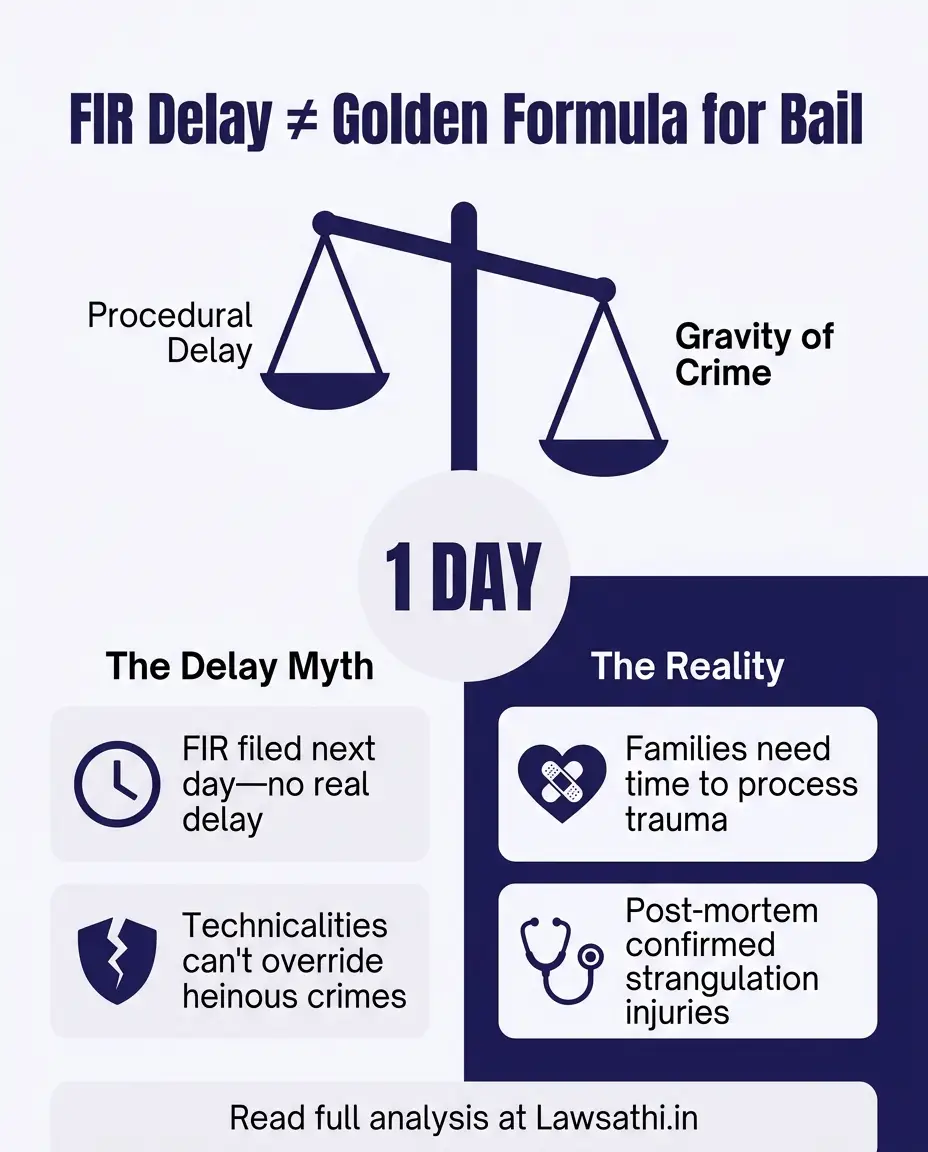
Consequently, a delay in reporting cannot dilute the gravity of the offense. The Court noted that dowry deaths remain a “serious problem in some sections of society.” It specifically mentioned Uttar Pradesh, Bihar, and Karnataka as high-risk states.
The judgment included a poignant observation about the societal menace. The Court stated, “Before the wedding, the groom’s family rarely makes exorbitant demands.” However, “once the marriage is formalised, they begin exerting pressure.” The bride’s parents are then left with little choice but to comply. This context makes the crime particularly heinous and demanding of a strict legal approach.
Gravity of Offense Over Technicalities
Furthermore, the Supreme Court emphasized that procedural technicalities cannot override substantive justice. The post-mortem report revealed multiple ante-mortem injuries. There was a ligature mark around the neck, along with contusions and abrasions.
These findings prima facie suggested strangulation, not mere hanging. The High Court failed to appreciate this crucial evidence. Therefore, the Supreme Court canceled the bail and remanded the matter for fresh consideration.
Legal Principles: Bail Jurisprudence in Dowry Death Cases
This judgment reinforces established principles of bail jurisprudence in India. It specifically highlights the interplay between bail provisions and special statutes protecting women.
The Statutory Presumption Under Section 118 BSA
Section 304B IPC (now BNS) operates with a reverse onus provision. Section 113B of the Indian Evidence Act, now Section 118 of the Bharatiya Sakshya Adhiniyam (BSA), creates a presumption. When a woman dies within seven years of marriage, the court must presume it is a dowry death.
However, this presumption applies only if the prosecution proves two things. First, the death must be caused by burns, bodily injury, or under abnormal circumstances. Second, the prosecution must show that the woman was subjected to cruelty or harassment for dowry “soon before death.”
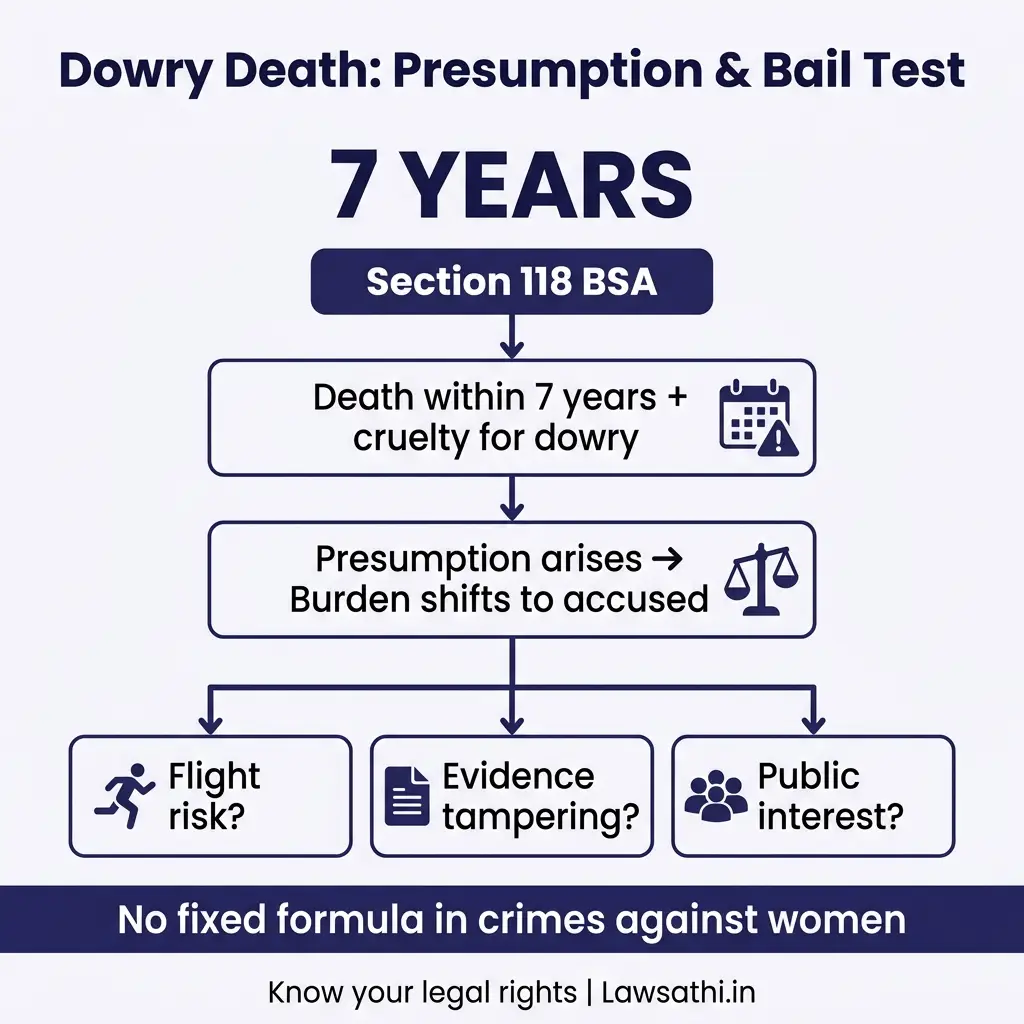
Once these basic ingredients are established, the burden shifts to the accused. He must rebut the presumption of guilt. The High Court in this case failed to consider this significant statutory provision. The Supreme Court noted that ignoring this presumption amounts to a serious error in law.
Application of the ‘Triple Test’ for Bail
Under Section 439 CrPC (now Section 483 BNSS), courts have broad powers to grant bail. However, this power is not unbridled. Courts must apply the well-established “triple test” for bail.
This test assesses whether the accused is likely to flee from justice. It also examines the likelihood of evidence tampering or witness intimidation. Finally, it considers the larger public interest and the gravity of the offense.
In cases involving crimes against women, the “triple test” applies differently. The Supreme Court has previously held that societal interest weighs heavily in such cases. For example, in Gurcharan Singh v. State (Delhi) (1978) 1 SCC 118, the Court noted that there cannot be an “inexorable formula” for bail. The nature of the offense and the character of the evidence are critical factors. In dowry death cases, the heinous nature of the crime tips the scales against granting bail lightly.
Precedents on Cautious Approach in Section 304B Cases
The Supreme Court in Gurmeet Singh v. State of Punjab (2021) 2 SCC 262 issued detailed guidelines for trials in dowry death cases. It emphasized that judges must be “extra careful” due to the precarious nature of Section 304B read with Section 113B.
The Court reiterated that Sections 304B and 498A are distinct offenses but can both apply simultaneously. The current ruling in Mahesh Chand builds on this precedent. It warns courts against passing unreasoned bail orders that might suggest a casual approach to crimes against women.
Practical Implications for Legal Practitioners
This judgment offers valuable guidance for both prosecutors and defense counsel. It reshapes how bail applications should be argued in dowry death cases.
Guidance for Prosecutors
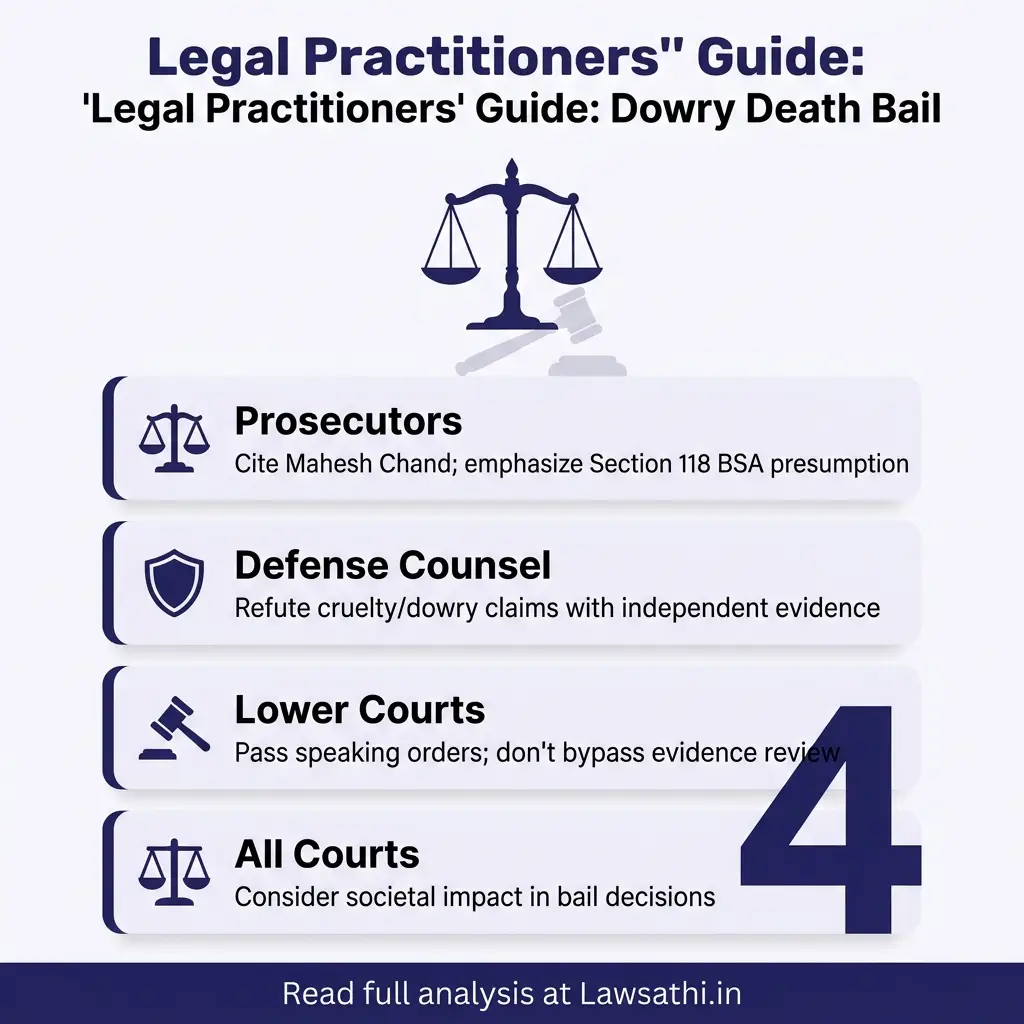
Prosecutors must now use this judgment to counter “delay in FIR” defenses effectively. They should cite Mahesh Chand to argue that delay is not a standalone ground for bail. Moreover, prosecutors must emphasize the statutory presumption under Section 118 BSA.
They should present the post-mortem report and medical evidence to establish the cause of death. Additionally, they must document the pattern of harassment and financial transactions proving dowry demands. The Supreme Court has made it clear that courts cannot overlook these substantive aspects.
Guidance for Defense Counsel
Defense counsel must evolve their strategy beyond procedural arguments. Relying solely on “delay in FIR” will no longer suffice. Instead, they must address the merits of the case more thoroughly.
They need to specifically refute the allegations of cruelty and dowry demand. Furthermore, they must provide a plausible explanation for the cause of death. To rebut the presumption under Section 118 BSA, they need independent evidence. Mere procedural lapses will not overcome the heavy presumption in dowry death cases.
Impact on Lower Courts
Trial Courts must now exercise greater caution in bail matters. They must pass speaking orders that address all relevant legal provisions. A bail order cannot simply cite procedural delays without examining the evidence.
Courts must also consider the societal impact of their decisions. The Supreme Court warned that bail orders should not signal that courts take crimes against women “lightly.” As a result, Trial Courts will likely adopt a more rigorous approach when evaluating bail in Section 304B cases.
Conclusion: Upholding the Integrity of Substantive Law
The Supreme Court’s decision to cancel bail in this dowry death case sends a powerful message. Substance must prevail over procedural technicalities. The Court firmly established that delay in FIR is not a “golden formula” for bail.
It reminded the judiciary that crimes against women affect society at large. Therefore, the courts must balance personal liberty with the broader interest of justice. The judgment reiterates that statutory presumptions exist for a reason. They are designed to protect vulnerable women in matrimonial homes.
Courts cannot bypass these presumptions on flimsy procedural grounds. For the legal community, this ruling is a crucial reminder. It underscores the need for reasoned orders that reflect the gravity of the offense. Moving forward, practitioners must align their arguments with these principles to ensure justice is served.
Stay ahead with the latest legal updates. Use LawSathi’s AI-powered case law search to find relevant precedents for your next bail hearing instantly. Try LawSathi free for 14 days.