
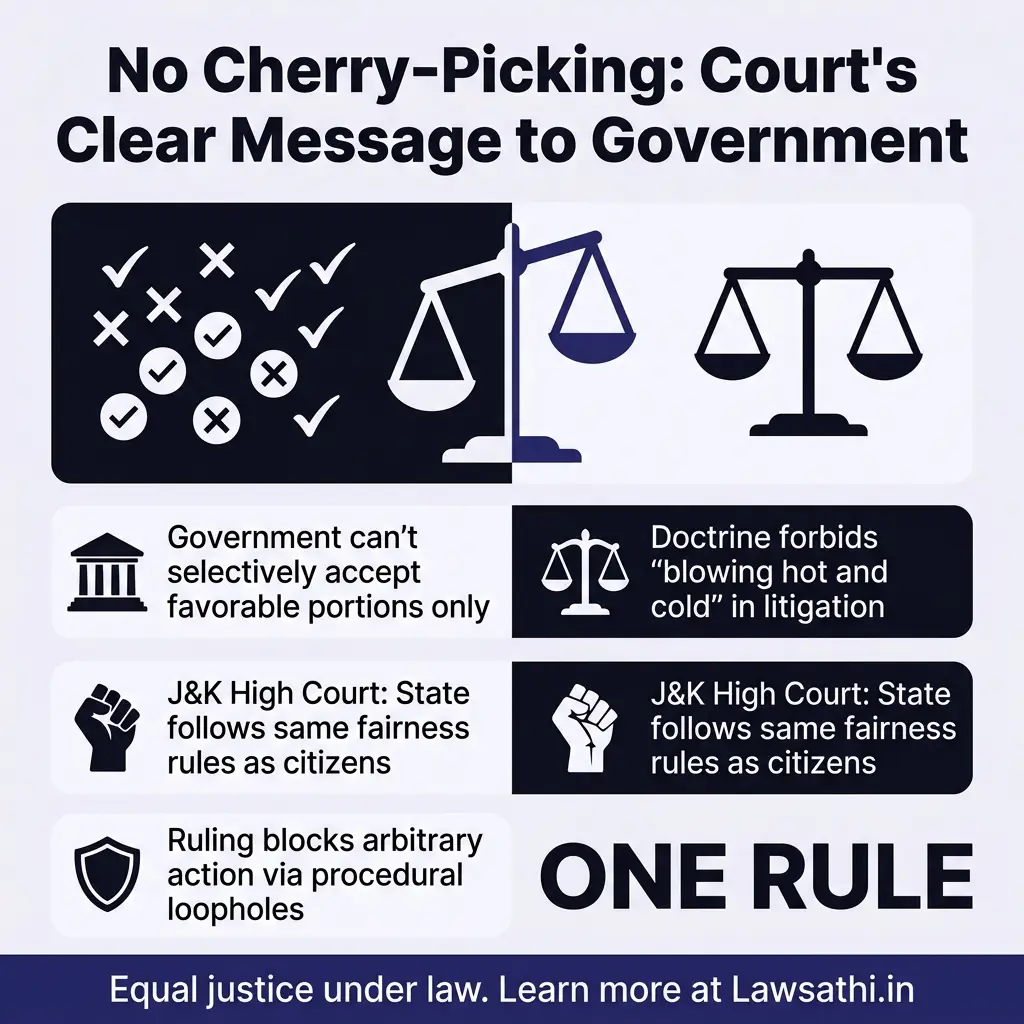
Governments often approach courts with a sense of entitlement. They believe they can cherry-pick favorable outcomes. However, a recent Jammu & Kashmir and Ladakh High Court judgment has firmly rejected this approach. The ruling establishes that the State cannot accept beneficial portions of a decree while simultaneously challenging the adverse ones. Therefore, this decision reaffirms a fundamental principle. The government must play by the same rules of fairness that apply to all litigants.
Introduction: The Principle of ‘Pick and Choose’ in Litigation
The doctrine against “blowing hot and cold” stands as a cornerstone of fair litigation practice. Simply put, a party cannot approbate (accept) and reprobate (reject) the same instrument simultaneously. This equitable principle prevents litigants from taking contradictory positions to suit their convenience.
Why This Ruling Matters
The J&K and Ladakh High Court’s stance carries significant weight for several reasons. First, it reinforces accountability in government litigation practices. Second, it protects citizens from arbitrary state action that exploits procedural loopholes. Most importantly, it upholds judicial discipline and consistency in the legal system.
Furthermore, the Supreme Court’s recent decision in Union Territory of Jammu & Kashmir v. Saba Wani 2026 INSC 439 arose from this very principle. The Court examined whether the government could create classifications between similarly situated candidates. Specifically, it questioned if classification based solely on litigation status was permissible.
The Core Legal Issue
The central question before the courts involved a troubling government practice. Authorities had accepted certain outcomes while challenging identical outcomes for others. Consequently, such selective treatment violates Article 14 of the Constitution. This provision guarantees equality before law to all citizens.
Case Background: The Dispute Leading to the Ruling
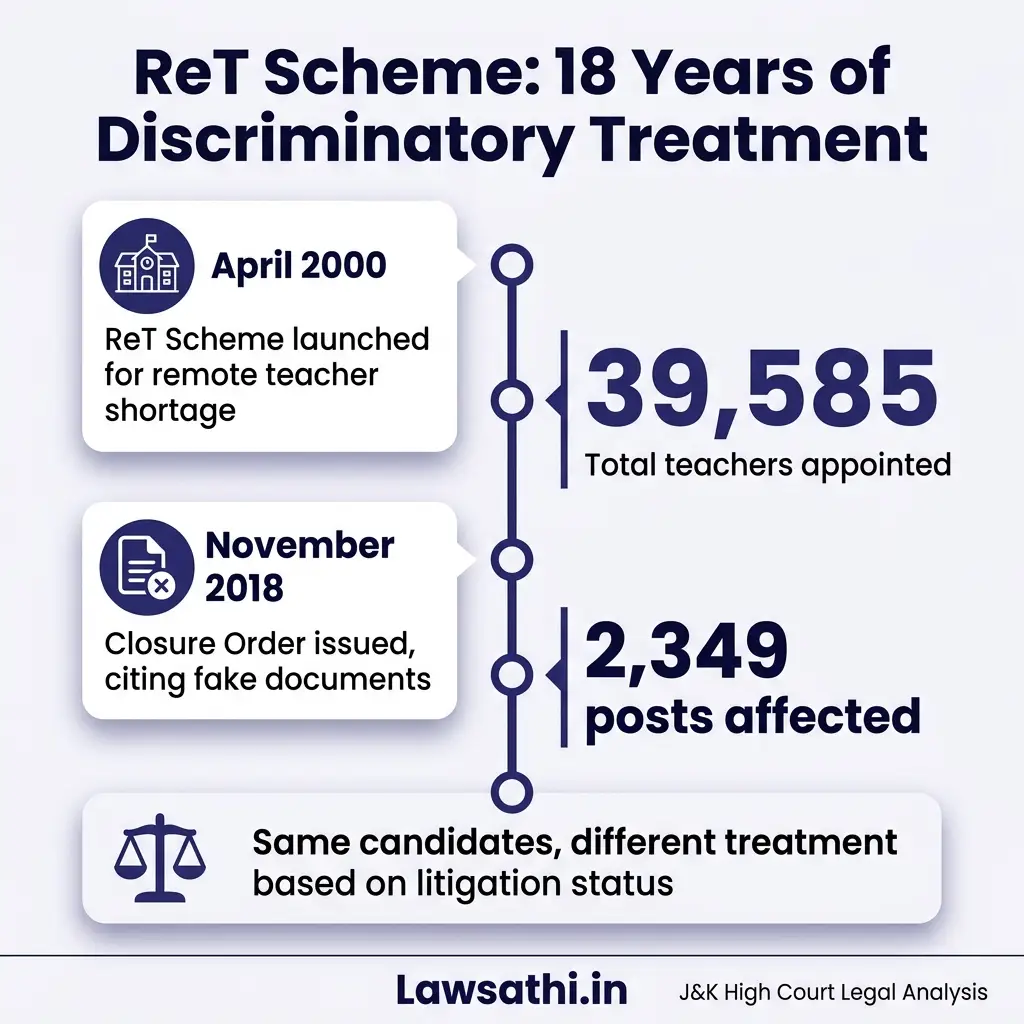
The dispute originated from the Rehbar-e-Taleem (ReT) Scheme launched on April 28, 2000. This scheme aimed to address the acute shortage of teaching staff at elementary levels. LiveLaw reports that the scheme particularly targeted underserved and remote areas.
The Closure Order and Its Impact
On November 16, 2018, the government issued G.O. No. 919-Edu. This order formally closed the ReT Scheme. It cancelled all advertisement notices and select panels where engagement orders had not been issued. The rationale cited concerns about fake mark-sheets, fabricated degrees, and forged documents.
However, the government’s implementation revealed an inconsistent approach. According to SCC Online, the closure affected 2,349 posts from 74 advertisements. Total ReT teachers appointed between 2002-2018 numbered 39,585.
The Government’s Dual Strategy
The State adopted a problematic two-track approach following the High Court’s intervention. First, it accepted appointments already made and continued them. Second, it challenged exceptions that protected candidates whose panels remained unacted upon.
In fact, this situation arose due to pending litigation. This created an absurd situation where similarly placed candidates received vastly different treatment. The government’s position effectively punished candidates merely because litigation was pending against them.
The High Court’s Observations: Reasoning and Rationale
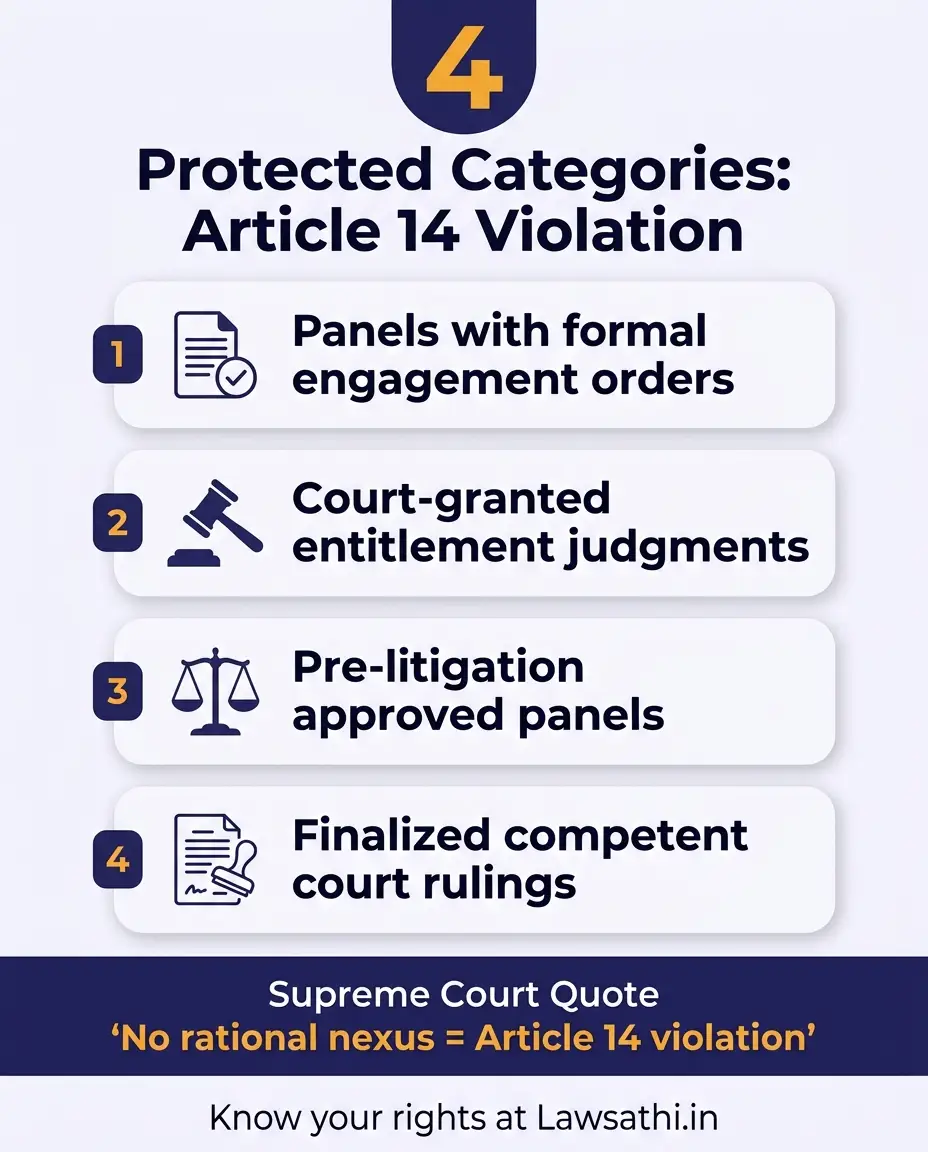
The J&K and Ladakh High Court identified this discriminatory treatment in its February 4, 2023 judgment. The Court carved out four categories where the closure order would not apply.
Four Protected Categories Under HC Order
The High Court protected select panels in specific circumstances. First, panels already acted upon with formal engagement orders issued. Second, judgments passed or to be passed by courts holding candidates entitled to engagement.
Third, approved select panels where aggrieved parties approached courts before action could be taken. Fourth, judgments by competent courts that attained finality.
Supreme Court’s Analysis on Classification
The Supreme Court examined the government’s additional affidavit dated February 23, 2026. The Court observed that the sole ground for denying engagement was pending litigation. Candidates against whom no litigation was pending received engagement orders.
However, candidates facing pending litigation were denied the same benefit. The Court held this classification “bears no rational nexus whatsoever” with the closure order’s objectives. The judgment noted that mere litigation pendency cannot form the basis for classification.
Article 14 Violation Identified
The Supreme Court found a clear violation of Article 14 principles. Classification between candidates with pending litigation and those without failed the twin-test of reasonable classification. Specifically, there was no intelligible differentia. Nor was there any rational nexus with the object sought.
Legal Deep Dive: Doctrine of Approbation and Reprobation
The doctrine of approbation and reprobation occupies a vital place in Indian jurisprudence. This equitable principle prevents parties from accepting and rejecting the same instrument simultaneously.
Understanding the Doctrine
According to CaseMine, the doctrine operates on broader considerations of fairness. It promotes justice and prevents contradictory positions in litigation. Therefore, a party that acts in accordance with a judgment cannot later dispute its validity.
The Supreme Court reinforced this principle in the FCI Workmen Case (2023 INSC 588). Management had voluntarily reinstated and regularized workmen for 18 years. The Court held they could not later challenge the Tribunal Award after such prolonged compliance.
Application to Government Litigation
This doctrine carries special significance when applied to government conduct. The State often attempts to accept beneficial judgment portions while challenging adverse ones. Such behavior contradicts principles of fairness and undermines judicial authority.
Additionally, the doctrine creates an estoppel effect against contradictory positions. If the government implements a judgment’s beneficial aspects, it waives the right to challenge that judgment’s validity.
Recent Supreme Court Pronouncements
In May 2026, the Supreme Court laid down key principles on promissory estoppel. First, the doctrine evolved through equity to avoid injustice. Second, it operates upon broader considerations of fairness, justice, and good conscience.
Third, it cannot compel the State to grant benefits never intended for a specific class. These principles complement the approbation-reprobation doctrine in government litigation contexts.
Precedents: Supreme Court and Other High Courts’ Stance
Indian courts have consistently rejected the “pick and choose” approach in litigation. Several landmark judgments establish this principle firmly.
State of Maharashtra v. Ramdas Shrinivas Nayak
In this landmark 1982 case, the Supreme Court addressed similar concerns. The Court held that public policy bars actions that contradict earlier judicial positions. Moreover, judicial decorum restrains parties from taking inconsistent stands.
The judgment emphasized that parties may resile from concessions only in rare cases. This exception applies only where wrong appreciation of law caused gross injustice.
FCI Workmen Case Application
The FCI Workmen Case provides a direct application of this doctrine. Food Corporation of India had complied with a Tribunal Award for 18 years. The Supreme Court held this prolonged compliance precluded any later challenge.
The Court cited Union of India v. N. Murugesan [(2022) 2 SCC 25] in support. Together, these judgments reinforce that parties cannot “blow hot and cold” before courts.
National Litigation Policy Framework
The National Litigation Policy 2010 explicitly addresses government litigation conduct. It states that “Government must cease to be a compulsive litigant.” The policy envisions government as an “efficient” and “responsible” litigant.
Specifically, an efficient litigant focuses on core issues and manages cases in a time-bound manner. A responsible litigant does not resort to litigation for the sake of litigating. False pleas and technical points should not be advanced.
Current Status and Concerns
Despite this policy framework, implementation remains inconsistent. According to a Lok Sabha answer from July 2023, 6,36,605 government cases remain pending. Furthermore, the updated National Litigation Policy awaits finalization.
Practical Implications for Legal Professionals
This Jammu & Kashmir and Ladakh High Court judgment offers powerful tools for advocates. Understanding its implications can strengthen your litigation strategy significantly.
Checklist: Has Government Waived Its Right to Appeal?
Defense counsel should systematically assess several factors. First, analyze the government’s prior conduct regarding the judgment. Has the government implemented or accepted any portion of the order?
Second, evaluate the duration of compliance. How long has the government acted according to the decree? Third, check consistency in treatment of similarly situated persons. Are others receiving different treatment for identical situations?
Fourth, apply the Article 14 classification test. Does the government’s classification satisfy the twin-test requirements? Is there intelligible differentia and rational nexus with objectives?
Strategic Arguments Available
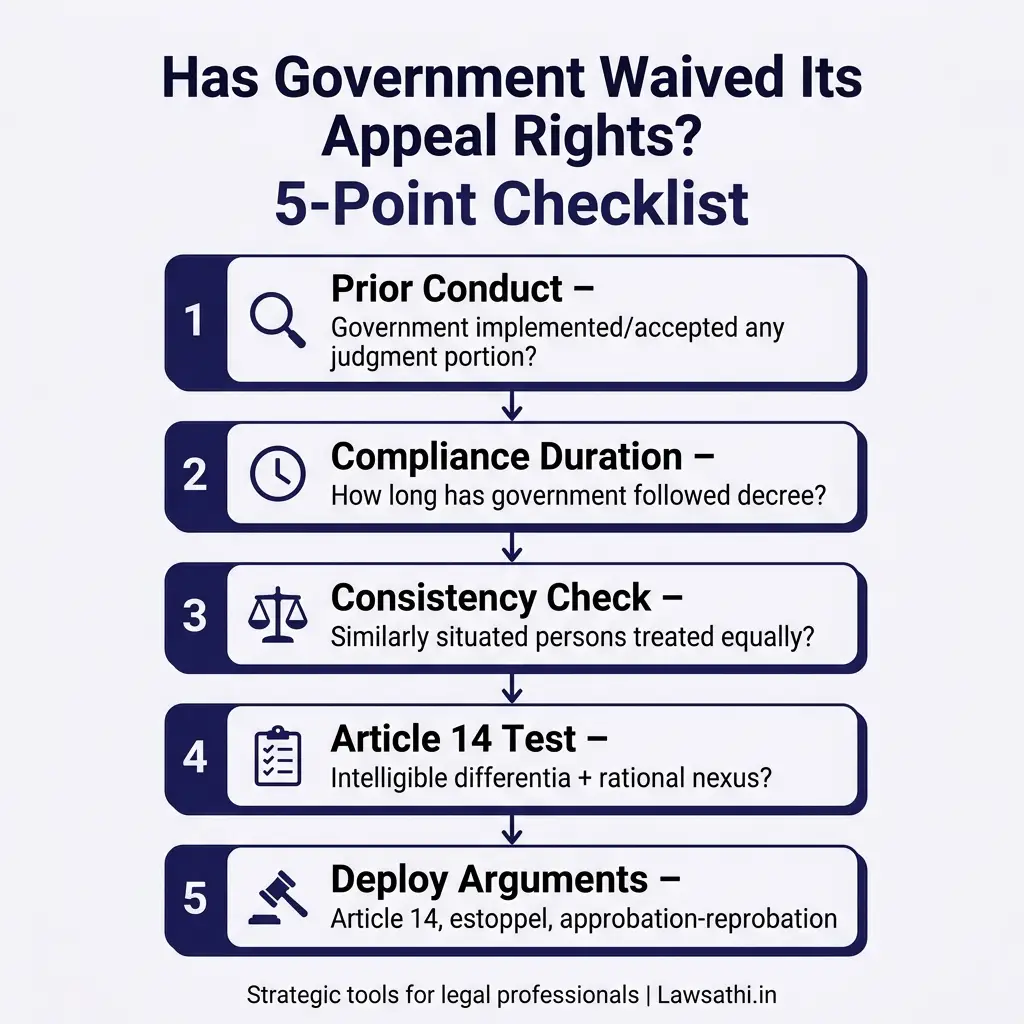
Defense lawyers can deploy multiple arguments against state appeals. First, highlight Article 14 violations through arbitrary classification between litigants and non-litigants.
Second, invoke the doctrine of approbation and reprobation. The government cannot accept beneficial parts while challenging adverse portions.
Third, argue estoppel based on prior conduct. Previous government actions preclude contradictory positions now.
Fourth, cite National Litigation Policy violations. The government’s own policy discourages such frivolous appeals.
Drafting Tips for Private Clients
Private litigants must also avoid contradicting their earlier conduct in pleadings. Therefore, ensure relief claims remain consistent with prior positions taken. Document any government acceptance of decree portions carefully.
Additionally, highlight disparities in treatment of similarly situated parties. This strengthens arguments under Article 14 and supports estoppel claims.
Conclusion: Reinforcing Accountability in State Litigation
The Jammu & Kashmir and Ladakh High Court judgment delivers a powerful message about accountability. Government cannot treat litigation as a game of selective acceptance.
Impact on Judicial Backlog
Government remains the “pre-dominant litigant” in Indian courts and tribunals. The National Litigation Policy aimed to reduce pendency from 15 years to 3 years. However, contradictory government appeals significantly contribute to judicial backlog.
The Supreme Court invoked its plenary powers under Article 142 in Saba Wani. This demonstrates the Court’s commitment to complete justice when government conduct falls short.
The Path Forward
As noted in Madras Bar Association v. Union of India (November 2025), reducing pendency requires shared institutional effort. Respect for settled law is essential to both good governance and judicial discipline.
Stricter implementation of the National Litigation Policy remains crucial. Empowered committees at national and regional levels must function effectively. Moreover, nodal officers need proper training for proactive case management.
This ruling reinforces that fairness applies equally to all parties before court. Government litigants bear no special privilege to pick and choose judgment outcomes.
Stay ahead of critical legal developments with LawSathi. Our AI-powered research tools help you find precedents and manage case details effortlessly. Sign up for a free trial today!