The legal battle between corporate giant Adani Enterprises and independent journalists reached a boiling point today. On February 4, 2026, the Supreme Court of India held a high-stakes hearing. Consequently, this session could redefine media freedom for years to come.
As of February 5, 2026, legal practitioners across India are analyzing the Adani Enterprises vs journalists case Supreme Court updates. This dispute balances the delicate right to reputation. At the same time, it considers the necessity of investigative journalism.
The Stakes of the February 4 Hearing
Therefore, this hearing serves as a landmark moment for the Indian legal fraternity. The Supreme Court is currently reviewing an appeal by Adani Enterprises. Specifically, they are challenging a Delhi High Court decision that refused to reinstate a “gag order” against several journalists.
The journalists involved include Paranjoy Guha Thakurta, Ravi Nair, Abir Dasgupta, and Ayaskant Das. Most importantly, the court is deciding if corporations can pre-emptively stop reports based on financial data.
Introduction: The Significance of the February 4 Supreme Court Hearing
The courtroom proceedings on February 4, 2026, highlighted a growing tension in Indian law. On one side, we see corporate entities protecting their market valuation. On the other side, we see journalists claiming their right under Article 19(1)(a).
Corporate Reputation vs. Free Press
For example, the counsel for Adani argued that “economic sabotage” should not be protected by free speech. However, the bench questioned if a blanket ban on “unverified” content is too vague for enforcement.
Furthermore, legal experts believe this will be a “Bonnard v. Perryman” moment for India. This means the court might set a very high threshold for granting prior restraint in defamation cases. You can follow the latest developments on LiveLaw for real-time updates.
A New Standard for Prior Restraint
Additionally, the bench’s observations suggest a move toward protecting “Responsible Journalism.” If the court rules for the journalists, it will make interim injunctions harder to obtain. As a result, this shift would fundamentally change how practitioners handle high-profile defamation suits.
Case Retrospective: Origin of the Conflict
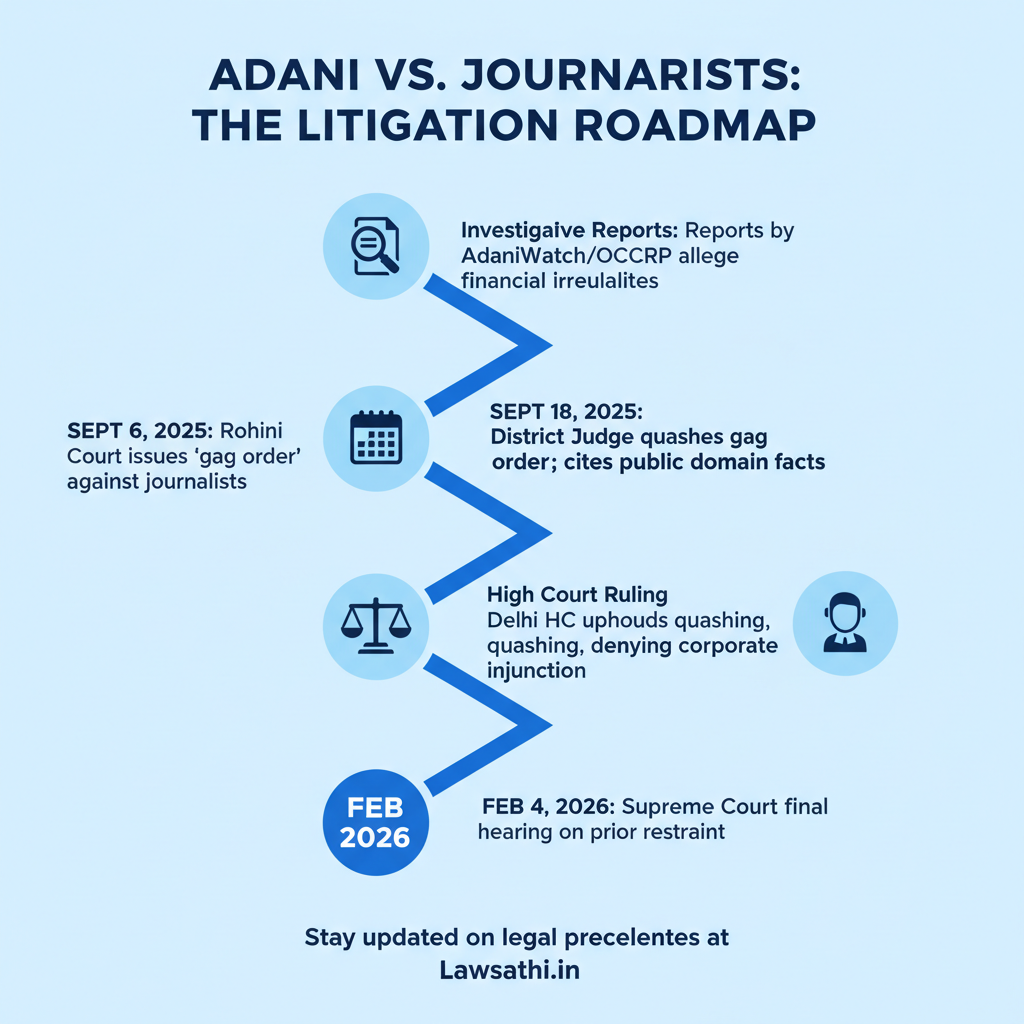
To understand the Adani Enterprises vs journalists case Supreme Court appeal, we must look at the trigger reports. The conflict began after articles appeared in AdaniWatch, OCCRP, and The Guardian. These reports alleged stock manipulation and opaque offshore financial structures.
The Initial Litigation Strategy
Initially, Adani Enterprises sought relief in the lower courts. On September 6, 2025, a Senior Civil Judge at Rohini Courts passed an ex-parte interim order. This order restrained journalists from publishing content deemed “defamatory.”
Consequently, the journalists were ordered to remove existing posts within five days. This sparked an immediate legal counter-offensive. Bar and Bench reported that the journalists challenged the suit almost immediately.
Quashing the Gag Order
In a significant turn, District Judge Ashish Aggarwal quashed the gag order on September 18, 2025. He observed that many of the articles had been in the public domain for years. LiveLaw noted that an ex-parte injunction was not warranted.
Adani then moved to the High Court, but the previous ruling was upheld. As a result, the matter reached the Supreme Court. Specifically, the primary argument now centers on whether the reporting was done in the “public interest.”
February 4 Hearing: Key Arguments in the Courtroom
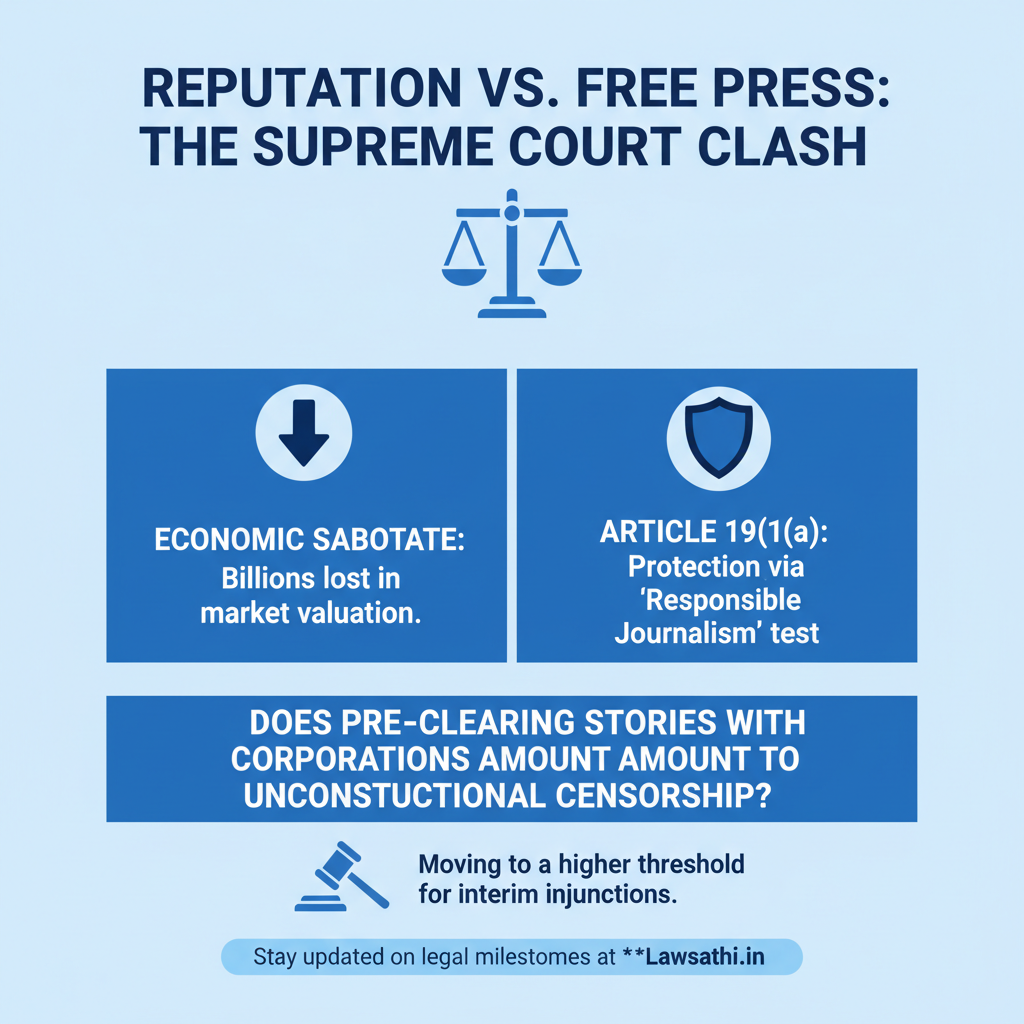
During the February 4 hearing, the Senior Counsel for Adani Enterprises focused on economic damage. They argued that foreign-funded reports cause billions in market cap losses. Therefore, they claimed that protection of “economic reputation” is a legitimate state interest.
The Defense of Responsible Journalism
In contrast, the defense relied on the “Responsible Journalism Test.” They argued that reporting is not defamatory if it is based on a verifiable paper trail. For instance, they used SEBI filings and customs documents to back their claims.
Moreover, the defense emphasized that the right to information is paramount. This argument is supported by recent trends in corporate accountability law.
Critical Observations by the Bench
The Supreme Court bench asked several piercing questions. Specifically, they questioned if forcing journalists to “clear” stories with corporations amounts to censorship. Consequently, practitioners expect a ruling that clarifies the limits of the “Prima Facie” test.
Comparison to Previous Jurisprudence
Such observations align with recent judgments like Tuhin Kumar Biswas v. State of West Bengal. This case reinforced the need to avoid criminalizing civil matters. Similarly, the bench seems wary of allowing corporations to use courts as a shield against scrutiny.
Legal Analysis: Corporate Defamation and SLAPP Suits in India
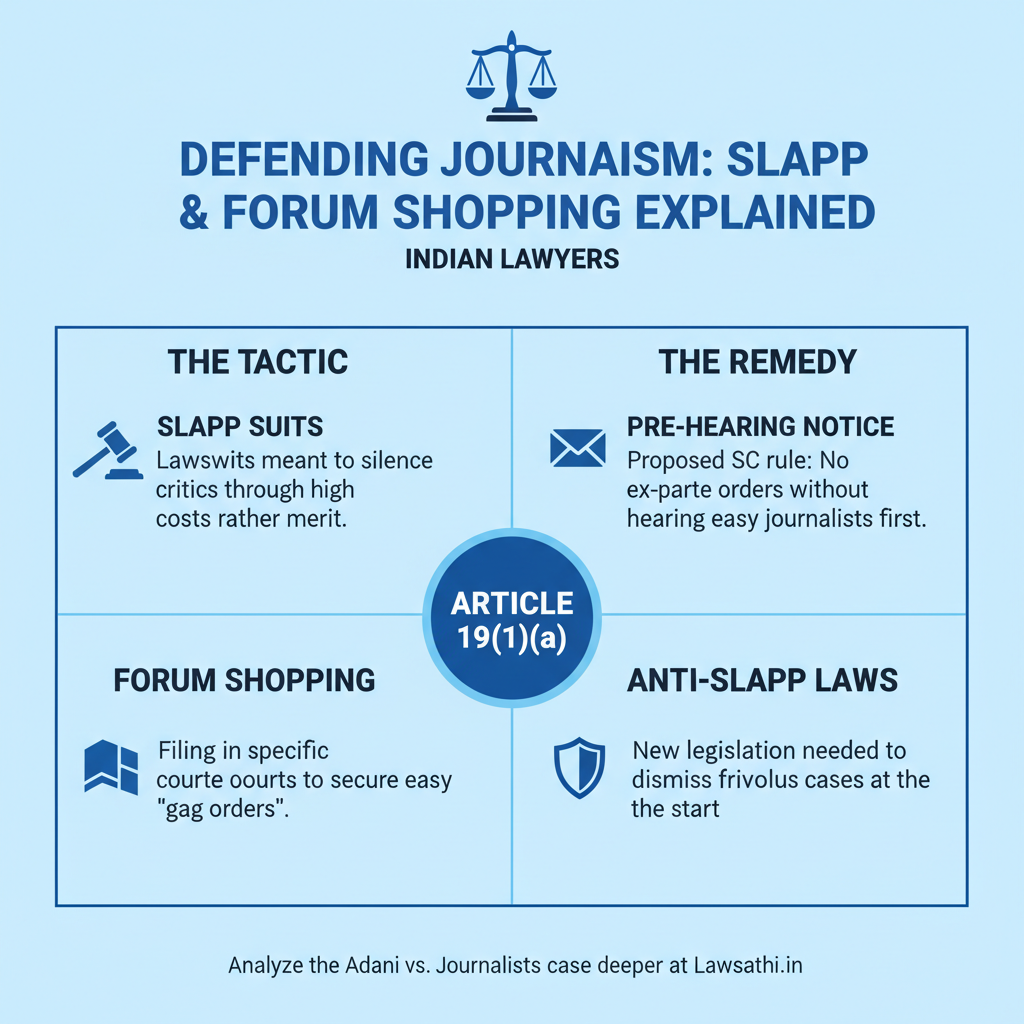
The Adani Enterprises vs journalists case Supreme Court is now a focal point for Anti-SLAPP jurisprudence. SLAPP stands for Strategic Lawsuits Against Public Participation. Generally, powerful entities use these suits to silence critics through expensive litigation.
The Rise of Forum Shopping
Furthermore, this case highlights the issue of “forum shopping” in India. Adani filed in the Rohini lower courts to seek quick ex-parte orders. Therefore, the Supreme Court may issue guidelines to prevent this practice in defamation cases.
For example, the court might mandate that an injunction require a pre-hearing notice. This would follow the spirit of recent Supreme Court orders regarding civil liberties.
Balancing Reputation and Transparency
Most importantly, the court must balance Article 19 with the right to reputation. Many lawyers believe India needs specific Anti-SLAPP legislation. Such laws would allow judges to dismiss frivolous defamation suits at the earliest stage.
As a result, this ruling will likely impact how digital media houses operate. Specifically, it will provide a clearer roadmap for “due diligence” in financial reporting.
The Role of AI and Legal Tech in Complex Corporate Litigation
Managing a case of this magnitude requires immense resources. Both sides in this dispute have utilized advanced legal technology. For instance, lawyers must index thousands of pages of offshore financial records.
Efficiency Through Document Indexing
Additionally, AI-powered document indexing has helped journalists prove they conducted “due diligence.” By using these tools, they can quickly find contradictions in regulatory filings. This level of precision is vital when facing a multi-billion dollar corporation.

Modern firms are now adopting tools for automated case tracking. This helps them manage simultaneous litigations across different states and jurisdictions.
Multi-Jurisdictional Case Management
Furthermore, the Adani Group has active cases in the US and Australia. Therefore, Indian lawyers must stay updated on international developments. Using AI tools allows legal teams to synchronize their arguments across various borders successfully.
Conclusion: What Lies Ahead for Media and Corporate Law
The final judgment in the Adani Enterprises vs journalists case Supreme Court is expected by late March 2026. This ruling will likely serve as a definitive guide for media law in India.
Future Impact on Freelance Journalism
Initially, a victory for the journalists would empower freelance investigators. It would signal that the courts will not tolerate “preventive censorship.” Conversely, a win for Adani might lead to stricter controls on investigative reporting.
Regardless of the outcome, the landscape of Indian defamation law is changing. Consequently, lawyers must prepare for more rigorous standards of proof in civil injunctions.
Final Thoughts for Practitioners
In conclusion, this case reminds us that legal research and documentation are your strongest weapons. Whether you represent a media house or a corporate entity, precision is everything.
Managing high-stakes litigation like this requires precision. Experience seamless case management and AI-driven legal research with LawSathi—Empowering Indian lawyers for the future. Book a demo today.