The legal profession in India stands at a remarkable crossroads in February 2026. Gone are the days when advocates relied solely on paper diaries and physical files to manage their practice. Today, AI in legal practice management India has become more than a buzzword. Rather, it represents a fundamental shift in how lawyers work, research, and serve their clients.
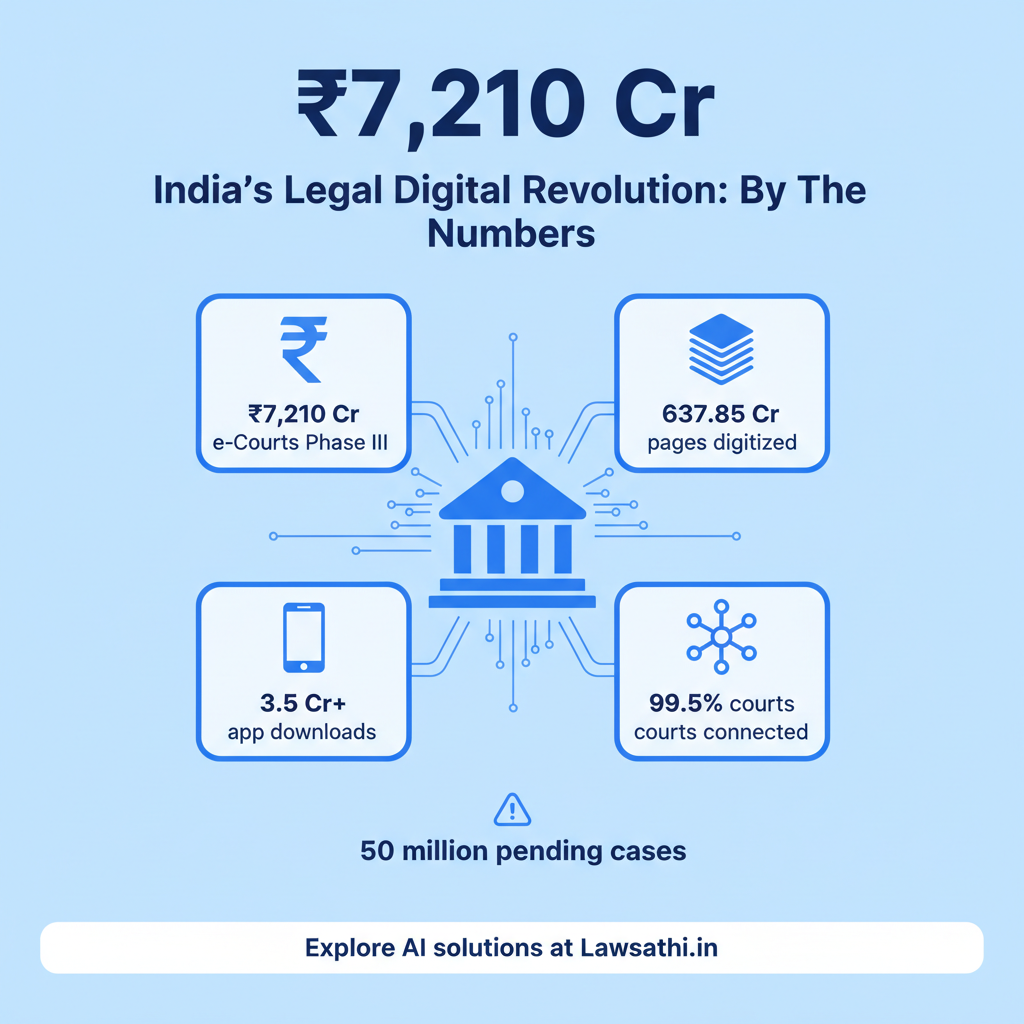
The Indian judiciary has embraced this transformation wholeheartedly. For instance, over ₹7,210 crore has been allocated for e-Courts Phase III. Consequently, the infrastructure for AI-powered legal work is now robust and accessible [^1]. Furthermore, approximately 50 million cases pending across Indian courts demand innovative solutions [^3]. This combination of judicial support and pressing need has created the perfect environment for AI adoption.
However, many advocates still wonder how these changes affect their daily practice. The answer lies in practical tools that solve real problems. Specifically, from automated case tracking to intelligent document drafting, AI is reshaping every aspect of legal work. This blog explores how Indian lawyers can harness these technologies effectively. As a result, advocates can build more efficient, profitable, and compliant practices.
Introduction: The Digital Dawn for Indian Legal Practices
From Paper Diaries to Digital Ecosystems
The transformation of Indian legal practice has been nothing short of revolutionary. In 2007, the e-Courts Mission Mode Project launched with a simple goal. It aimed to computerize court records and digitize cause lists. Today, that initiative has evolved into a comprehensive digital ecosystem.
Currently, 637.85 crore pages of court records stand digitized across the country [^7]. Additionally, 99.5% of court complexes connect through a dedicated Wide Area Network. These numbers represent more than just technological achievement. In fact, they signal a fundamental change in how legal work happens.
The Scale of Digital Adoption
Indian advocates have responded enthusiastically to these changes. The e-Courts Services mobile app has recorded over 3.5 crore downloads [^9]. Moreover, more than 1.03 crore cases have been filed through the e-filing platform. Similarly, court fee transactions worth ₹1,234 crore have been processed digitally.
This shift from traditional methods brings tangible benefits. For example, lawyers no longer need to physically visit courts for basic information. Real-time cause lists, case status updates, and digital document access have become routine. Consequently, advocates can focus more on substantive legal work rather than administrative tasks.
Why AI Matters Now
The integration of AI into this digital infrastructure represents the next logical step. With ₹53.57 crore specifically earmarked for AI and blockchain technologies, the government has signaled its commitment [^1]. Therefore, powerful tools are becoming available at scale for practicing advocates.
AI in legal practice management India offers solutions to persistent challenges. To illustrate, case management, research, drafting, and compliance can all benefit from intelligent automation. The result is improved efficiency, reduced errors, and better client service.
Smart Case Management: Beyond Simple Data Entry
Automated Case Tracking from e-Courts
Managing multiple cases across different courts has always challenged Indian advocates. Missing a hearing date or failing to track a case status can have serious consequences. However, AI-powered case management tools now offer a reliable solution.
These tools automatically fetch case dates and status updates from the e-Courts portal. For example, the Digital Courts 2.1 application provides judges digital access to all case-related documents [^10]. Similarly, the same technology can inform advocates about their matters in real-time.
Additionally, automated SMS alerts have transformed client communication. Over 14 crore SMS messages have been sent to litigants and advocates [^3]. As a result, this reduces the burden on court officials while keeping all parties informed.
Predictive Analytics for Case Strategy
AI goes beyond simple tracking to offer strategic insights. Platforms like SUPACE (Supreme Court Portal for Assistance in Court Efficiency) use AI to identify relevant precedents [^10]. Similarly, LegRAA (Legal Research Analysis Assistant) extracts relevant legal references from vast databases.
These tools analyze historical judgments and case data to offer predictive insights. Advocates can estimate potential case outcomes and timelines with greater accuracy. Therefore, this information proves invaluable for client counseling and case strategy formulation.
For instance, courts have already begun using AI for bail jurisprudence research. In Jaswinder Singh v. State of Punjab, a judge used ChatGPT for legal research assistance [^6]. Furthermore, the Manipur High Court followed similar approaches in service matters.
Reducing No-Shows and Administrative Burden
Missing court dates hurts both advocates and their clients. Fortunately, AI-powered reminder systems address this problem directly. Automated client updates ensure that litigants know when to appear.
Furthermore, AI chatbots can handle routine client queries about case status. This frees up valuable time for advocates to focus on substantive work. In fact, the e-Courts portal receives 35 lakh daily hits, demonstrating the demand for such information [^6].
Case management software for advocates has evolved significantly. Modern solutions integrate seamlessly with court systems. Specifically, they provide comprehensive dashboards showing all active matters, upcoming dates, and pending tasks.
Revolutionizing Legal Research and Drafting
NLP-Powered Legal Research
Legal research has traditionally consumed countless hours of an advocate’s time. Searching through precedents, bare acts, and commentaries requires patience and expertise. However, Natural Language Processing (NLP) has transformed this landscape entirely.
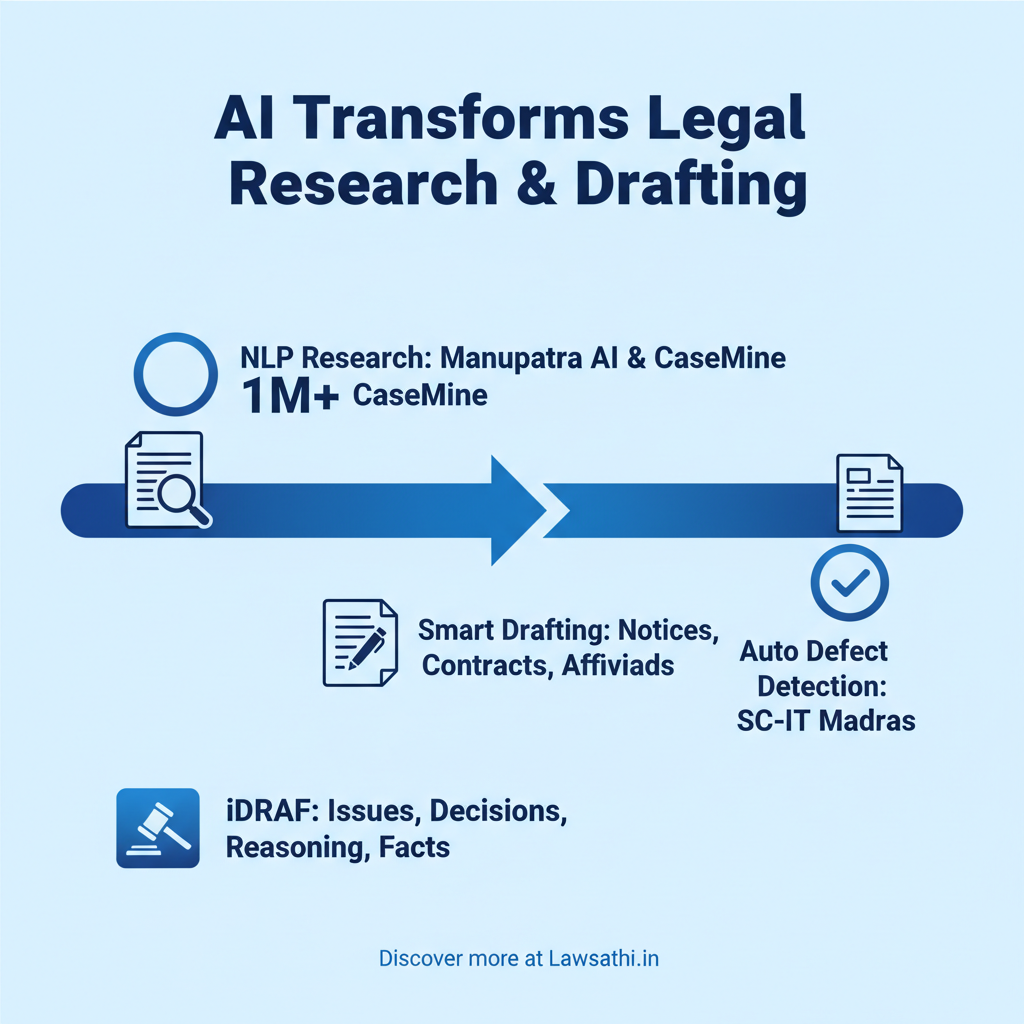
Platforms like Manupatra now offer AI-powered search across comprehensive legal databases [^16]. With 25 years of legal tech leadership, such platforms understand the Indian legal context deeply. Consequently, advocates can find relevant cases using natural language queries rather than complex search syntax.
CaseMine’s AMICUS AI represents another significant advancement. Launched in June 2023, this GPT-powered assistant has answered over 1 million questions [^17]. Moreover, it processes pleadings, written submissions, evidence, orders, and judgments to provide comprehensive analysis.
Smart Document Drafting
Drafting legal documents requires precision and attention to detail. Fortunately, generative AI now assists advocates in preparing notices, affidavits, and contracts. These tools understand Indian legal standards and formatting requirements.
For example, AMICUS AI creates chronologies and issue mappings from case documents [^17]. It can draft documents based on uploaded materials while maintaining legal accuracy. As a result, this significantly reduces drafting time for routine matters.
LegitQuest’s iDRAF offers another innovative approach. Specifically, it structures judgments into “Issues, Decisions, Reasoning, and Facts” [^20]. This enables swift case comprehension and efficient document preparation.
Reducing Human Error
Even experienced advocates can miss citations or make formatting errors. However, AI tools help catch these mistakes before they become problems. In fact, the Supreme Court has collaborated with IIT Madras on automated defect detection [^10].
Machine learning and OCR tools examine petitions, annexures, formatting, and metadata. They flag potential defects before filing, saving time and avoiding rejection. Therefore, this quality control mechanism benefits both advocates and the judicial system.
Automated legal drafting India solutions maintain high standards while improving efficiency. They do not replace the advocate’s judgment. Instead, they handle routine tasks so lawyers can focus on strategy and advocacy.
Navigating Compliance: AI and the DPDP Act 2023
Understanding Your Obligations
The Digital Personal Data Protection (DPDP) Act 2023 represents a paradigm shift in data governance. For law firms handling client data, compliance is not optional. Under this legislation, law firms qualify as Data Fiduciaries with specific obligations.
Section 4 of the Act requires processing only for “lawful purpose” with valid consent [^11]. This consent must be free, specific, informed, unconditional, and unambiguous. Moreover, the maximum penalty for breach of security safeguards reaches ₹250 crore [^12].
The DPDP Rules notified in November 2025 provide greater clarity [^14]. Law firms now have an 18-month transition period for most obligations. However, substantive compliance for security safeguards begins May 2027.
Seven Pillars of Data Security
Rule 6 of the DPDP Rules 2025 establishes seven mandatory security pillars [^14]. First, comprehensive data security measures including encryption and masking are required. Second, strict access controls with Multi-Factor Authentication must be implemented.
Third, real-time visibility and monitoring through systematic logs is mandatory. Fourth, robust data backup systems ensure business continuity. Fifth, one-year log retention creates a “black box” for investigations.
Sixth, contractual obligations for data processors require Data Protection Addendums. Seventh, effective technical and organizational measures include training and policy updates. Consequently, AI tools help implement and maintain these requirements systematically.
How AI Ensures Compliance
DPDP Act compliance for lawyers becomes manageable with the right AI tools. Automated audit trails record all data access and modifications. Additionally, Role-Based Access Control ensures only authorized personnel can view sensitive information.
Furthermore, AI systems can flag potential compliance issues before they escalate. They monitor data handling practices and alert administrators to anomalies. As a result, this proactive approach prevents violations rather than merely detecting them.
It is crucial to note that law firms remain vicariously liable for third-party vendor breaches [^14]. Therefore, choosing technology partners with robust security measures is essential. The right AI practice management platform addresses these concerns comprehensively.
The Virtual Courtroom: AI Integration in Litigation
Managing Virtual Hearings Effectively
Virtual hearings have become a permanent feature of Indian litigation. Video conferencing facilities now operate in 3,240 court complexes and 1,272 jails [^7]. In fact, over 3.93 crore hearings have been conducted through video conferencing to date.
The Nyaya Shruti App exemplifies this transformation. Launched in 2024 under the Inter-operable Criminal Justice System, it facilitates virtual appearances [^8]. Moreover, the app connects accused persons, witnesses, police officials, prosecutors, and prisoners seamlessly.
Furthermore, 17 High Courts have notified Nyaya Shruti Rules to govern these proceedings. This standardization ensures consistency across jurisdictions. Therefore, advocates must adapt their practice to effectively utilize these virtual platforms.
Real-Time Transcription and Translation
India’s linguistic diversity creates unique challenges in litigation. Fortunately, AI-powered translation services address this directly. For instance, the Supreme Court Vidhik Anuvaad Software (SUVAS) translates judgments into 18 Indian languages [^10].
Similarly, the ASR-SHRUTI tool provides voice-to-text dictation for orders and judgments. Integrated within Digital Courts 2.1, it preserves full editorial and judicial control. Moreover, real-time transcription of Constitution Bench proceedings has already become standard practice.
These capabilities benefit advocates appearing in courts outside their linguistic comfort zone. Additionally, they improve access to justice for litigants who speak different languages.
Digital Evidence Management
Managing evidence digitally requires sophisticated tools. The e-Sakshya Platform enables digital recording of evidence with enhanced accuracy [^8]. As a result, this reduces procedural disputes and improves transparency.

The Inter-operable Criminal Justice System (ICJS) digitally links police, courts, prisons, and forensic systems [^9]. Its “one data, one entry” principle eliminates duplication. Consequently, advocates can access verified FIRs, charge sheets, and forensic reports faster.
AI tools for Indian lawyers now include comprehensive digital evidence management. These systems organize, index, and retrieve evidence efficiently. Furthermore, they maintain chain of custody records and ensure integrity throughout proceedings.
—
Choosing the Right AI Practice Management Suite
Essential Features to Evaluate
Selecting the right practice management platform requires careful consideration. First, security features must align with DPDP Act requirements. Look for encryption, access controls, monitoring capabilities, and audit trails.
Scalability matters as your practice grows. Cloud-based solutions offer flexibility and accessibility from anywhere. However, some firms may prefer on-premise solutions for greater data control.
Additionally, Indian language support is crucial for many advocates. Translation capabilities across 18+ languages serve multilingual client bases effectively. Moreover, voice-to-text functionality in regional languages adds further value.
Leading Platforms Available
Legal tech India 2026 offers several compelling options. For example, Manupatra’s Legal Tech Suite provides comprehensive features including notice management, IPR management, and contract management [^16]. Their 25-year track record inspires confidence.
CaseMine’s AMICUS AI offers multi-document intelligence workspace capabilities [^17]. It connects to extensive case law repositories from India, USA, and UK. Therefore, this suits advocates handling international matters.
Government tools provide free alternatives. The e-Courts Services app, Judgment Search Portal, and National Judicial Data Grid offer essential functionality [^9]. As a result, these serve advocates with limited budgets effectively.
Cost-Benefit Analysis
The investment in AI practice management tools delivers measurable returns. Specifically, reduced research time, fewer administrative errors, and better client communication all contribute. Moreover, compliance risk mitigation prevents potentially catastrophic penalties.
For solo practitioners, basic cloud solutions may suffice initially. However, growing firms should consider comprehensive platforms that scale with their needs. Above all, the key is matching features to actual practice requirements.
Conclusion: Future-Proofing Your Legal Career
The integration of AI into Indian legal practice is no longer optional. With government investment exceeding ₹7,210 crore in e-Courts Phase III, the infrastructure is firmly established [^1]. Consequently, advocates who embrace these tools gain competitive advantages in efficiency, compliance, and client service.
The benefits are clear and substantial. For instance, automated case tracking eliminates missed dates and forgotten matters. AI-powered research reduces hours of work to minutes. Similarly, smart drafting tools minimize errors while accelerating document preparation.
Compliance with the DPDP Act becomes manageable with appropriate technology. The ₹250 crore maximum penalty for security breaches demands serious attention [^12]. Fortunately, AI tools help implement and maintain the required security measures systematically.
However, technology serves best as an enabler, not a replacement. The advocate’s judgment, ethical standards, and professional expertise remain paramount. In other words, AI handles routine tasks so lawyers can focus on what matters most: serving their clients effectively.
The future belongs to advocates who balance technological proficiency with human insight. Most importantly, those who master this balance will thrive in India’s evolving legal landscape.
Ready to transform your practice? Discover how LawSathi’s AI-powered platform can streamline your workflow and secure your client data. Start your free trial today!
[^1]: How AI is Enhancing Access to Justice in India [^3]: From Backlogs to Breakthroughs: The Integration of AI in India’s Judiciary [^6]: AI in judicial processes: Transforming India’s legal system [^7]: Digitization of Courts – Press Information Bureau [^8]: Strengthening of E-Courts System [^9]: Digital Infrastructure in District Courts [^10]: e-Courts Software Applications Developed under eCourts Project [^11]: The Digital Gavel: Navigating Adjudication Under DPDP Act, 2023 [^12]: Companies can save up to ₹250 crore: Navigating the DPDP Act 2023 [^14]: Digital Personal Data Protection Rules 2025: A practical roadmap [^16]: Manupatra Legal Tech Suite [^17]: CaseMine launches Multi-Document Intelligence in AMICUS AI [^20]: India’s AI-driven legal future: Opportunities and emerging trends in 2025