The Indian legal landscape is currently witnessing a massive transformation regarding reservation policies. Recently, the debate surrounding the Creamy Layer SC ST Reservations has reached the highest levels of judicial scrutiny. Specifically, this discussion gained immense momentum following a Public Interest Litigation (PIL) filed by advocate Ashwini Kumar Upadhyay.
Introduction: The Paradigm Shift in Reservation Jurisprudence
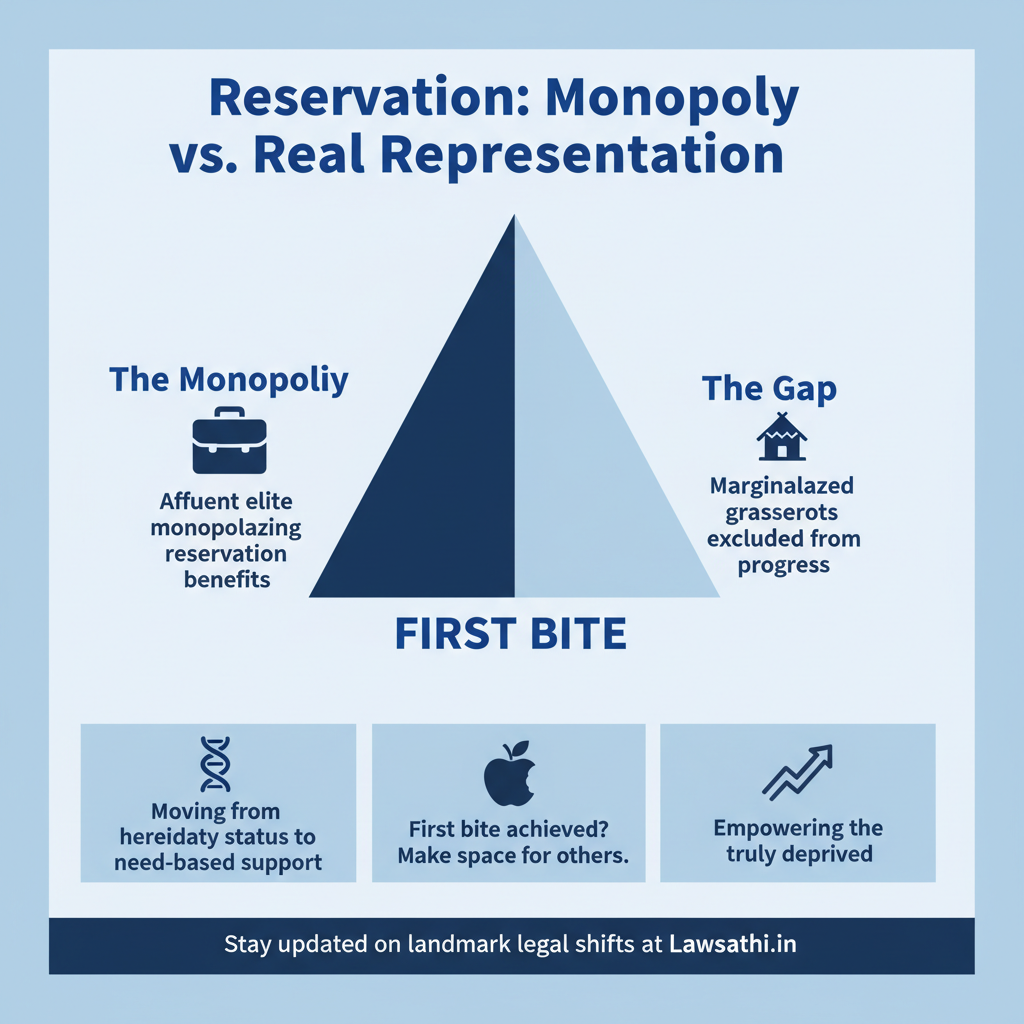
Ashwini Kumar Upadhyay filed a significant petition in the Supreme Court. In this petition, he argued that affluent members within Scheduled Castes (SC) and Scheduled Tribes (ST) monopolize reservation benefits. Consequently, the most marginalized individuals at the bottom of the pyramid remain excluded.
The Focus on Actual Backwardness
Moreover, the petitioner contends that reservation should be a tool for upliftment rather than a hereditary right. For instance, children of high-ranking officials often enjoy superior educational resources. Therefore, continuing to grant them reservation benefits may deprive those in remote villages of genuine opportunities.
Why This Case Matters to Lawyers
Furthermore, this legal challenge is not merely about policy changes. In fact, it questions the very definition of social equality in India. Legal practitioners must understand these shifts to advise clients effectively. Specifically, they need this knowledge for public employment and admission cases.
Currently, the Supreme Court is moving away from treating SC/ST categories as a single block. Instead, it is acknowledging their internal diversity. For this reason, lawyers must stay updated on these evolving constitutional standards.
The Evolution of the ‘Creamy Layer’ Concept in India
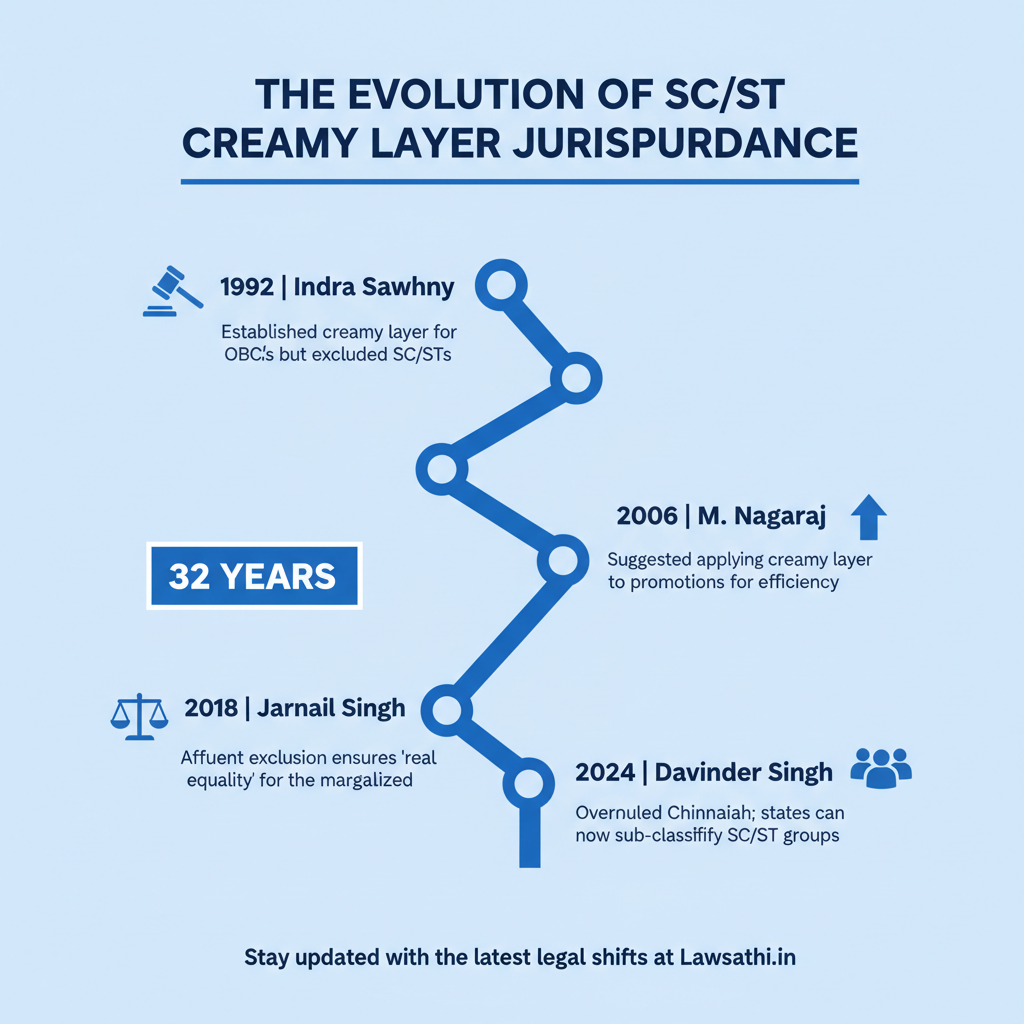
Historically, the “creamy layer” principle only applied to Other Backward Classes (OBCs). The landmark Indra Sawhney (1992) judgment established this distinction. At that time, the Court believed SCs and STs suffered from unique social stigmas like untouchability.
The Transition to Promotion Quotas
However, the legal stance began to shift with the M. Nagaraj (2006) case. The Court hinted that the creamy layer could apply during promotions to maintain efficiency. Later, the Jarnail Singh (2018) ruling took this a step further. It held that excluding the affluent ensures real equality within the reserved categories.
Redefining Social and Economic Status
By 2026, the definition of backwardness has evolved significantly. Courts now recognize that economic progress can eventually mitigate some social disabilities. Therefore, applying the Creamy Layer SC ST Reservations principle helps in identifying those who truly need state support. As a result, the law is becoming more targeted and effective.
Arguments for Exclusion: Ensuring Benefits Reach the Grassroots
Proponents of the exclusion argue for a major shift. They want to move from “Symbolic Representation” to “Actual Backwardness.” Currently, many benefits remain concentrated in second or third-generation beneficiaries. This concentration often leaves the most backward sub-sects without any real representation.
Addressing Top-Heavy Distribution
Data shows that certain sub-groups often secure a majority of reserved seats. For example, in North India, some castes are better represented than others like the Balmikis. Consequently, the “top-heavy” distribution prevents horizontal growth among all sub-castes.
Furthermore, Justice B.R. Gavai recently addressed this disparity. He noted that an urban elite child cannot be compared with a child from a remote tribal area. Therefore, the law must distinguish between these different social realities.
Impact of Concentrated Benefits
Additionally, the “first bite of the apple” theory suggests a logical limit. It implies that once a family climbs the social ladder, they should make space for others. This logic forms the backbone of the Creamy Layer SC ST Reservations debate. If the affluent remain in the pool, the cycle of poverty continues for the rest.
Legal Challenges: Article 341 and the President’s List
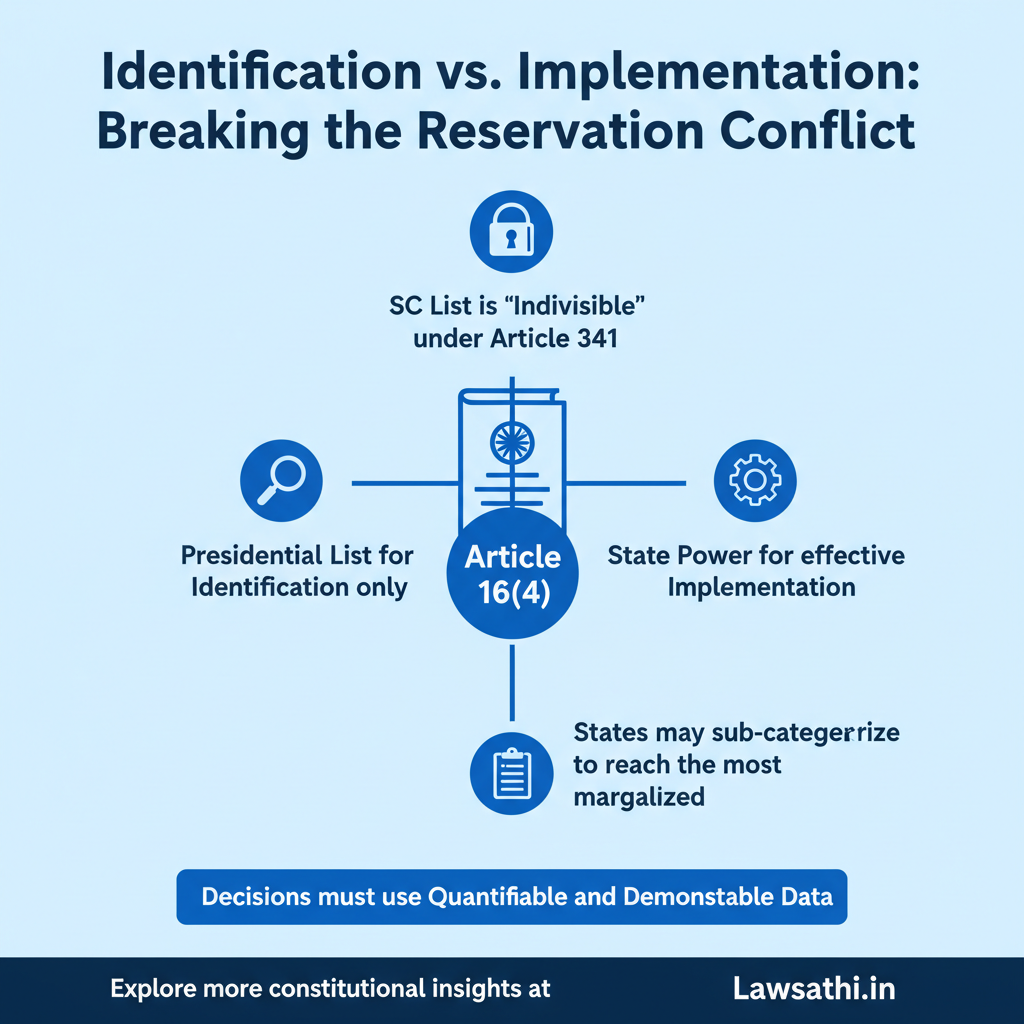
Opponents of the creamy layer exclusion often cite Article 341 of the Constitution. Specifically, they argue that the Scheduled Caste list is “indivisible.” According to this view, only Parliament has the power to vary the list prepared by the President. As a result, they claim that states cannot create sub-categories.
The Overruling of E.V. Chinnaiah
However, the legal landscape changed with the 7-judge bench ruling in State of Punjab v. Davinder Singh (2024). This judgment overruled the earlier E.V. Chinnaiah decision. In this ruling, the Court clarified that Article 341 exists for the purpose of identification.
In contrast, Article 16(4) exists for reservation implementation. Therefore, these two articles serve distinct legal functions.
Judicial Review and State Power
Consequently, states now have the authority to sub-classify SCs and STs. Nevertheless, they must back these decisions with “Quantifiable and Demonstrable Data.” The Judiciary also retains the power to review these classifications. In other words, they must ensure decisions are not arbitrary or politically motivated.
Implications for Indian Lawyers and Legal Practitioners
The introduction of Creamy Layer SC ST Reservations will lead to a surge in litigation. Therefore, lawyers must now focus on gathering empirical evidence for their clients. For instance, any challenge to state-level quotas will require detailed data. Practitioners must specifically prove “inter-se backwardness” to succeed in court.
Navigating Public Employment Disputes
In the future, recruitment rosters will likely reflect sub-categorical quotas. For example, a state government might reserve a specific percentage for the “most backward” sub-groups. Legal practitioners should advise departments to update their service rules immediately. Consequently, they can help clients avoid complex constitutional challenges and lengthy delays.
The Role of Objectively Verifiable Data
Moreover, practitioners must understand that “blanket” policies are no longer sufficient. Courts will demand “Objectively Verifiable Data” to justify any exclusion or sub-classification. Therefore, legal research must now involve a mix of constitutional law and statistical analysis. In short, data is now just as important as legal precedent.
The Future of Sub-Classification and Affirmative Action
As we look toward the future in 2026, the implementation of these rules remains a challenge. The social and political fallout could be significant. However, many experts believe this is a necessary step toward substantive equality.
Global Precedents for Targeted Benefits
In fact, India is not alone in this approach. Other countries with affirmative action models also use targeted benefits. For example, South Africa uses similar methods to reach the most disadvantaged citizens. These global models show a trend toward excluding affluent minorities to help those in extreme poverty.
Balancing Merit and Social Justice
In conclusion, the goal of Creamy Layer SC ST Reservations is to balance meritocracy with social justice. By ensuring that reservation protects the vulnerable, India can achieve a more equitable society. In fact, the journey from the Ashwini Kumar Upadhyay petition marks a new era in Indian law.
Stay ahead of constitutional shifts and manage your research effectively. Specifically, you can use LawSathi’s AI-powered research tools to track Supreme Court precedents in real-time. Book a demo today!