Navigating cross-border matrimonial disputes is increasingly common for Indian lawyers today. Specifically, many Non-Resident Indians (NRIs) seek your help. They want to ensure their foreign judgments hold weight at home.
However, executing a foreign divorce decree in Indian courts is not an automatic process. It requires deep knowledge of statutory rules. It also demands an understanding of evolving judicial precedents.
Navigating the Complexity of NRI Legal Disputes
Private international law in India is complex. Specifically, Indian family law does not treat all foreign countries equally. You must first distinguish between “Reciprocating” and “Non-Reciprocating” territories.
Consequently, this distinction dictates your legal strategy. It determines whether you file for direct execution. In other cases, you may need to initiate a fresh legal suit.
Understanding Recognition vs. Enforcement
Therefore, practitioners must differentiate between mere recognition and actual enforcement. Recognition refers to the legal system accepting a change in marital status. In contrast, enforcement gives that foreign judgment “legal teeth.” Most importantly, this is crucial for matters like property division or child custody.
The Statutory Framework: Decoding Section 13 and 14 of the CPC
The foundation of your case lies in the Code of Civil Procedure, 1908. Specifically, Section 13 outlines the conclusiveness of foreign judgments India.
A foreign decree acts as a final word unless it falls under specific exceptions. Specifically, there are six exceptions you must avoid.
Key Exceptions for Foreign Judgments
For example, a judgment is not conclusive if a court of “competent jurisdiction” did not pronounce it. Furthermore, the court must have decided the case on its merits.
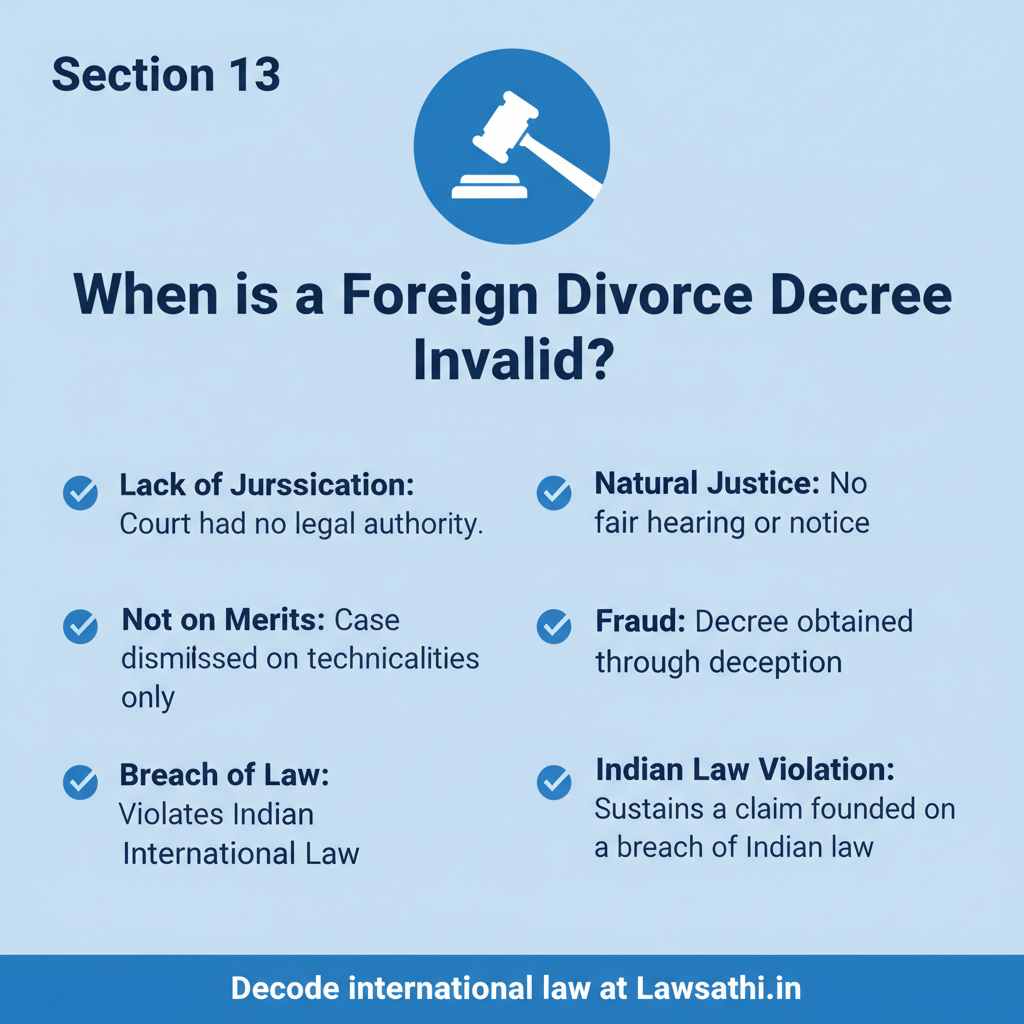
If the decree was obtained via fraud, it remains invalid. Similarly, any breach of Indian law will void the decree. Therefore, practitioners must scrutinize every foreign order against these rigorous tests.
Presumption of Validity Under Section 14
Additionally, Section 14 of the CPC provides a rebuttable presumption. The court will presume a certified copy is valid.
However, the opposing party can still challenge the court’s competence. As a result, you should prepare to defend the foreign court’s jurisdiction. Do this from the very outset of the case.
Jurisdictional Requirements: When is a Foreign Court ‘Competent’?
The most litigated issue in executing a foreign divorce decree in Indian courts is jurisdiction. Indian courts are often protective of marriages solemnized under the Hindu Marriage Act. Consequently, you must prove the foreign court had the legal right to hear the case.
Impact of the Y. Narasimha Rao Standard
The Supreme Court established the “gold standard” in the Y. Narasimha Rao case. The court ruled that a foreign court is only competent if the respondent resides there.
Alternatively, the respondent must voluntarily submit to that court’s authority. This rule prevents unfair “forum shopping” by a single party.
Recognition for Mutual Consent Divorces
In contrast, mutual consent foreign divorce recognition is generally smoother. If both parties participated and consented, Indian courts usually grant comity.
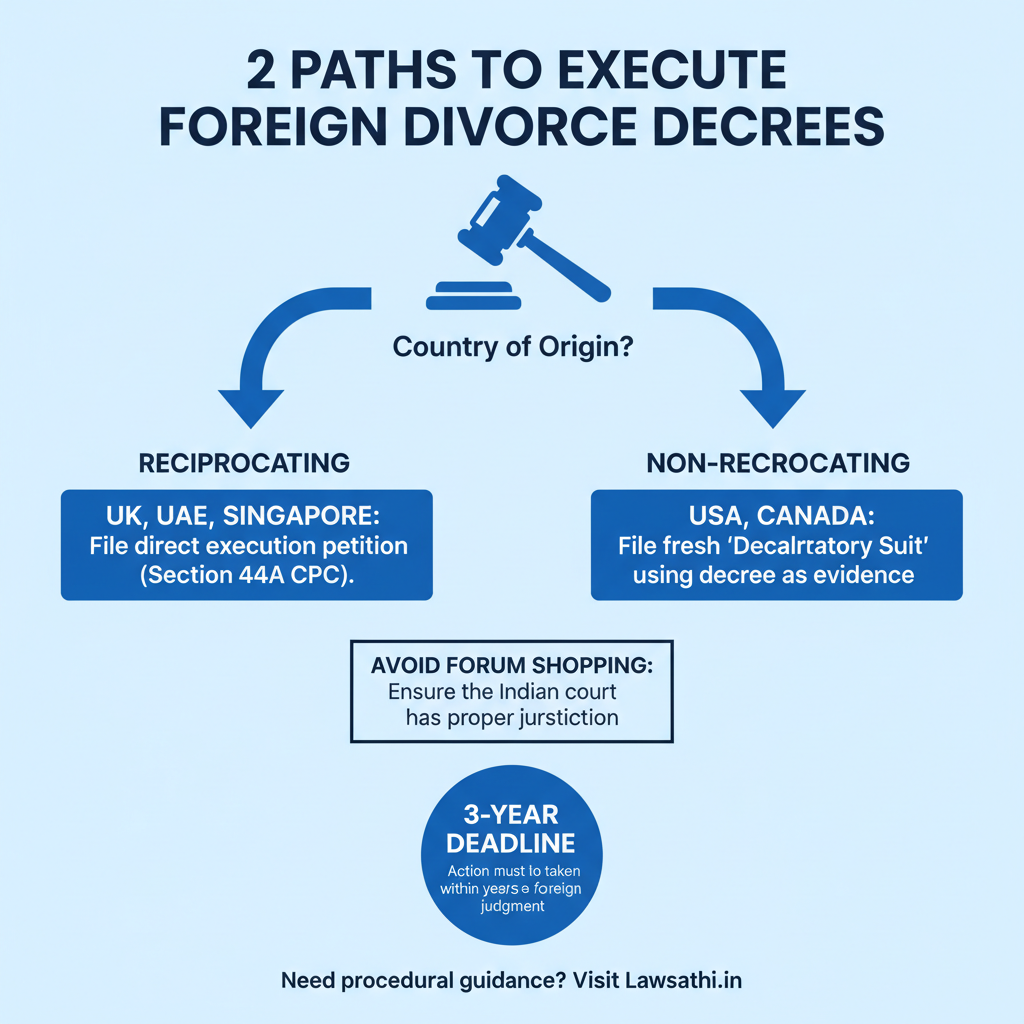
Most importantly, the grounds for divorce should align with Indian law. Specifically, recent Gujarat High Court rulings in 2025 clarify this. They suggest that “no-fault” divorces without participation are often treated as nullities.
Procedural Pathway: Filing for Execution vs. Filing a Declaratory Suit
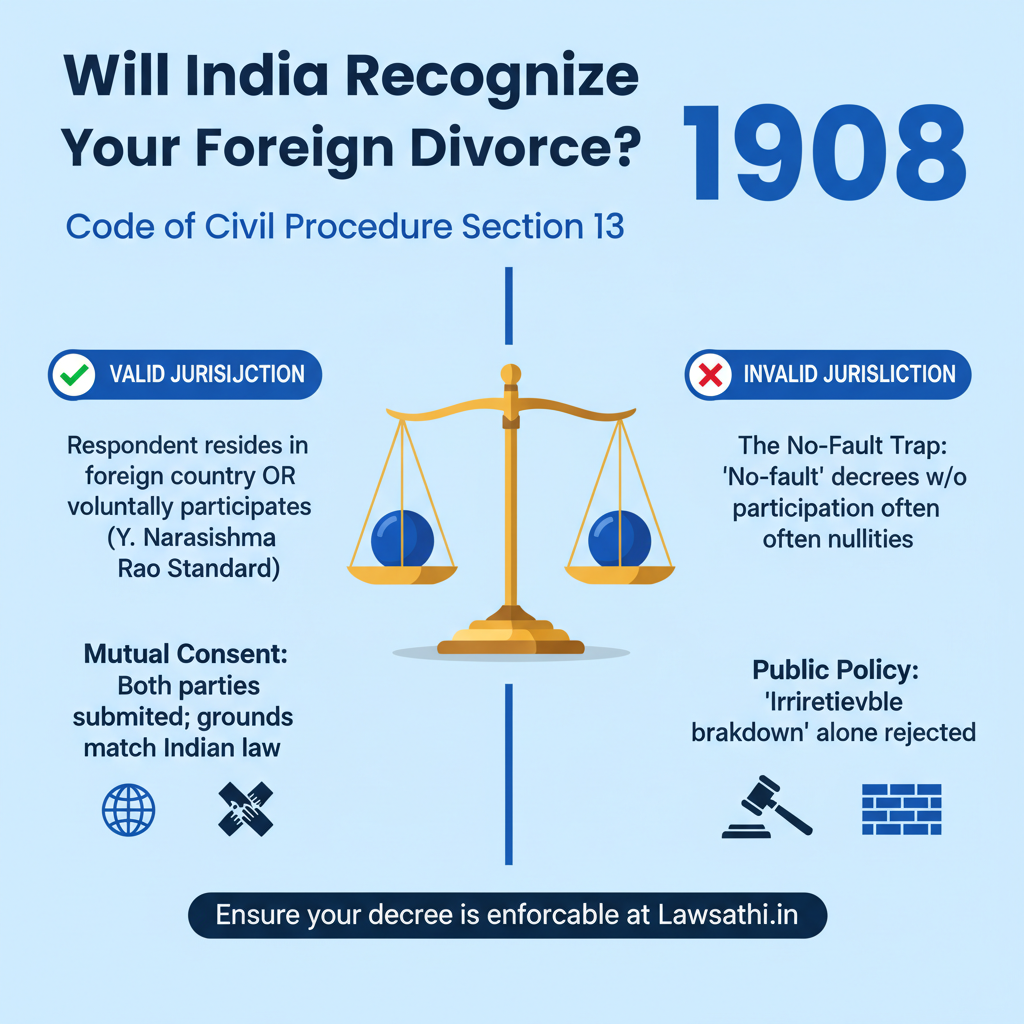
The procedure depends entirely on where the decree originated. For territories like the UK, UAE, or Singapore, you use Section 44A. These are reciprocating territories.
As a result, you can file an execution petition directly. You do this in a District Court or a High Court with original jurisdiction.
Dealing with Non-Reciprocating Territories
However, the process is different for countries like the USA or Canada. You must file a fresh “Declaratory Suit” based on the foreign judgment.
In this scenario, the foreign decree serves as strong evidence. It is not a direct order. Consequently, you are asking the Indian court to pass its own decree based on the foreign one.
Essential Deadlines for Filing Execution
Finally, pay close attention to the clock. The limitation period for executing a foreign decree is three years.
This clock usually starts from the date of the foreign judgment. Moreover, the Supreme Court has warned against shopping for limitation periods. Therefore, you must act promptly to protect your client’s rights.
Mandatory Documentation Checklist for Legal Practitioners
Success in executing a foreign divorce decree in Indian courts depends on paperwork. Without proper legal documentation for foreign decree execution, your petition will fail. High Courts are increasingly strict about the “chain of custody” for these documents.
Apostille and Authentication Requirements
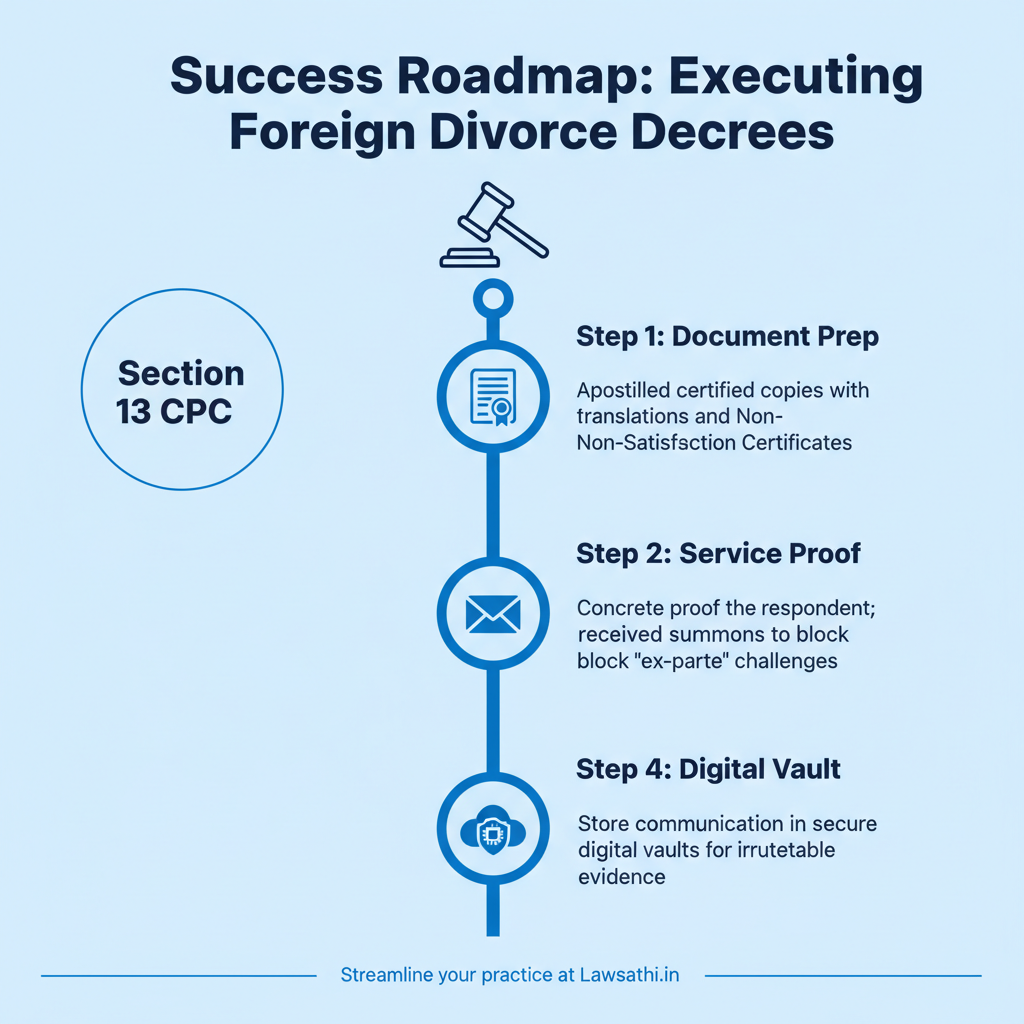
First, obtain a certified copy of the decree. This document must be Apostilled per the Hague Convention.
If the country is not a member, get it authenticated by the Indian Embassy. Additionally, ensure you have a “Certificate of Non-Satisfaction.” This proves the decree remains unfulfilled in the originating country.
Professional Translation and Service Proof
Second, provide a certified English translation. Use this if the original is in a foreign language. Moreover, you must prove the respondent received the summons.
Affidavits regarding the service of summons are vital. For example, they help you defend against claims that the decree was “ex-parte.” They also ensure you meet the standards of natural justice.
Common Hurdles: Principles of Natural Justice and Public Policy
Many foreign decrees face challenges on the grounds of “Public Policy.” For instance, India does not yet recognize “irretrievable breakdown of marriage.”
This is not a statutory ground under the Hindu Marriage Act. Although the Supreme Court uses Article 142 for such cases, lower courts may struggle.
Defending Against Ex-Parte Challenges
Furthermore, “ex-parte” decrees are frequently contested. Expect resistance if your client obtained a divorce while the other spouse was in India.
You must demonstrate that the respondent had an opportunity to appear. In fact, if the foreign court ignored Indian law, the decree might be void.
Risks of Fraud and Forum Shopping
Similarly, false claims of “domicile” create significant risks. If a party moves just to get a quicker divorce, it constitutes fraud.
Indian courts despise “forum shopping.” Therefore, always verify the client’s residency duration before filing. This protects your case from being dismissed later.
The Future of Matrimonial Execution: AI and Digital Management
By 2026, technology has fundamentally changed how we handle these cases. For instance, SCC Online and Harvey AI now allow lawyers to cross-reference global laws instantly.
This helps you prove “comity of courts” during your arguments. Moreover, digital tools make case tracking much more efficient.
Managing Digital Evidence with Care
However, the Supreme Court has warned about AI-generated fabricated evidence. Courts are now imposing costs for unverified AI submissions.
As a professional, you must use secure digital vaults. Store genuine communication and service records safely. This ensures your evidence remains beyond reproach.
Strategic Conclusion for Modern Practices
Executing a foreign decree requires procedural precision. It also needs strategic foresight. By understanding the CPC, you can protect your NRI clients effectively.
Always keep up with digital trends in the legal field. Finally, ensure your documentation is impeccable to survive the Section 13 test.
Streamline your international matrimonial filings and manage documentation effortlessly. Upgrade your practice with LawSathi’s AI-powered management tools today.