# Filing a Delay Condonation Application for Delayed Appeals: A Complete Guide for Lawyers
Missing a deadline in litigation can be a nightmare for any advocate. In India, the law of limitation ensures that disputes reach a final conclusion. However, life and legal practice are often unpredictable. This is where a delay condonation application serves as a vital legal remedy.
Introduction: The Rigor of Limitation and the Safety Valve of Section 5
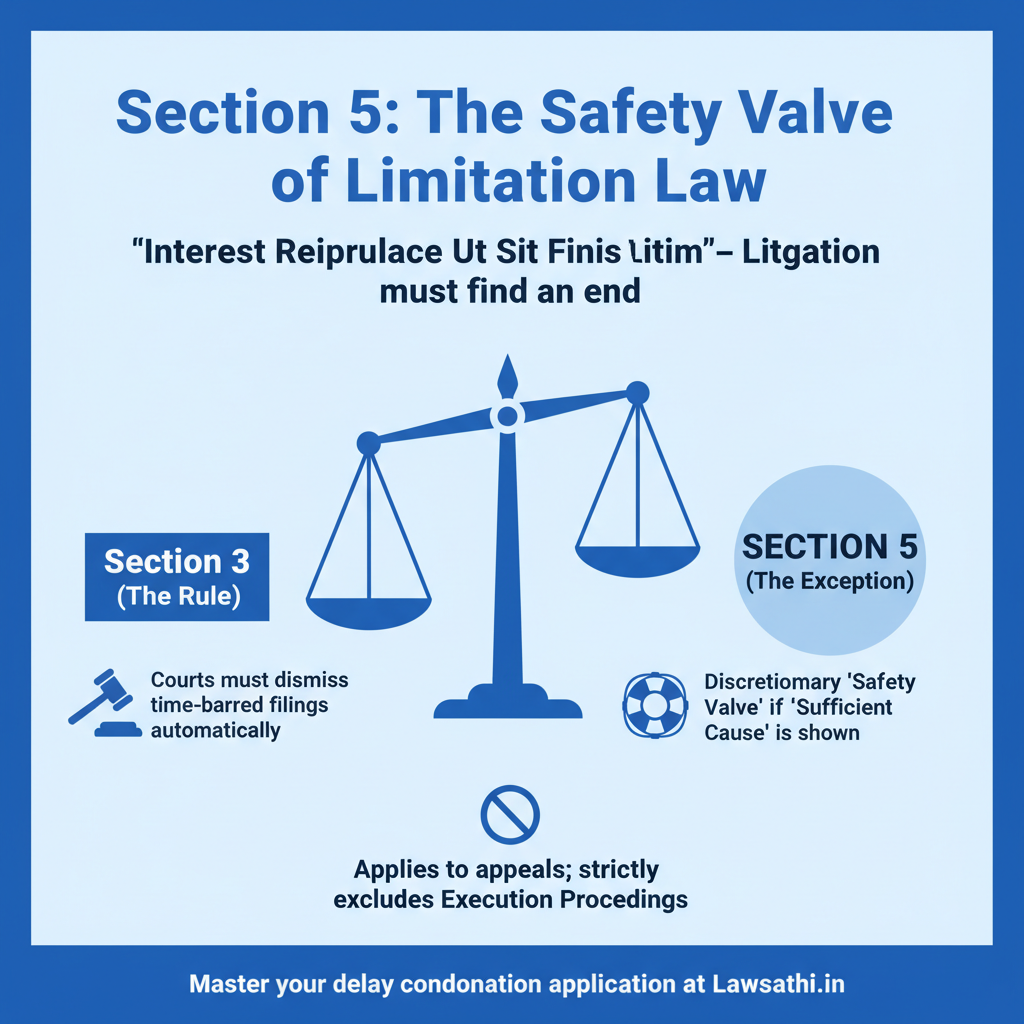
The Limitation Act, 1963, governs the timeframes for filing legal proceedings in India. This Act rests on a specific legal maxim. Specifically, it follows “Interest Reipublicae Ut Sit Finis Litium.” This means it is in the interest of the State that there be an end to litigation. Therefore, the law expects litigants to be vigilant at all times.
The Consequences of Inaction
Section 3 of the Act imposes a mandatory duty on courts. Specifically, the court must dismiss any appeal filed after the prescribed period. This happens even if the opposing party does not raise the issue of limitation. Consequently, missing a deadline can result in the loss of a client’s right to justice.
Section 5 as a Discretionary Relief
Fortunately, Section 5 acts as a “safety valve” for litigants. It allows courts to admit appeals or applications after the deadline. However, this is not an automatic right for the lawyer. The applicant must show “sufficient cause” for the delay. This balance ensures that procedural rigor does not result in a miscarriage of justice.
Statutory Framework: Section 5 of the Limitation Act Explained
Understanding the scope of a delay condonation application is essential for effective practice. Section 5 applies specifically to appeals and certain applications. However, it does not apply to all legal proceedings across the board.
Where Section 5 Does Not Apply
Most importantly, Section 5 expressly excludes execution proceedings under Order XXI of the CPC. This is a critical distinction for lawyers to remember. If you miss a deadline in an execution matter, you cannot rely on Section 5. Instead, you must look for specific statutory exceptions or prove fraud.
The Requirement of Explaining Every Day
In the case of Pathapati Subba Reddy v. Special Deputy Collector (2024), the Supreme Court clarified the applicant’s duty. You must explain the entire period of delay. Furthermore, this explanation should cover the time from the start of the limitation until the date of filing.
Jurisdictional Scope of the Power
Courts have discretionary power to condone delay. This power exists in appellate courts and courts handling miscellaneous applications. Moreover, the court must be satisfied that the cause shown is genuine. Therefore, drafting a precise application is the first step toward reclaiming your client’s rights.
Defining ‘Sufficient Cause’: Judicial Interpretations and Precedents
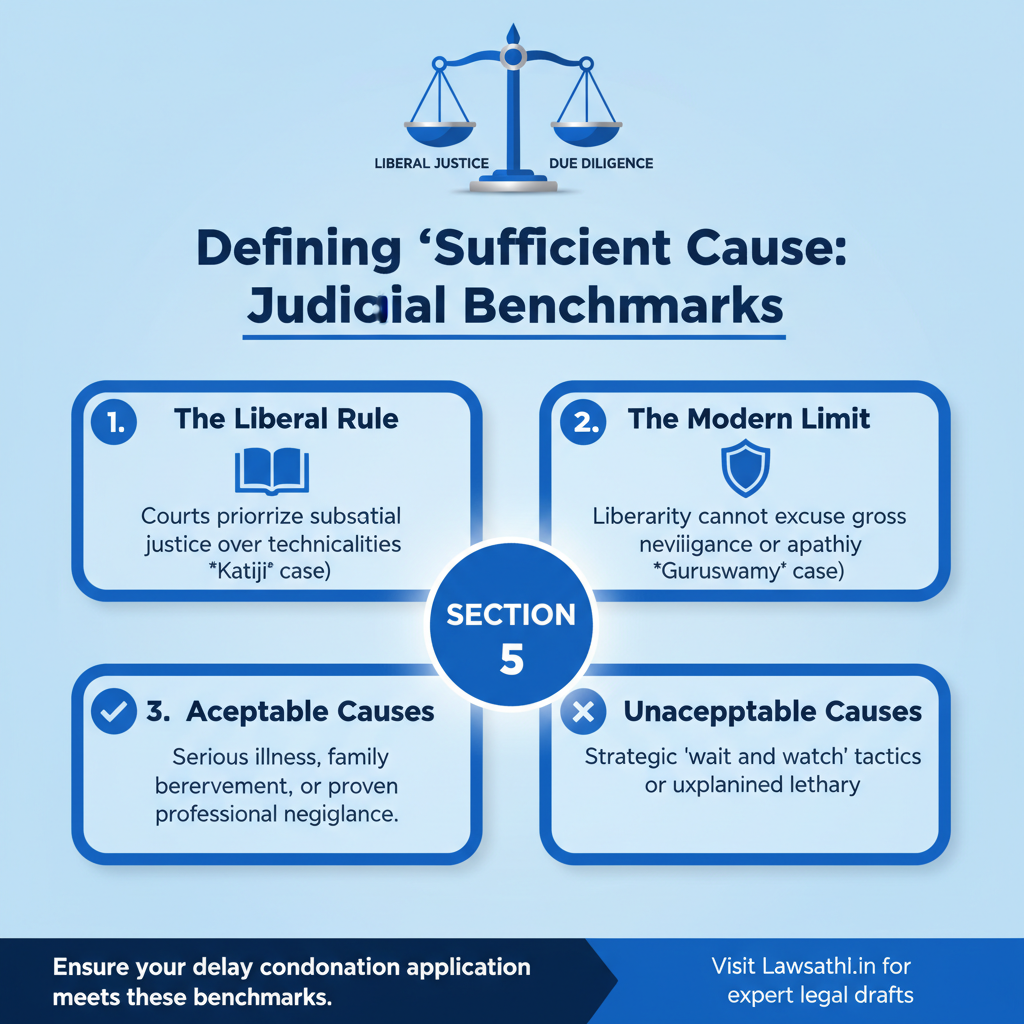
What exactly constitutes “sufficient cause”? To illustrate, courts often view this as an elastic expression. It must be applied in a way that subverts technicality for the sake of justice.
The Liberal vs. Strict Approach
The landmark case of Collector Land Acquisition v. Mst. Katiji (1987) established a liberal approach. The Supreme Court held that courts should not be pedantic. Instead, they should aim for “substantial justice.” For example, a minor delay should not bar a party from a hearing on merits.
Modern Judicial Caution
However, recent judgments like H. Guruswamy v. A. Krishnaiah (2025) add a layer of caution. The court noted that a liberal approach cannot kill the law of limitation. In other words, you cannot use “sufficient cause” to cover gross negligence.
Acceptable and Non-Acceptable Causes
Acceptable causes often include illness or death in the family. Additionally, professional negligence by a previous lawyer can be a valid reason. Conversely, “wait and watch” strategies are usually rejected. While courts are lenient with the State, even government departments must eventually explain their reasons for lethargy.
Step-by-Step Procedure for Filing the Application
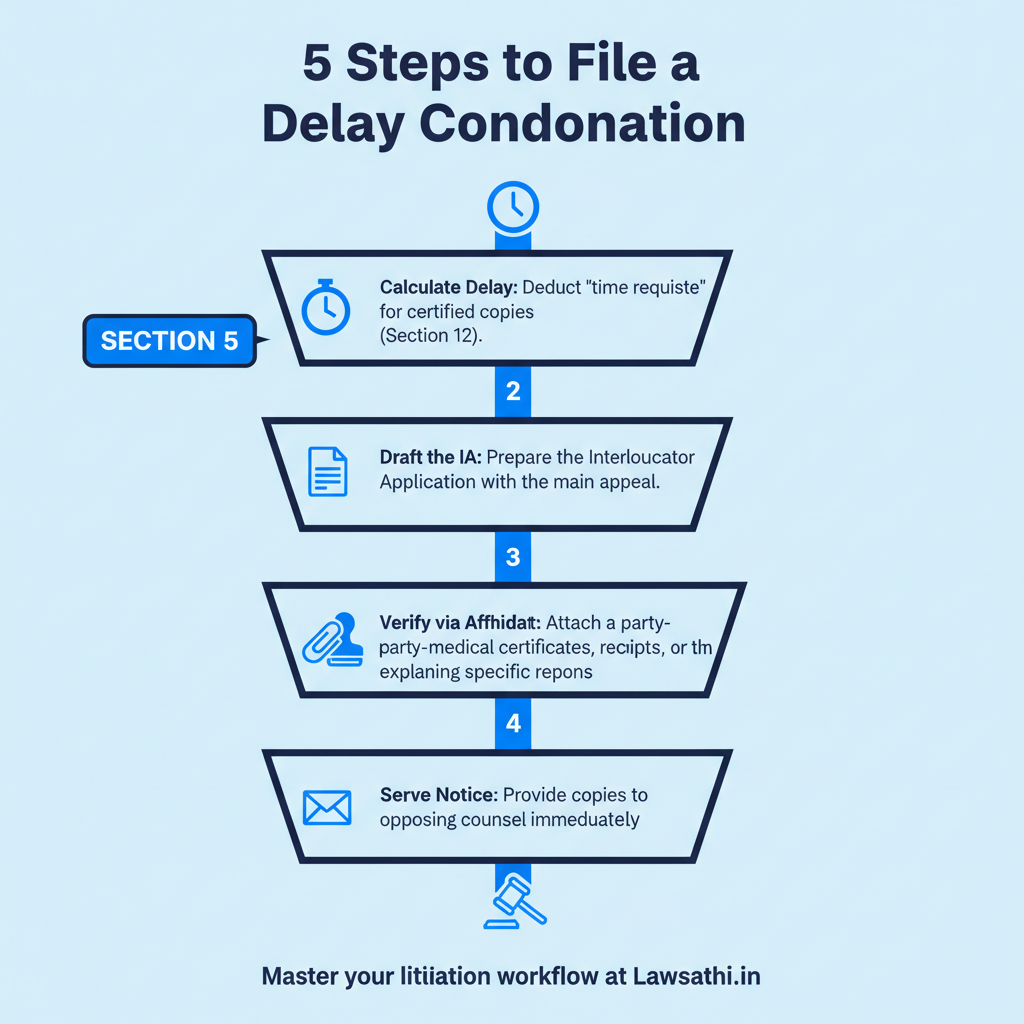
Filing a delay condonation application requires careful procedural adherence. You must file it as a Miscellaneous Application. This is often called an Interlocutory Application (IA). Moreover, this application must accompany the main appeal or petition you are seeking to file.
Draft the Main Application and Affidavit
The application must state the facts leading to the delay clearly. Moreover, a supporting affidavit must accompany it. The party or an authorized representative should sign this affidavit. Specifically, it must swear to the truth of the reasons provided for the delay.
Calculating the Exact Period of Delay
First, calculate the base limitation period for your case. Second, use Section 12 of the Limitation Act to exclude specific periods. For example, exclude the “time requisite” for obtaining a certified copy of the order. This time starts from the application date until the copy is ready.
Procedural Formalities in Court
Different High Courts may have specific rules for filing these applications. Typically, you will need to pay a nominal court fee for the IA. Ensure all medical certificates or evidence are attached as annexures. Finally, serve copies of the application to the opposing counsel immediately.
Drafting Tips for Litigation Lawyers: Avoiding Pro-forma Rejections
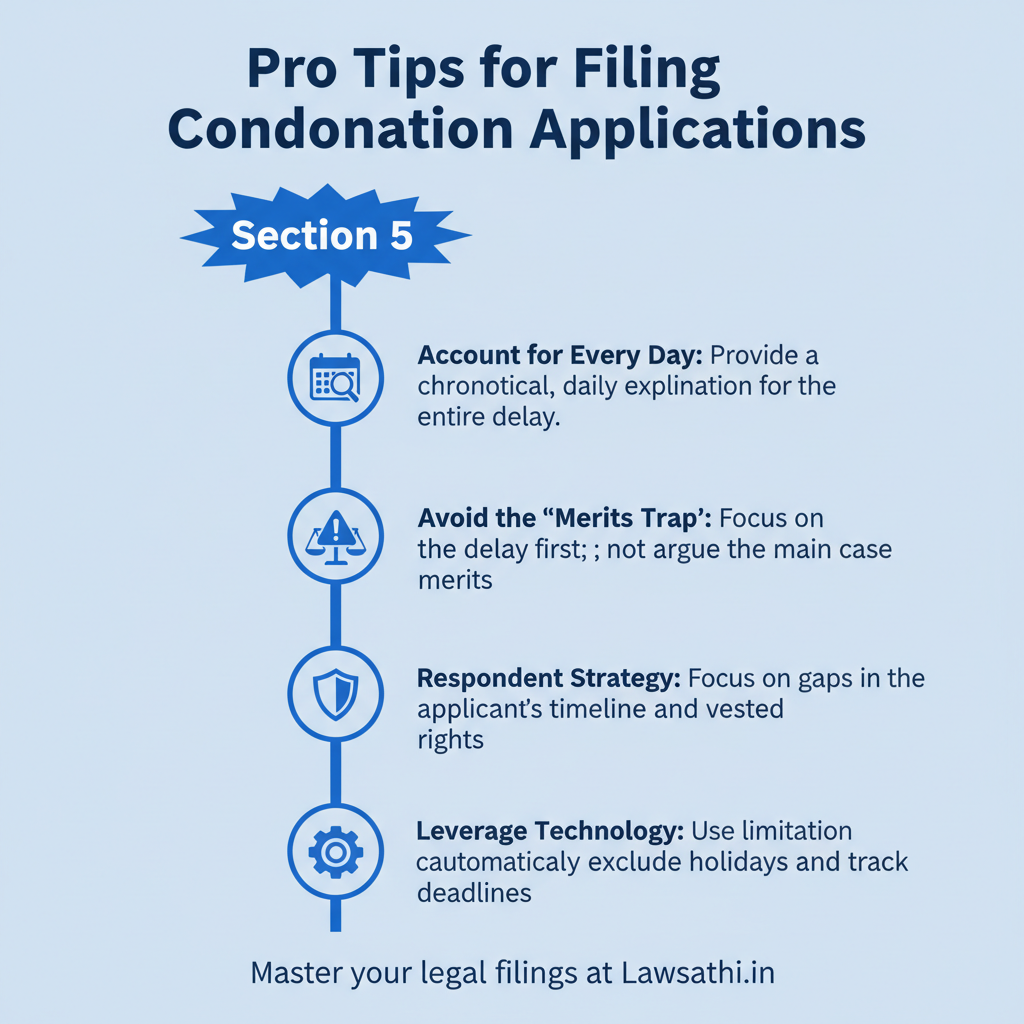
A poorly drafted application often leads to instant rejection. Therefore, structure your “Explanation of Delay” chronologically. A simple timeline is often more effective than long, confusing paragraphs.
Use Documentary Evidence
Always attach proof for every claim you make. For instance, if you claim the client was ill, attach a valid medical certificate. If there was a postal delay, include the tracking report. Consequently, the court will find your claims much more credible and reliable.
Focusing on the Primary Cause
Avoid the “merits trap” during the initial hearing. The Supreme Court in Surendra G. Shankar v. Esque Finamark (2025) held a key ruling. It stated that courts should not consider the merits until the delay is condoned. Therefore, prioritize explaining the cause of delay over arguing the case itself.
Language and Tone
Keep your tone respectful and factual at all times. Use active voice to describe your actions. For example, state that the appellant applied for the copy on January 5th. Furthermore, avoid passive constructions that obscure who was responsible for the delay.
The Opponent’s Perspective: How to Challenge a Delay Condonation Application
If you represent the respondent, you have a duty to oppose unjustified delays. In fact, the expiry of limitation creates a “vested right” for your client. This right should not be disturbed without a very strong reason.
Filing a Counter-Affidavit
You should file a detailed reply to the delay application. Specifically, point out any inconsistencies in the applicant’s timeline. If there are periods left unexplained, highlight them for the court. This demonstrates a lack of due diligence by the other side.
Arguing Against Condonation
Focus on the principle of finality in litigation. Highlight if the delay appears to be a “strategic choice” rather than a bona fide mistake. Additionally, argue that the applicant has been grossly negligent. In such cases, the court is less likely to grant discretionary relief.
Technology as a Safeguard: Using LawSathi to Eliminate Delays
Manual tracking of limitation periods is risky in a busy practice. Modern lawyers now use technology to prevent these delays altogether. Digital tools can manage your deadlines with high precision.
Automated Limitation Calculators
LawSathi offers automated tools that calculate limitation periods based on court types. These tools automatically exclude court holidays. Furthermore, they account for the time taken to obtain certified copies under Section 12.
Centralized Deadline Tracking
Additionally, LawSathi provides automated alerts for your entire legal team. You can set notifications for 30, 15, and 7 days before a deadline. This ensures that no appeal falls through the cracks due to a busy schedule.
Instant Access to Evidence
Storing digital copies of receipts in a centralized system allows for instant retrieval. As a result, your team can file appeals much faster. Therefore, you spend less time explaining delays and more time winning cases for your clients.
Never miss a limitation deadline again. Use LawSathi’s AI-powered automated deadline tracking and calendar management to stay ahead of your appeals. Schedule a demo today.