Introduction: Gujarat’s Bold Legislative Move Against Land Encroachment
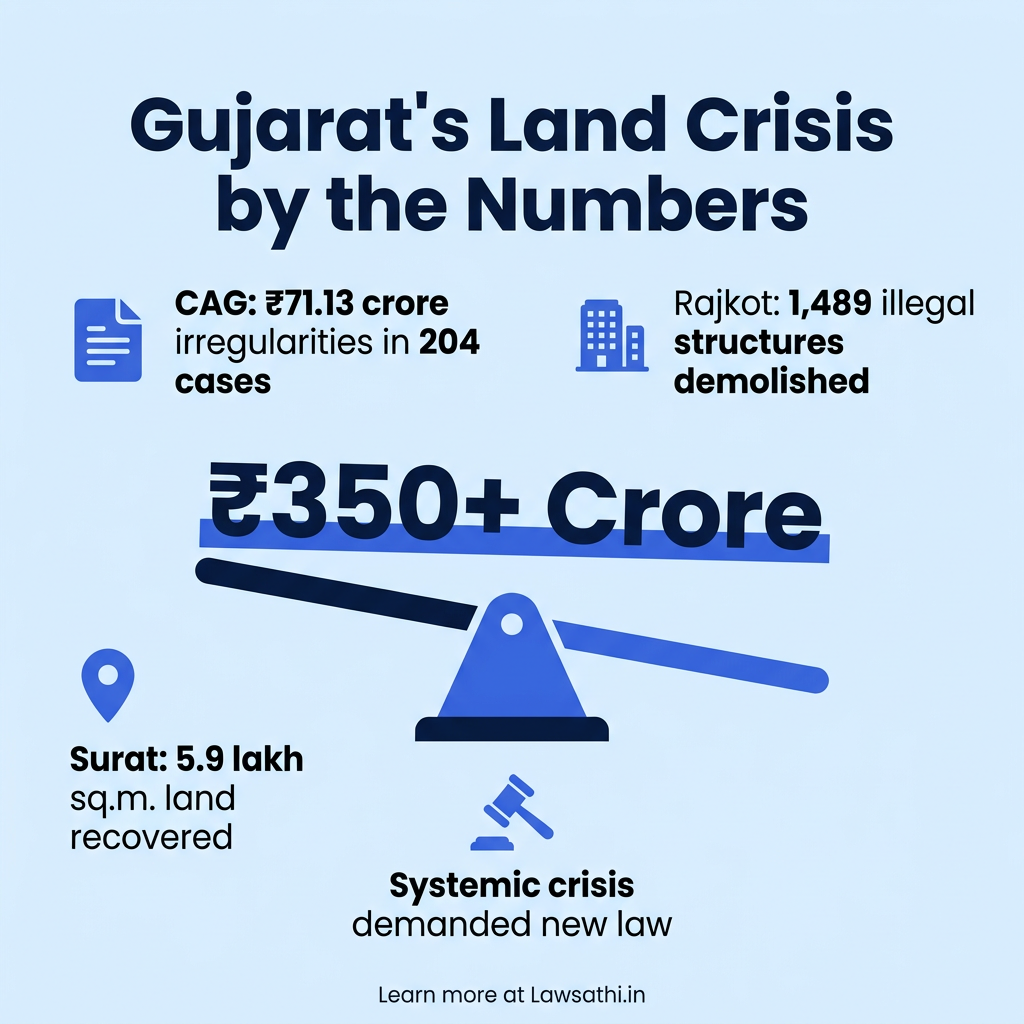
Land encroachment has plagued Gujarat’s agricultural sector for decades. The Comptroller and Auditor General of India identified ₹71.13 crore in irregularities across 204 cases. These cases involve land revenue matters, including encroachment and short levy of premium CAG Report. This systemic problem demanded decisive legislative intervention.
The Scale of Illegal Land Grabbing
Recent enforcement actions reveal the magnitude of this crisis. In February 2026, the Rajkot Municipal Corporation demolished 1,489 illegal structures. This action cleared 88,750 square meters of government land valued at over Rs 350 crore Indian Express.
Similarly, authorities recovered 5,91,219 square meters of government land in Surat district. These numbers demonstrate why the Gujarat land grab law has become essential for property lawyers across India.
The Gujarat Land Grabbing (Prohibition) Act, 2020, notified on October 9, 2020, represents India’s most stringent legislation against land encroachment. Furthermore, its active enforcement in 2026 signals a paradigm shift in revenue law enforcement. Therefore, legal practitioners must understand this law thoroughly. This is because it affects both government and private land disputes.
Key Provisions of the New Gujarat Land Protection Legislation
Understanding the Definition of Land Grabbing
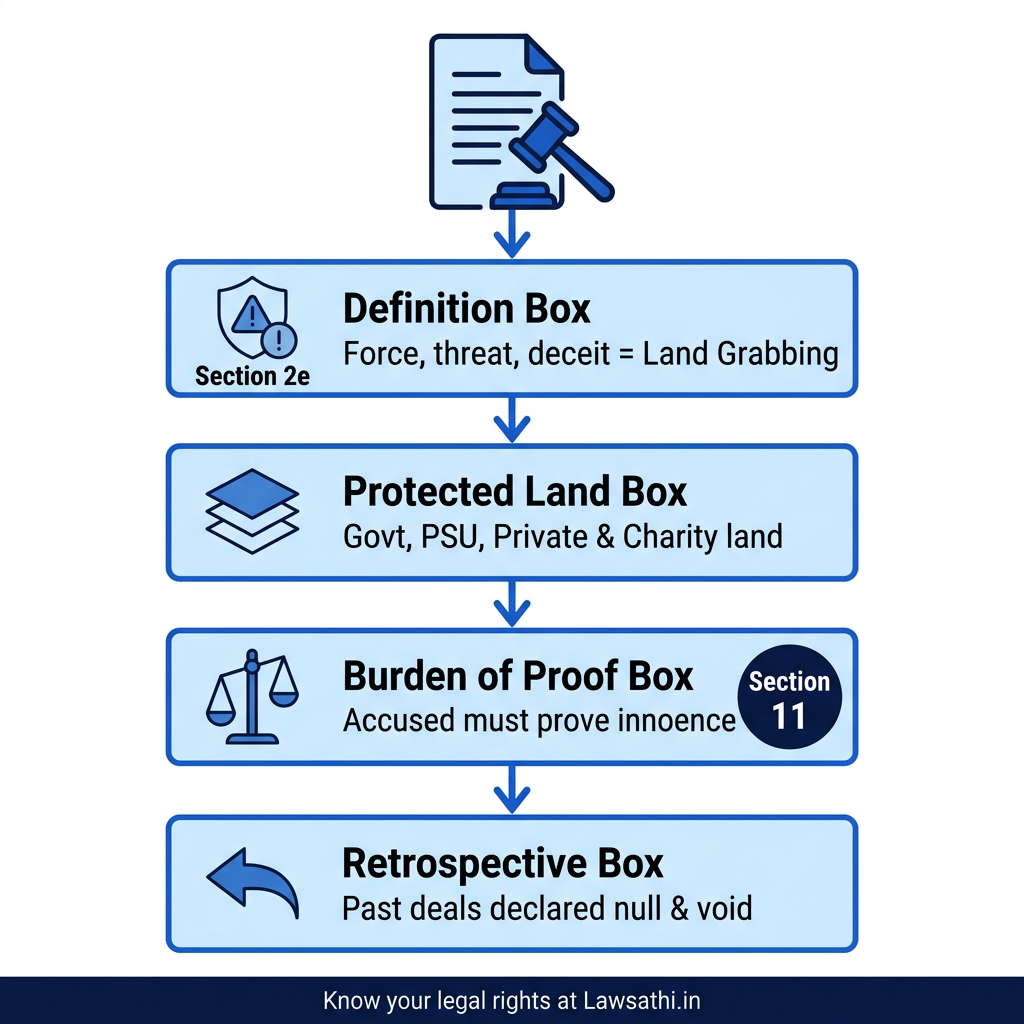
Section 2(e) of the Act defines land grabbing comprehensively. It covers every activity of a land grabber to occupy land without ownership, title, or physical possession Gujarat Government Gazette. The definition includes using force, threat, intimidation, or deceit.
Additionally, the law covers creating illegal tenancies, lease agreements, and licenses. Transfer or sale of grabbed land also constitutes an offence. Even constructing unauthorized structures for sale, hire, or personal use falls within this definition. Consequently, the Gujarat land grab law creates a broad net to catch various forms of encroachment.
Who Qualifies as a Land Grabber?
Section 2(d) defines a “land grabber” expansively. It includes not just the person who commits land grabbing. In fact, financial aid providers for illegal possession also face prosecution. Those collecting rent or charges through criminal intimidation qualify as land grabbers. Even abettors and successors-in-interest fall within this definition.
Protected Categories of Land
The legislation protects multiple categories of land under Section 2(e):
1. Government land 2. Public Sector Undertaking land 3. Local authority land 4. Religious or charitable institution land 5. Private person’s land
This last category makes the Gujarat land grab law unique. Unlike traditional encroachment laws, this Act applies equally to disputes between private parties.
The Controversial Reverse Burden of Proof
Section 11 introduces a revolutionary shift in evidentiary burden. When land is prima facie proved to be owned by the government or private person, the Special Court shall presume the alleged occupier is a land grabber LiveLaw. As a result, the burden shifts to the accused to prove lawful possession.
Legal scholars have criticized this provision. They argue it potentially violates Article 20(3) of the Constitution, which protects against self-incrimination. However, courts have generally upheld similar reverse burden provisions in other statutes.
Retrospective Application and Override Effect
Section 17 declares that any transaction relating to grabbed land shall be null and void. This applies whether before or after the Act’s commencement. This retrospective application challenges existing court decrees and tribunal decisions. Furthermore, Section 15 strengthens the law by stating it overrides all inconsistent laws, decrees, or court orders.
These provisions create significant uncertainty for property owners with longstanding possession. Specifically, even court decrees obtained before 2020 may face challenges under this law.
Legal Implications for Property Lawyers and Their Clients
Impact on Ongoing Land Dispute Litigation
The Gujarat High Court’s February 2026 ruling in the Ashram case demonstrates the law’s practical impact. The Court upheld state action despite claims of 39 years of possession Indian Express. The Single Judge supported eviction from 45,000 square meters of government land. This eviction was under Section 202 of the Gujarat Land Revenue Code, 1879.
This judicial approach signals that long-standing possession no longer guarantees protection. Similarly, the Orissa High Court echoed this reasoning in February 2026. The Court stated that mere long-standing occupation does not ripen into a legal right. This applies when initial entry itself is unauthorized Times of India.
Enhanced Due Diligence Requirements
Lawyers must now conduct more thorough due diligence for agricultural land transactions. The standard title search no longer suffices. Therefore, a comprehensive checklist should include:
Document Verification: 1. 7/12 extract (Satbara) and 8A entries through AnyRoR portal 2. Pending mutation applications 3. Physical possession verification matching recorded area 4. DGPS survey results for accurate measurement 5. Title chain examination for encroachment history
Category Verification: – Government land classification – Grazing land (gauchar) status – New versus old tenure classification – Non-agricultural permission status
Shifting Burden of Proof in Practice
Before the Gujarat land grab law, plaintiffs bore the burden of proving title and possession. However, now once prima facie ownership is established, occupants must prove lawful possession. This shift fundamentally changes litigation strategy.
Additionally, adverse possession claims have become more difficult to sustain. Long-standing possession without documented recognition no longer provides automatic protection. Consequently, documentation requirements have become significantly stricter.
New Defenses Available to Landowners
Landowners facing eviction proceedings can raise several defenses:
1. Valid title documentation with proper registration 2. Government allotment orders from competent authority 3. Long-standing possession with revenue record recognition 4. Court decrees predating the Act (subject to Section 17 challenge) 5. Adverse possession claims matured before 2020
Effect on Third-Party Rights and Bona Fide Purchasers
Section 17’s retrospective nullity provision creates significant risks for third parties. The Act declares all transactions relating to grabbed land void, regardless of when they occurred. As a result, bona fide purchasers who bought land in good faith may lose their rights entirely.
This risk makes title insurance increasingly important for property transactions. Therefore, lawyers should advise clients to obtain comprehensive title insurance before purchasing agricultural land.
Enforcement Mechanisms and Penalties Under the New Law
Role of Revenue Authorities and District Collectors
The District Collector chairs the Committee constituted under Section 2(a) Gujarat Revenue Department. This Committee considers all applications and complaints regarding land grabbing. Subsequently, it makes findings for the Special Court’s consideration.
Severe Criminal Penalties
Section 4 prescribes stringent punishment for land grabbing:
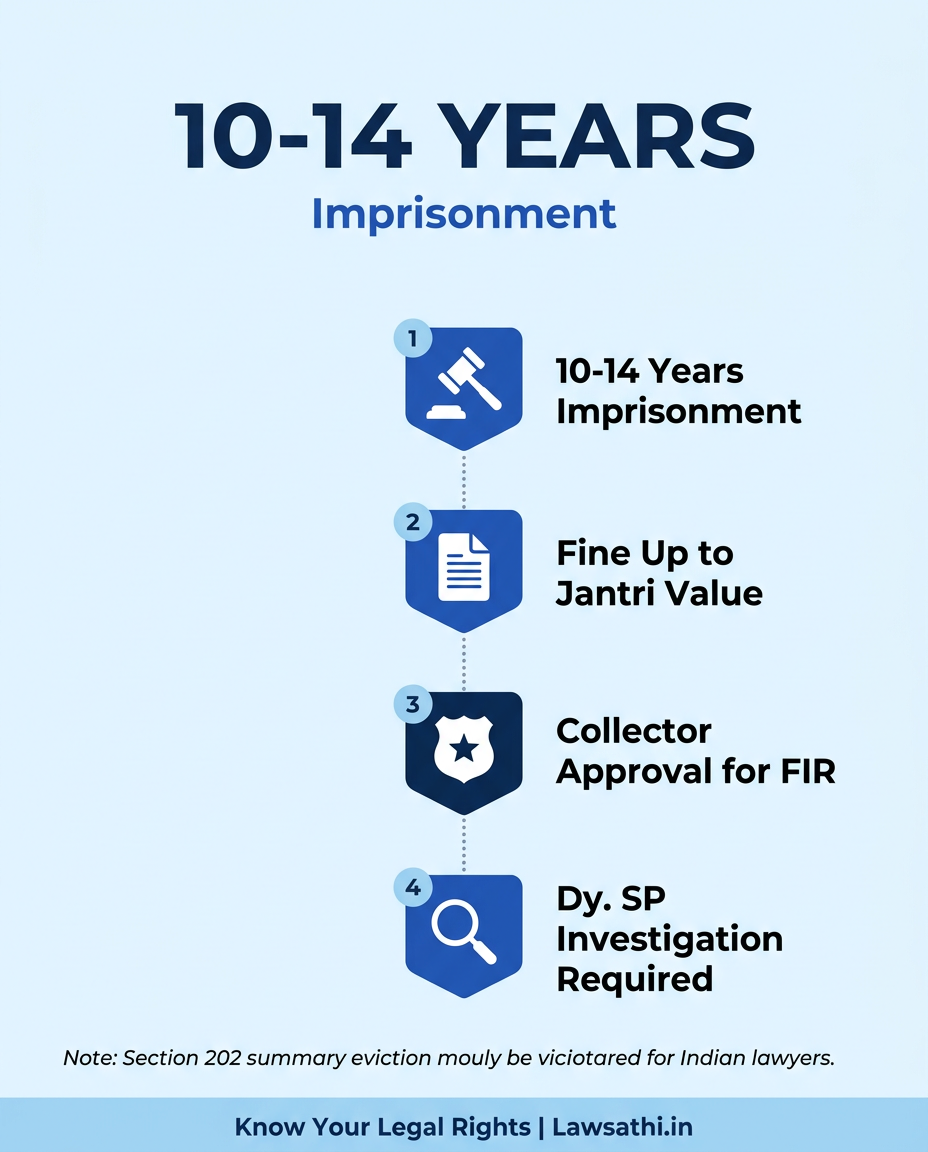
– Minimum imprisonment: 10 years – Maximum imprisonment: 14 years – Fine: Up to Jantri value of the property
Notably, the law provides no provision for lesser sentences. Critics argue this violates the doctrine of proportionality established in constitutional jurisprudence. However, the legislature clearly intended deterrence through severity.
Summary Removal Procedures
Section 202 of the Gujarat Land Revenue Code, 1879, provides for summary eviction. The competent revenue authority issues an eviction notice. Furthermore, the procedure allows limited time for response before removal.
The Rajkot demolition case illustrates this procedure in action. Authorities issued 952 notices ten months before demolition Indian Express. They conducted personal hearings before issuing second notices. The High Court refused urgent hearing, and demolition proceeded.
Appeal Mechanisms and Judicial Review
The appeal hierarchy includes:
1. Special Court (Section 7) 2. Gujarat Revenue Tribunal 3. Gujarat High Court (Division Bench) 4. Supreme Court
However, a critical infrastructure gap exists. Special Courts have not been established in all districts despite active enforcement. This creates practical difficulties for affected parties seeking remedies.
Coordination with Law Enforcement
Section 12 requires specific procedures before filing FIRs. No FIR can be filed without prior approval of the District Collector in consultation with the Committee. Additionally, investigation must be conducted by an officer not below the rank of Deputy Superintendent of Police.
For major enforcement actions, police deployment is substantial. For example, the Rajkot operation involved 2,900 police personnel Zee News. The Deputy Commissioner of Police (Crime) personally supervised the operation.
Compliance Timeline and Action Items for Landowners
Immediate Actions Required
The Gujarat land grab law prescribes no statutory deadline for filing claims. However, ongoing possession of grabbed land constitutes a continuous offence under Section 4(2). Therefore, landowners should regularize or vacate immediately upon receiving any notice.
Essential Documentation for Lawful Possession
Primary Documents: 1. 7/12 Extract (Satbara): Record of Rights showing ownership 2. 8A Extract: Mutation entries 3. Property Card: For urban properties 4. Registered Sale Deed/Gift Deed/Will: With probate where required
Supporting Documents: 5. Government allotment order (if applicable) 6. Non-Agricultural permission certificate 7. Building permission for structures 8. Tax receipts proving continuous possession 9. Village Form No. 1-14: Various revenue records
Steps for Landowners to Protect Property
Lawyers should advise clients to take these proactive measures:
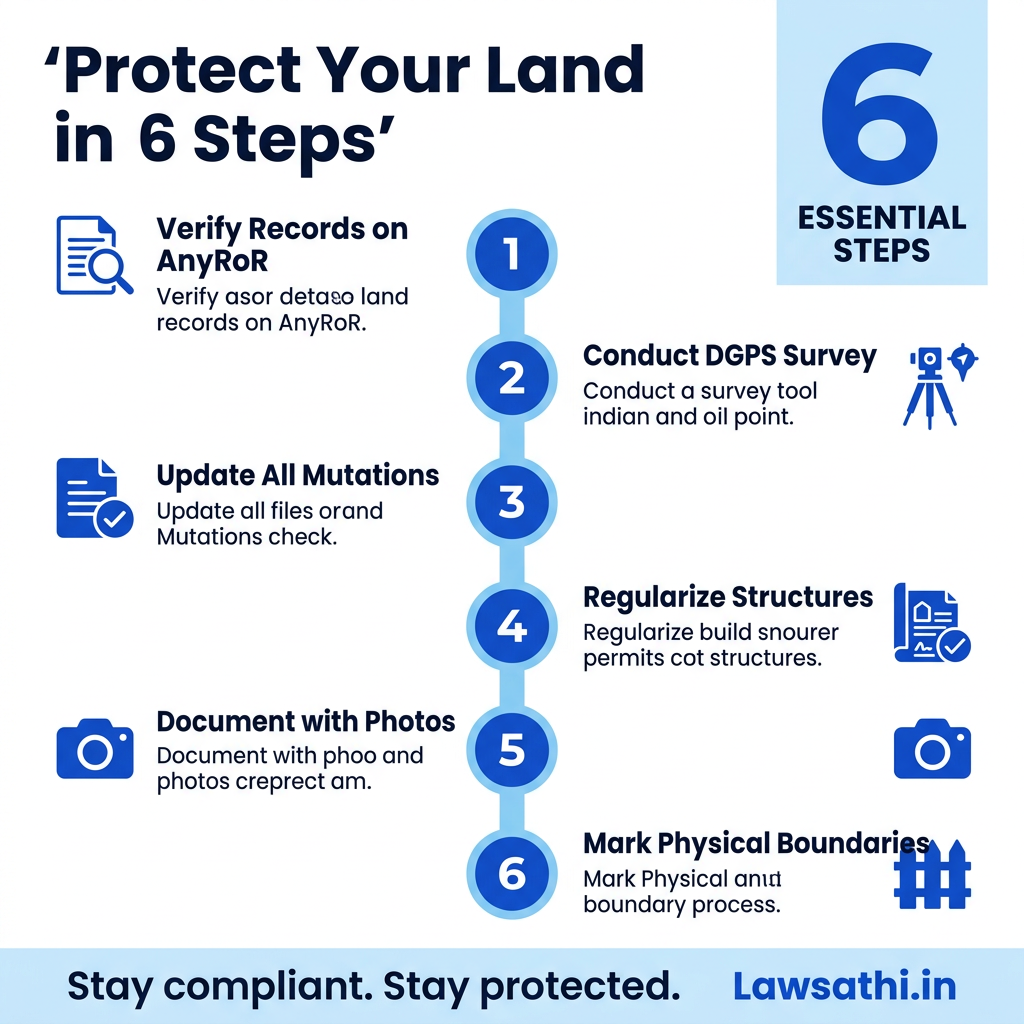
Step 1: Verify Records First, check the AnyRoR portal (anyror.gujarat.gov.in) for current entries.
Step 2: Conduct DGPS Survey Second, modern measurement ensures accuracy and prevents boundary disputes.
Step 3: Update Mutations Third, file pending mutation applications immediately.
Step 4: Regularize Structures Fourth, obtain permissions for all unauthorized constructions.
Step 5: Document Possession Fifth, maintain dated photographs showing active cultivation or use.
Step 6: Physical Demarcation Finally, install fencing or boundary walls to clearly mark property limits.
Digital Land Record Systems
Gujarat has digitized land records through the AnyRoR portal. This system provides online access to 7/12 extracts and 8A entries. Additionally, the E-Nath portal handles property registration. Jantri provides land rates for stamp duty and penalty calculations.
Lawyers should encourage clients to regularly monitor these portals. In fact, early detection of fraudulent entries can prevent serious complications.
How This Law Fits Within India’s Broader Land Reform Landscape
Comparison with Other States’ Laws
Several states have enacted similar legislation, but with notable differences:
Odisha Prevention of Land Encroachment Act: This law provides for summary eviction of unauthorized occupants. Recent High Court rulings emphasize procedural compliance Times of India.
Andhra Pradesh Assigned Lands Act (Amended February 2026): In contrast, this Act allows assignees to lease lands for clean energy projects. It focuses on industrial growth and employment generation Times of India.
Key Distinction: The Gujarat land grab law remains the most stringent. Specifically, it combines criminal prosecution with civil proceedings. It prescribes minimum 10-year imprisonment. Moreover, it applies to private land disputes between individuals.
Constitutional Validity Considerations
Legal scholars have raised several constitutional concerns:
1. Article 20(3): Protection against self-incrimination versus reverse burden of proof 2. Article 14: Equality before law; retrospective application may violate this principle 3. Article 21: Procedural due process; summary eviction concerns 4. Doctrine of Proportionality: Uniform 10-year minimum sentence
The Supreme Court’s February 2026 ruling in the Assam forest encroachment case offers guidance. The Court emphasized that environmental protection must proceed through lawful means Mondaq. Therefore, procedural safeguards remain essential even in eviction cases.
Intersection with Central Land Acquisition Laws
The Right to Fair Compensation and Transparency in Land Acquisition, Rehabilitation and Resettlement Act, 2013, governs authorized government acquisition. It provides enhanced compensation and rehabilitation benefits. In contrast, the Gujarat land grab law addresses unauthorized occupation specifically.
Recent Supreme Court rulings clarify that retrospective solatium and interest cannot be denied in National Highway acquisitions Moneylife. This principle of equality applies across land acquisition frameworks.
Impact on Agricultural Investment
The Gujarat land grab law has significant market implications:
– Increased due diligence costs for transactions – Title insurance becoming essential – Decreased informal land transactions – Higher premiums for clean title properties – Investment risks in disputed properties
Practical Advisory: What Lawyers Should Tell Their Clients
Immediate Steps for Landowners
Audit Current Holdings: First, verify all land records match physical possession exactly.
Update Documentation: Second, file pending mutations without delay.
Regularize Encroachments: Third, obtain permissions for any unauthorized structures immediately.
Engage Surveyors: Finally, DGPS surveys establish accurate boundaries and prevent disputes.
Red Flags in Property Transactions
Lawyers should caution clients about these warning signs:
1. Price significantly below market rate indicates possible title issues 2. Seller unable to produce original documents 3. Discrepancy between recorded area and physical possession 4. Structures without building permissions 5. Land near riverbeds, roads, or public spaces 6. Recent mutation entries requiring verification 7. Power of Attorney transactions needing extra scrutiny 8. Government/allotted land being sold with transfer restrictions
Enhanced Drafting Considerations for Sale Agreements
Title Warranty Clause: Seller warrants clear title free from encumbrances. Additionally, no land grabbing cases should be pending or threatened. Physical possession must match documents exactly.
Indemnity Clause: Seller indemnifies against Land Grabbing Act proceedings. Coverage includes legal costs, penalties, and damages.
Representations: Land not encroached on government or private property. All structures duly authorized. Furthermore, no notices received from authorities.
Conditions Precedent: Buyer’s due diligence satisfactory. Mutation application approved. Updated 7/12 extract reflecting buyer’s name.
Strategies for Defending Against Eviction
Procedural Defenses: Challenge notice compliance under Section 202. Document if opportunity for hearing was denied. Additionally, verify procedural timeline violations. Question jurisdictional authority.
Substantive Defenses: Present valid title documents properly registered. Prove government allotment from competent authority. Moreover, establish long-standing possession with revenue recognition.
Opportunities for Legal Practice Expansion
The Gujarat land grab law creates new practice areas:
1. Land Grabbing Act compliance audits 2. Due diligence services for corporate acquisitions 3. Title insurance advisory 4. Defense in land grabbing cases 5. Regularization consultancy 6. Government land allotment advisory 7. DGPS survey coordination
Conclusion: Staying Ahead in a Changing Legal Landscape
The Gujarat land grab law fundamentally transforms property law practice in the state. Its reverse burden of proof, retrospective application, and stringent penalties create unprecedented challenges. Therefore, property lawyers must adapt quickly to serve clients effectively.
The law’s combination of civil and criminal remedies represents a new approach to encroachment. Additionally, its application to private land disputes between individuals expands its reach significantly. Constitutional challenges may reshape certain provisions. However, the legislative intent remains clear.
Key Takeaways for Legal Practitioners
| Aspect | Pre-2020 Position | Post-Act Position | |——–|——————-|——————-| | Burden of Proof | On claimant | Reverse onus on occupant | | Applicability | Government land mainly | Government + Private land | | Criminal Penalties | Various under IPC | Minimum 10 years + Jantri value fine | | Retrospective Effect | Generally no | Yes (Section 17) |
Future Developments to Watch
Constitutional challenges may reach the Supreme Court regarding Sections 11, 15, and 17. Additionally, Special Court infrastructure expansion is necessary for effective implementation. Furthermore, digital integration through enhanced land record systems will continue. Other states may replicate this stringent model.
Continuous Legal Education in Revenue Law
Revenue law evolves rapidly across Indian states. Lawyers must track amendments, judicial interpretations, and procedural requirements regularly. Fortunately, technology tools help monitor legal developments efficiently.
Stay updated on the latest revenue law changes across India. LawSathi’s AI-powered legal research and case management platform helps you track amendments, manage land dispute cases, and serve clients better. Sign up for a free demo today and transform your legal practice.