# Odisha Land Encroachment Bill 2026: A Legal Analysis of the New Revenue Laws
The landscape of property rights in Odisha is undergoing a massive transformation. For decades, the Odisha Land Encroachment Bill remained a topic of intense debate.
Today, the 2026 updates represent a paradigm shift. These changes impact how the state manages land revenue and unauthorized occupation. Consequently, property owners must understand these new rules.
Introduction: The Paradigm Shift in Odisha’s Land Revenue Administration
Odisha historically struggled with the enforcement of the Orissa Prevention of Land Encroachment (OPLE) Act, 1972. Administrative inaction often left thousands of acres of government and institutional land in limbo. However, recent judicial pressure has forced a total legislative overhaul.
Addressing Persistent Enforcement Challenges
The move follows several Public Interest Litigations (PILs). These cases exposed the failure of executive machinery. For example, in Trinath Panda v. State of Odisha, the High Court issued critical guidelines.
The Court noted that authorities must use Section 133 of the CrPC to remove illegal structures promptly. Consequently, the new 2026 framework codifies these judicial mandates into statutory law. This ensures that enforcement is both faster and more transparent.
Alignment with Digital Governance Goals
Furthermore, the new bill aligns with the Digital India Land Records Modernization Programme (DILRMP). The state now treats digital land records as primary evidence. These are no longer treated as mere presumptive entries.
As a result, the legislation protects both private property and government land with higher efficiency. Digital records now offer a clearer picture of ownership. Therefore, fraudulent claims are harder to maintain in court.
Key Provisions: Decoding the New Anti-Encroachment Framework
The Odisha Land Encroachment Bill 2026 introduces a stringent framework designed to minimize delays. It primarily targets the slow-moving nature of traditional revenue courts. Therefore, legal professionals must adapt to the new summary eviction procedures.
Summary Eviction and Magistrate Duties
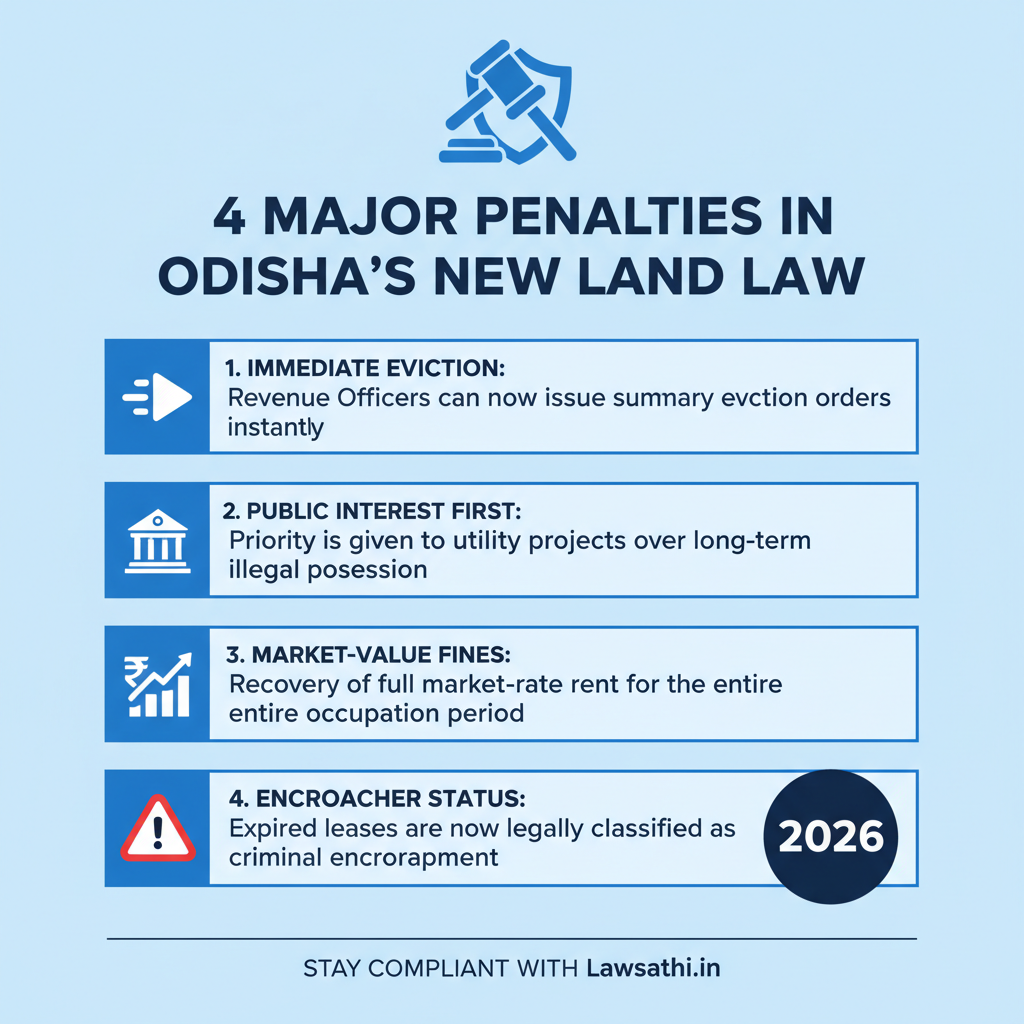
Under the new act, the Revenue Officer possesses strengthened powers to act on illegal occupation. Once they receive a report, they must issue a conditional order immediately. In fact, if the encroachment affects public utility, authorities can bypass lengthy hearings.
This reflects the stance in the Dargah property case. In that case, the court ruled that public utility outweighed long-term unauthorized use. Specifically, the state prioritizes public benefit over illegal private possession.
Heavier Penalties and Redefined Encroachers
The law now imposes strict recovery of market-value rent for the entire period of occupation. Additionally, the definition of an ‘encroacher’ has expanded significantly. It now includes “tenants holding over” whose leases have expired.
These individuals are now treated as “tenants at sufferance” under common Transfer of Property Act principles. As a result, staying past a lease term carries heavy financial risks.
Specialized Land Tribunals for Disputes
Moreover, the bill establishes specialized land tribunals to ensure speedy disposal of disputes. These courts aim to prevent the clogging of the regular judicial system. Consequently, most routine eviction matters will no longer reach the civil courts. This change should reduce the average time spent in litigation.
Unlocking Dream Homes: The Regularisation Component
While the bill is tough on trespassers, it offers a lifeline for the marginalized. Specifically, it integrates with the “Jaga Mission” to help the urban poor. This dual approach ensures that industrial encroachers face heat while residents find stability.
Regularising Land for the Urban Poor
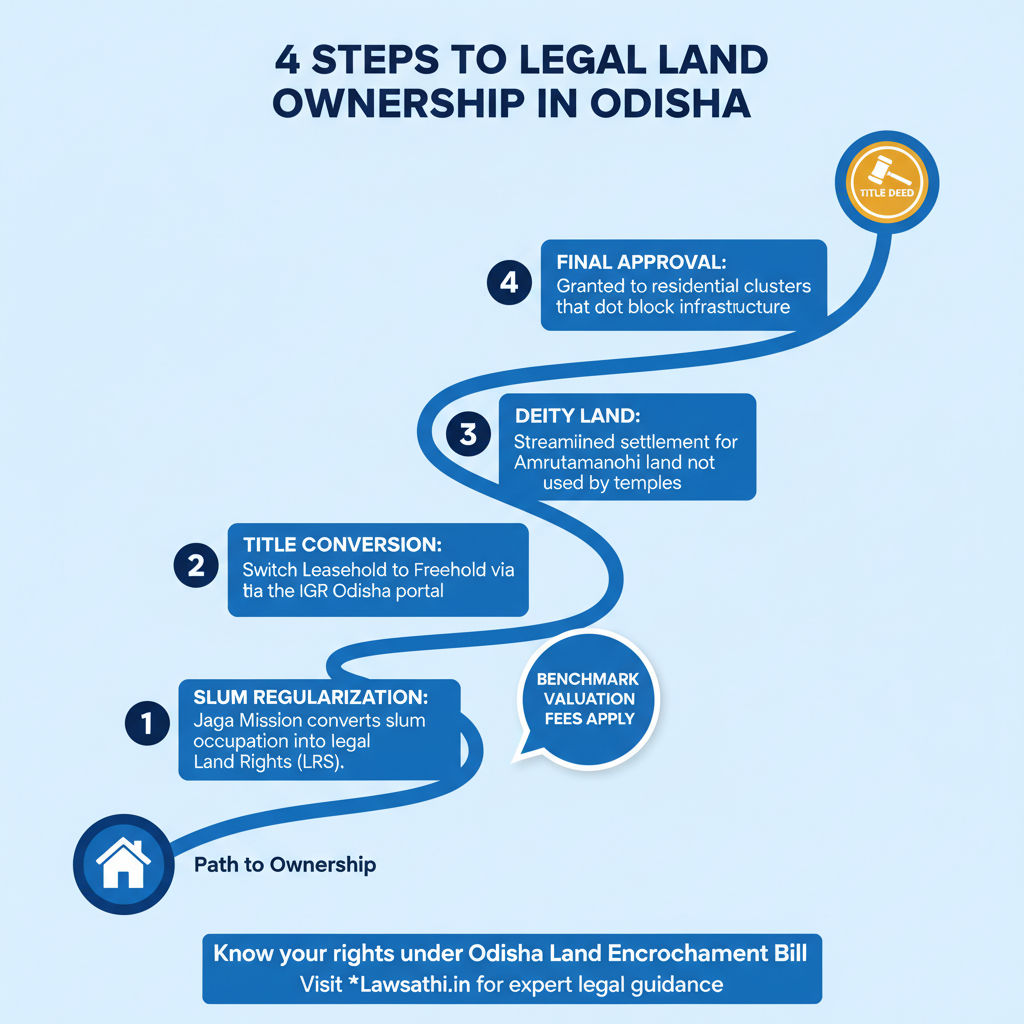
The 2026 updates provide a legal bridge to convert occupation into Land Rights (LRS) for slum dwellers. This social justice component is vital for inclusive urban growth. However, this regularisation applies strictly to residential clusters. These clusters must not hinder public infrastructure.
Conversion of Leasehold to Freehold
Furthermore, the bill simplifies the process of converting leasehold land to freehold status. This is particularly relevant in cities like Bhubaneswar and Cuttack.
Residents can now secure clear titles by paying a prescribed “conversion fee.” This fee is based on current Benchmark Valuations. Consequently, this provides long-term security to thousands of homeowners. It also increases the overall value of the properties.
Clearing Deity and Temple Land Titles
Additionally, the law clarifies the status of “Amrutamanohi” or deity land. Previously, these disputes required complex approvals from temple administrations.
Now, the Uniform Policy (Revised) allows for streamlined settlements. This applies if the land is not required for temple purposes. Therefore, people living on these lands can finally achieve legal clarity.
Impact on Legal Practice: What Lawyers Need to Know
The Odisha Land Encroachment Bill completely changes the strategy for property litigation. Lawyers can no longer rely on traditional defense mechanisms used under the 1972 Act. The focus has moved from “possession” to “verifiable digital title.”
Shift in Jurisdictional Focus
Historically, many lawyers challenged eviction orders in civil courts. However, the new law limits this jurisdiction.
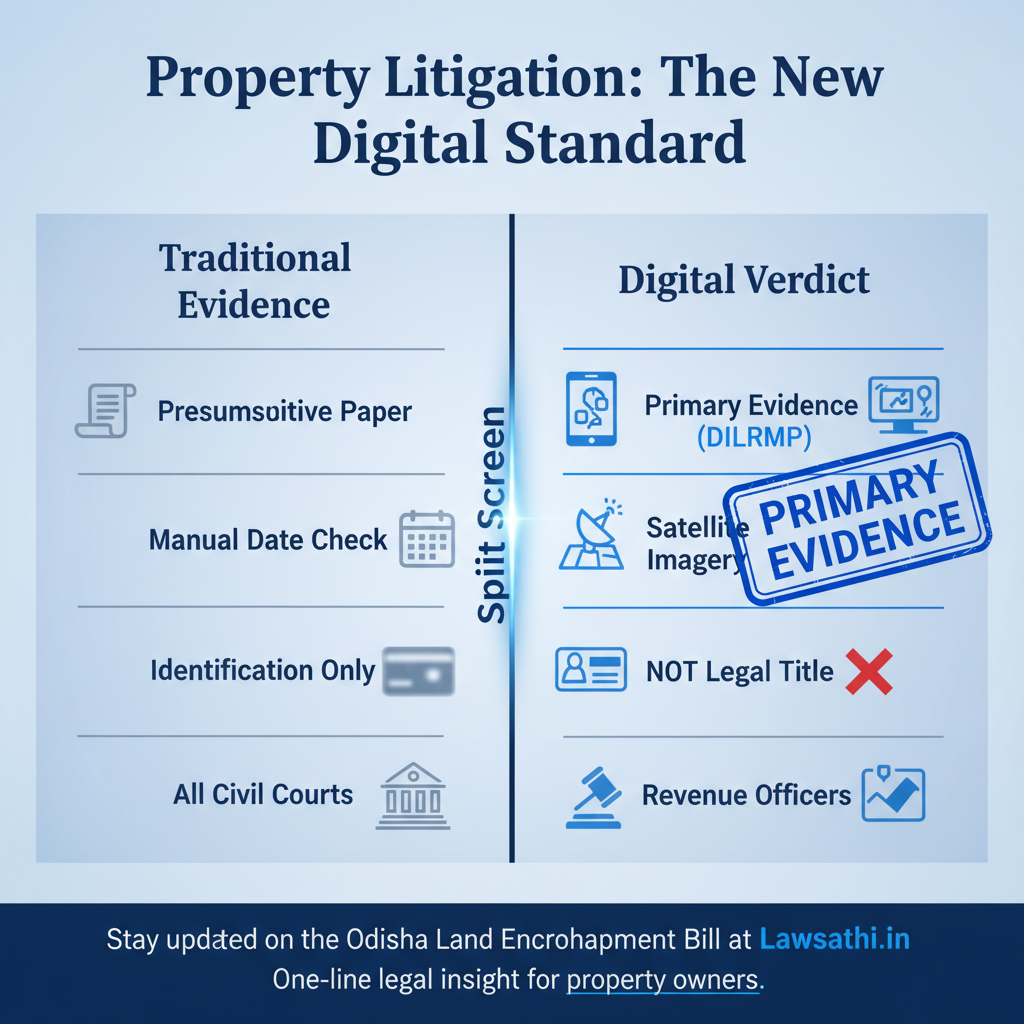
Civil courts will now only intervene when complex questions of “Title” are present. Therefore, practitioners must focus their efforts elsewhere. Specifically, they must represent clients before Revenue Officers and Tribunals.
Digital Evidence and Satellite Imagery
Most importantly, evidence standards have undergone a digital revolution. The state now accepts satellite imagery as admissible proof for the “date of encroachment.”
For example, if a client claims possession for 30 years, satellite records can verify the claim instantly. In other words, physical evidence is becoming secondary to technological data. As a result, falsifying the duration of stay is now nearly impossible.
Aadhaar and ID Cards as Defense
Furthermore, the courts have clarified a major misconception regarding identity documents. In Bishnu Charan Sahoo v. State of Odisha, a clear ruling was issued.
The court stated that Aadhaar or Voter IDs do not confer legal title. Lawyers must therefore avoid basing their arguments solely on residency documents. Instead, they should prioritize Bhulekh record verification.
Challenges and Criticisms: Navigating the Legal Hurdles
Despite its benefits, the Odisha Land Encroachment Bill faces significant scrutiny. Critics worry about the concentration of power in administrative hands. Therefore, lawyers must be vigilant against potential procedural lapses.
Risks of Summary Eviction Powers
There is a growing concern regarding the misuse of “summary eviction” powers. Because the process is fast, some occupants might not get a fair hearing.

Additionally, the mandatory nature of these orders leaves little room for administrative discretion. Consequently, this might lead to more writ petitions before the High Court. Many legal experts expect a surge in appeals.
The Trap for Bona Fide Purchasers
Moreover, a major legal hurdle exists for those who unknowingly bought deity land. Even if a person has occupied the land for decades, the law remains firm.
If the original title remains with the deity, the encroachment cannot be easily regularised. This creates a “title trap” for many middle-class buyers. As a result, buyers must conduct thorough title searches.
Conflict with Traditional Rights
Finally, the law creates a digital divide for tribal communities. Traditional occupation rights often lack digital footprints. As a result, the requirement for digital record entry may conflict with statutory protections. This remains a sensitive area for legal challenges.
Conclusion: The Future of Property Litigation in Odisha
The Odisha Land Encroachment Bill 2026 marks the end of an era. In this new regime, the digital title is the ultimate king. These reforms will likely stabilize the real estate market.
Furthermore, the modernization of the IGR Odisha portal ensures greater transparency for buyers. As land records become real-time, the scope for property fraud decreases significantly.
Ultimately, the 2026 bill reflects a modern Odisha. It balances strict enforcement with the social necessity of housing. Above all, it provides a faster framework for all stakeholders.
Managing complex land revenue cases in Odisha? Streamline your property litigation and document management with LawSathi’s AI-powered platform. Schedule a demo today!