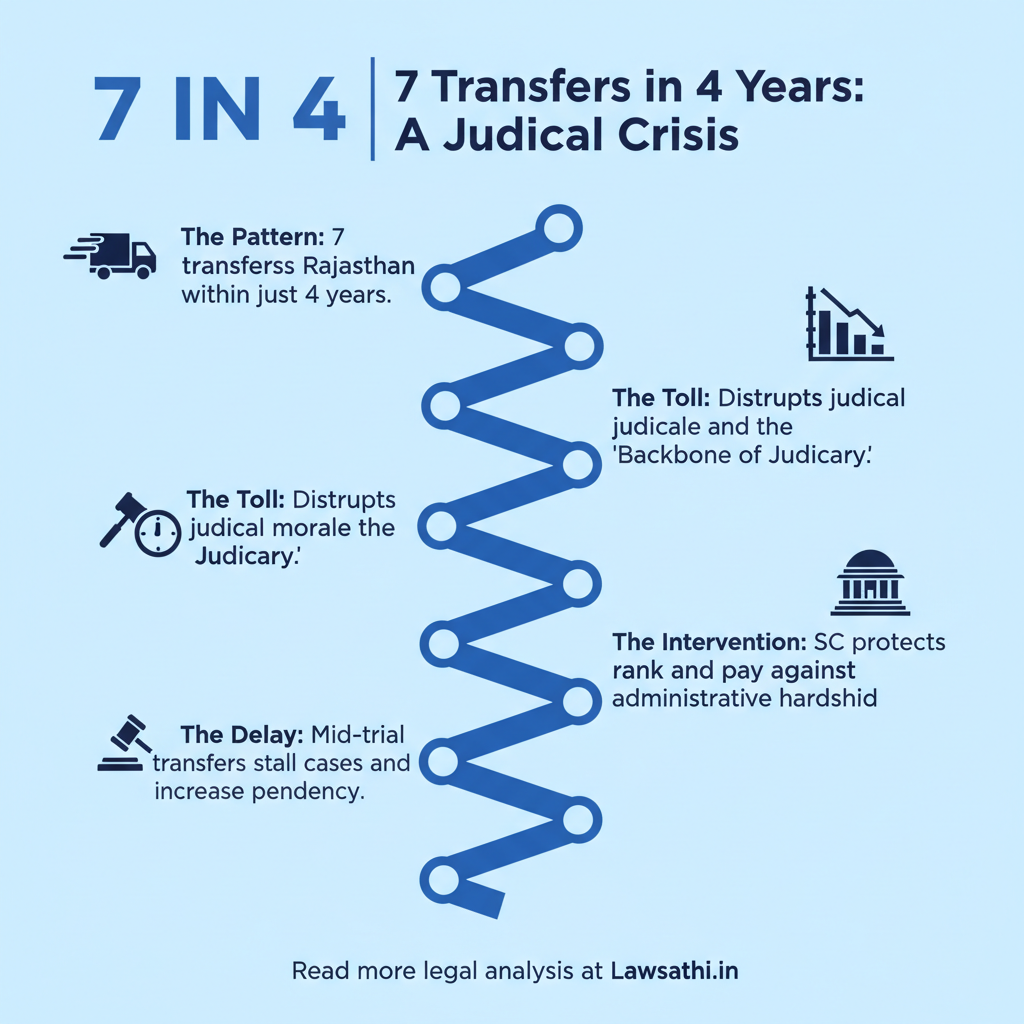
The Rajasthan Principal District Judge Supreme Court case has recently highlighted a critical issue. Specifically, it addresses how frequent transfers disrupt the career of a seasoned judicial officer. In this landmark intervention, the Supreme Court of India stepped in to protect a judge. This officer faced seven transfers in just four years.
Protecting the Backbone of the Judiciary
The Apex Court emphasized that such rapid movement is highly disruptive for any officer. Most importantly, it can hurt the morale of the entire district judiciary. Consequently, the Court issued an order to protect the officer’s rank and pay scale.
Therefore, this case serves as a vital reminder of protections available to judicial officers. It ensures that administrative powers do not bypass service protections. Specifically, we will now explore the timeline of this case and its legal implications.
The Factual Timeline: A Case of Administrative Hardship
The history of the Rajasthan Principal District Judge Supreme Court case reveals a pattern of extreme shifting. Within a narrow four-year window, the petitioner moved multiple times across different districts. For example, the officer served in major hubs like Jaipur and Jodhpur. Later, the administration moved them to smaller districts.
Impact on Judicial Efficiency
Frequent transfers do more than just affect a judge’s personal life. Specifically, they stall the progress of long-term trials. When a judge moves mid-trial, the successor often hears arguments afresh. As a result, the pendency of cases in the district increases significantly.
From High Court to the Apex Court
The officer first sought relief through the administrative side of the Rajasthan High Court. However, the High Court declined to interfere with the transfer orders. Subsequently, the officer filed a Special Leave Petition (SLP) in the Supreme Court. This appeal cited “administrative harassment” and a complete lack of tenure stability.
Legal Framework: Article 235 and the Control Over Subordinate Courts
Under Article 235 of the Constitution of India, High Courts hold administrative control over subordinate courts. This includes the power to manage postings and promotions. However, this power is not absolute or arbitrary.
Limits to Administrative Discretion
The Supreme Court has clarified that this “control” must foster judicial independence in India. For instance, a transfer becomes “punitive” if it is used as a hidden penalty. Moreover, it should not bypass formal disciplinary proceedings required under Article 311.
Precedents on Judicial Dignity
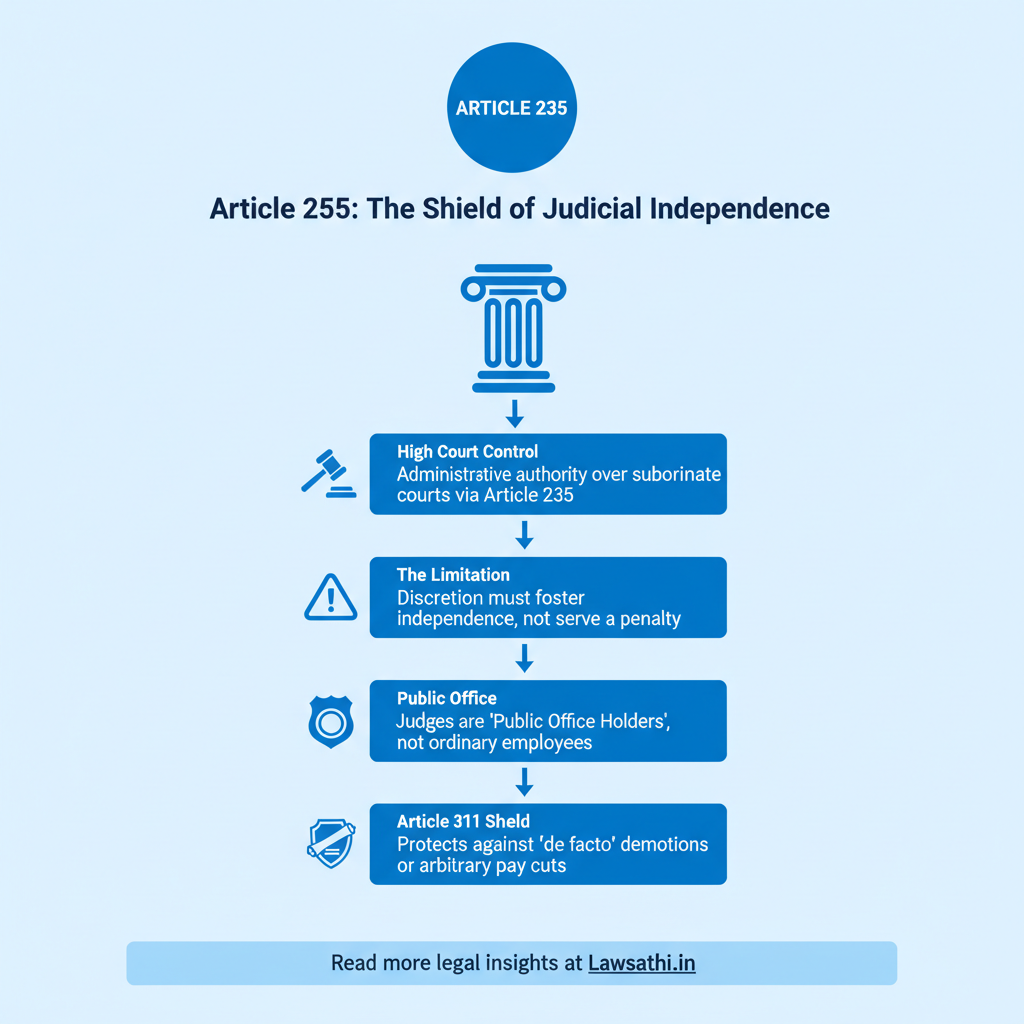
In the past, landmark judgments have protected the dignity of the district judiciary. Courts have ruled that judicial officers are not mere employees. Instead, they are holders of public office. Consequently, the High Court’s administrative actions must reflect the respect due to such a position.
Protecting Rank and Pay: Why the SC Intervention is Crucial
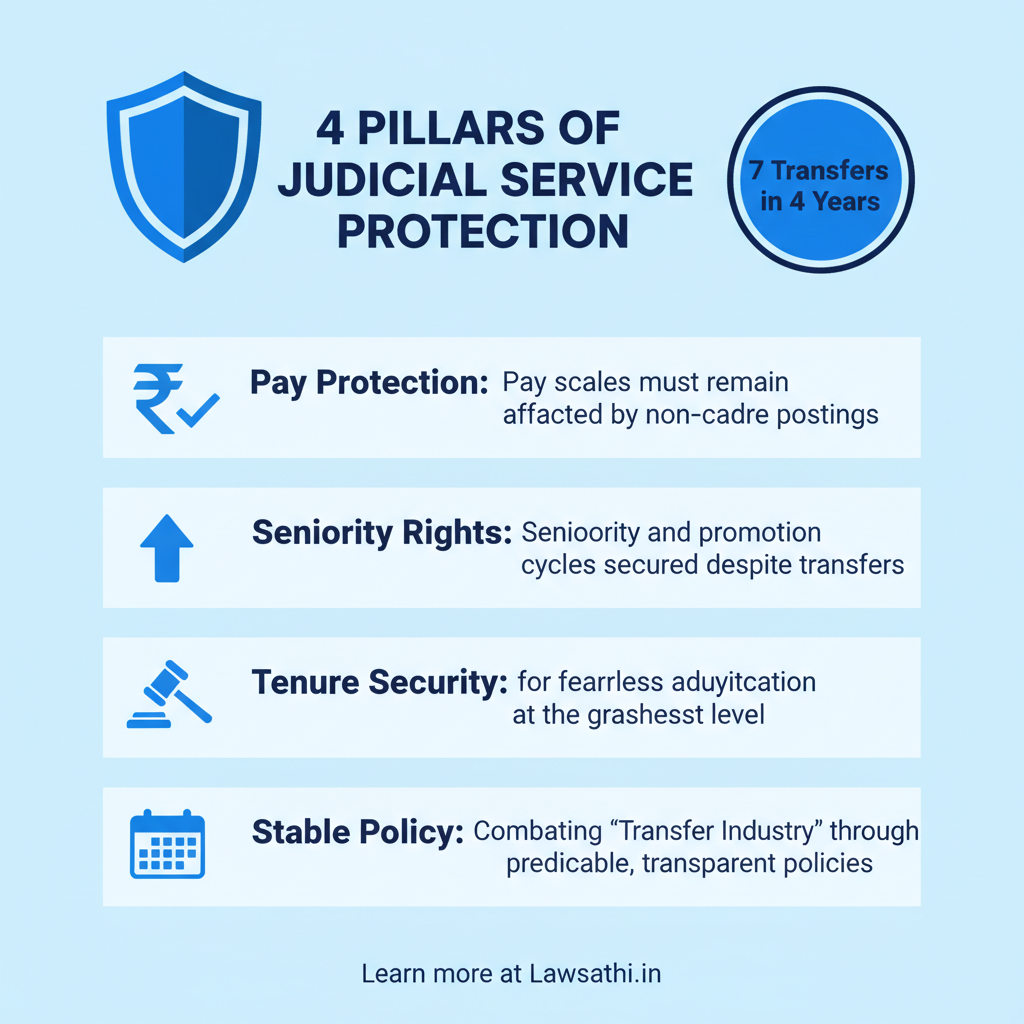
The Rajasthan Principal District Judge Supreme Court case focuses heavily on “Rank and Pay” protection. If a judge moves to a non-cadre post, it might look like a demotion. This can negatively impact their seniority and future promotion cycles.
Avoiding De Facto Demotions
The Supreme Court directed that the officer must retain their original pay scale. Additionally, their seniority must remain unaffected by the frequent local movements. This ensures that the officer does not suffer financially due to administrative whims.
A Signal to High Court Administrations
This ruling sends a strong message to all High Courts across India. Generally, transfers should follow a predictable and fair policy. Above all, they should not be used to pressure upright judicial officers. In this way, the SC acts as a guardian of the lower judiciary.
Judicial Independence at the Grassroots Level
Judicial independence is often discussed in the context of the Higher Courts. However, it is equally important at the district level. District judges handle nearly 90% of India’s litigation. Therefore, they need security of tenure to adjudicate cases without fear or favor.
Security of Tenure and Fearless Adjudication
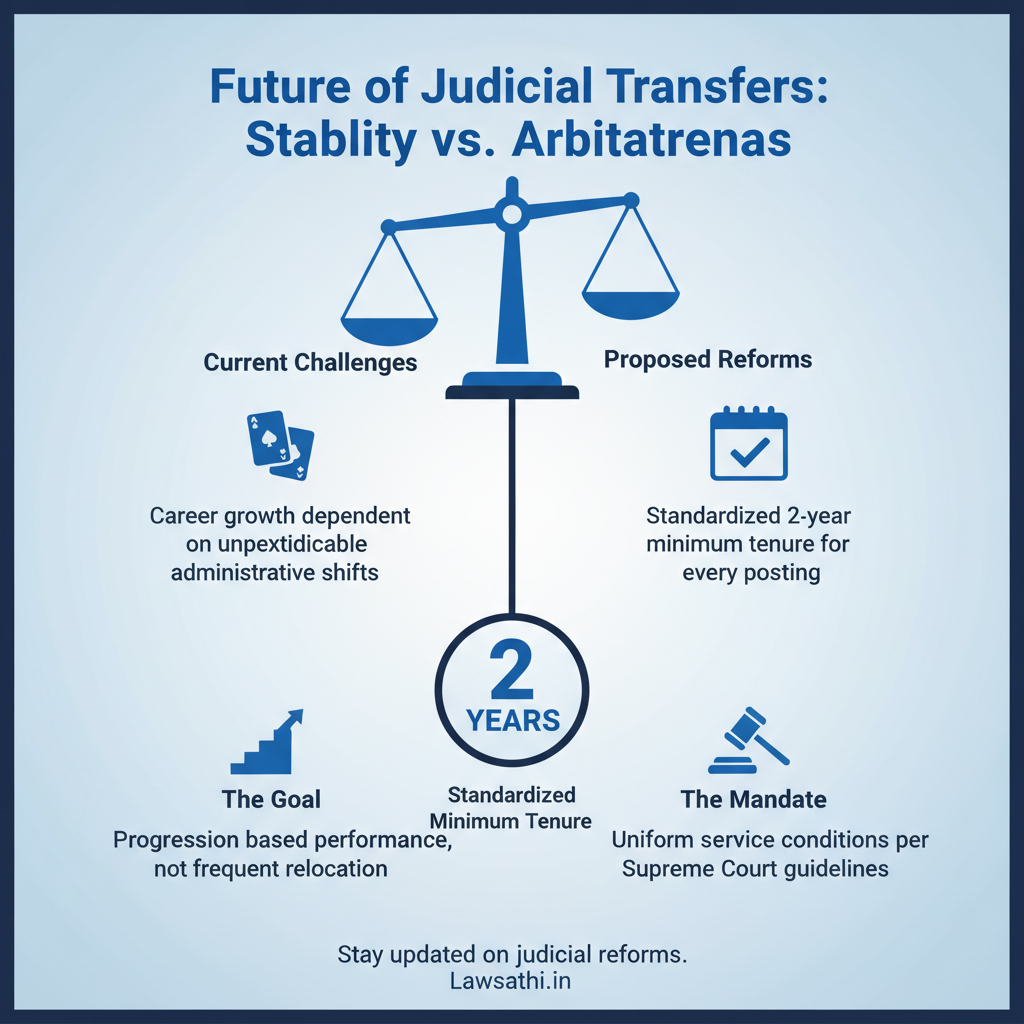
If a judge fears a sudden transfer to a remote area, their decision-making might suffer. In contrast, a stable tenure allows them to focus on complex legal issues. The All India Judges’ Association v. Union of India case highlights this need. It calls for uniform service conditions for all judges.
The Problem of “Transfer Industries”
In some states, frequent transfers create an environment of uncertainty. This is often described as a “transfer industry.” To illustrate, when transfers happen every few months, transparency is lost. By intervening, the Supreme Court discourages such practices in judicial services.
Implications for Legal Practitioners and Judicial Aspirants
For lawyers and judicial aspirants, this case provides a valuable lesson in service law. It clarifies how the Supreme Court monitors Rajasthan High Court administrative oversight. Furthermore, it shows that internal mechanisms exist to correct administrative excesses.
Boosting Morale for RJS Aspirants
Candidates for the Rajasthan Judicial Service (RJS) can feel more secure about their future. They now know that the law protects them from arbitrary shifting. In other words, their career progression is tied to merit rather than administrative luck.
Standardized Transfer Policies
This case might lead to a review of the Rajasthan Judicial Service Rules. Specifically, there is a call for a standardized “minimum tenure” policy. Such reforms would ensure that most judges serve at least two years in one location.
Conclusion: Balancing Administrative Needs with Judicial Dignity
The Rajasthan Principal District Judge Supreme Court case is a victory for judicial stability. It successfully balances administrative needs with the dignity of the officer. While the High Court can move officers, it must not strip them of their rank.
Most importantly, the Supreme Court has reaffirmed the district judiciary as the backbone of the legal system. As a result, protecting these judges is essential for the rule of law. This intervention ensures that merit remains the primary driver of a judicial career.
Stay updated on the latest judicial rulings and manage your practice seamlessly with LawSathi’s AI-powered insights. Start your free trial today!