The Supreme Court of India recently delivered a monumental judgment that reshapes constitutional law. By declaring the Right to Menstrual Hygiene Fundamental Right under Article 21, the Court has bridged a critical gap in gender justice. This ruling marks a historic shift in how Indian courts view biological realities within the framework of human rights.
A Historic Shift in Constitutional Jurisprudence
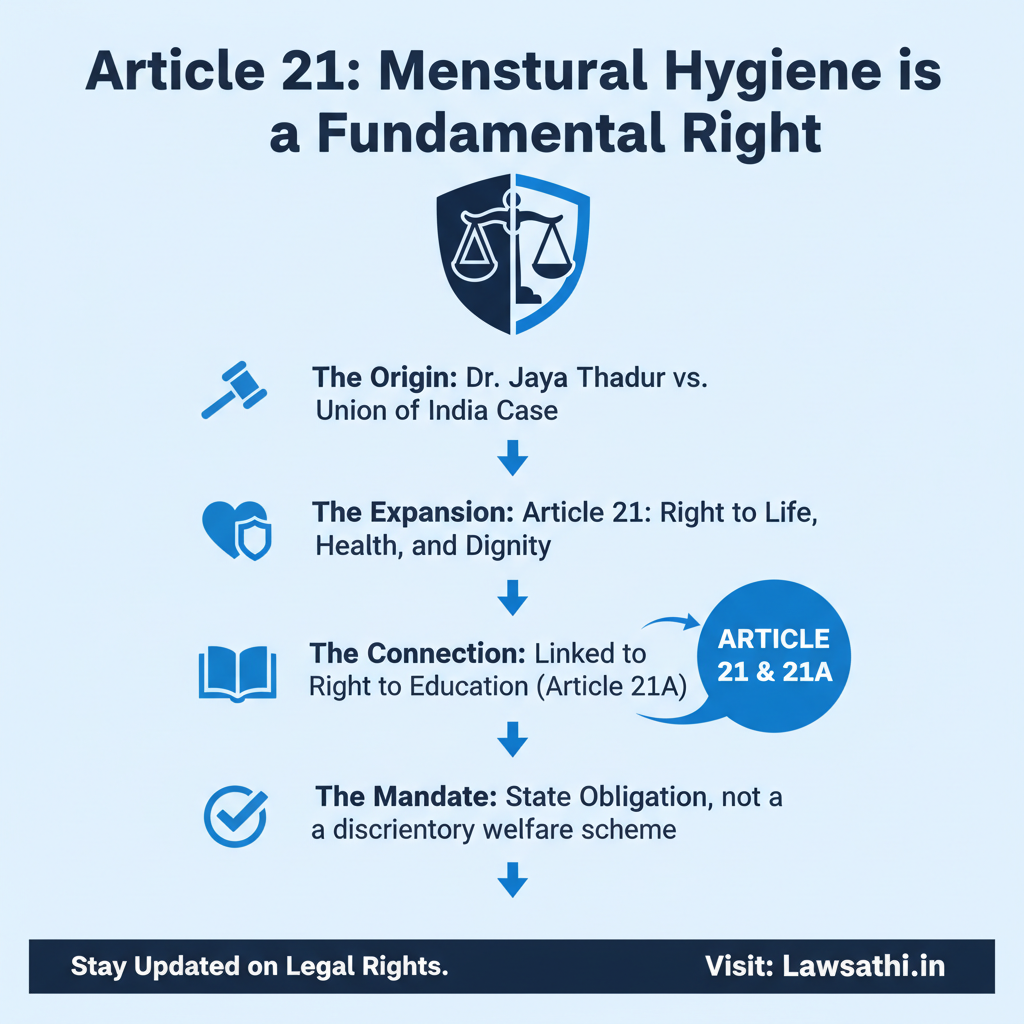
For decades, menstrual health remained a silent struggle for millions of Indian girls. However, the case of Dr. Jaya Thakur vs. Union of India changed this trajectory forever. Specifically, the Court expanded the scope of the “Right to Life” to include health, privacy, and dignity.
Evolution of Article 21 and Dignity
Article 21 is no longer just about mere physical existence. Instead, it now encompasses the right to live with human dignity. For example, the Supreme Court emphasized that lack of menstrual hygiene often leads to school dropouts. Therefore, this right is now inextricably linked to the Right to Education under Article 21A.
Judicial Context and Legal Growth
The judiciary observed that biology should not hinder constitutional entitlements. This vision aligns with previous landmark rulings like Navtej Singh Johar. That case prioritized transformative constitutionalism. Consequently, the State must now treat menstrual hygiene as a mandatory obligation rather than a discretionary welfare scheme.
Decoding the Verdict: Menstrual Hygiene and Article 21
The Court’s reasoning focused on the intersection of health and equality. It ruled that failing to provide menstrual facilities creates a “biological disadvantage.” For example, the Court noted that girl students face systemic exclusion due to natural physiological processes.
Linking Health to Human Dignity
Dignity is the core of the Right to Menstrual Hygiene Fundamental Right. In fact, the Court argued that “Period Shaming” violates the basic spirit of the Constitution. Therefore, providing sanitary products is essential for maintaining the bodily privacy of women.
Gendered Aspects of Articles 14 and 15
Furthermore, the ruling addresses substantive equality under Articles 14 and 15. The Court clarified that treating everyone the same is not enough. Instead, the State must acknowledge biological differences to ensure true equity. Specifically, this means providing infrastructure that meets the unique needs of female citizens.
Breaking Barriers to Education
Most importantly, the Court highlighted that biological reality shouldn’t be a barrier to constitutional rights. Many girls lose nearly five days of school every month. Consequently, this leads to long-term educational gaps. By recognizing this right, the Court aims to foster an inclusive environment for all students.
Mandates for Central and State Governments
To give this right teeth, the Court issued specific directives. The Union Government must now implement a National Model for Menstrual Hygiene. This policy targets all government-aided and residential schools across the country.
Infrastructure and Product Distribution
First, the Court mandated the distribution of low-cost or free sanitary pads. Second, schools must provide separate, functional toilets for girls. These toilets must have adequate water supply and safe disposal mechanisms. For instance, incinerators and vending machines are now required in most educational settings.
Timelines for Policy Execution
Additionally, the Court set strict timelines for implementation. The Union was directed to gather views from all stakeholders within a few weeks. Thereafter, states must file detailed compliance reports regarding their toilet-to-student ratios. This ensures that the judgment results in real-world changes.
Accountability Through Ongoing Monitoring
The Supreme Court is using the tool of “Continuing Mandamus” here. This means the case remains open to monitor government progress. As a result, authorities cannot easily ignore these directives. This level of judicial oversight is crucial for socio-economic rights in India.
Impact on Legal Practice: New Avenues for PILs and Advocacy
For Indian lawyers, this ruling opens vast opportunities for Public Interest Litigation (PIL). The Right to Menstrual Hygiene Fundamental Right serves as a powerful precedent. Moreover, lawyers can now challenge inadequate facilities in prisons, workplaces, and public spaces using this framework.
Precedents for Health-Related Rights
Furthermore, the judgment strengthens the foundation for other health-related litigation. For example, the Supreme Court Bar Association (SCBA) recently sought guidelines against invasive “period checks” at workplaces. This shows how Article 21 is evolving. Specifically, it protects menstrual dignity in various sectors.
Intersection with Labor Laws
The ruling also impacts the ongoing debate on menstrual leave. While the Court previously referred menstrual leave policies to the Ministry, the status has changed. In fact, states like Karnataka are already seeing legal challenges regarding paid leave.
Advocacy in Prison Reform
Furthermore, this right extends to marginalized populations like female inmates. In cases like Sukanya Shantha v. Union of India, the Court addressed caste-based discrimination. Similarly, lawyers can now use the menstrual hygiene mandate. This helps them demand better conditions in correctional facilities.
Global Context: How India Compares
India’s recognition of the Right to Menstrual Hygiene Fundamental Right places it among global leaders. While Western nations often focus on “Tampon Tax” relief, India has gone further. Specifically, it has made hygiene an enforceable constitutional right for all citizens.
Alignment with Sustainable Development Goals
Consequently, this ruling aligns India with the United Nations Sustainable Development Goals (SDGs). Specifically, it supports SDG 4 (Quality Education) and SDG 5 (Gender Equality). In other words, the Court has effectively moved the needle from “welfare” to “entitlement.”
International Comparisons and Lessons
In contrast to countries like Spain, India emphasizes infrastructure and education. Spain focuses more on statutory menstrual leave. However, India addresses the root cause of exclusion in developing economies. Additionally, India is catching up with global trends regarding workplace dignity.
From Welfare to Enforceable Right
Above all, this shift means that citizens can approach High Courts under Article 226 for violations. If a government school lacks basic hygiene facilities, it is now a direct breach of the Constitution. Similarly, this provides a legal shield against discriminatory workplace practices.
Conclusion: The Path Toward Menstrual Equity
The Supreme Court’s declaration is a landmark victory for gender justice in India. By establishing the Right to Menstrual Hygiene Fundamental Right, the judiciary has validated the lived experiences of millions. However, the success of this ruling depends on rigorous implementation.
Therefore, the legal fraternity must play a proactive role. We must ensure that these directives do not remain “paper law.” By monitoring state compliance, lawyers can help achieve true menstrual equity. Most importantly, this judgment is a step toward a more dignified life for every woman in India.
Stay updated on landmark judgments affecting your practice. Manage your case law research and litigation deadlines seamlessly with LawSathi’s AI-powered platform. Book a demo today!