The Supreme Court freebies cash transfer schemes debate has reached a critical juncture in Indian constitutional law. Recently, the apex court expressed serious concerns about the culture of pre-election cash transfers. These concerns highlight their impact on democratic processes. Consequently, for legal practitioners, these observations signal potentially significant shifts in electoral law jurisprudence. Therefore, understanding this evolving legal landscape is essential for advising clients on compliance and litigation strategies.
Introduction: Supreme Court’s Strong Observations on Electoral Freebies
The Supreme Court of India has once again placed the controversial “freebies culture” under judicial scrutiny. A bench comprising Chief Justice Surya Kant and Justice Joymalya Bagchi heard a petition challenging cash transfer schemes. Specifically, these schemes were announced before the Bihar Assembly Elections 2025. The timing of these observations is particularly significant. After all, state elections are upcoming across multiple regions.
Recent Bench Observations and Context
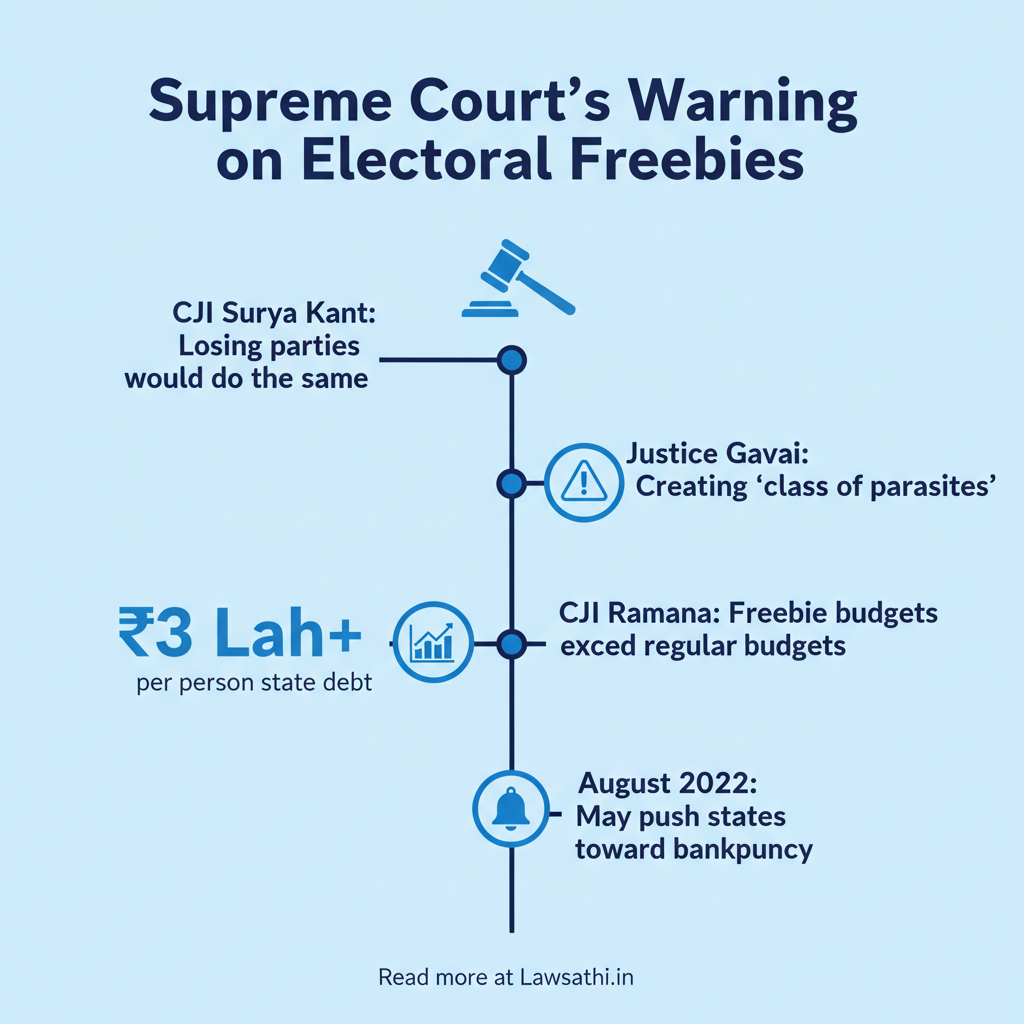
During the February 6, 2026 hearing, CJI Surya Kant made pointed observations about the nature of such petitions. Specifically, he noted that the Court was examining the freebies issue seriously. However, he expressed reservations about entertaining petitions filed by political parties that had suffered electoral losses. The Chief Justice remarked that such parties would likely implement similar schemes if they came to power.
The case, Jan Suraaj Party v. Election Commission of India W.P.(C) No. 107/2026, questioned the constitutional validity of cash transfers to voters. Justice BR Gavai had earlier offered even sharper criticism. He warned that freebies were creating “a class of parasites.” According to him, these individuals refused to work because they received free rations and money without labor.
Significance for Legal Practitioners
In fact, these observations carry weight beyond mere judicial commentary. Moreover, they indicate the Court’s willingness to examine the constitutional validity of pre-election cash transfers. Therefore, for lawyers, this presents both challenges and opportunities in electoral and constitutional litigation.
Background: The Petition and Key Issues Raised
The current judicial examination of freebies stems from multiple public interest litigations. For instance, Advocate Ashwini Kumar Upadhyay filed a significant PIL in 2022. This petition challenged the practice of promising irrational freebies from public funds before elections.
Core Arguments in the Original Petition
The petitioner argued that pre-election freebie promises unduly influence voters. Furthermore, such promises disturb the level playing field essential for free and fair elections. As a result, the petition sought declarations that these practices violate multiple constitutional provisions.
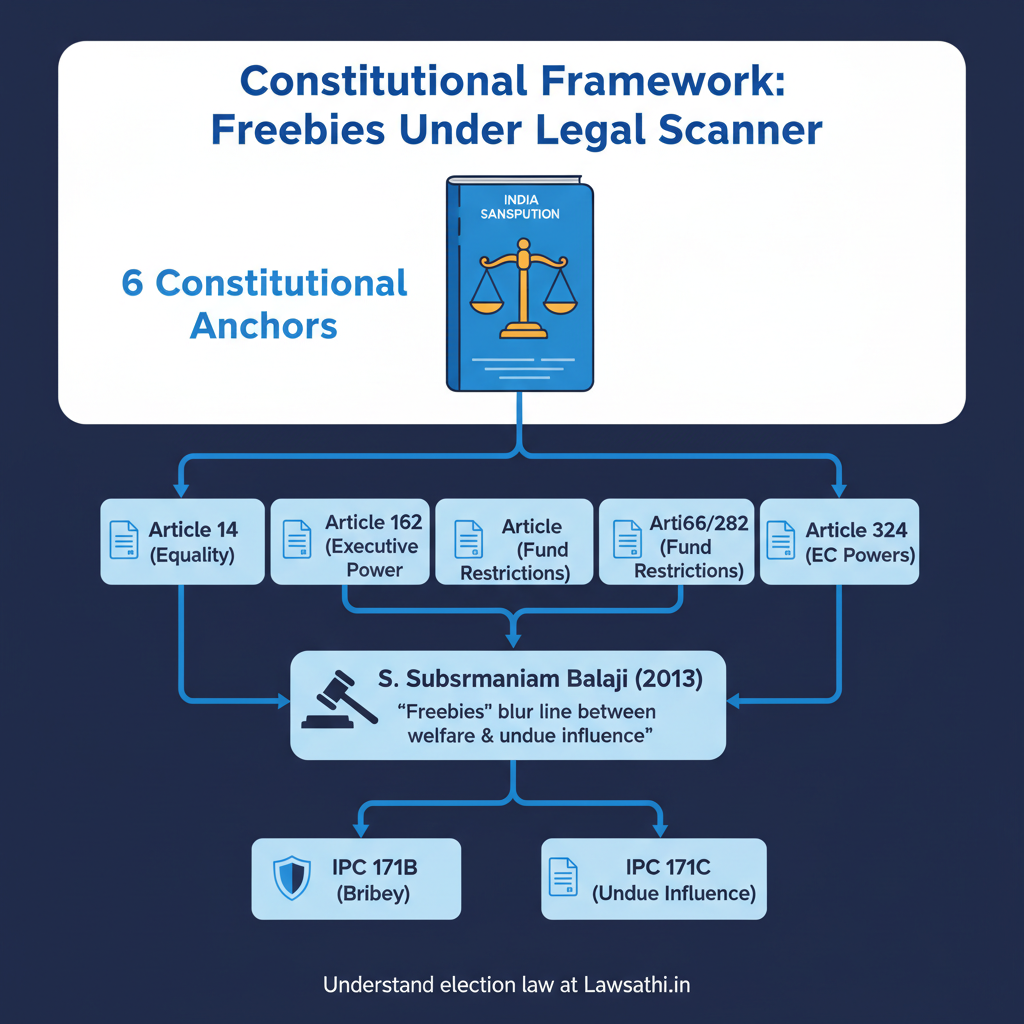
Specifically, the petition invoked Article 14 (equality before law) and Article 162 (executive power of the State). Additionally, it cited Article 266(3) (consolidated funds) and Article 282 (expenditure defrayable by Union or State). The petitioner also argued that freebie promises were analogous to bribery under Section 171B IPC. Furthermore, they constituted undue influence under Section 171C IPC.
State-Specific Schemes Under Challenge
The petition highlighted several schemes announced before state elections. In Punjab, multiple parties promised monthly cash transfers to women ranging from Rs. 1,000 to Rs. 2,000. Similarly, Uttar Pradesh witnessed promises of free smartphones, scooters, and electricity. The fiscal implications were staggering.
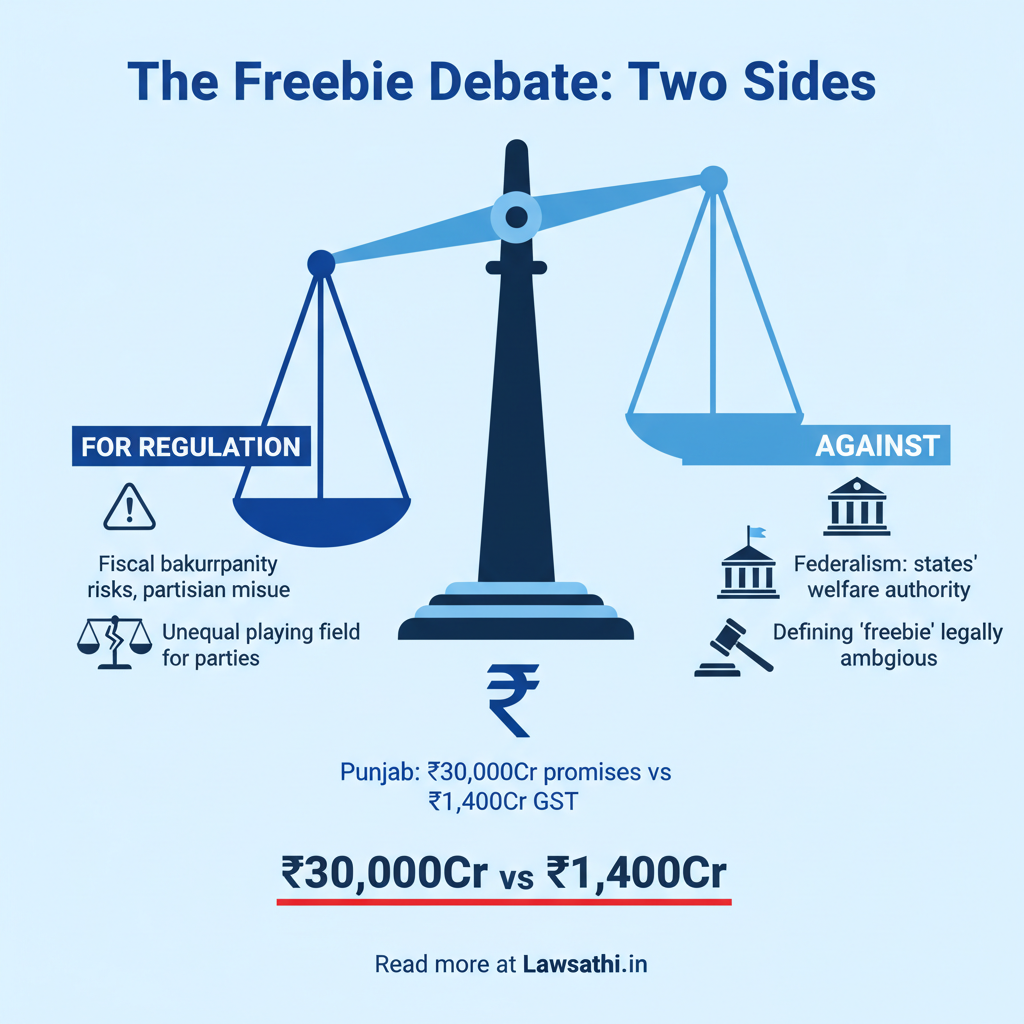
For instance, Punjab would require Rs. 12,000-30,000 crore monthly to fulfill these promises. However, its GST collection stood at merely Rs. 1,400 crore. Moreover, the state debt burden exceeded Rs. 3 lakh per person.
The Jan Suraaj Party Petition
The more recent petition by Prashant Kishor’s party challenged Bihar’s Mukhyamantri Mahila Rojgar Yojana. Specifically, this scheme proposed direct transfers of Rs. 10,000 to 1.56 crore women voters. Consequently, the petition alleged violations of Articles 14, 21, 112, 202, and 324 of the Constitution.
Supreme Court’s Key Observations: Bench Remarks and Reasoning
The Supreme Court freebies cash transfer schemes discussion has evolved through multiple hearings. During this time, different benches have expressed varying concerns about this electoral practice. Therefore, understanding these observations requires examining the judicial reasoning carefully.
CJI Ramana’s 2022 Observations
Former Chief Justice NV Ramana presided over an earlier bench hearing the freebies issue. He questioned how to control this growing phenomenon. Specifically, CJI Ramana emphasized that freebie budgets were exceeding regular budgets in many states.
His observation highlighted a crucial point: ultimately, whose money was being promised? The answer was clear—people’s money. In fact, some states carried debt burdens exceeding Rs. 3 lakh per person. Yet, they continued offering freebies. The then-CJI noted this created an uneven playing field for political parties.
August 2022 Reference Order
A three-judge bench comprising CJI NV Ramana, Justice Hima Kohli, and Justice CT Ravikumar issued a significant reference order. This order articulated the Court’s concerns about fiscal responsibility. Specifically, it stated that freebies might push state governments toward bankruptcy. As a result, they would become unable to provide basic amenities.
The bench observed that such freebies utilized taxpayers’ money solely for increasing party popularity and electoral prospects. Consequently, this characterization marked a departure from treating all welfare measures as legitimate policy choices.
Justice Gavai’s Sharp Critique
Justice BR Gavai offered perhaps the most pointed critique of the freebies culture. Speaking from personal experience of his agricultural family background, he noted that farmers in Maharashtra struggled to find laborers. The reason was straightforward—people preferred receiving benefits without working.
His warning about creating “a class of parasites” sparked significant debate. While some viewed this as harsh, others agreed it reflected ground realities in rural India.
Constitutional Framework: Relevant Articles and Judicial Precedents
Any legal analysis of the Supreme Court freebies cash transfer schemes issue must examine constitutional provisions. Several articles of the Constitution bear directly on this question. Additionally, judicial precedents provide guidance on the boundaries of permissible electoral promises.
The S. Subramaniam Balaji Precedent
The landmark case of S. Subramaniam Balaji v. State of Tamil Nadu, (2013) 9 SCC 659 established the initial framework. This case arose from DMK’s promise of free colour televisions in its 2006 election manifesto.
The Court held that pre-election promises could not be construed as “corrupt practice.” This determination was made under Section 123 of the Representation of the People Act, 1951. However, it acknowledged that freebie distribution undoubtedly influenced voters. In fact, it “shakes the root of free and fair elections.”
Issues Framed for Reconsideration
The 2022 reference framed several questions for a larger bench to consider. First, what is the scope of judicial intervention in such matters? Second, can any enforceable order be passed? Third, would appointing an expert commission serve the purpose? Finally, does S. Subramaniam Balaji require reconsideration?
These questions remain pending before the three-judge bench. Ultimately, their answers will shape electoral jurisprudence significantly.
Relevant Constitutional Articles
Article 14 guarantees equality before law and protection against arbitrary state action. Petitioners argue that arbitrary classification in freebie distribution violates this provision. Similarly, Article 162 defines the extent of State executive power. This raises questions about spending authority.
Article 266(3) imposes restrictions on withdrawal from consolidated funds. In contrast, Article 282 permits expenditure for “public purpose” by the Union or State. Therefore, the interpretation of “public purpose” becomes crucial in determining freebie validity. Additionally, Article 324 empowers the Election Commission to supervise free and fair elections.
Impact on Election Commission’s Regulatory Powers
The Election Commission of India currently operates within limited parameters regarding freebies. Following the Balaji judgment, the EC framed guidelines for election manifestos. These guidelines form Part VIII of the Model Code of Conduct.
Current MCC Guidelines on Manifestos
The guidelines require manifestos to avoid content repugnant to the Constitution. Additionally, political parties must reflect the rationale for their promises. Furthermore, they must indicate ways and means to meet financial requirements for promised schemes.
The EC guidelines do not object to welfare measures rooted in Directive Principles of State Policy. However, parties should avoid promises that vitiate the election process. Such promises exert undue influence on voters. Election Commission of India guidelines specify prohibitory periods for manifesto releases.
Limitations on EC’s Authority
The Solicitor General Tushar Mehta acknowledged that both the Union and Election Commission have limited roles. Specifically, the EC cannot de-register political parties despite over 3,061 registered parties existing. Moreover, no explicit provision in the Representation of the People Act empowers the EC to regulate manifestos substantively.
The Need for Stronger Mechanisms
Senior Advocate Vikas Singh noted that existing guidelines lack enforcement mechanisms. Consequently, no consequences follow violations of the MCC manifesto provisions. This creates a gap between regulatory intent and actual compliance.
Implications for Political Parties and Future Elections
The Supreme Court freebies cash transfer schemes deliberations will significantly impact political strategies. Parties must navigate evolving judicial expectations while addressing voter expectations. The balance remains delicate.
Current Campaign Practices
Despite judicial observations, parties continue announcing cash transfer schemes before elections. Currently, no stay prohibits such announcements. In fact, CJI Ramana acknowledged the reality: “Every party is doing the same thing.”
This creates a collective action problem. Individual parties cannot unilaterally disarm from the freebies race without electoral disadvantage. Therefore, judicial intervention may become necessary to break this cycle.
The Welfare Versus Freebie Distinction
Arguments defending freebies cite welfare state obligations under Directive Principles. Political parties contend they understand people’s problems through electoral engagement. Therefore, courts cannot prescribe what parties can promise voters.
However, opponents counter that promises without budgetary support assessment distort electoral competition. Fiscal irresponsibility and dependency culture concerns merit serious consideration. Consequently, the challenge lies in distinguishing legitimate welfare from electoral inducements.
High Court Perspectives on Challenges
The Madhya Pradesh High Court recently addressed the Ladli Behna Yojana challenge. It held that policy decisions are not amenable to judicial review. This applies unless they are unconstitutional, arbitrary, mala fide, or contrary to statute. As a result, this standard creates a high threshold for challengers.
Critical Analysis: Arguments For and Against Regulation
The debate over Supreme Court freebies cash transfer schemes regulation involves competing constitutional values. Therefore, lawyers must understand both perspectives to effectively advise clients.
Arguments Supporting Regulation
Proponents of regulation cite multiple concerns. First, fiscal bankruptcy risks loom over states with unsustainable freebie commitments. Second, taxpayers’ money gets misused for partisan political advantage rather than public welfare.
Third, unequal financial resources among parties distort the playing field. Fourth, promises made without financial assessment lack credibility. Finally, dependency culture undermines work ethics and economic productivity.
Arguments Against Regulation
Critics of judicial intervention raise federalism concerns. Specifically, states possess independent authority to design welfare policies within their spheres. Therefore, judicial overreach into policy domains violates separation of powers principles.
Additionally, defining “freebie” versus “welfare scheme” proves exceptionally difficult. For example, free education, healthcare, and public transport could qualify as freebies under broad definitions. Yet these represent legitimate government functions in modern welfare states.
The Definition Challenge
The distinction between “freebie” and “welfare scheme” remains legally undefined. Targeted benefits for specific groups may differ from universal schemes. Similarly, developmental activities serving public purposes contrast with private goods distribution. Therefore, courts must develop principled criteria for this classification.
What Lawyers Need to Know: Actionable Insights
Practitioners navigating the Supreme Court freebies cash transfer schemes landscape need practical guidance. The following insights can inform client advice and litigation strategies.
Current Legal Position
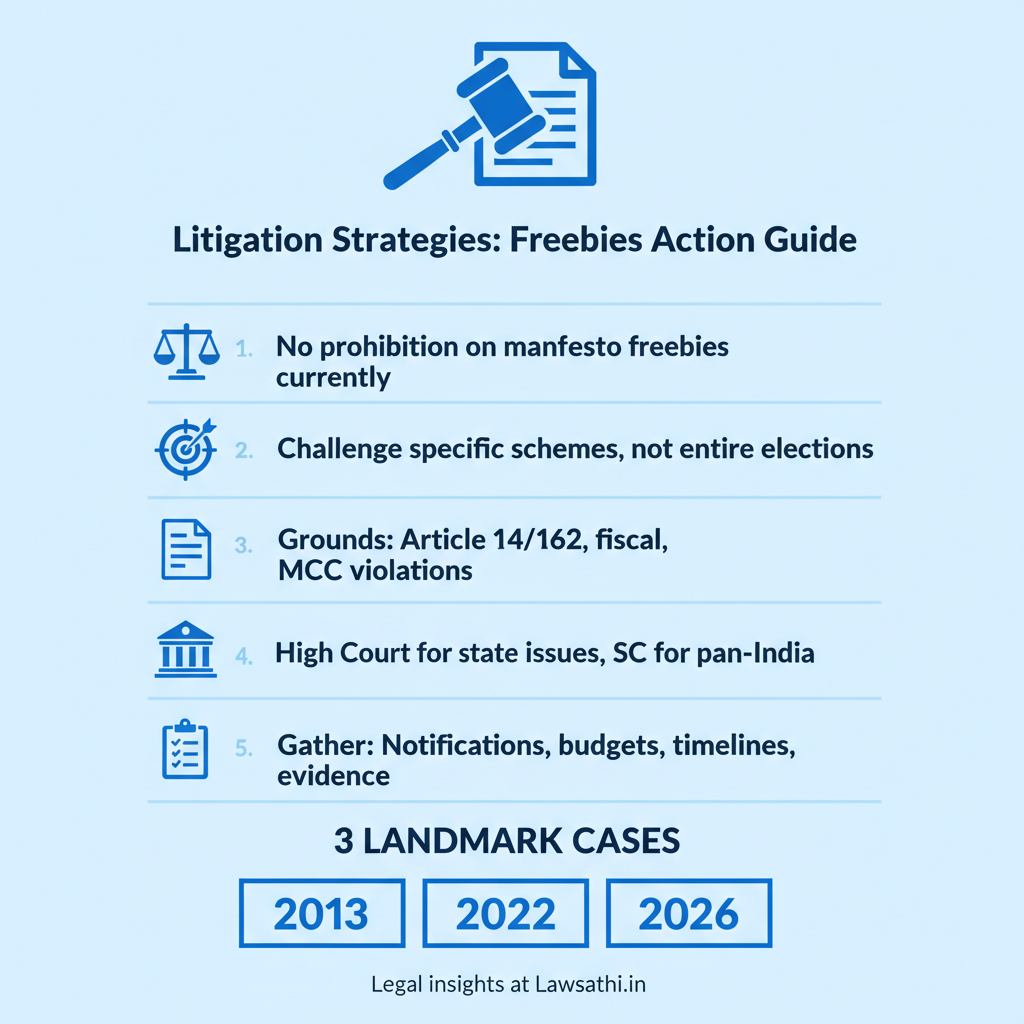
Currently, no prohibition exists on announcing freebies in manifestos. The Election Commission guidelines require only that parties provide rationale and indicate financial means for promises. However, these requirements remain largely unenforced.
Litigation Strategies
CJI Surya Kant’s observation that specific schemes should be challenged separately offers important guidance. Rather than challenging entire elections, petitioners should target individual problematic schemes. As a result, this approach increases prospects for judicial intervention.
Grounds for challenge include Article 14 violations (arbitrary classification) and Article 162 violations (beyond executive power). Additionally, fiscal irresponsibility and Model Code of Conduct violations serve as valid grounds. Proper forum selection matters—High Courts for state-specific issues, Supreme Court for pan-India questions.
Documentation Requirements
Effective litigation requires comprehensive documentation. First, scheme notifications and budget allocations must be gathered. Second, comparative data on state finances strengthens arguments. Third, timeline of announcements relative to election dates demonstrates timing patterns. Finally, evidence of MCC violations supports petition claims.
Key Case Citations for Reference
Lawyers should familiarize themselves with several key cases. These include S. Subramaniam Balaji v. State of Tamil Nadu, (2013) 9 SCC 659. Additionally, Ashwini Kumar Upadhyay v. Union of India, 2022 SCC OnLine SC 1098 is relevant. Furthermore, Jan Suraaj Party v. Election Commission of India, W.P.(C) No. 107/2026 should be studied.
Conclusion: The Road Ahead for Electoral Reforms
The Supreme Court freebies cash transfer schemes jurisprudence remains in evolution. Currently, the matter awaits hearing before a three-judge bench. No immediate stay on freebie announcements exists.
Summary of Current Position
The Court has consistently characterized this as a “serious issue.” It requires balancing welfare obligations and fiscal responsibility. Multiple benches have expressed concern about the timing of cash transfers before elections. However, binding directions await the larger bench’s determination.
Legislative Clarity Needed
The Representation of the People Act could potentially be amended to address this gap. Specifically, Section 123(1) currently covers only candidates and agents, not political parties. A new chapter prohibiting irrational freebie promises might address the lacuna. Additionally, a negative list approach could provide needed clarity. This would distinguish impermissible promises from legitimate welfare commitments.
The Judiciary’s Limited Role
Constitutional courts cannot legislate. However, they can frame guidelines through the Election Commission. Furthermore, they can constitute expert commissions to examine the issue comprehensively. The balance between competing interests requires careful calibration.
The 2022 reference order aptly captured a fundamental truth. It stated: “There can be no denying the fact that in an electoral democracy such as ours, the true power ultimately lies with the electorate.” Yet ensuring that electorate exercises that power without undue inducement remains the constitutional challenge.
Stay ahead with real-time legal updates. LawSathi tracks Supreme Court judgments and delivers instant alerts to your dashboard. Start your free trial today.